PART 6 (THE END): The Secret Hidden in the Music 057
Part 6 – The Waltz Remembered
For a moment, no one moved.
The fresh signature beneath the old royal seal seemed to hold the ballroom in place.
Lady Celeste stared at the dispatch, her face gone pale.
Then she stepped toward the officer.
“May I see it?”
He passed her the page.
She read it once, then again, and shook her head.
“That is not my signature.”
The councilman looked from Celeste to Adrian.
“The authorization bears the royal seal.”
“A seal can be copied,” Celeste said, her voice unsteady but clear. “But I did not request the records, and I did not authorize their removal.”
Adrian did not reach for the dispatch.
“Then we must establish who did.”
The officer bowed his head.
“The archive keeper says the request came through the proper channels. The seal was accepted as genuine.”
“Was it examined by anyone else?” the archivist asked.
“Not before the ledgers were released.”
Elara watched Celeste’s hands tighten around the paper.
The accusation that had hovered over her family now seemed to have found a new shape, and Elara recognized the fear in Celeste’s expression: the fear that a rumor might become a verdict before the facts had a chance to speak.
“Lady Celeste,” Elara said gently, “do you recognize the handwriting?”
Celeste looked again at the page.
“No. It is meant to look like mine, but it is not.” She lifted her eyes to Elara. “I understand how this appears.”
“I do too.”
“I have no wish to make your mother’s history harder to uncover.”
“Then we will uncover it together,” Elara said. “Carefully.”
Something in Celeste’s expression eased, though her worry remained.
Adrian turned to the council.
“No one will be accused on the strength of this page alone,” he said. “The archivist and the council’s historians will compare the seal, the handwriting, and the record of who had access to the archive.”
“And the ledgers?” the presiding councilman asked.
“We will locate them.”
The prince’s answer was firm without being forceful.
The council members began to speak among themselves, their voices low and measured.
The ballroom, so recently filled with dance and applause, had become a place where people were trying to choose the right next step.
The archivist examined the dispatch beneath the ballroom lamps.
He looked at the seal, then at the writing, and asked the officer to describe exactly how the records had been requested.
When the officer finished, the archivist’s expression grew thoughtful.
“The authorization bears the correct seal,” he said, “but the impression is unusually shallow. It may have been taken from a copied stamp rather than the original.”
“Can you prove that?” Adrian asked.
“Not here. But the archive keeper may know which household staff delivered the order, and the seal itself can be compared with the Crown’s registry.”
Celeste handed the dispatch back to the archivist.
“I will cooperate with the review,” she said. “I will answer every question the council asks.”
The presiding councilman inclined his head.
“Your willingness will be recorded.”
“And so will the fact that I did not sign this,” Celeste said. “I will not allow my silence to become an admission.”
There was no sharpness in her voice, only resolve.
Elara understood that resolve.
She had once believed keeping quiet was the safest way to protect a truth.
Now she knew that silence could leave a person’s name in the hands of whoever chose to tell the story.
Adrian instructed the officer to accompany the archivist to the archive at first light.
The council would appoint independent reviewers, and no further records could be moved without two witnesses and a written entry in the royal register.
The decision did not settle the matter, but it placed the next steps in the open.
As the officers and council members began arranging the review, Celeste came to stand near Elara.
“I am sorry,” she said.
Elara looked at her.
“For what?”
“For what I said before the dance.” Celeste’s gaze lowered briefly. “I judged you because I thought the competition required me to be better than you. I made your body and your ability into a public joke before you had even been given the chance to dance.”
Elara remembered the laughter, and the way her fingers had clenched in the folds of her gown.
She also remembered Celeste stepping too early, losing the rhythm, and leaving the floor with a face bright from embarrassment.
“I did not enjoy hearing it,” Elara said.
“I know.”
“But I also know what it is like to be watched and reduced to the least convenient thing about you.”
Celeste’s eyes lifted.
“I was afraid that if I faltered, everyone would decide I was unfit for the role my family expected me to fill.”
“And so you tried to make sure I faltered first.”
“Yes.” Celeste let out a slow breath. “That is not an excuse.”
“No,” Elara said. “But it is a place to begin.”
Celeste nodded, accepting the answer without asking for more.
“I will help correct what I can,” she said. “Not because it will repair everything, but because it should be done.”
“That would matter.”
For a moment, they stood together without the careful rivalry that had separated them.
Across the ballroom, Adrian watched them, then returned his attention to the council.
He did not interrupt their conversation or try to shape it for them.
Elara was glad.
The night continued, but the competition did not.
The council agreed to postpone the final decision until the records had been examined and the court understood the full account of Mara Vale’s departure.
The remaining candidates were invited to rest, and the guests began leaving the ballroom in small groups.
Some looked toward Elara with newfound respect.
Others seemed uncertain what to say.
She found that she no longer needed every face to approve of her.
What mattered was that her mother’s name would not be left to rumor again.
Near midnight, Adrian walked with Elara to the quieter corridor outside the old music room.
The manuscript had been returned to its protective case, and the queen’s letter was held in the archivist’s care.
“Are you all right?” he asked.
“I think I will be, once I have had time to understand what I feel.”
“That is fair.”
“I am happy that the truth is coming out,” she said. “I am angry that my mother had to carry it alone. And I am sad that I cannot ask her why she never told me.”
Adrian nodded.
“You do not have to choose only one feeling.”
“I used to think I did.”
“So did I.”
They stood near the tall windows, where the garden lay quiet beneath the moon.
“Your mother’s letter made you responsible for a promise she could not keep,” Elara said.
“It did.”
“Do you resent that?”
“No.” He considered his answer. “But I wish she had trusted me with the truth while she was alive. I wish our family had trusted the truth enough to let it be heard.”
Elara saw the regret in his face, but not the self-pity.
He was not asking her to forgive the palace on behalf of everyone who had lived within it.
He was trying to understand what its silence had cost.
“You cannot change what your mother failed to do,” Elara said. “You can choose what happens now.”
“That is what I am trying to do.”
“I know.”
He looked toward the music room doors.
“Would you like to hear the manuscript played, once the archivists have finished examining it?”
“Yes,” Elara said. “But not tonight.”
“Whenever you are ready.”
“And I would like to play it myself.”
“I would be honored to listen.”
She smiled, small but genuine.
“You have spent the whole evening learning how to listen.”
“I have had a very good teacher.”
Elara glanced at him.
“My mother?”
“Both of you.”
The answer warmed her more than she expected.
Over the following days, the palace changed its pace.
The competition remained suspended while the independent reviewers examined the manuscript, the sealed inquiry, and the transfer records.
Elara was not asked to attend every meeting.
When she was invited, she went because she wanted to understand what had happened, not because she wished to become the center of the court’s attention.
Adrian kept his word.
He did not use her presence to influence the historians, and he did not ask them to reach a conclusion more quickly for his sake.
The archive staff recorded every document they handled.
The handwriting on the false authorization did not match Celeste’s, and its seal had been made from a softened impression rather than the Crown’s original stamp.
The household records traced the request to a former assistant of Edmund Voss, who had retained access to old administrative forms and attempted to remove the ledgers before the new review began.
When questioned, the assistant admitted that he had taken them to prevent the records from reopening the old inquiry.
He had acted alone, fearing that the history would reveal his own family’s connection to Voss’s dealings.
The ledgers were found in a locked storage room beneath the former secretary’s offices.
Their pages matched the inventory note in the piano.
Together with the queen’s letter and the original manuscript, they established that Mara had protected the music at the former queen’s request, while Voss arranged to sell palace property through false restoration orders.
The evidence also showed that Celeste’s grandfather had signed one transfer authorization without knowing that it concealed a sale.
He had trusted Voss’s explanation that the objects were being sent for restoration.
A separate letter from him, discovered among the ledgers, showed that he had later questioned the missing items but had accepted the secretary’s assurance that the matter had been resolved.
His failure to press further had helped the false account endure.
It did not make him innocent of every mistake, but it did not make him a willing partner in theft.
Celeste read the findings in the council chamber with her aunt beside her.
She listened without interruption.
When the historians finished, she asked that the family’s part in the record be described honestly, including her grandfather’s trust in Voss and his failure to demand a proper accounting.
She did not ask for the uncomfortable details to be removed.
Elara watched her make that choice and understood that Celeste, too, was beginning to see the difference between protecting a family and protecting its reputation.
The formal hearing took place a week later in the palace’s council chamber.
This time, the doors were open to members of the court and to representatives of the city guilds, so that the findings could not be folded away into another sealed archive.
Adrian sat at the head of the table, but he did not speak for the historians.
He listened as they presented the documents, explained their methods, and answered questions.
The queen’s letter was read aloud.
The original manuscript was displayed beneath a clear protective cover.
Mara Vale’s annotations ran through the pages in a careful, familiar hand, and the final note from the former queen was shown beside it.
The council’s findings were clear.
Mara had taken the manuscript at the queen’s request to keep it from being sold.
She had not stolen it.
The inquiry had never established her guilt, and the palace had treated her departure as proof of wrongdoing without giving her a fair hearing.
Edmund Voss had abused his authority to arrange the sale of royal objects and to conceal his actions.
He had since died, but the record of his conduct was corrected, and the palace began reviewing the remaining property accounts from his years of service.
Celeste’s grandfather had unknowingly signed one of the transfer orders, then failed to investigate its irregularities when questions arose.
His family had not arranged the theft, but its influence had helped the old account remain undisturbed.
When the historians finished, Adrian rose.
“For years, the palace allowed an incomplete record to stand in place of the truth,” he said. “My family’s silence helped preserve that injustice.”
No one moved.
“My mother intended to correct it,” he continued, “but she did not do so before she died. I am sorry that the Crown failed Mara Vale, and I am sorry that it took so long to restore her name.”
He turned toward Elara.
“Mara Vale was not a thief,” he said. “She was a loyal tutor who protected the Crown’s heritage when those entrusted with its care failed to do so.”
Elara had imagined hearing those words many times since finding the manuscript.
She had expected relief.
Instead, she felt grief rise first, sharp and tender, because the apology was arriving years too late for the person who most deserved to hear it.
Then came the relief, quiet and steady.
Her mother’s name was no longer trapped in a sealed file.
It had been spoken clearly in the room where the accusation had begun.
Elara stood.
“Thank you,” she said.
Her voice caught, and she took a breath before continuing.
“I cannot speak for my mother about what she would have wanted. But I know she believed music should bring people together, not be used to hide the choices of those in power.”
She looked at the manuscript.
“I hope the palace remembers her for the music she gave it, and for the truth she tried to protect.”
A deep quiet followed.
Then the court stood.
The applause that rose was not the startled applause of the ballroom after her dance, nor the polite tribute given to royalty.
It was quieter, more reverent, and more moving.
Elara kept her eyes on the manuscript while it continued.
Celeste stood as well.
When the room settled, she addressed the council.
“I repeated a cruel judgment about Elara before I knew anything about her,” she said. “I was wrong, and I will not pretend that learning the truth about my family’s past makes my own words less hurtful.”
She turned to Elara.
“I am sorry.”
Elara met her gaze.
“Thank you for saying so.”
Celeste’s eyes shone, though she did not look away.
“I will help the archivists correct the family records and establish a fund for preserving the music library. It cannot undo the choices of my grandfather or the things I said. But it can help ensure that the next generation does not inherit the same silence.”
“That sounds like a good place to begin,” Elara said.
The council accepted her proposal.
The false authorization was entered into the record, and Celeste’s name was formally cleared of issuing it.
Her family’s history remained complicated, as all family histories were, but no one could use the forged page to condemn her.
The competition was not resumed.
The council had planned for the candidates to be judged by a series of tests, but the truth that had emerged made the purpose of the contest feel different.
When the final meeting concluded, Adrian addressed the candidates and the gathered court.
“The challenges were intended to help me understand the qualities of the people who might one day stand beside me,” he said. “But no challenge can decide a marriage, and no public performance can make a person belong to someone else.”
His gaze found Elara’s, though he did not single her out for the court.
“I will not ask anyone to accept a future because of a title, an alliance, or an expectation.”
The candidates were released from the competition with the Crown’s gratitude and the freedom to choose their own paths.
Some left for their families’ estates.
Others remained at court to pursue work in diplomacy and charity.
Celeste chose to stay for a time, helping the archivists sort the records connected to her family and learning more about the royal music collection.
She and Elara did not become close all at once.
Trust, Elara had learned, was built through small decisions repeated over time.
But they began to speak without the court between them.
Sometimes they discussed the archive.
Sometimes they disagreed about what the council should do next.
And once, when Celeste asked if Elara might teach her the steps to the waltz, Elara agreed.
They practiced in the old music room, where the restored piano stood open and the manuscript rested safely in its case.
Celeste stumbled during the turn.
She laughed, embarrassed.
“Do not look down,” Elara told her.
“I have been told that before.”
“Then try listening instead.”
The music filled the room.
Celeste found the rhythm on her second attempt, and this time she did not watch her feet.
Months passed.
The palace music library was restored, and the manuscript received a proper place in its collection.
Its title was entered beneath Mara Vale’s name, with a note explaining how she had protected it and why the queen had trusted her with it.
The music was performed for the first time in public since the queen’s death.
Elara stood beside Adrian in the front row, her mother’s name printed in the program.
The opening notes rose through the hall.
She felt the familiar beat beneath the melody, and for a moment she could almost imagine Mara beside her, tapping time against the edge of the piano.
Adrian did not reach for Elara’s hand until she turned toward him.
Even then, he paused.
“May I?” he asked.
She placed her hand in his.
The waltz moved around them, warm and full of memory.
They did not dance for the court or for the competition that had once defined their place in the palace.
They danced because the music was beautiful, because the story behind it had finally been told, and because they had both chosen to be there.
When the final note faded, the audience rose in applause.
Elara looked up at Adrian.
He was no longer merely the prince who had offered her a dance.
He was the man who had listened when the truth became difficult, who had apologized without demanding forgiveness, and who had left her space to choose.
“Would you walk with me?” he asked afterward.
“I would.”
They took the garden path beneath the lanterns, where the night air carried the scent of roses and the distant sound of fountains.
Adrian spoke carefully, as though each word mattered because it did.
“I care for you,” he said. “But I do not want my title, my family’s past, or this court to make you feel that you owe me an answer.”
Elara stopped beside the low stone wall.
“What are you asking?”
“For the chance to build a life together, if it is what you want. Not because you won a contest. Not because the court expects it. And not because I believe I can offer you a perfect future.”
His expression was open and uncertain.
“I am asking whether you would choose to know me, day by day, and see where that leads.”
Elara thought of the young woman who had stepped onto the ballroom floor afraid that every whisper would become her truth.
She thought of the mother she had lost, and the secret that had finally become a story the palace could carry honestly.
She thought of Adrian’s patience on the dance floor, and the quiet care with which he had let her make her own choices.
“I would,” she said.
The relief in his face was gentle and unmistakable.
“Then I will try to deserve that choice.”
“You do not have to be flawless to deserve it.”
“No?”
“My mother taught me to listen for the ground beneath the melody.” Elara took his hand. “I think people are much the same. What matters is what holds them steady.”
He smiled.
“I will remember that.”
They did not hurry toward marriage.
Their affection grew through conversations, shared decisions, and the ordinary hours that court life had once made difficult to imagine.
Elara continued teaching music, first to a handful of palace pages and later to anyone who wished to learn.
She never hid that Mara Vale had served at the palace.
She told the story as it had happened, with pride for her mother’s courage and honesty about the cost of the silence that followed.
Adrian learned to ask questions before making decisions, and to let others see when the crown’s weight was heavy.
The palace did not become perfect.
It became more willing to examine itself.
When Elara and Adrian married, it was after they had chosen one another freely and with a full understanding of what their future would ask of them.
The ceremony was held in the garden beneath a pale spring sky.
The court gathered, the city’s musicians played, and Celeste stood among the guests with a small bouquet of white flowers in her hands.
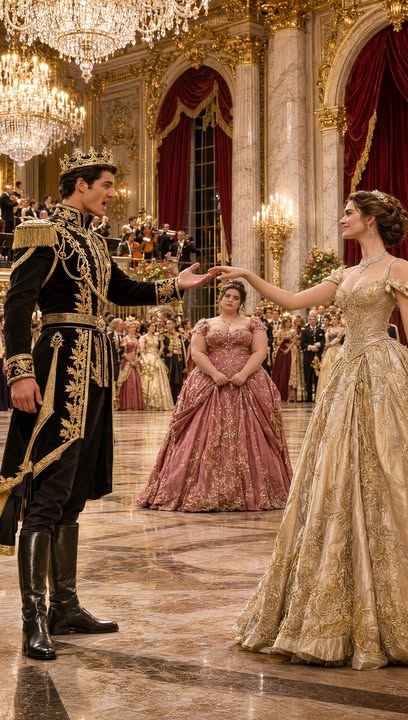
The waltz from the old manuscript began as Elara and Adrian stepped onto the dance floor.
She wore deep rose-pink silk, embroidered with golden leaves.
Her gown flowed around her with the same quiet grace as the dress she had worn on the night of the challenge.
The first strong beat arrived.
Adrian offered his hand.
Elara took it, and they began.
This time, she did not need to fix her gaze on the far side of the room.
She looked up at him.
Their steps were not perfect, and neither tried to make them so.
They listened to the music together, each trusting the other to find the rhythm when it shifted.
Around them, the court watched in silence that slowly became wonder.
Then the applause rose, bright and joyful, carrying Mara Vale’s name through the palace that had once forgotten her.
Elara kept her eyes on Adrian as they turned beneath the light.
And for the first time, the old waltz belonged to no secret, no accusation, and no test.
It belonged to the people who had listened.
**–THE END–PLEASE
Share your thoughts or feedback to motivate us to create more stories ♥️
* * *
[PREVIOUS: PART 5](https://storyly.idolsgift.com/blog/part-5-the-secret-hidden-in-the-music-057)
✓ Lynn R. Adams
Part 6 – The Waltz Remembered For a moment, no one moved. The fresh signature beneath the old royal seal seemed to hold the ballroom in place. Lady Celeste stared at the dispatch, her face gone pal…