PART 6 (THE END): The Secret Beneath the Surface 058
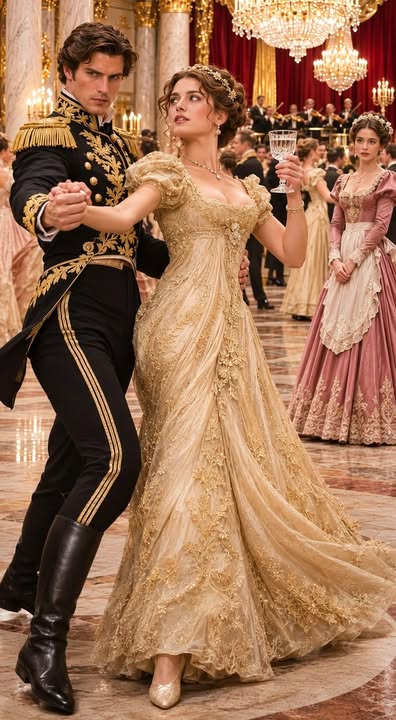
Part 6 – The Waltz We Chose
“The truth must be spoken before the prince is asked to choose whom he will marry.”
Alexander read the line once more, his eyes fixed upon my mother’s handwriting.
The great hall remained silent around us, every courtier waiting to learn whether he would speak.
He lowered the letter.
“Then my father understood what I did not,” he said. “A choice made without truth is not a choice at all.”
Lord Harbury stood with his hands clasped behind his back, his face drawn and thoughtful.
The steward held the corrected ledger against his chest, careful not to let its pages bend.
Alexander turned toward the assembled court.
“I will not ask anyone to accept a private explanation in place of a public correction,” he said. “The records will show that Eleanor Vale created the exercise with my father, that she left of her own choice, and that the accusation of theft was false.”
He paused, letting the words settle.
“The exercise was meant to teach attention and trust. I used it to judge women who had no part in creating its rules. That was my mistake, and I will not make it again.”
The stillness in the hall changed.
It did not disappear, but it softened, as if the people listening had begun to understand that no one was being asked to applaud.
Lady Victoria stood near the front, her hands folded at her waist.
When Alexander looked toward her, she met his eyes without turning away.
“I owe you an apology as well,” he said. “You entered a contest believing it would be fair, and I gave you no reason to think otherwise.”
Victoria’s expression eased, though sadness remained in it.
“Thank you for saying so,” she replied. “I would rather be disappointed by the truth than rewarded by a contest that was never what it claimed to be.”
A few courtiers shifted, uncertain how to respond.
Victoria did not look toward them.
She gave me a small nod, then returned her attention to Alexander.
“I hope you will remember that a fair decision is not always the one that leaves everyone pleased,” she said.
“I will.”
“And I hope you will remember that I entered because I wished to choose my own future, not merely because the court expected me to.”
“I do remember.”
That seemed enough for her.
She turned and walked from the hall with her maid beside her, carrying her dignity as carefully as she had once carried the crystal glass.
I watched her go with a feeling that held no triumph.
Whatever our differences, we had both been placed inside a choice someone else had designed for us.
Alexander waited until the doors had closed before he continued.
“The marriage competition is canceled,” he said. “The women who entered will be given a full account of what has been found, and no one will be treated as though she lost.”
This time, the murmurs that followed were not quite as uncertain.
Some people nodded.
Others looked toward Lord Harbury, waiting to see what the adviser would do.
He stepped forward.
“I served the household when the old papers were placed aside,” he said. “I failed to ensure that the staff record was corrected. I cannot say who added the false accusation, but I should have noticed that the entry did not belong with the original record.”
The hall listened.
“I will make no defense of that failure,” he continued. “The archive will preserve the altered line beside the correction, so the truth of what was done is not hidden under a cleaner page.”
Alexander inclined his head.
“Thank you.”
Lord Harbury looked at me.
“Miss Vale, I am sorry that your mother’s name was left to carry an accusation that should never have been attached to it.”
I considered the apology.
It did not return the years in which I had wondered what my mother had done, nor did it change the suspicion I had felt when the ledger appeared.
But the adviser had not asked me to pretend that it did.
“Thank you for saying so,” I replied.
The royal archivist carried the correspondence packet to the table where the steward had set out the corrected register.
She placed my mother’s original page beside the ledger, with the letter she had written to Alexander’s father opened beneath it.
The court could now see the name Eleanor Vale in my mother’s own hand.
Not as a line in a list of household workers, not as a fragment of a note, and not as an accusation.
As the creator of a lesson the palace had remembered imperfectly and the woman who had chosen to leave when her work was no longer being named truthfully.
I stepped closer.
The old music sheet rested on a length of clean cloth, and the faded strokes looked delicate beneath the afternoon light.
My mother’s handwriting had always seemed practical to me, made for lists of errands and small reminders.
Here it was, steady and clear, carrying a thought that had travelled farther than she could have known.
Remember the water.
Let it finish its turn.
I touched the edge of the table, not the paper.
For the first time since finding her name in the ledger, I felt the memory of her without the weight of the accusation beside it.
She had left because she had chosen to leave.
She had made something worth keeping, and she had asked that the truth be kept with it.
The palace had finally listened.
The court dispersed slowly, in low voices, without the grand certainty of a celebration.
The decision was too serious to turn into applause, and Alexander did not ask anyone to make it one.
He remained beside the table while the archivist sealed the letters for preservation.
I stood back, not at his side, and saw him notice the distance between us without trying to close it.
That evening, I went to the servants’ quarters and packed the few things that belonged to me.
I had not decided to leave the palace forever.
But I wanted to remember that I could.
The music book went into my case, wrapped in the linen my mother had once used to protect it from damp.
Clara sat on the edge of my bed while I folded my dresses.
“You do not have to go,” she said.
“I know.”
“Do you want to?”
“I want to know what I would choose if no one were watching.”
She thought about that.
“That sounds fair.”
“I may stay.”
“And if you leave?”
“Then I will leave.”
Clara took the folded dress from my hands and laid it carefully in the case.
“You are allowed to want both things,” she said. “A home here and a life that belongs to you.”
I looked at her.
“Since when have you become so wise?”
“Since you started teaching princes.”
I laughed, and the sound eased the tightness in my chest.
The next morning, the steward sent for me.
He met me in the small records room, where the ledger had been placed beneath a glass cover.
A new entry had been added beside my mother’s name.
Eleanor Vale left the palace by her own choice after contributing to the design of the waltz demonstration, a lesson in attention and trust created in collaboration with His Majesty.
Below it, in a separate hand, the false accusation was identified as a later addition unsupported by evidence.
The original alteration had not been erased.
It had been dated, described, and corrected.
I read the entry slowly.
“It is right,” I said.
The steward let out a breath.
“I am glad you think so.”
“Will anyone be able to change it again?”
“The archivist has made a record of the page and placed the correspondence with it.”
“Thank you.”
He looked at the ledger.
“I should have questioned the old entry when I first saw it.”
“Yes,” I said.
He accepted the answer without protest.
Then he brought out a second document.
The palace had prepared a new rule for staff records: no dismissal, departure, or allegation could be entered without a dated account of the cause, signed by the responsible officer and witnessed by another member of staff.
Beside it lay a proposal for a small fund to support workers who wished to study music, reading, or another skill outside their duties.
“The prince asked that the first grant be offered in your mother’s name,” the steward said. “But you may refuse it.”
I read the proposal.
It did not offer me a reward for dancing, nor a place beside Alexander, nor a polished story for the court.
It was meant for servants who had never been asked what they might become if given the chance.
“I would rather the fund be available to all the staff,” I said.
“That is what the proposal provides.”
“Then I accept it in her name.”
The steward smiled.
“I believe she would have liked that.”
“So do I.”
Alexander asked to speak with me later that afternoon.
He did not summon me to the ballroom or his father’s study.
He sent a note through Clara asking whether I would meet him in the west garden, and the note made clear that I was free to decline.
I went because I wanted to hear what he had to say.
The garden was quiet, with the winter roses protected beneath glass and a narrow path leading between the bare trees.
Alexander waited beside a stone bench.
He wore no uniform, only a dark coat, and he held nothing in his hands.
“I wanted to ask how you are,” he said.
“People usually ask that when they expect a particular answer.”
“I don’t.”
“I am relieved.”
He smiled, then looked toward the garden path.
“I have been thinking about the last line in your mother’s letter.”
“So have I.”
“My father promised her that he would tell me why she left before I chose whom to marry.”
“And he did not.”
“No.”
“Perhaps he believed he would have time.”
“Perhaps.” Alexander’s expression turned inward. “Or perhaps he thought keeping the lesson safe was the same as passing it on.”
I walked beside him beneath the bare branches.
“People often mistake keeping a truth for speaking it.”
“I did.”
“So did Lord Harbury.”
“And perhaps my father.”
He did not say it with bitterness.
He seemed to be allowing his father the same human complexity he had begun to allow himself.
“I cannot know what he intended,” I said. “But I know what my mother wrote.”
“She wanted the truth spoken before I was asked to choose whom to marry.”
“Then you have spoken it.”
“I have spoken part of it.”
He stopped beside the bench.
“The court will continue to ask about marriage. They will expect me to choose someone, and they will expect the choice to settle questions.”
“They are allowed to expect things.”
“That does not mean I have to give them the answer they want.”
“No.”
He searched my face.
“I am not asking you to marry me.”
“I know.”
“I am not asking you to stay.”
“I know that too.”
“I want you to choose what comes next without feeling that my decision has already been made for you.”
The words were careful.
There was affection in them, but he was not using affection to turn my freedom into a promise.
I looked toward the palace, its windows bright against the winter sky.
“I have spent years being grateful that I had work, a bed, and people who knew my name,” I said. “I thought choosing a different life meant being ungrateful for this one.”
“You are not ungrateful for wanting more.”
“My mother did not wait for permission to leave when the truth of her work was at stake.”
“No,” he said. “She did not.”
“I think I want to stay for a while.”
His face brightened, but he did not step closer.
“I would be glad to see you here.”
“I want to study music.”
“I can ask the steward to arrange—”
“Not because you asked.”
He stopped himself.
“You are right. I am sorry.”
“You can make the fund available. I will apply like anyone else.”
“That is fair.”
“And I want to continue my work for now.”
“Then that is what you should do.”
I studied him.
“Would you like to know what I want from you?”
“Yes.”
“I want you to learn how to ask without expecting the answer to please you.”
He nodded.
“I can try.”
“And I want to know you outside a contest, outside your father’s papers, and outside the idea that I have something to teach you.”
“I would like that.”
“Slowly.”
“Slowly,” he agreed.
“Without secret meetings that make the servants carry the cost.”
“I will be careful.”
“Not careful because you are a prince.”
He considered the correction.
“Careful because you are a person with your own life.”
“That is better.”
We resumed walking.
He did not reach for my hand, and I found that I was glad of the choice.
For the weeks that followed, the palace changed in quiet ways.
The old entry in the ledger remained visible beside the correction, and the correspondence packet was placed in the archive with a record of where it had been found.
The palace did not transform overnight.
There were still rules that favored some people and silenced others, and there were still courtiers who believed a private kindness could be mistaken for a public promise.
But the servants’ names were entered more carefully.
The staff could request a review of a record without asking Lord Harbury’s permission.
The new study fund opened in the spring, and its first applicants included a scullery maid who wanted to read well enough to write to her brother, a footman who wished to learn arithmetic, and a young kitchen worker who had been borrowing music books whenever she could find them.
I applied for lessons in music.
The archivist lent me a copy of the score from the sealed packet, and the first time I saw my mother’s name printed beneath the title, I had to set the page down and breathe.
Alexander began taking his lessons in noticing where other people worked, though I was no longer his only teacher.
He visited the kitchen with Mrs. Bell’s permission and learned how much planning went into preparing a royal supper.
He spent an afternoon in the steward’s office listening to the clerks explain how records could be misread when no one wrote down why a decision had been made.
He asked questions and, more often than he expected, listened to answers that did not fit what he had assumed.
When he came to the servants’ passage, he did not come in secret.
He asked first whether his presence would interfere with anyone’s work.
Sometimes the answer was yes.
When it was, he left.
That mattered more to me than the visits themselves.
Our conversations became less like lessons and more like meetings between two people who were learning each other’s ways of seeing.
He told me stories about his father that were not grand enough to appear in official biographies: the king burning his toast, forgetting the names of flowers, and pretending not to notice when Alexander hid beneath the writing desk as a child.
I told him about my mother’s humming, the small room where we had lived, and the way she would tap a rhythm against the table when she was thinking.
I did not tell him everything at once.
He did not ask me to.
Lady Victoria left for her family estate before the summer.
Before she went, she sent me a small card with a line written in her own hand.
A contest should never be mistaken for a measure of a person.
I kept it inside the music book, not beside my mother’s notes but between two blank pages where it could rest without becoming part of the score.
At the end of summer, Alexander asked if I would accompany him to a public concert in the city.
He asked plainly, not as a prince offering a favor but as a man inviting a woman whose company he enjoyed.
I said yes.
We went with an escort, and the court saw us together, but neither of us pretended the evening meant more than it did.
Afterward, he walked me to the carriage and asked when I might like to see him again.
I told him when I knew.
He accepted that answer.
Time passed in a way that did not hurry us.
I completed my first term of music lessons.
Alexander learned that listening was not a performance one could master for praise; it was a habit that required beginning again whenever pride made a person stop hearing.
We spent more evenings in conversation, and there were moments when I found myself looking forward to his arrival before I could explain why.
When the court asked whether he intended to marry, he answered that he would not make another public contest of a private choice.
Some people were disappointed.
Others were relieved.
No one could say the answer had been taken from me.
One evening, nearly two years after the night of the challenge, Alexander met me in the west gallery with a sheet of music in his hand.
The old music room had been opened and restored.
The cabinet stood beneath the wall where it had once been hidden, its wood cleaned and repaired.
My mother’s original page rested in a glass case beside the score.
Not hidden in the family papers.
Not displayed as a curiosity.
Its label named Eleanor Vale as its co-creator and explained that she had designed the lesson with Alexander’s father to teach attention and trust.
I had helped write the words.
Alexander had insisted that the description include the reason she left.
“She would have wanted the line kept with the music,” I said.
“I think so too.”
He set the score on the small music stand.
“Would you dance with me?”
“Is there a glass involved?”
“Not unless you want one.”
“Then I will consider it.”
He waited, smiling.
I looked at the old page in its case, at the mark my mother had made beside the waltz, and at the prince who had learned that asking was different from deciding.
“Yes,” I said. “I will dance with you.”
He offered his hand.
This time, I took it because I wanted to.
The musicians began the waltz softly.
Alexander followed my first step, then looked to me for the next.
I led us through a slow turn beneath the restored gallery windows, the music moving gently between us.
After a few measures, I picked up a crystal glass from the table and filled it with water.
“Are you sure?” he asked.
“I know what I am doing.”
“Then I will trust you.”
I held the glass in my left hand and offered him my right.
The waltz continued.
Alexander did not turn sharply or test my balance.
He followed the movement I chose, attentive to the change in my shoulder and the quiet turn of my wrist.
The water shivered in the glass, caught the lamplight, and settled.
We crossed the gallery together, no court waiting to judge us and no contest deciding what either of us deserved.
When the final note faded, I looked down.
Not a drop had spilled.
Alexander’s smile held no victory.
Only gratitude.
Outside the tall windows, the evening light lay over the palace grounds, and inside the music room my mother’s name rested beside the work she had made.
I had not been chosen by a challenge, and I had not become anyone’s reward.
I had chosen to stay.
I had chosen to dance.
And when Alexander offered me his hand again, I chose to take it.
**–THE END–PLEASE
Share your thoughts or feedback to motivate us to create more stories ♥️
* * *
[PREVIOUS: PART 5](https://storyly.idolsgift.com/blog/part-5-the-secret-beneath-the-surface-058)
✓ Lynn R. Adams
Part 6 – The Waltz We Chose “The truth must be spoken before the prince is asked to choose whom he will marry.” Alexander read the line once more, his eyes fixed upon my mother’s handwriting. The g…