PART 6 (THE END): The Secret Beneath the Silver Thread 046
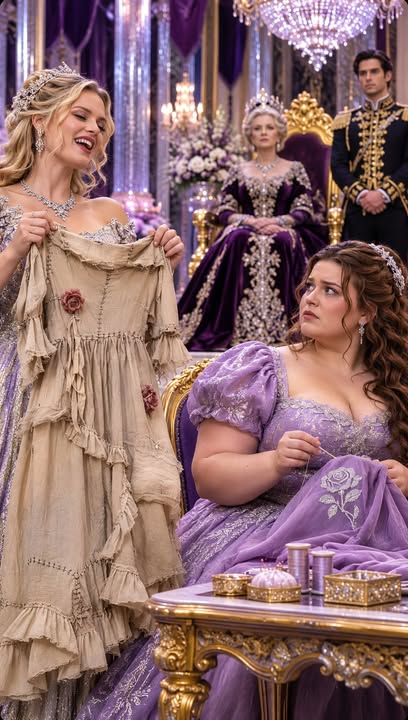
Part 6 – The Seventh Petal
I looked up at the queen.
Her face had gone pale.
Beneath the first line, Mother had written a name.
And the name was Sir Edmund Vale’s son, the man now serving as Catherine’s closest adviser.
For a moment, the council chamber seemed to draw all its air into the space between us.
William’s arm remained steady beneath my hand.
“May I read it?” Catherine asked.
I looked at the folded page, then at the people gathered around us.
“Not here,” I said.
The queen’s expression softened.
“Of course.”
We returned to the private room by the east gallery, where the tall windows looked over the palace gardens.
Mistress Pell came with us to examine the letter, and Mara, William, and Mr. Bell followed.
Isabella and Lady Rowena waited in the corridor at my request.
I unfolded the page.
Clara, if you have chosen to stand beside Catherine, there is one more truth I need you to know.
Sir Edmund Vale did not act alone.
His son, Julian, carried the sealed report to the queen and told her that you and I had died on the road.
He was young, but old enough to understand that the report was false.
I do not know whether he believed he was protecting his father, the crown, or himself.
I only know he knew the truth.
The final lines were faint, written in the same careful hand as the rest of the letter.
If Julian still lives, let him answer for his own choices, not for his father’s.
Truth should make room for justice, Clara, but it should not become another excuse to punish someone without listening.
I had to stop reading.
Catherine sat very still, her hands clasped on the table.
“Julian Vale,” she said quietly.
“He has advised me for twelve years.”
William’s jaw tightened, but he did not speak.
“Do you believe the letter?” he asked at last.
“I believe my mother,” I replied.
“But I don’t know what Julian did or why.”
Catherine drew in a slow breath.
“We will speak with him.”
“Not in front of the court,” I said.
“No,” she agreed. “Not until we know more.”
The queen looked toward Mistress Pell.
“Please verify the dates and the seal, and compare the letter with the other pages in Eleanor’s hand.”
Mistress Pell nodded.
“I’ll begin at once.”
She carried the letter to the table near the window, where the morning light was strongest.
While she worked, the rest of us waited in a silence that felt different from the silences before.
This one held no accusation, only the work of being careful.
When Julian Vale arrived, Catherine received him in the same private room.
He was a thoughtful-looking man in his forties, with dark hair beginning to silver at the temples.
He bowed to the queen, then glanced at the papers on the table.
“Your Majesty,” he said. “You asked to see me.”
Catherine did not gesture for him to sit.
“Do you remember delivering a report to me twenty-seven years ago, concerning Eleanor and the infant princess?”
Julian’s expression changed so slightly that another person might have missed it.
“I remember being asked to bring you a report.”
“Did you know it was false?”
He looked down at his hands.
For a long moment, he said nothing.
Then he answered.
“Yes.”
Catherine closed her eyes.
William shifted beside me, but I touched his sleeve lightly.
Julian noticed the movement and looked at me.
“You are Clara Whitmore,” he said.
“I am.”
“I’m sorry.”
“I don’t know what your apology means yet.”
“That is fair.”
He took a breath and turned back to the queen.
“My father told me Eleanor had been allowed to leave with the child, but he believed the court could not withstand the uncertainty of a missing heir.”
“So he wanted you to tell me the child was dead,” Catherine said.
“He said that if you kept searching, the old regent’s faction would use your grief to divide the court.”
“And you believed him?”
“I wanted to.”
Julian’s voice stayed low, without any effort to make his choice sound noble.
“I was twenty-one, newly placed in the royal office, and desperate to prove I could be trusted. I told myself the report would keep the kingdom steady until the danger passed.”
“But it was a lie,” I said.
“Yes.”
“And once the danger passed?”
“I was afraid to admit what I had done.”
He looked directly at Catherine.
“Each year that went by made the truth harder to confess.”
The queen’s eyes shone with hurt.
“You let me mourn my daughter.”
“Yes.”
“You let the court blame Eleanor.”
“Yes.”
Julian lowered his head.
“I can offer no excuse that would make those choices right.”
Catherine was quiet for a long time.
When she spoke, her voice was measured, though grief ran through it.
“I will not pretend this has no consequence.”
“I understand.”
“You will step away from your advisory position while the records are reviewed.”
“I will.”
“And you will provide every document you still hold concerning the inquiry.”
“I will.”
Catherine glanced at me.
“I also want the people Eleanor protected to be heard, not exposed against their will.”
Julian nodded.
“I will help identify them, and I will not name anyone without their consent.”
I watched him, trying to separate the man before me from the years of silence he had allowed.
“I won’t forgive you today,” I said.
“I don’t expect you to.”
“But I don’t want this to become a spectacle.”
“It won’t,” Catherine said.
“We will correct the record publicly,” she continued, “and handle the rest with care.”
Julian bowed.
For the first time since he entered, he looked less like an adviser and more like a man who had finally set down a secret he had carried too long.
He left without asking for forgiveness.
That, at least, was a beginning.
Over the following days, the palace archive became the center of a quiet, thorough inquiry.
Julian turned over his papers, including copies of the altered report and the original inquiry finding.
Mistress Pell compared the records with the physician’s register, the royal nursery ledger, and the two letters Mother had left behind.
The evidence aligned.
The seven-petaled rose appeared on the private correspondence between Catherine and Eleanor.
The royal token matched the nursery records.
The crescent-shaped scar on my shoulder matched the physician’s note, though Doctor Vale reminded us that no single mark could carry the burden of a whole identity.
The signed order, Eleanor’s letter, and the inquiry’s original finding told the same story.
Catherine had entrusted me to Eleanor.
Eleanor had protected me.
The accusation against her had been false.
The queen did not rush to make the truth into a celebration.
She asked for the record to be corrected first, the people who had helped Eleanor to be consulted, and the court to be told only what could be established.
Some had since died.
Some had asked to remain unnamed.
Mr. Bell agreed to be mentioned only as the keeper of Eleanor’s sewing box, not as a hero.
“I did what she asked me to do,” he said.
“That was enough.”
When Catherine’s public statement was finally prepared, I read every line before it was shared.
It described the queen’s choice to place her newborn daughter in Eleanor’s care during a period of political danger.
It acknowledged that Eleanor had left with permission, and that the inquiry had cleared her.
It stated plainly that the later accusation was false and that the queen’s own grief had been shaped by a report built on untruth.
Most importantly, it named Eleanor not as a fugitive or a thief, but as a trusted friend and protector.
Catherine asked whether I wanted my own name included.
I thought about the little room above the fabric shop, the shop itself, the life I had built stitch by stitch.
“Yes,” I said.
“But write that I am Clara Whitmore.”
She nodded.
“Then that is what we will say.”
The statement was read aloud in the palace courtyard beneath a clear autumn sky.
The gathered court listened without murmuring.
Catherine stood beside me, neither holding my hand nor expecting me to take hers.
When she finished speaking, she turned toward the people assembled there.
“This is my daughter, Clara,” she said.
“For twenty-seven years, I believed she was gone.”
Her voice trembled, but she did not turn away from the truth.
“She was loved and raised by Eleanor, who carried out my request and protected my child at great personal cost.”
Catherine paused.
“Today I clear Eleanor’s name, and I welcome Clara home, if home is a word she wishes to use.”
The words settled over us gently.
I had thought that if Catherine called me her daughter in public, I might feel transformed, as if the crowd’s recognition would rewrite my life.
It did not.
I was still the girl who had learned to sew beside Mother.
I was still the woman who had made a lavender gown with ordinary cloth and a stubborn hope.
But now I could stand in the same courtyard as the queen and know that I had not been asked to trade one truth for another.
I was Eleanor’s daughter.
I was Catherine’s daughter.
And I was Clara.
When Catherine stepped away from the speaking stand, she did not reach for me.
I reached for her.
Her hand closed around mine, careful at first, then warm.
A breath escaped her, and tears gathered in her eyes.
“Thank you,” she whispered.
“For what?”
“For letting me meet you.”
“I’m still meeting you, too.”
Her smile came through her tears.
“So we are.”
William joined us a moment later.
He looked at me as though he had been waiting to make sure I still felt like myself.
“Would it be all right if I walked beside you?” he asked.
I gave him my hand.
“You have been doing that already.”
“Then I’ll keep practicing.”
He offered his arm, and I took it.
The court had begun to disperse, but Isabella remained near the edge of the courtyard.
She approached slowly, without the bright smile she had once used as a shield.
“I told the seamstresses and the judges what I said to you,” she told me.
“I said I wanted to make you feel ashamed because I was afraid your work would matter more than my name.”
“What did they say?”
“That I should apologize without asking you to make me feel better.”
She looked down at her hands.
“So I’m sorry, Clara. You deserved to be judged for your work, not your body, and I was cruel.”
The apology was clear, and she did not ask me to accept it.
“Thank you for saying it plainly,” I replied.
“I don’t know what we’ll be to each other yet.”
“You don’t have to know.”
“I’m trying to remember that.”
“Then perhaps you’re beginning.”
A small, uncertain smile touched her face.
“I would like to help with the workshop you mentioned.”
“I haven’t mentioned a workshop.”
“Not yet,” she said. “But you should.”
I laughed, and the sound surprised me.
“I’ll think about it.”
“Good.”
She glanced toward Lady Rowena, who stood apart from the court, watching her daughter with a solemn expression.
Isabella went to her.
They did not embrace, but they stood together, speaking quietly, and for once neither seemed to be deciding what the other ought to say.
In the weeks that followed, the palace announced that Eleanor’s name had been formally cleared in the royal record.
The court also acknowledged that Lord Voss had helped replace the original finding and that Sir Edmund Vale had knowingly delivered a false report.
Julian Vale resigned from his position while an independent review continued.
He cooperated fully, and Catherine made no public judgment beyond the evidence.
Lady Rowena provided the papers her family had kept hidden.
She also gave the palace permission to publish the original inquiry finding, though she asked that her mother’s name not be included.
Catherine respected the request.
Isabella, for her part, began attending meetings about the women’s workshop I had proposed.
At first, she arrived with notes and a careful list of possible patrons.
I told her the first thing the workshop needed was a room with good light and tables large enough to spread fabric across.
She listened.
Then she helped persuade several palace stewards to offer an unused workroom near the old kitchens.
I visited it with her on a cool morning.
The windows were tall, the floorboards worn smooth by years of footsteps, and the air held the faint scent of beeswax and cedar.
“It used to be a room where palace women mended linens,” Isabella said.
“It feels right,” I replied.
“We can make it useful again.”
The workshop would teach sewing and garment making to women who wanted work, whether they lived near the palace or in the city.
We would make clothes in a full range of sizes, and no one would be asked to change her body to deserve a well-made gown.
The palace would provide the room and materials.
The women who worked there would decide what they made and how they were paid.
Catherine listened to my plan without trying to turn it into a grand royal project.
She only asked what I needed first.
“Thread,” I said.
“And honest measurements.”
She smiled.
“Those I believe we can provide.”
I kept sewing while the workshop was being prepared.
For the first public fitting, I chose the beige practice dress Isabella had once waved at me in the ballroom.
I had carried it home after the competition, more out of stubbornness than sentiment.
Its fabric was plain, but the shape was wrong.
The waist pulled.
The sleeves sat stiffly.
The hem dragged in the back.
I unpicked the seams and began again.
This time, I let the fabric fall naturally across the body.
I shaped the waist without pinching it, added soft lavender panels to the skirt, and stitched a narrow line of silver along the cuffs.
Then, at the neckline, I embroidered a small rose.
Six petals were complete.
I left the seventh open.
When the workshop’s first day arrived, women filled the old room, bringing baskets of thread, half-finished dresses, and questions they had been too shy to ask elsewhere.
Mara stood by the door, welcoming them as if she had always belonged there.
Mr. Bell had sent over bolts of sturdy cotton and fine wool, and insisted on writing no charge in the ledger until the workshop could pay him back.
Isabella helped arrange the cutting tables.
She did not take charge.
When a young seamstress asked whether a dress could be made beautifully for a body larger than the shop’s old patterns allowed, Isabella looked at me before answering.
“Of course it can,” I said.
“That’s why we’re here.”
She nodded and carried the fabric to the table.
Near midday, Catherine arrived without ceremony.
She wore a dark blue dress and a small silver brooch shaped like a leaf.
She did not bring a retinue or ask the women to stop working.
She stood beside me and watched as I guided a beginner through her first straight seam.
“Your mother would have loved this room,” she said.
“Eleanor loved rooms where people made things together.”
“I know.”
Catherine ran her fingertips over the edge of the worktable.
“I keep thinking of all the years I missed.”
“So do I.”
“I’m sorry I cannot give them back.”
“I don’t think anyone can.”
She looked at me, her eyes full of the tenderness she had learned not to demand from me.
“May I help with the rose?”
I took the lavender dress from the mannequin and placed it across the table.
“There are six petals.”
“I see.”
“The last one is for someone who finishes the work.”
Catherine lifted her gaze to mine.
“Is that what Eleanor told you?”
“She told you, once.”
“She did.”
“I think she meant that the pattern could belong to more than one person.”
Catherine touched the cloth, then waited.
I threaded the silver needle and handed it to her.
She took it with both hands, as if accepting something fragile.
Together, we stitched the final petal.
Her first stitch was uneven.
Mine followed it, crossing the thread neatly into place.
We worked slowly, neither of us trying to hurry the other.
When the rose was finished, the seven petals sat together beneath the silver light.
Catherine did not call it a sign.
She did not call it proof.
She simply looked at it, then at me.
“It is beautiful,” she said.
“So is the work that went into it.”
Across the room, William was showing a group of children how to wind thread without tangling it.
He had made a mess of the first spool, and one of the girls was laughing as she helped him undo the knot.
When he noticed me watching, he raised the tangled thread in surrender.
“I’m learning,” he called.
“So am I,” I answered.
Mara brought over a tray of tea.
Mr. Bell began telling the women about a shipment of cloth that had arrived at the shop, and Isabella listened as one of the seamstresses explained why the workshop needed different kinds of needles.
The room was full of voices, light, and the soft, steady sound of fabric being cut.
Catherine stood beside me, not as a queen who had found a lost object, but as a woman who had finally been given the chance to know her daughter.
William moved through the room as the brother I had never known, growing closer without asking me to become someone else.
And above us, in the old workroom near the kitchens, Eleanor’s rose was no longer hidden inside a sewing box or pressed between the pages of a secret letter.
It belonged to everyone who helped finish it.
**–THE END–PLEASE
Share your thoughts or feedback to motivate us to create more stories ♥️
* * *
[PREVIOUS: PART 5](https://echoesofstories.idolsgift.com/blog/part-5-the-secret-beneath-the-silver-thread-046)
✓ Lynn R. Adams
Part 6 – The Seventh Petal I looked up at the queen. Her face had gone pale. Beneath the first line, Mother had written a name. And the name was Sir Edmund Vale’s son, the man now serving as Cathe…