PART 6 (THE END): The Secret Beneath the Planks 069
Part 6 – The Bridge They Built Together
Elara read the name a third time, then closed her father’s notebook and held it against her chest.
For a while she remained at the workbench, listening to the quiet house and the soft tick of rain against the window.
Her father had not written the name to condemn anyone.
He had written it so that, someday, the truth might have somewhere to begin.
The following morning, Elara returned to the palace with the notebook in her traveling bag.
She did not go first to the prince.
She went to the records room, where the royal treasurer, the palace scribe, and the steward had gathered around the old ledgers.
Celestine had arrived before her, carrying the original account books from her family’s estate.
When Elara showed them her father’s note, the steward’s face tightened with recognition.
The name belonged to Lord Fenwick, a senior palace adviser who had served the prince’s mother and remained on the council after her death.
For a moment, nobody spoke.
Then the steward sat down.
“I remember the name,” he said. “Lord Fenwick oversaw several departments when Lord Merrow was ill.”
“Did he handle the bridge funds?” the prince asked.
The treasurer turned the ledger toward them.
“The transfer from Lord Merrow’s office was followed by a second entry, authorizing payment for timber that never appears in the builder’s records.”
“Who authorized that entry?” Elara asked.
The treasurer studied the narrow handwriting.
“The clerk who prepared it was employed by Lord Fenwick.”
The scribe placed the handwriting assessment beside the ledger.
The payment order bore Celestine’s father’s genuine signature, but the description of what he had approved had been added afterward.
Her father had signed a transfer to the palace, believing it would pay for the bridge.
The altered order had made it appear that he had approved the money being moved elsewhere.
The rest of the evidence came together slowly, through dated entries, letters, and the recollections of two retired palace workers whom the inquiry found in nearby villages.
They remembered Martin Vale refusing to sign the completion report.
They remembered him asking for the missing timber and being told that the matter had already been settled.
One former clerk confirmed that Lord Merrow had diverted the repair funds through Lord Fenwick’s office to cover an unrelated palace expense.
Fenwick had later helped prepare the false statement that blamed Martin for the unfinished work.
Neither man had been alive for years, but the records showed how the deception had been arranged and why it endured.
Celestine’s father had not knowingly helped conceal the theft.
He had signed a legitimate payment order, and the description had been altered after it left his hands.
The investigation also found that the hidden cut in the bridge’s support had been made before Martin’s crew arrived.
No document proved who had cut it or why.
The inquiry recorded that uncertainty plainly, refusing to turn suspicion into fact.
What it could prove was enough: the repair had never been completed, the funds had been diverted, and Martin Vale had been blamed for refusing to certify unsafe work.
The prince called the council together once the evidence had been reviewed by independent auditors.
He invited Elara and Celestine to attend, though neither was required to speak.
Elara chose to sit beside the treasurer, with her father’s report in front of her.
She did not want to be displayed as a symbol of the crown’s remorse.
She wanted the record corrected in the same careful language that had once been used to bury it.
The prince addressed the council without a crown or ceremonial robes.
“The inquiry has established that Martin Vale warned the palace the bridge was unsafe, that the repair funds did not reach his crew, and that the statement used to dismiss him was not written or approved by him.”
He paused, letting the words settle.
“The crown failed to protect an honest worker and preserved a false account of his conduct.”
No one in the room could mistake the responsibility in his voice.
“The record will be corrected publicly,” he continued.
“The diverted funds will be returned to the family who provided them, and compensation will be paid to Martin Vale’s heirs.”
Celestine sat very still as the prince looked toward her.
“Your family’s contribution was given in good faith,” he said.
“I would like it returned to the crown,” Celestine answered, “so it can be used for the bridge and the builders’ workshop.”
The prince considered her words.
“Your family is not responsible for Lord Merrow’s actions.”
“I know,” she said.
“But I want the money to serve the purpose my father intended.”
The prince nodded.
“Then we’ll honor that choice.”
The council approved the correction and the return of the funds, along with an independent review of other repairs once overseen by Lord Merrow’s office.
The palace scribe prepared a public statement that described what had been found and what remained unknown.
It did not claim the crown had acted perfectly.
It did not name a culprit for the cut beam without evidence.
It said plainly that Martin Vale had warned the palace, that his warning had been suppressed, and that he had been wrongly dismissed.
When the statement was read in the palace courtyard, Elara stood beside the old fountain with her aunt and Celestine.
The prince spoke the words himself.
He did not ask Elara to stand at his side, and she was grateful for that.
When Martin’s name was cleared, the applause that followed was not loud or triumphant.
It was warm, respectful, and long enough for Elara to feel the years between her father’s warning and the day it was finally heard.
Her eyes filled, though she did not try to hide it.
Afterward, the prince approached her.
“I know this cannot give back the years he lost.”
“No,” Elara said. “But it gives the truth somewhere to stand.”
He lowered his head.
“I’m sorry it took so long.”
“So am I.”
There was no easy comfort in what had happened, but there was relief in no longer having to carry the old story alone.
The bridge remained closed until a master builder inspected the timber and designed a full restoration.
Elara helped review the practical details, but she insisted that a trained team do the work and that every stage be independently checked.
She brought her father’s notebook to the workshop, where builders studied his sketches and notes alongside the new plans.
More than once, Elara found herself imagining the questions he would have asked.
Where did the weight travel?
What had been overlooked?
What would happen when the wood was wet, or when the stream ran high?
She could not answer in his voice, but she could ask the questions he had taught her to ask.
The work took several weeks.
Celestine visited the workshop often, first to check the accounts and later to learn how the builders measured and fitted the new supports.
The first time she picked up a plane, she held it too tightly and scraped a rough strip from a practice board.
The builder beside her smiled.
“Wood’s patient,” he said. “You can try again.”
Celestine looked at the crooked mark.
“I’m not used to being allowed to try again.”
“Then it’s a good day to start.”
She did.
Elara watched from the doorway and saw, beneath Celestine’s careful posture, the same uncertainty she had glimpsed by the canal.
The noblewoman was still proud.
She was also learning that skill belonged to practice, not inheritance.
At the prince’s suggestion, Celestine used part of her family’s returned contribution to help establish a training workshop for palace builders and apprentices.
The workshop welcomed people from the city as well as the palace grounds.
It taught practical construction, repair, measurement, and safety, with every instructor expected to explain not only how to do a task but why it mattered.
Celestine asked Elara to help shape the first course.
“I don’t want a statue or a plaque with my name on it,” she said as they examined a list of tools.
“What do you want?”
“People who know how to recognize a weak joint before it fails.”
“That sounds like a useful beginning.”
“It is more useful than being admired for paying for something.”
Elara smiled.
“Then we agree.”
Their friendship did not arrive all at once.
It grew from honest work, from uncomfortable conversations, and from the quiet respect of not demanding more trust than the other could give.
Celestine never asked Elara to forget how she had laughed at her.
Elara never pretended the laughter had not hurt.
But, in time, they learned to speak without either of them needing to perform.
The restored footbridge opened on a mild spring morning.
Its new supports were firm, its boards level, and its handrails fitted to the stone without strain.
The prince had asked that the opening be a simple one, with the builders present and no court spectacle.
Elara arrived early and walked the span with the master builder, checking the joins and the surface beneath her shoes.
At the center, she paused and listened.
The bridge held quietly over the stream.
The prince waited on the near bank with Celestine and the workshop’s first group of apprentices.
“Is it ready?” he asked.
“It is,” Elara said.
“Are you sure?”
She gave him a knowing look.
“I’m sure because we tested it.”
He stepped onto the bridge beside her.
Together they crossed to the other bank, where the builders and apprentices waited.
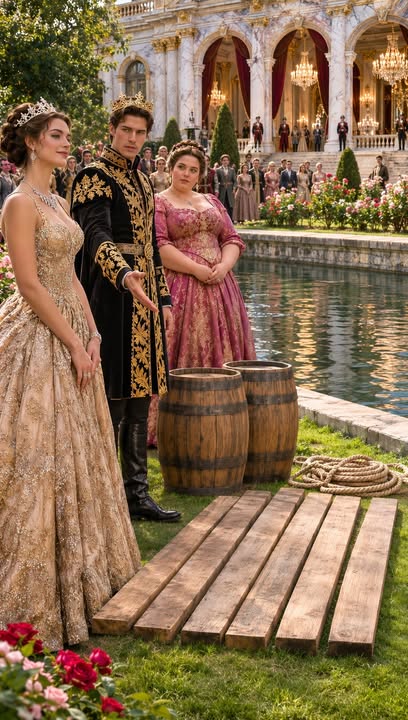
A pair of attendants carried the six original planks from the canal challenge.
They had been cleaned and carefully preserved, their old rope marks still visible along the edges.
The planks were mounted beneath a small wooden canopy beside the restored bridge.
There was no crown carved above them, no grand inscription claiming that one person had made the crossing alone.
A modest plaque read:
Six planks, joined with care.
A crossing is made by what each part can bear, and by the hands willing to hold it steady.
Elara ran one finger along the worn edge of the first plank.
“I thought those boards would end up forgotten in a storeroom,” she said.
“They helped begin a better question,” the prince replied.
“What question?”
“How do we build something strong enough for more than one person?”
She looked at him.
“And what is your answer?”
“That I should not ask anyone to cross a structure I have not helped inspect.”
“That’s a start.”
“I hoped you might say that.”
His smile was gentle, but Elara could see the restraint beneath it.
He had not called her back as a reward.
He had not asked her to turn the inquiry’s conclusion into a marriage.
Since the day she left, he had sent her copies of each finding and kept his promises without asking her to praise him for it.
They had spoken sometimes about the inquiry, sometimes about the workshop, and sometimes about nothing important at all.
He had never told her what she owed him.
Now he stood beside the bridge and waited for her to choose whether she wanted to remain.
“Elara,” he said, “I have something to ask, but you may answer whenever you’re ready.”
She looked across the stream to where Celestine was helping an apprentice adjust a measuring cord.
The young builder was listening carefully, and Celestine was laughing at a mistake she had made herself.
The sound was lighter than Elara remembered from the garden.
“What is it?” she asked.
“I’d like you to return to the palace, if you choose.”
“As what?”
“As yourself.”
“That is not a position.”
“No,” he said. “It is the part I should have understood first.”
He drew a breath.
“If you wanted a role in the crown’s work, I would ask you to help shape it with me. Not because you crossed the canal, and not because of your father’s case. Because I trust the way you see problems, and because I want a life in which you can disagree with me and still be heard.”
“And if I say no?”
“Then I will be grateful for what you have already taught me.”
“And if I say I need more time?”
“Then you will have it.”
Elara studied his face.
She remembered the prince who had first watched from the bank, waiting for her to prove she belonged in his challenge.
She remembered the man who had listened when she told him to hold the bridge steady, then let go when she needed to test it without his help.
She remembered the promise he had kept when she chose to leave.
“I don’t want to be a queen because a contest promised it,” she said.
“Nor do I want you to be.”
“I don’t want my father’s story used as a reason to bind me to you.”
“It won’t be.”
“And I will tell you when I think the crown is wrong.”
“I expect you to.”
“Even in council?”
“Especially there.”
Elara let the answer settle.
Then she asked, “Do you still want to marry me?”
The prince did not hurry to answer.
“Yes,” he said at last. “But only if you want that life too, and only if we build it without asking the crown to stand in for trust.”
The words were not perfect.
They were not meant to be.
Elara reached for his hand.
“I want to try,” she said. “Not as a prize. Not as an apology. As a partner.”
His fingers closed around hers, warm and steady.
“Then I will try to be worthy of that.”
“Don’t try to be worthy,” she said, smiling through the emotion rising in her throat. “Do the work.”
He laughed softly.
“I’ll do the work.”
Celestine looked over and saw their joined hands.
She did not interrupt.
Instead, she raised a measuring cord for the apprentice to see, allowing them the privacy of that first unguarded happiness.
The wedding took place beside the restored bridge in the early summer.
It was not a grand ceremony designed to make the kingdom forget a wrong.
The prince and Elara spoke their vows beneath a canopy of green branches, with builders, gardeners, palace staff, relatives, and friends gathered along the stream.
Elara wore deep rose-pink, the color of the gown she had worn on the day she first crossed the canal.
The fabric moved freely around her as she walked toward the prince.
Her aunt held her hand until the final few steps.
Celestine stood among the witnesses, wearing no jeweled tiara, only a simple gold pin that had belonged to her mother.
When Elara reached the prince, he did not speak of destiny or a contest.
He promised to listen when she questioned a plan, to share decisions that affected their people, and to remember that a title could never replace the work of earning trust.
Elara promised to speak honestly, to accept help without surrendering her judgment, and to meet him as an equal even when their paths were difficult.
The promises were not tied like rope around a plank.
They were offered freely, with room for both of them to hold their own strength.
After the ceremony, the guests crossed the restored bridge in small groups.
At its entrance, the six original planks rested beneath their canopy, weathered and unassuming.
Elara stopped beside them.
Her father had taught her to test before trusting, to listen for what a hurried eye might miss, and to speak when something was not sound.
The prince came to stand beside her.
“I wish he could have seen this,” he said.
“So do I.”
“Would he have approved of the bridge?”
“He would have inspected it first.”
The prince laughed, and Elara’s laughter joined his.
Beyond them, Celestine was showing an apprentice how to tighten a binding knot without crushing the wood.
The workshop’s youngest builder was listening closely, his face bright with concentration.
People crossed the bridge at an easy pace, trusting the supports beneath them because the supports had been examined, repaired, and tested.
Elara slipped her hand into the prince’s.
For years, she had thought her father’s legacy was the shame people attached to his name.
Now she understood that his legacy was the way he had taught her to look carefully, speak truthfully, and build so that others could safely follow.
No one plank had carried the crossing alone.
No single person had restored what had been broken.
And, beside the stream, beneath the summer light, the future waited not as a prize to be claimed, but as a bridge they would build together.
**–THE END–PLEASE
Share your thoughts or feedback to motivate us to create more stories ♥️
* * *
[PREVIOUS: PART 5](https://storyly.idolsgift.com/blog/part-5-the-secret-beneath-the-planks-069)
✓ Lynn R. Adams
Part 6 – The Bridge They Built Together Elara read the name a third time, then closed her father’s notebook and held it against her chest. For a while she remained at the workbench, listening to the…