PART 6 (THE END): The Secret Beneath the Music 046
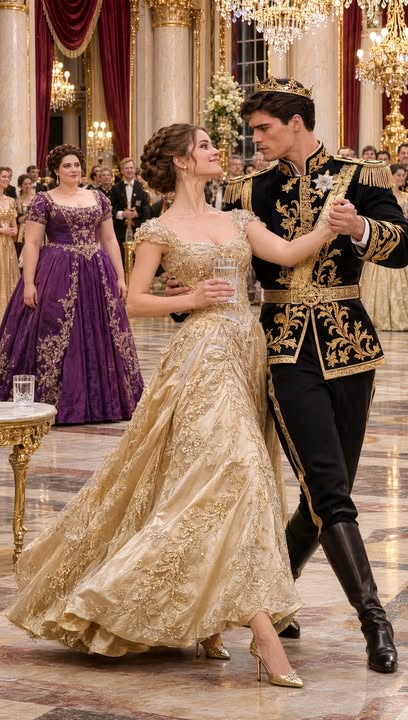
Part 6 – The Dance We Choose
“He wrote that Marian was not merely asked to help him after the accident.”
The prince’s voice remained steady, but the paper trembled between his fingers.
“He says she was the one who stopped the fall from becoming worse—and that he never told the court because she asked him to keep the truth hidden.”
For several heartbeats, no one spoke.
The ballroom’s chandeliers shone above us, gilding the faces turned toward the prince, while the orchestra sat motionless with their instruments lowered.
My mother’s name seemed to fill the room more completely than the music had.
“What happened?” I asked.
The prince looked down at the card.
“I need to read the whole message before I can answer.”
He turned toward the court master, who nodded and led him to a quiet table near the platform.
The crowd parted without being asked.
I watched the prince settle the card on the table, careful not to crease it further, and read the faded lines again.
His right hand shook.
This time, he let it.
Celeste came to stand beside me.
“Do you want me to stay?” she whispered.
“Yes.”
She touched my arm, a small, steadying gesture, and we waited.
The prince read the message once more, then closed his eyes briefly.
When he looked up, his expression held grief, but also a kind of relief, as if a long-held doubt had finally been given a shape.
He returned to us with the card in his hand.
“My father wrote this after he learned the palace had recorded Marian’s work without giving her proper credit,” he said. “He says she was riding with him when his horse stumbled near a stone bridge.”
The room remained quiet.
“He fell badly and caught his right hand beneath him. Marian was there. She helped keep him still until the physician arrived, and afterward she worked with him and the dance master to find a safer way for him to move.”
His gaze lowered to the message.
“He says she did not want the court to turn the accident into a public story, and she did not want her daughter growing up as a subject of palace attention. She asked him to keep her name private.”
My breath caught.
My mother had not been absent from the palace’s history because her work meant little.
She had stepped away because she wanted to protect the life she was building for me.
The prince continued.
“My father agreed to keep the accident private. He also agreed that the new step would be recorded within the family collection. But he did not realize the dance master had entered the payment as complete when Marian had received only a fraction of what was promised.”
“Did your father know about the difference?” I asked.
The prince studied the card again.
“He learned years later. He wrote that he intended to correct the record, but Marian asked him not to make a public issue of it. She had moved on, and she did not want the palace drawing me into a matter she had chosen to leave behind.”
My eyes stung.
I thought of my mother’s notebook, its pages crowded with dance notes and ordinary reminders, and wondered how many times she had decided that keeping our life peaceful mattered more than being recognized.
“Did he say why he never told you?” I asked.
“He says he meant to explain when I was older. Then my own hand began to tremble, and he feared I would believe the injury had been passed on as a sentence.”
The prince looked at his fingers.
“He wanted me to understand that an injury could shape what I needed without defining what I was capable of. He died before he found the right way to tell me.”
The ballroom had gone utterly still.
The prince did not seem to notice the people listening.
He was speaking now to my mother’s memory, and to the father he had lost, as much as to us.
“I spent years thinking the tremor was something I had to hide if I wanted anyone to trust me,” he said. “My father knew better. Marian knew better. I wish I had learned that from them sooner.”
The court master bowed his head.
No one rushed to fill the silence.
Then Mrs. Vale, who had arrived quietly near the ballroom doors, stepped forward.
“The archives can confirm the letter and the ledger entries,” she said. “The records will need to be reviewed before they are formally amended, but there is no reason to leave Marian’s contribution unacknowledged.”
Lord Merrick looked toward the prince.
“Your Highness, if the message is genuine, we should document its contents and consult the family archives before making a public announcement.”
“We will,” the prince said. “But not in a way that makes Marian’s work disappear while we wait for the perfect phrasing.”
He turned toward me.
“I want to ask your permission before sharing anything more about your mother.”
I had expected the palace to decide what counted as public.
I had expected my mother to become a footnote people could debate without knowing what she had wanted.
Instead, the prince stood before me and waited.
“Tell them what she did,” I said. “Tell them she helped your father after the accident and designed the step that made it safer for him to lead.”
He nodded.
“Would you like her name included?”
“Yes.”
My voice shook, but it did not break.
“She chose privacy, not erasure. I think it matters that people know the difference.”
The prince’s face softened.
“It does.”
He turned back to the ballroom.
“My father’s message confirms that Marian helped him after his accident,” he said. “She also created the safer leading technique he later taught me. The palace recorded the work under the royal family collection, and the records show that her contribution was never properly credited.”
A quiet murmur passed through the room, not of scandal but of understanding.
He lifted his right hand.
It trembled slightly in the warm light.
“My hand has a recurring tremor, and my father’s injury may be part of its history. I will not pretend that the tremor does not affect me. I also will not let it stand as the whole account of what I can do.”
The court physician stepped closer, though she did not interrupt.
“I’m going to seek treatment and learn what adaptations help me dance safely,” he continued. “Marian’s technique offers one place to begin, but it is not a cure, and I won’t pretend it is. It is a piece of knowledge she gave the palace, and the palace should have recognized her for it.”
He paused, looking from one contestant to another.
“The challenge last night was intended to discover whether someone could read the signals in my lead. I should have told you why before asking you to dance. I am sorry that I did not.”
The apology did not turn the earlier failures into successes.
It did not erase the unease of being tested without knowing what was at stake.
But it was offered plainly, without asking anyone to make him feel better about it.
Several contestants nodded.
One of them, the woman in silver, lifted her hands in a brief, supportive clap.
Others followed, slowly at first, then with warmth.
The applause was not the startled roar that had followed our dance.
It was gentler.
It sounded like people choosing to stay in the room.
The prince lowered his hand.
“Thank you,” he said.
Mrs. Vale approached with the archival folder.
“Your Highness, if the council agrees, I can begin the formal record correction tomorrow.”
“Please do.”
“And the compensation question?”
“Let us establish exactly what was paid and what was promised. Marian’s family should not have to ask the palace to do what its own records already show.”
I felt Celeste’s shoulder brush mine.
When I looked at her, she was watching the prince with a new respect.
Not because he had solved the matter in one evening, but because he had allowed the truth to remain complicated.
Lord Merrick spoke with the court master, and the two of them began quietly discussing the next steps.
No one announced a winner of the competition.
No one asked me to decide immediately whether I wished to remain.
For the first time since I had arrived at the palace, the absence of an announcement felt like a kindness.
Later, when the ballroom had emptied and the last of the guests had gone upstairs, I found the prince alone in the music room.
He stood beside the grand piano, turning his father’s card between his fingers.
The room was lit only by wall lamps, which softened the polished wood and made the tall windows look like dark mirrors.
“May I come in?” I asked.
He looked up.
“Please.”
I stepped inside and closed the door behind me.
“How are you?” I asked.
He considered the question.
“Sad,” he said. “Relieved. A little angry at how much time we lost to silence.”
“That sounds like a lot to hold at once.”
“It is.”
He placed the card on the piano.
“My father tried to protect me by waiting until the right moment.”
“And the right moment never came.”
“No.”
I stood beside him, leaving a respectful space between us.
“My mother did something similar,” I said. “She thought keeping the palace away from me would protect my childhood.”
“Did it?”
“Mostly. I had a home, a small studio, and a mother who taught me how to trust my own balance.”
I thought of her hands guiding my shoulders when I was young, correcting me with a light touch rather than a command.
“But I wish she had told me more,” I added. “I understand why she didn’t. I still wish.”
The prince nodded.
“I wish my father had told me he was afraid I would mistake his injury for my future.”
“Maybe he hoped you would never have to know the fear.”
“Maybe.”
He turned his right hand palm-up.
The tremor was visible in the fingers, subtle but unmistakable.
“I used to think that if I practiced long enough, I could make it stop.”
“And now?”
“Now I want to learn what my hand can do without demanding it behave like someone else’s.”
“That sounds more useful.”
“It does.”
He gave me a tired smile.
The physician had spoken to him after the announcement, he said, and arranged for a specialist consultation.
There would be questions and tests, and he did not yet know what treatment might help.
For now, he had been advised to rest his hand and avoid forcing movements through fatigue.
“I’m relieved you’ll have someone to guide you,” I said.
“So am I.”
“And you don’t have to prove you can lead perfectly before you let anyone dance with you.”
His gaze held mine.
“I would like to ask you to dance again.”
“Not because I’m good at preventing spills?”
“Because I want to dance with you.”
“Those are not the same reason.”
“I know.”
He offered his left hand.
Then, after a thoughtful pause, he offered his right as well, palm open and honest.
“You can choose whichever feels comfortable,” he said. “And we can stop whenever you want.”
I looked at his hands.
The choice he offered was small, but it carried the weight of everything he had learned to say.
I placed my left hand in his right.
“Slowly,” I said.
“Slowly.”
There was no orchestra.
The music room held only the hush of the palace at night and the faint ticking of a clock somewhere beyond the door.
The prince began with a simple step.
I felt the tremor beneath his fingers, and the old habit in me stirred, ready to compensate before he asked.
I did not move ahead of him this time.
I waited for his signal.
His hand shifted, not quite in the old pattern, but with care.
I answered with my weight, and we found a shared rhythm.
The step was uneven.
It was also ours.
When the prince’s hand trembled more sharply, he stopped.
“I’m sorry,” he said.
“Don’t be.”
“I thought I had it.”
“You had it for as long as you had it.”
The words seemed to reach him.
He looked down at our hands.
“Would you like to continue?”
“Yes,” I said. “But we can change the step.”
His shoulders eased.
Together, we altered the movement, turning the dance into something gentler, with more room between the beats.
It was not the Vale Turn exactly.
It was not the prince’s father’s step, or my mother’s, or the challenge that had brought us together.
It was a beginning made from all of them, with enough space for what neither of us could yet do.
When the clock chimed, we stopped.
The prince did not try to hold the moment in place.
He released my hand carefully.
“Thank you,” he said.
“You’re welcome.”
“I don’t know what happens next.”
“Neither do I.”
“But I would like to find out with you.”
I looked at him, at the tired honesty in his face, at the hand he had not hidden.
“So would I.”
The days that followed did not transform the palace overnight.
The archives took time to review the correspondence, compare the payment records, and determine how best to amend the family collection.
The prince began his appointments with the specialist, learning what might contribute to the tremor and which movements placed too much strain on his hand.
Some mornings were easier than others.
On the difficult mornings, he learned to stop before frustration became punishment.
I stayed in the competition through its final stages, though the council changed its purpose.
It became less a contest for a single future queen and more a series of public-service projects proposed by the contestants.
Celeste found her footing there.
She spoke about restoring dance instruction in the neighborhoods where families could not afford private lessons, and about creating programs in which children with different bodies and abilities could learn together without being told they had to move the same way.
She did not speak to impress the court.
She spoke because she had remembered what it felt like to want to dance and be told that wanting was not practical.
When the council asked whether she would help shape the program, she accepted.
When they asked whether she would remain in the competition, she said she would, but no longer because her family expected it.
She chose to stay because the work mattered to her.
I did not become queen that season.
There was no sudden proposal, no declaration that a single dance had settled the shape of my life.
The prince and I kept meeting, sometimes in the gardens, sometimes in the music room, sometimes in the archives while Mrs. Vale read aloud from newly uncovered letters.
We learned each other in ordinary moments.
He learned that I preferred tea too strong and mornings quiet.
I learned that he became stubborn when worried and thoughtful when he was trying not to show it.
We argued about how quickly the palace should announce the archive’s findings.
We listened when the other was right.
We danced when his hand allowed it, changing the steps when it did not.
The palace eventually corrected its records.
The revised history named Marian as the creator of the safer leading technique, and acknowledged that the compensation recorded in her name had not matched the amount promised.
The royal family made restitution to her estate, which I used to help establish a dance program in the neighborhood where my mother had taught me.
We named it the Marian Vale Dance Program, not because her work belonged to the palace, but because it had always belonged to the people she wanted to help.
Celeste joined the program’s advisory board and became its most persuasive advocate.
The prince attended the opening day without a speech prepared.
He watched from the side as children ran across the studio floor, laughing when they missed a turn and trying again without apology.
A framed page from my mother’s notebook hung near the entrance.
The drawing of the Vale Turn was beneath a line of her handwriting:
Listen through the hand.
The prince stood beside me as we watched a young girl teach her grandfather the first part of the step.
His right hand trembled.
He let it rest openly at his side.
“She would have liked this,” he said.
“Yes,” I replied. “She would have.”
He looked at me.
“Would you dance with me after they’ve gone?”
“If you want to.”
“I do.”
“And if your hand gets tired, we stop.”
“We stop.”
The years did not make every uncertainty disappear.
They gave us ways to meet it together.
The prince continued treatment and learned to lead with adaptations that respected his hand instead of hiding it.
I continued dancing because it brought me joy, not because the court needed proof that my body belonged on a ballroom floor.
Celeste helped reshape the competition into a genuine public-service program, one that asked what each contestant wished to build rather than how elegantly she could survive a test.
And when the prince proposed, he did not do it beneath the chandeliers or before an audience.
He asked me after we had shared an ordinary evening in the little studio where the program began, while rain tapped gently against the high windows.
“I want a life with you,” he said. “Not because you saved me, or because our families have a history, or because a crown needs a partner. I want it because every day with you makes me more honest about who I am.”
I looked at him, and then at his open hand.
“You don’t need to promise me a perfect dance,” I said.
“I can promise to listen.”
“Then yes.”
The wedding took place in the palace garden, where the roses had begun to open.
Celeste stood beside me, radiant in a gown of deep blue.
Mrs. Vale sat in the front row with the archivists, holding a copy of the amended record.
The prince’s treatment had helped him find steadier days, though his hand still trembled sometimes.
No one tried to hide it.
When the music began, he offered me his right hand.
I placed mine in it.
We took the first step together, not perfectly, not fearlessly, but with attention.
The old royal turn opened beneath our feet, carrying my mother’s care, his father’s memory, and all the truths we had once been afraid to speak.
Neither of us led alone.
Neither of us followed without being seen.
And as the music lifted around us, the palace finally understood what Marian had known all along: a partner did not need a flawless hand to lead.
Only the courage to listen, and the grace to move together.
**–THE END–PLEASE
Share your thoughts or feedback to motivate us to create more stories ♥️
* * *
[PREVIOUS: PART 5](https://echoesofstories.idolsgift.com/blog/part-5-the-secret-beneath-the-music-046)
✓ Lynn R. Adams
Part 6 – The Dance We Choose “He wrote that Marian was not merely asked to help him after the accident.” The prince’s voice remained steady, but the paper trembled between his fingers. “He says she…