PART 6 (THE END): The Secret Beneath the Little Horse 052
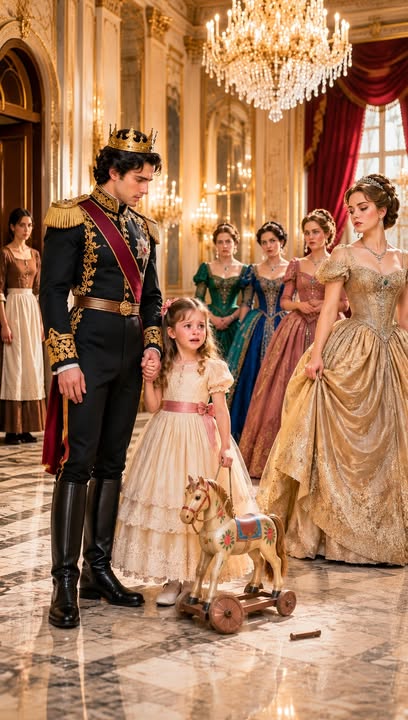
Part 6 – A Home Chosen Freely
The maid recognized her father’s name beside the courier’s note, but she did not understand why it had been written there.
The prince held the scrap beneath the lamp, careful not to crease its brittle edge.
“Could it be a note about the invitation?” he asked.
The steward examined the faded ink.
“It may be,” he said. “The courier’s handwriting is clearer here than in the ledger, though the record itself is incomplete.”
The maid looked at the name she had known all her life.
Her father had left the village before the messenger arrived, choosing to stay with her when she had needed him.
Now, years later, his name had found its way back to her through a queen’s letter and a little horse.
“May I read it?” she asked.
The steward passed her the scrap.
The line was brief: “The craftsman asked that his daughter be told, should the queen’s message reach them, that her father had been honored by the kindness of the request.”
The maid read it twice.
She pressed the paper gently to the table, keeping her fingers from trembling.
“He knew about the queen’s note,” she said.
“Perhaps the messenger found him before he left,” the prince replied. “Or perhaps your father sent word after the invitation reached the village.”
The steward nodded.
“The records suggest the courier met him on the road. He declined the invitation, but he did not refuse the queen’s thanks.”
The maid looked up.
“He wanted me to know?”
“It seems he did,” said the steward. “But there is no evidence the message ever reached your home.”
The final mystery was not a grand secret or a hidden royal connection that changed who her father had been.
It was smaller, and for that reason it touched her more deeply.
Her father had understood the queen’s kindness, had been moved by it, and had hoped his daughter would hear of it someday.
Perhaps the paper had been lost in the confusion of travel.
Perhaps he had meant to tell her later, when there was a quiet evening and enough time to explain.
Then life had carried on, as it always did, leaving some words unspoken.
The maid folded the scrap along its old crease.
“My father was honored,” she said. “And he chose to stay with me anyway.”
The prince’s expression softened.
“He did not have to choose between those things. He could be grateful to the queen and still know where he belonged.”
The maid looked at him.
“That sounds like something you have been trying to learn.”
He gave a faint smile.
“I have.”
The princess, who had been listening from beside the toy shelf, picked up the wooden horse and came closer.
“Did the queen write about the horse?”
“She did,” the maid said, making room for her beside the table. “She thanked my father for repairing it.”
“And she wanted him to come here?”
“She invited him.”
The princess’s eyes widened.
“Did he come?”
“No,” said the maid. “He stayed in the village with me.”
The child glanced down at the horse.
“Because he loved you.”
“Yes.”
The princess leaned against the maid’s side.
“Then the horse brought all of you together, even though you didn’t know.”
The maid considered the child’s words.
“Perhaps it did.”
The prince looked at his daughter, then at the old note.
“Your mother hoped kindness would travel farther than rank,” he said. “It seems it did.”
The steward gathered the papers and set them back into their protective folder.
“We should preserve these records safely,” he said. “The queen’s note and the courier’s account belong together.”
“Please do,” said the prince. “And make a copy for the princess, for when she is old enough to enjoy the whole story.”
The princess looked up at him.
“Can I have a copy now?”
“A simple one,” he said. “With the parts you understand.”
“And a picture of the horse.”
“I think we can arrange that.”
The steward’s smile was warm and quiet.
“I will have a small illustrated copy prepared.”
The girl hugged the horse against her chest.
“Then I can remember that he came from the village.”
“And that he was loved there before he was loved here,” the maid said.
The princess looked at her thoughtfully.
“Like you?”
The maid met the child’s eyes.
“Like me in some ways.”
“And you’re loved here too,” the girl said.
The maid felt the truth of it settle in her, gentle and unforced.
“Yes,” she said. “I am.”
In the weeks that followed, the court slowly found its way around the choice the prince had made.
The maid was given a place in the household that did not ask her to pretend she had always belonged to the nobility.
She helped with the princess’s daily lessons and spent part of each morning in the royal library, where she learned to read the old household records with the steward.
Her hands, once occupied mostly with linens and service trays, now turned pages, copied notes, and helped the princess mend small things under careful supervision.
The prince kept his promise to court her slowly.
He did not ask for an answer each time he offered her a walk in the garden or a seat beside him at supper.
Sometimes they spoke of the kingdom.
Sometimes they spoke of books, of their childhood homes, or of the ordinary sadness of missing people who had once made a room feel full.
Sometimes they sat together without needing to fill the silence.
The maid came to understand that the prince’s gentleness was not a performance offered to win her favor.
It was a choice he made even when no one else was watching.
And the prince came to understand that her hesitation was not a rejection to be overcome.
It was care, both for herself and for his daughter, and he respected it.
The princess grew more at ease with each passing day.
She still missed her mother.
Some mornings, she asked to sit beside the portrait in the family gallery, and some evenings, she wanted her father to tell the same story about the brave horse’s journey.
The maid never tried to take her mother’s place.
She helped the girl remember her instead.
Together, they placed the queen’s portrait in the small room where the princess kept her books and toys.
The wooden horse rested on a shelf beneath it, its repaired wheel turning smoothly whenever the child rolled it across the rug.
The princess liked to say that her mother had chosen the horse because it looked brave, and that her grandfather had made it strong enough to travel home.
The maid corrected no part of the story.
By spring, the court had stopped speaking of the repair as though it were a test the maid had won.
It had become something simpler: the beginning of a friendship, and of a family taking shape without anyone being pushed into place.
The prince still held his position and its duties.
The maid still held the right to choose her own.
One quiet evening, months after the marriage challenge, the prince asked her to walk with him beneath the palace’s blossoming pear trees.
The air smelled of damp earth and new leaves.
Petals rested along the stone path, pale as scraps of paper.
“I have been thinking about the first day we spoke,” he said.
The maid glanced at him.
“Because of the horse?”
“Because I asked a room full of people to decide whether someone should be near my daughter.”
She waited, letting him find the words.
“I thought I was giving her a chance to feel hope,” he continued. “But I put you in the middle of a question neither of you had chosen.”
“You listened when I told you what I needed.”
“I should have asked before making the question public.”
“Yes,” she said. “You should have.”
He accepted the answer without protest.
They walked a little farther.
“I have also been thinking about what I feel for you,” he said. “That has not changed, but I don’t want you to hear it as an invitation you must answer.”
The maid looked at the branches overhead.
“I know.”
“I would like to ask you something, though.”
She turned to him.
“If you said no, would you still want to walk with me?”
“Yes,” she said, and knew it was true.
He held out his hand, palm up, as he had done once before in the gallery.
She took it willingly.
The prince drew a breath.
“Would you consider marrying me, when you are ready to make that choice?”
The maid did not answer at once.
She thought of her father’s workshop, of the smooth wooden awl in her drawer, and of the lesson he had taught her: look carefully before you mend what is broken.
She thought of the little girl who had once clutched a horse and feared that everyone she loved would leave.
She thought of the man beside her, who had learned not to turn love into a promise demanded from someone else.
Most of all, she thought of the life she had built since arriving at the palace, a life that had become hers by degrees because she had been allowed to choose each step.
“I would,” she said.
The prince’s fingers closed gently around hers.
“Because of the title?”
“No.”
“Because of the horse?”
“No,” she said, smiling. “I would marry you because I have seen who you are when there is nothing to gain from looking graceful.”
His eyes brightened.
“And because you let me take my time.”
“I will keep doing that.”
She leaned closer.
“I am ready.”
The prince kissed her brow, then rested his forehead lightly against hers.
Neither of them hurried to call the moment a victory.
It was not a contest won.
It was a life chosen.
They told the princess together the next morning.
She was sitting on the rug beside the toy shelf, using a soft cloth to polish the wooden horse.
The prince sat on one side of her, and the maid sat on the other.
“We have something to tell you,” he said.
The girl looked at them, then down at the horse.
“Is someone leaving?”
“No,” the maid said. “Not today.”
The child’s shoulders eased a little.
The prince took her hand.
“The maid and I have decided we would like to marry.”
The princess went very still.
Then she looked at the maid.
“Because you want to?”
“Yes,” the maid replied. “Because I want to.”
“Not because you fixed the horse?”
“Not because of the horse.”
“Not because the queen said you should?”
“Not because of that either.”
The princess considered the answer with all the seriousness of a small child trying to understand a very large change.
“Will you still be my friend?”
The maid placed her hand over the girl’s.
“Yes.”
“Will you still come to my room?”
“If you want me to.”
“Will you still help me fix things?”
“When you want to learn.”
The princess looked at her father.
“Will you still be my father?”
The prince gave a soft laugh, touched by the question.
“Always.”
The girl looked from one face to the other.
“Then I think it’s all right.”
She reached for the horse and placed it between them.
“He can come to the wedding.”
“He should,” the maid said.
“He was there first.”
The prince smiled.
“He has certainly earned his place.”
The wedding was held in the palace garden at the beginning of summer, beneath the pear trees that had filled with blossoms.
It was not a contest, and no one was asked to prove they deserved a place beside the prince.
The nobles attended, along with servants, guards, kitchen workers, and the people who had become part of the little girl’s daily life.
The former noblewoman in lavender came too.
She offered the maid a sincere greeting and wished them both happiness.
The maid accepted without forgetting their difficult beginning, but she did not carry anger into the day.
The steward stood near the front with a small illustrated copy of the queen’s note in his hands, ready to give it to the princess after the vows.
The bride wore a simple ivory gown chosen for comfort as much as beauty.
The worn wooden awl rested safely in a pocket sewn inside it, close to her heart.
The prince wore his formal black-and-gold uniform, though he left his crown in his rooms.
He did not need it to make the vows meaningful.
When the ceremony began, the princess walked between them with the wooden horse cradled carefully in her arms.
She had polished its painted back until it shone, though she had taken care not to rub away the faint star and crescent beneath its saddle.
At the front of the garden, she placed the horse on a small table beside the portrait of her mother.
“She should see,” the girl whispered.
The maid looked at the portrait.
For a moment, the woman there seemed to be present not as a shadow to be replaced, but as someone whose love had helped make this day possible.
The prince bowed his head toward the portrait.
The bride did the same.
Then they turned toward each other and spoke their vows.
They promised to be honest, to be patient, and to make room for one another’s choices.
They promised not that grief would disappear, nor that nothing would change, but that they would meet change together without asking anyone to pretend.
When they were declared husband and wife, the applause rose through the garden like a warm breeze.
The princess clapped with all her strength.
Later, beneath the pear trees, she climbed onto a low bench between them.
She rested one hand against her father’s sleeve and the other against the bride’s.
“Are we a family now?” she asked.
The maid looked at the prince.
He let her answer.
“We have been becoming one,” she said. “And we can keep choosing it, every day.”
The princess seemed satisfied.
“Then I choose it too.”
She leaned against them, the wooden horse in her lap.
That evening, the old toy was placed in a special room beside the portrait of the queen.
The princess insisted that the shelf be low enough for her to reach.
The prince agreed, and the maid helped steady it while the steward checked that it was secure.
The horse stood in the center, not locked away behind glass, but close to the books and toys the child used every day.
Its repaired wheel rested firmly on the axle.
Beneath the saddle, the small star and crescent caught the candlelight.
The princess turned the horse once, making it roll the length of the shelf.
“It works,” she said.
The maid smiled.
“It does.”
“Because your father made it.”
“And because he repaired it,” said the prince.
“And because you repaired it again,” the princess added.
The maid touched the carved mark beneath the saddle.
Her father had never known the whole journey his work would make.
The queen had never known the woman who would someday sit beside her daughter.
The child had not known that the toy she loved carried a quiet piece of another family’s history.
Yet kindness had passed from one pair of hands to another, unhurried and unclaimed, until it had brought them all to this room.
The princess picked up the horse and held it close.
Then she took the maid’s hand and her father’s.
Together, they stood beneath the queen’s portrait, with the bright windows open to the summer evening and the future no longer a question anyone had to answer alone.
**–THE END–PLEASE
Share your thoughts or feedback to motivate us to create more stories ♥️
* * *
[PREVIOUS: PART 5](https://storyly.idolsgift.com/blog/part-5-the-secret-beneath-the-little-horse-052)
✓ Lynn R. Adams
Part 6 – A Home Chosen Freely The maid recognized her father’s name beside the courier’s note, but she did not understand why it had been written there. The prince held the scrap beneath the lamp, c…