PART 6 (THE END): The Secret Beneath the Crown 069
Part 6 – A Tower for Everyone
For a moment, the great hall held its breath.
Alexander looked from the note to the council members, then back to the chief steward.
“Who left with him?” he asked.
The steward read the messenger’s words once more, as though the name might change if he gave it time.
“Queen Eleanor,” he said. “She accompanied Martin Hale and his family to the eastern village after he was released from the palace infirmary.”
A murmur passed through the hall.
Alexander’s face had gone very still.
“My mother left the palace?”
“It appears so,” the steward replied. “The records show she was away from court for several days after the accident, but the purpose of her visit was never recorded.”
Olivia felt the story shift again—not toward scandal, but toward a quiet human truth that had been missing from every official account.
Eleanor had not merely written that Martin’s family should be heard.
She had gone to hear them herself.
The messenger waited near the side entrance, still holding his travel cloak in one hand.
Alexander stepped down from the dais.
“Will you tell us what you learned?”
The messenger bowed.
“I spoke with Mrs. Hale, Your Highness. She is Martin’s daughter. She said her father recovered, though he never returned to palace work. He and her mother settled in the village, where he repaired ordinary lifts and farm equipment.”
“Is he still alive?” Olivia asked.
“He died several years ago,” the messenger said gently. “But his daughter remembers him speaking of Queen Eleanor. He said she visited their home after the accident and listened to him describe what had happened.”
The hall had grown completely quiet.
“Did he say who ordered the shortened pause?” Alexander asked.
The messenger looked down at the note.
“Mrs. Hale remembers her father saying the alteration was approved by the council. He never named one person as responsible. He said several people had wanted the demonstration finished before the evening reception.”
The answer brought no simple culprit, no single name to place beneath the old blame.
Instead, it revealed a choice made by a group, a hurried decision that had seemed convenient until a worker was hurt.
“And the signature?” Victoria asked softly.
The chief steward unfolded the message.
“Mrs. Hale said her father did not know who had first proposed the change. The order was signed by the council’s presiding secretary. At the time, that was Lord Pembroke.”
Several people turned toward an elderly council member seated near the front.
Lord Pembroke had been a young secretary during the accident, but he had not been present at the gathering’s opening.
Now he rose slowly.
“I signed the order,” he said.
No one interrupted him.
His gaze rested on the tracing, where Tomas Vale’s note had recorded the original pause restored.
“I was a junior secretary,” he continued. “The council asked for the demonstration to be shortened. I prepared the instruction, believing the adjustment had been tested. Master Vale warned us that it had not.”
Alexander’s voice remained gentle.
“Did you know he objected before the test?”
“I did.” Lord Pembroke lowered his eyes. “I believed the risk was small, and I thought the demonstration would be delayed if we stopped to inspect the mechanism again.”
He paused, the silence around him allowing the admission to remain what it was.
“I was wrong.”
There was no applause and no accusation from the room.
The simple acknowledgment seemed more difficult than either.
Olivia thought of the words on Eleanor’s drawing: Never shorten this interval while the platform is occupied.
The danger had not come from a mysterious flaw, nor from a reckless engineer.
It had come from people who had decided that a few minutes mattered more than a careful check.
“What happened after the accident?” Alexander asked.
Lord Pembroke looked at the letter.
“Queen Eleanor asked the council to hear Martin and his family. She also asked us to suspend the trial until the tower had been restored.”
“Did the council agree?” Victoria asked.
“We agreed to suspend it,” he replied. “But we did not hold the hearing she requested.”
“Why not?” Olivia asked.
Lord Pembroke did not look away.
“We were afraid that the accident would be seen as a failure of the palace. We thought keeping the matter quiet would protect everyone.”
“And Master Vale was blamed,” Alexander said.
“I did not correct the account when it began to spread.” Lord Pembroke’s hands rested on the table before him. “I told myself that the engineer had signed the restoration record, so the responsibility was his to bear. That was unfair, and I knew it.”
His voice faltered, then steadied.
“I am sorry.”
Tomas Vale’s message lay beside Queen Eleanor’s letter.
Bring the injured attendant’s name.
Now they had given him the name, and more than the name.
They had found Martin Hale’s family.
They had heard the truth from the person who had kept silent when it mattered.
Alexander turned toward the waiting messenger.
“Will Mrs. Hale speak with us?”
“She said she would, if her words are recorded accurately and her family is not asked to defend decisions made by others.”
“They will not be,” Alexander said. “We’ll invite her to tell us what her father remembered, in whatever way she finds comfortable.”
The messenger bowed again.
“I will carry your answer.”
When he had gone, Alexander faced the hall.
“The records confirm that the council requested a shorter interval, that Master Vale objected, and that the accident happened when the safety catch had not settled. Lord Pembroke has confirmed that he signed the order and that Martin Hale’s hearing did not take place.”
He glanced toward the former secretary.
“We will preserve his account alongside the written documents, and we will invite Mrs. Hale to add whatever she wishes. We will not turn this into a search for one person to carry the blame for every choice. But we will not leave the engineer blamed for a warning he gave, or the injured worker unnamed.”
Lord Pembroke bowed his head.
“I will sign a statement confirming the order and my part in what followed.”
Alexander nodded.
“Thank you.”
The exchange was neither grand nor effortless.
It was a beginning.
Then Alexander looked across the hall, at the council, the workshop representatives, the palace staff, and the families who had been invited to hear the tower’s history.
“My mother designed the tower as part of a larger workshop,” he said. “The plans show a place where palace workers, craftspeople, and nobles could solve practical problems together. For too long, we remembered the golden structure and forgot the purpose around it.”
He turned toward Olivia.
“She saw what the rest of us had missed. The pauses were not flaws. They were part of the lesson.”
Olivia felt the attention of the room settle upon her, but Alexander did not present her as the answer to a contest.
He gave her the space to speak for herself.
She stepped forward.
“The tower taught me to wait until I understood how it moved,” she said. “That was all I did. I listened to the bell and noticed the pause.”
She looked around the hall.
“Some people will climb. Some will design, repair, measure, or ask questions. The point should not be to prove that one person is worthy. It should be to make something safer and more useful together.”
A workshop representative near the back nodded.
A palace seamstress raised her hand and asked whether the new workshop might include plans for adjustable worktables.
A gardener called out that the sloping paths Eleanor had drawn would help carry tools to the upper terraces.
The questions came one by one, tentative at first, then with growing confidence.
The hall began to change from a place of judgment into a place of work.
Alexander listened as the first suggestions were recorded.
Victoria listened, too.
When a young apprentice hesitated before offering an idea for a smaller safety catch, Victoria moved nearer and asked him to explain it.
She did not speak over him or praise him as if she were granting permission.
She listened until he had finished.
Olivia saw the difference.
The old challenge had placed everyone in a line, each hoping to be the person who reached the crown.
Now people were gathering around the same table.
The council agreed to appoint an independent group of mechanics, archivists, workers, and family representatives to examine the tower and document its history.
Lord Pembroke offered to provide a signed statement.
The chief steward volunteered the palace maintenance records.
Mrs. Bell undertook to prepare faithful copies of Eleanor’s letters and sketches.
Alexander made clear that no one would climb the tower again until the inspection was complete and every safety measure had been tested.
Only after the group approved the repairs would the structure reopen.
The decision took much of the afternoon.
By the time the gathering ended, the papers had been secured, the next meeting had been scheduled, and the first list of workshop projects had filled two pages.
Olivia felt tired, but it was the good tiredness that followed a day of meaningful work.
Alexander walked with her from the hall, while Victoria joined them at the doors.
“My family has asked me to come home for a while,” Victoria said. “They believe I should stay away from the council until the matter is quieter.”
“Do you want to go?” Olivia asked.
“I want to visit them,” Victoria said. “I don’t want to hide from what I said.”
She looked at Olivia.
“I hope I can keep learning how to be a better friend, even when it is inconvenient.”
Olivia smiled.
“Then come back for the workshop.”
“I will.”
Victoria hesitated, then offered her hand.
Olivia took it.
The gesture did not erase the past, but it carried a promise that neither of them needed to dress in grand words.
As Victoria walked away, Alexander remained beside Olivia in the corridor.
“You changed the shape of the day,” he said.
“Only because many people chose to listen.”
“That is what my mother wanted.”
Olivia looked back at the hall.
“Then she was right to build a workshop.”
The weeks that followed did not transform the palace overnight.
The inquiry took time.
The written records were compared with the palace ledgers, and Mrs. Hale was invited to speak with the archivist and the repair group.
She chose to share her father’s memories in her own words.
The palace recorded them without polishing away his uncertainty or making his family responsible for anyone else’s choices.
Tomas Vale arrived three weeks later.
He was older than in the tracing’s small portrait, with silver in his hair and a thoughtful expression that made Olivia think of a person who had spent a long time listening before speaking.
Alexander met him in the workshop room rather than the council chamber.
Olivia and Victoria were there, along with Mrs. Bell and two palace mechanics.
Vale looked first at the tower drawings, then at the brass key on the table.
“I wondered whether that key still existed,” he said.
“You knew about the compartment?” Olivia asked.
“I helped install the first version. Queen Eleanor changed it twice.” He smiled faintly. “She said a secret was only useful if it taught someone how to look.”
He examined the tracing he had signed and confirmed that the council’s shortened interval had been removed after the accident.
He described how he had returned to the tower after Martin was released from the infirmary, determined to restore the safety catch before anyone could attempt another test.
“I thought the letter to the council would be enough,” he said. “When it became clear that people were telling a different story, I did not know how to correct it without making the Hales’ life harder. I regret that I let the silence stand.”
“You were blamed for something you warned against,” Alexander said.
“Yes,” Vale replied. “But I also knew the family had lost their peace because of the accident. I did not want their grief turned into a court argument.”
Mrs. Bell explained how Martin’s daughter had chosen to speak.
Vale listened carefully, then nodded.
“Then the truth can be told without taking their choice away.”
Alexander offered him a place on the repair group.
Vale accepted, on the condition that the tower remain closed until the full mechanism had been tested and that the workshop be open to people beyond the court.
“That was always the point,” he said.
The group worked through the winter.
They repaired the turning assembly, replaced worn bearings, strengthened the safety catch, and added clear signs showing when the tower was moving and when it was paused.
Olivia helped design a set of handholds that could be adjusted for different reaches and grips.
She also worked with the mechanics on a broad platform lift, so anyone who wished to examine the upper levels could do so without climbing.
The old plans for a sloping approach were adapted to the ballroom’s entrance.
The design was tested by the people expected to use it, not merely approved from a distance.
Alexander joined the work whenever his duties allowed.
He learned to file a rough edge without bending the metal, and he learned that a diagram could be beautifully drawn and still fail to account for the way a tired hand would hold a tool.
Olivia corrected him once when he tried to move a measuring brace before she had finished marking the line.
He stopped at once, apologized, and waited.
The workshop grew warmer with each week.
The palace’s lower rooms, once dusty and closed, filled with the sound of hammers, pencils, careful argument, and the occasional bell used to test the old lift signals.
Victoria returned after visiting her family.
She began by helping organize the notes, but soon found that she had a gift for bringing people into conversation.
When the workshop became crowded, she made sure the quietest participants had room to explain their ideas.
When she disagreed, she asked questions before offering her opinion.
The change did not go unnoticed.
A few people who had once praised her only for her gowns and family connections began to seek her advice on the projects.
Victoria seemed most pleased when a kitchen worker thanked her for listening.
At last, on a clear spring morning, the safety group approved the tower.
The hall had been rearranged.
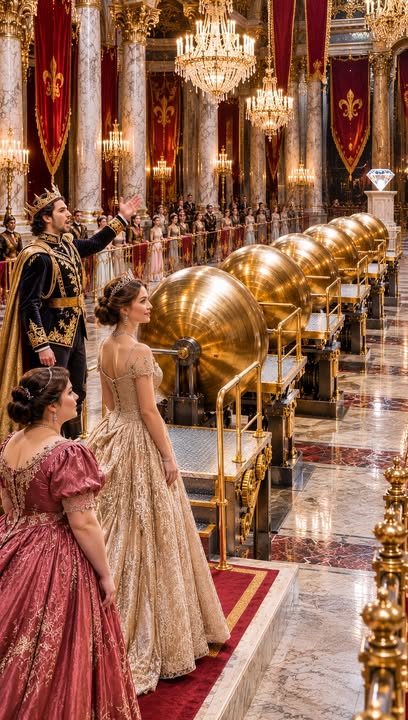
The golden structure stood at its center, but the old cushion line had been replaced with a broad, accessible approach and several stations where people could study its mechanisms.
No contest had been announced.
No prize waited at the top.
The crown rested beneath a clear cover on a nearby table, its hidden compartment open.
Beside it lay Eleanor’s note.
For the one who listens before she claims.
People gathered around the tower in small groups.
Children studied the turning panels.
A mechanic explained the pause to a pair of visiting gardeners.
Two apprentices tested a handhold they had helped design.
Mrs. Hale sat near the front beside her daughter, listening as Alexander spoke.
Tomas Vale stood nearby with one hand resting on the rail he had helped repair.
Alexander did not stand beneath a chandelier or wait for applause.
He stood beside Olivia at the entrance to the workshop.
“For many years,” he said, “this tower was described as a way to choose a winner. Today, we reopen it as a place to learn from one another.”
He turned toward Martin Hale’s family.
“The palace should have heard your father sooner. I am sorry that it did not.”
Mrs. Hale accepted his apology with a solemn nod.
“My father would have wanted the machine repaired,” she said. “He liked making things work.”
Alexander’s expression softened.
“Then we will try to honor that.”
The first bell rang.
DONG.
The tower moved a little, then paused.
This time, no one mistook the pause for a flaw.
A child reached toward the nearest handhold, but before she could begin, she looked to her mother.
“Can I try?”
“If you want to,” her mother said.
The child began, slowly, while an apprentice stayed close enough to guide her without taking the work from her hands.
At the first turn, she stopped.
She listened.
The pause came.
Then she adjusted her grip and continued.
Around her, people watched with interest, but no one counted how high she climbed.
The bells rang again, not as commands to hurry, but as signals that the machine was moving safely.
Olivia felt Alexander beside her.
“Do you remember what you were thinking when you reached the crown?” he asked.
“I was wondering why it had an arrow.”
“And now?”
“Now I think the arrow was an invitation to ask what else could turn.”
He smiled.
“I still have much to learn from you.”
“Good,” she said. “That gives us something to do.”
His laughter was quiet, but it came easily now.
They worked together through the spring and into the summer.
Their affection deepened in the unremarkable spaces between ceremonies: while they measured the new workshop tables, while they shared tea after a long day, while Alexander listened to Olivia explain why an old lift should not be hurried.
Neither of them called it a reward.
Neither of them treated it as something the other owed.
When Alexander finally asked whether she might imagine a future with him, he did so in the workshop courtyard, beside a low table they had built together.
“I’m not asking because you climbed the tower,” he said. “I’m asking because I have come to know you, and because I hope we can keep choosing one another as we learn.”
Olivia looked at him, taking her time.
“Then let’s keep choosing,” she replied. “And let’s keep building a life that leaves room for other people’s voices, too.”
He offered his hand.
She placed hers in it.
Their marriage came much later, after the workshop had become part of the palace’s ordinary life and after they had shared enough seasons to know one another in both joyful and difficult weather.
Victoria stood with them on their wedding day, no longer a rival, but a friend who had earned her place through honesty and care.
Tomas Vale attended with Mrs. Hale and her family.
The palace archivist displayed Eleanor’s original sketches beside the plans for the restored workshop.
The old golden tower stood in the courtyard, open to everyone who wished to understand how it worked.
When the bells rang, they did not announce a winner.
They sounded across the palace grounds as children, craftspeople, nobles, servants, and visitors gathered around a table full of unfinished inventions.
Olivia stood beside Alexander, their hands linked, while Victoria laughed with a group of apprentices near the repaired lift.
The tower turned once, slowly and safely, then paused.
And in that quiet space before it moved again, the palace seemed to hear what Queen Eleanor had meant all along: that the strongest things were not claimed alone, but made together.
**–THE END–PLEASE
Share your thoughts or feedback to motivate us to create more stories ♥️
* * *
[PREVIOUS: PART 5](https://storyly.idolsgift.com/blog/part-5-the-secret-beneath-the-crown-069-1)
✓ Lynn R. Adams
Part 6 – A Tower for Everyone For a moment, the great hall held its breath. Alexander looked from the note to the council members, then back to the chief steward. “Who left with him?” he asked. Th…