PART 6 (THE END): The Secret Beneath the Brace 008
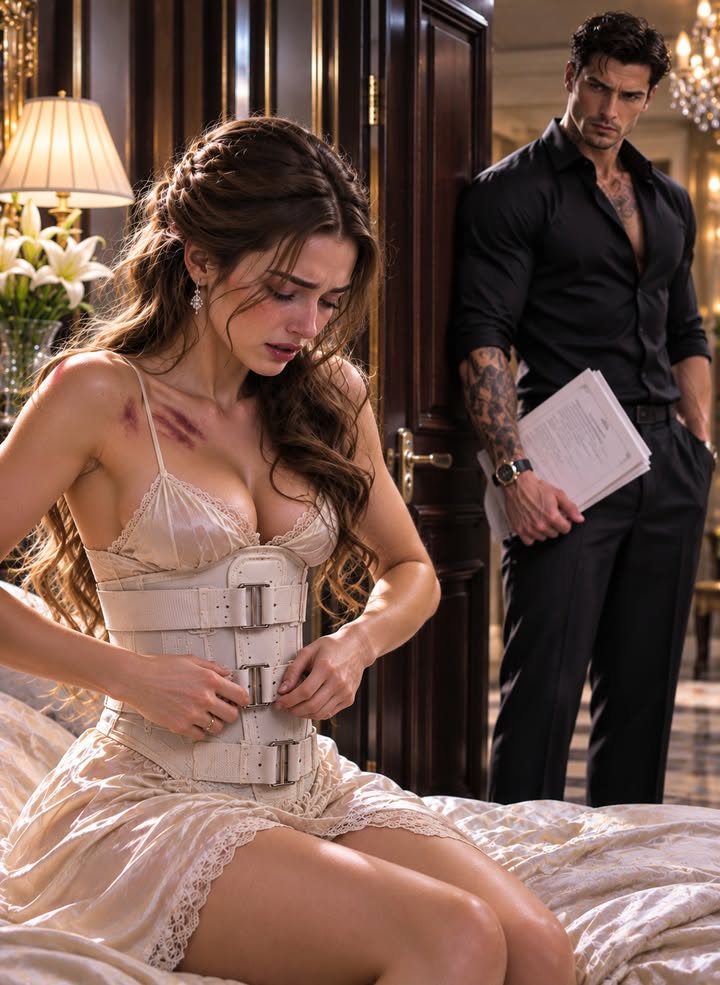
Part 6 – The Life We Chose
“They saw someone get out of the sedan after the collision and leave something near your car before the driver disappeared.”
My hand tightened around the phone.
“What did they leave?”
“A small envelope.”
Elena had gone very still across the room, her fingers resting over the brace beneath her robe.
“What was inside?” I asked.
“Your name, Dominic,” my lawyer said. “And a note saying the next message would be delivered through your wife.”
The words seemed to draw the warmth out of the room.
I looked at Elena, who was watching me, not the phone.
“Did they identify the person who left it?” I asked.
“Not yet. The witness remembers a dark coat and a cap, but the face was obscured. The envelope was collected as evidence. The note is being examined.”
“Was the message addressed to Elena?”
“No. It referred to her as the next way to reach you.”
Elena’s breath caught.
I turned away from the window, careful to keep my voice level.
“Thank you. Don’t share any information about her medical care, and don’t contact her directly without her permission.”
“Understood,” my lawyer said.
“And please tell the investigators we’ll cooperate, but we won’t be taking any steps on our own.”
“I’ll make that clear.”
When the call ended, I remained with the phone in my hand.
The old version of me would already have been reaching for names, calling people who owed me favors, trying to make the unknown smaller by surrounding it with my own certainty.
That instinct rose now, insistent and familiar.
I let it pass without obeying.
Elena watched me from the bed.
“Tell me what you’re thinking,” she said.
“I’m thinking I want to promise nothing can ever reach you again.”
“And you know you can’t promise that.”
“I know.”
“What can you promise?”
“That I won’t hide this from you, and that I’ll let the authorities do their work instead of turning fear into another private war.”
She studied my face, looking for the hidden qualification.
“Then we’ll hear what they find,” she said.
“Yes.”
“Together, if I want to be there.”
“Together, if you want.”
She nodded, and I set the phone aside.
The note had been intended to make me react, to tell me that someone knew Elena mattered to me and might use that knowledge to draw me back toward the life I was leaving.
It did not tell us who had written it.
It did not tell us whether the person behind the sedan had been acting alone or following someone else’s plan.
But the investigators now had a witness, the vehicle connection, and a trail of records that had been concealed or misplaced for reasons they still needed to establish.
For once, I did not try to fill the gaps with my own conclusions.
The meeting with the authorities took place two days later in a quiet office, with my lawyer beside me and Elena’s consent guiding what I shared about the records.
She chose not to attend.
Before I left, she asked me to tell her everything when I returned, even if the answers were incomplete.
I promised I would.
The questions focused on the old dispute, the people who might have known my movements, and the sedan connected to the temporary registration.
I answered as precisely as I could, separating what I remembered from what I suspected.
The investigators explained that they were following the evidence and would not ask me to contact anyone connected to it.
That boundary mattered.
It kept the process from becoming another expression of my old power, and it gave Elena and me room to remain a couple rather than becoming two people waiting for the next alarm.
When I returned home, I told her what had been asked and what I had answered.
“There may be more interviews,” I said. “They didn’t promise a quick conclusion.”
“I don’t need a quick one,” she replied. “I need a true one.”
So did I.
The next weeks became an exercise in patience.
The authorities traced the sedan to a chain of borrowed identities and found that it had been used by someone connected to the old criminal dispute.
The driver had followed my car, likely intending to frighten me or draw me into a response, but the evidence did not establish that Elena had been deliberately targeted.
The collision happened when the sedan accelerated on the icy road and lost control.
That did not make the danger harmless, or the driver’s choices excusable.
It did mean the accident had not been a carefully planned attempt to injure Elena.
The first record of the collision had been altered after the fact, with key pages removed from the file before it reached the specialist.
Investigators determined that Luke had not caused the collision and had not removed the pages.
He had, however, quietly contacted the hospital after learning what the officer’s report said, asking them to keep the incident information from anyone without authorization.
He believed someone connected to the dispute might search for Elena’s treatment details.
His request had been made through an administrator he knew from the old network, and that administrator had then withheld portions of the file instead of logging the request properly.
It was not the grand conspiracy Luke had feared.
It was a chain of frightened, private decisions, each made by someone who believed secrecy was safer than trust.
The missing records had made it harder to understand the collision and had given the warning on the envelope more power than it deserved.
The investigation continued, but the immediate evidence was turned over to the authorities, and the people connected to the old dispute were being handled through proper channels.
No one came to the house.
No one contacted Elena.
The threat did not vanish with a single official call, but it stopped being a mystery we were forced to carry alone.
Luke came to the house once, at Elena’s request.
He waited in the sitting room while I asked her if she was sure she wanted to speak with him.
“I want to hear him,” she said. “I don’t want you deciding whether he deserves that.”
“I won’t.”
She chose to have the conversation with me in the room, not as a guard but as the person who had also been hurt by his choices.
Luke looked older than I remembered him looking, though only a few weeks had passed.
He did not try to defend the clinic calls.
He did not ask us to understand how hard his position had been.
“I thought I could keep the danger away if I controlled what reached you,” he said. “I was wrong.”
Elena’s voice stayed quiet.
“You kept me from making decisions with the truth.”
“Yes.”
“You made Dominic’s suspicion worse.”
“Yes.”
“You knew I was frightened and still used my absences to keep him focused somewhere else.”
Luke lowered his eyes.
“Yes.”
I felt the old anger, but it no longer demanded that I decide his punishment.
It simply marked the place where trust had been broken.
“You were loyal to an idea of me,” I said. “Not to the person I was trying to become.”
Luke looked up.
“I know.”
“I don’t know if I can trust you again.”
“I understand.”
Elena rested both hands on the arms of her chair.
“I don’t need you to make this right today,” she said. “I need you to stop making choices for us.”
“I will.”
“Then begin by giving the authorities everything you know about the old dispute.”
“I already have.”
“And anything else you remember about the records.”
“I will.”
She nodded.
The conversation did not restore what had been damaged between us and Luke.
It did something more modest, and perhaps more honest: it ended the pretense that concern excused intrusion.
When he left, Elena did not ask me what I thought of him.
She asked me whether I was all right.
“I’m sad,” I said after a moment. “I thought we knew each other better than that.”
“So did I.”
“I’m angry too.”
“You’re allowed to be.”
“I don’t want the anger to make every choice for me.”
“Then don’t let it.”
She reached for my hand.
Her fingers were warm against mine, and the tenderness of it did not mean she had forgotten what had happened.
It meant she was choosing this moment, not erasing the others.
The surgery was scheduled for early spring.
In the weeks leading up to it, Elena asked questions until she understood the procedure, the risks, and the long recovery ahead.
She made the final decision with her specialist, without pressure from me and without pretending she was unafraid.
When she told me the date, I asked what she needed.
“Someone who can hear that I’m scared without trying to make the fear disappear,” she said.
“I can do that.”
“And someone who remembers I’m still the one making the decisions.”
“I can do that too.”
“Then stay close.”
“I will.”
The morning of the operation arrived beneath a pale, colorless sky.
I drove her to the hospital alone.
At the entrance, she took my hand and held it longer than she had the night I found her in the brace.
“I’m not asking you to promise everything will be fine,” she said.
“I won’t.”
“Just be here when I wake up.”
“I’ll be here.”
The operation took several hours.
I waited with my hands folded and my phone silent, reading the same page of a book without absorbing a word.
When the specialist finally came to speak with me, he said the procedure had gone as planned.
Elena was resting and would be monitored closely.
It was not a promise about the future, but it was the answer we needed for that day.
Recovery came in small measures.
The first week was a careful arrangement of pillows, medication, sleep, and movement measured one step at a time.
Elena hated needing help to sit up.
I learned to ask before reaching for her, even when I could see what she needed.
Some days, she was patient with the slow work.
Other days, pain made patience impossible.
She did not have to soften her frustration for my sake, and I did not try to turn every difficult hour into proof that she was healing.
I learned that care was not the same as control.
Sometimes it meant bringing the water she asked for and leaving the room when she wanted quiet.
Sometimes it meant sitting nearby while she decided whether to try another step.
Sometimes it meant admitting that I was frightened too.
The house changed along with us.
I dismissed the remaining people who had kept our old household arranged around my former work and brought in only the help Elena approved.
The doors stayed locked at night, but there were no men waiting outside them.
I turned over the records and names I had given the authorities, and I kept every appointment with the investigators.
Some people from my old life stopped calling.
Others asked me to return to the work I had left.
I did not answer them with threats or explanations.
I built a smaller, quieter life, one decision at a time.
At first, I was not certain who I was without the old loyalties and routines.
Then I began to discover that a day could be useful without being dangerous.
A morning could belong to a legal meeting instead of a plan.
An evening could be measured by whether Elena’s pain had eased, whether the soup had stayed warm, whether we had made each other laugh once.
It was not a smaller life than the one I had left.
It was simply a life in which I could hear the people I loved.
Elena’s strength returned slowly.
The brace remained part of her days while her body healed, and there were weeks when progress seemed to stop.
She never pretended that recovery was graceful.
She swore at the difficult exercises, laughed at the specialist’s insistence that patience counted as work, and sometimes wept when her back hurt after a good day.
I stayed beside her without telling her what those tears meant.
By the time summer came, she could stand for longer stretches.
In early autumn, with the specialist’s approval, she took her first careful steps without the brace.
She moved from the bed to the chair while the specialist watched, one hand resting lightly on the walker.
The room held its breath.
Elena reached the chair and lowered herself into it, exhausted and smiling.
I had been standing by the wall, afraid that even my hope might make her feel watched.
She looked at me.
“You can come closer,” she said.
I crossed the room.
She held out her hand, and I took it.
“I did it,” she whispered.
“You did.”
“I’m not finished.”
“No.”
“But I did it.”
“You did.”
Her smile widened, and the room seemed to fill with light that had nothing to do with the sun.
The first time she walked a short distance without support came weeks later.
The second time was steadier.
There were setbacks, but they no longer turned into a verdict on everything ahead.
Her body was learning its own strength again, and I was learning not to mistake a difficult day for a broken future.
On the anniversary of the ice-storm collision, we returned to the small garden behind our home.
The air was cold enough to sting, but the sky was clear.
Elena walked with a cane, moving at her own pace.
I stayed beside her without holding her unless she asked.
We reached the bench beneath the bare maple tree and sat together.
For a while, neither of us spoke.
Then Elena said, “I used to think if I could just get better, I could go back to the day before the crash.”
“I wanted that too.”
“But I don’t think we can go back.”
“No.”
“I don’t want to.”
I turned toward her.
She watched the last leaves move in the breeze.
“I want the marriage we make now,” she said. “Not the one we keep trying to recover.”
My throat tightened.
“So do I.”
“I want to keep telling you when I’m afraid.”
“I want you to.”
“I want you to ask instead of deciding what my silence means.”
“I will.”
“And I want to know the truth, even when it’s complicated.”
“You’ll have it.”
She looked at me then.
“Not because you think it will protect me from worrying.”
“Not because of that.”
“Because I’m your partner.”
“Because you’re my partner.”
Elena leaned her shoulder against mine.
The simple weight of her there carried more meaning than any vow we had made before the collision.
We did not return to the marriage we had before the road, the secrecy, and the months of suspicion.
That marriage had been built partly on confidence and partly on things we had assumed we could afford not to say.
We began again with fewer assumptions.
We spoke about the Tuesday appointments, the questions she had hidden, and the accusations I had mistaken for certainty.
She told me when the pain frightened her.
I told her when old fear made me want to take control.
We did not always get it right, but we stopped treating honesty as something we could postpone until the moment was convenient.
A year after the night I found her in the brace, we stood in the sunroom where she had first told me she wanted surgery.
The divorce petition was still in the desk drawer.
I had never destroyed it, and Elena had never signed it.
She asked me to bring it to the table.
I set the pages between us, the same pages that had once scattered across the floor like the ending I thought I had chosen.
Elena opened the folder, then closed it again.
“Do you still want me to have the choice?” she asked.
“Yes.”
“I know I can leave.”
“Yes.”
“I know I don’t owe you another chance because you changed your life.”
“I know.”
She reached for my hand.
“I want to stay,” she said. “Not because I’m afraid of what happens if I leave, and not because you gave up something for me.”
My breath caught.
“I want to stay because I love the person you’re trying to become, and because you let me choose him for myself.”
I held her hand carefully.
“I love you,” I said. “Not as a promise that I’ll never fail you, but as a promise that I’ll keep telling you the truth when I do.”
“That’s a better promise.”
We did not make grand plans.
We did not invite an audience or pretend the road ahead would be free of pain.
We renewed our vows in the garden, privately, with the specialist’s note of encouragement folded in Elena’s pocket and the divorce petition left unsigned in the desk.
Elena stood without the brace, her weight balanced carefully, her hand resting in mine.
When she said, “I choose you,” she did not say it as the woman who had once danced barefoot in our kitchen, or as the woman who had tried to keep me safe by carrying everything alone.
She said it as herself, with all the knowledge of what we had hidden, feared, and survived.
“I choose you too,” I answered.
The promise did not return us to the lives we had lost.
It gave us a new one to build.
Afterward, we stayed in the garden until the evening air turned cool.
Elena leaned against me, steady on her own feet, and I held her hand without pulling her closer than she wished.
The world beyond the garden remained imperfect.
There were still records to correct, people to answer to, and memories that sometimes returned without warning.
But there was no locked door between us.
When Elena looked at me, I did not search her face for evidence.
I waited for her words.
And when she spoke, I listened.
**–THE END–PLEASE
Share your thoughts or feedback to motivate us to create more stories ♥️
* * *
[PREVIOUS: PART 5](https://puretales.idolsgift.com/blog/part-5-the-secret-beneath-the-brace-008)
✓ Lynn R. Adams
Part 6 – The Life We Chose “They saw someone get out of the sedan after the collision and leave something near your car before the driver disappeared.” My hand tightened around the phone. “What did…