PART 6 (THE END): The Secret Beneath the Boat 057
Part 6 – The Work of Her Own Hands
“Can the truth be made private,” Lina asked, “without becoming another payment for silence?”
No one answered at once.
The old receipt lay between them, its paper thin from years in the sealed case.
Lina’s father had signed it to keep his family housed, not because he had changed his mind about who made the design.
The distinction mattered.
It mattered more than the money, more than the royal award, more even than what the court might say about the family that had received it.
At last Adrian spoke.
“No,” he said. “Not if privacy is being used to keep the truth from those it concerns.”
Lina’s gaze remained on the receipt.
“I don’t want a spectacle.”
“Neither do I,” he replied. “A hearing can be conducted with dignity. The records can be presented plainly, without turning anyone’s pain into entertainment.”
Lord Varrick stood very still.
“My daughter offered a private correction because I feared what a public account would do to our family,” he said. “But fear does not change what happened.”
Seraphina turned toward him.
“Father?”
He looked at her, and for the first time since Lina had met him, his composure seemed less like certainty than effort.
“I remember Elias,” he said. “I remember his drawings and how carefully he tested every measurement.”
His eyes went to the statement in Master Pell’s hands.
“I did not remember writing this. I should have.”
“Did you know the final report credited you alone?” Adrian asked.
Lord Varrick lowered his head.
“I knew the report named me as sponsor and designer. I told myself the work had been a collaboration, and that the reward would allow me to provide for the dock and for my own household.”
He paused, searching for words that would not make his choices sound better than they were.
“When the king’s office asked for a single name, I allowed mine to stand. When Elias’s credit was delayed, I did not insist that it be corrected.”
“And the payment?” Lina asked.
“I knew the palace had settled his contract,” he said. “I did not know it had been made on those terms.”
He looked again at her father’s signature.
“But I accepted the award without asking whether he had been paid fairly, and I let years pass without setting the record straight.”
It was not a complete confession to every question.
It was not an excuse.
For Lina, that mattered.
Seraphina’s eyes shone, but her voice stayed steady.
“Our family benefited from his work.”
“Yes,” her father said.
“And from his silence.”
“Yes.”
The simple answers seemed to cost him more than a polished apology could have.
Lina looked at Seraphina.
“You don’t have to answer for what your father chose.”
“I know,” Seraphina said. “But I do have to decide what I will do with what I know.”
She turned to the prince.
“I will testify to the records and support a public correction.”
Lord Varrick met her gaze.
“I had hoped to protect you from this.”
“You can’t protect me by asking me to pretend I never learned it.”
Her father nodded slowly.
“No,” he said. “I cannot.”
Master Pell placed the receipt, the king’s instruction, and the engineering ledger together in a careful arrangement.
“The evidence is sufficient to establish that Elias Vale designed the pulley-and-roller method, that Lord Varrick presented it under his own name, and that Elias’s promised credit was never given,” he said.
“There may still be questions about the payment and the family debt,” Adrian replied. “Those must be investigated separately.”
Lina looked at the little note again.
Her father had left it among her sketches, hidden in a box she had kept through every move and every narrow room.
Keep this safe until the truth is ready to be heard.
She had thought the words meant that he wanted her to preserve his drawings.
Now she understood that he had trusted the future to find its way toward them.
“I want the court to hear it,” she said.
The fear remained in her, but it no longer stood between her and the choice.
“I want my father’s name restored where the kingdom can see it. I want the records corrected, and I want the full debt investigated, not only the part the Varricks are willing to repay privately.”
Adrian gave a solemn nod.
“Then that is what we will do.”
“I may lose whatever chance I had of becoming queen.”
The words made Seraphina look at her, startled.
Lina had almost forgotten the contest beside the lake, the rules that had turned a boat into a test of suitability and a maid into a possible future bride.
Adrian did not dismiss her fear.
“I will not make you a queen as a reward for choosing what is right,” he said. “And I will not ask you to stay silent in exchange for any promise.”
Lina met his eyes.
“Thank you.”
The hearing was held two days later in the palace council chamber.
It was not a grand spectacle, though the room was full.
The royal household’s officials sat beside the archivists, and a small number of court representatives attended to witness the correction.
Lina stood with her mother at her side.
Her mother wore the dark blue dress she had kept for important occasions, mended carefully at the cuffs.
The wooden box rested on the table before them, its familiar weight somehow steadier than the great chamber around it.
The prince sat among the council rather than at its head.
He had insisted that the hearing be led by the senior royal magistrate, so no one could say he had decided the matter alone.
Master Pell presented the records in order.
First came the work ledger, where Elias Vale’s name appeared beside the initial drawings and measurements.
Then came the engineering register, describing the pulley above the bank and the rollers beneath the boat’s keel.
The boat sketch Lina had carried since childhood was compared with the surviving notation in the records.
The dock tokens were shown, each stamped with the royal emblem and her father’s name.
Last came the statement Lord Varrick had written, acknowledging Elias’s design and promising that his contribution would receive separate payment and public credit.
The promise had been witnessed by the late king.
Lord Varrick spoke next.
He did not claim that time had made the report correct, or that he had earned an award that belonged entirely to him.
He said that he had accepted credit he should have shared, failed to insist that Elias receive the recognition promised, and allowed the correction to remain undone.
Seraphina confirmed that the family had long repeated the account that her father alone devised the method.
“I believed it because my father told it that way,” she said. “Now that I know more, I cannot continue telling it as if the records said nothing.”
No one applauded.
No one jeered.
The room listened, and that quiet felt more respectful than either.
Lina spoke last.
She explained that her father had drawn the design so workmen could move heavy boats without hauling them through the mud.
She told them how she had watched dockworkers use tools after her duties were done, and how the shape of her childhood sketch had returned to her beside the lake.
She did not ask the court to admire her.
She did not describe the hardship of her family as though it were a performance.
She spoke of what had happened, and of what must be made right.
“I want his name restored because he earned the credit,” she said. “I want the debt investigated because it shaped our lives. And I want the record to say that the palace accepted his work and then failed to honor its promise.”
The senior magistrate thanked her.
He announced that the archive would be corrected, that the royal award’s record would be revised, and that an independent review of the original payment and the Vale family’s debt would begin.
The palace would repay any sum found to have been wrongly charged to Lina’s family, along with the costs their household had borne in trying to challenge the account.
The crown would also publish the corrected history of the dock design and recognize Elias Vale as its principal inventor.
Adrian rose only after the decision had been entered into the official record.
“On behalf of the crown,” he said, “I regret that our own offices allowed this wrong to endure. We cannot return the years it took from Elias or his family, but we can correct the record, repay what was owed, and make certain the truth is not left in a sealed box again.”
Lina looked at her mother.
Her mother’s hand rested over hers on the table.
It was not triumph that filled Lina’s chest.
It was grief, relief, and a strange, tender sense that her father had become present in the room without needing to be brought back from the past.
After the hearing, Lord Varrick approached them in the chamber’s quiet side gallery.
He kept several respectful steps between himself and Lina.
“I cannot ask you to forgive me,” he said. “I can only tell you that I am sorry.”
Lina studied his face.
She could see no easy way to answer.
“I hope you help make the correction last,” she said.
“I will.”
Seraphina came to stand beside him.
“My family will return the award that was given for the design,” she said. “The review will determine the rest, but we will not contest it.”
Her father nodded.
“We will also fund the restoration of the dockworkers’ old workshop.”
Seraphina glanced toward Lina.
“If that is useful to you.”
“It might be,” Lina said. “If the workshop welcomes people who have never had the chance to study.”
“Then it will.”
Seraphina did not ask Lina to call them friends, nor did Lina offer a forgiveness she was not ready to give.
But when Seraphina held out her hand, Lina took it.
Their clasp was brief and sincere.
The weeks that followed brought changes that were less dramatic than the hearing and more demanding.
Master Pell corrected the royal registers and placed a copy of Elias’s design beside the archive’s account of the dock improvement.
The wooden boat remained ashore while the workers examined its old timbers.
Beneath the loose floorboard, the two brass tokens were stored together, their matching emblems and names carefully documented.
One was returned to Lina’s keeping.
The other remained in the archive with a note explaining where it had been found.
The review of the family accounts took longer.
When the findings were complete, the crown repaid the debt that had been wrongly attached to Lina’s family, including the charges they had incurred while seeking to challenge the original record.
The sum did not make them wealthy.
It gave her mother enough to repair their roof, clear the remaining obligations, and stop counting every candle as though it might be the last.
Her mother kept one small portion aside.
“For your studies,” she told Lina.
“I thought I would save it for you,” Lina said.
“I am saving it for your future.”
The prince made no immediate offer of a title, a wedding, or a place at court.
Instead, he asked Lina whether she wished to apply to the royal engineering school that had recently opened its doors to students beyond the old guild families.
“The admission examination is difficult,” he told her. “You would be judged on the same work as everyone else.”
“That is what I want,” Lina replied.
She sat the entrance examinations with her hands shaking and her mind clear.
Her years of watching dockworkers had taught her to observe.
Her sketches had taught her to imagine.
The problems on the examination page asked for both.
When the results were posted, Lina found her name among the successful applicants.
She read it once, then again, scarcely believing that a line in a public register could hold so much possibility.
Her mother hugged her in the street outside the school.
“You did this,” her mother whispered.
“We did,” Lina said, and thought of her father.
Seraphina began working with the palace archivist on the records of royal commissions.
She found that she had a patient mind for the careful details that others overlooked.
Her family’s influence did not vanish, but its meaning changed.
The Varricks returned the portion of the award that belonged to the crown and helped fund a workshop where palace workers could learn safer methods of hauling, lifting, and repair.
Seraphina attended its opening without jewels or an announcement.
She stood beside the dockworkers and listened while they explained which tools needed improving.
“I used to think leadership meant being the person everyone looked at,” she told Lina one afternoon. “Now I think it may mean noticing who has been doing the work all along.”
Lina smiled.
“That sounds like a good place to begin.”
Her studies were demanding.
She learned geometry, material strength, water engineering, and the patient art of testing an idea rather than trusting it merely because it looked elegant on paper.
Some days she missed the quiet familiarity of palace service.
Other days, when a calculation finally made sense or a model lifted a weight exactly as intended, she felt the joy she had once allowed herself to imagine only in secret.
The prince visited the school occasionally, but he never arrived with an entourage that would make her feel like an exhibit.
He asked about her work.
She asked about the dock repairs.
They spoke as two people learning how to know each other without allowing the court to answer for them.
The question of marriage waited between them, not as a bargain or a prize, but as something they had not yet asked of one another.
By the time Lina completed her studies, she had designed a safer loading frame for the royal harbor and helped establish a training program for apprentices from working families.
Her first finished design was not a grand invention.
It was a practical lifting platform that spared dockworkers from carrying heavy loads up steep ramps.
When the workers used it for the first time, they tested it carefully, just as her father would have.
Then the oldest among them looked at Lina and said, “Your father would have been proud.”
For a moment, all she could do was hold the edge of the platform and feel the strength of the timber beneath her palms.
“I hope so,” she said.
“He would,” the worker replied. “I knew him.”
The words opened a door in her memory.
“You worked with him?”
“A little. He had a way of asking what the weight was doing before he asked what a person could carry.”
Lina smiled through the ache in her throat.
“That sounds like him.”
The worker rested one hand against the new frame.
“He wanted the work to be safer for everyone.”
“Then we’ll keep making it so.”
Years after the boat contest, Lina returned to the palace by choice.
She did not come back as a maid, nor as someone summoned by royal favor.
She came as an engineer to open the first of the new workshops established by the prince and the royal dockworkers.
Its wide doors stood open to the courtyard.
Inside were benches for drawing, sturdy tools for building, and windows placed high enough to let in the afternoon sun.
Above the entry hung a simple plaque:
The Elias Vale Workshop.
Beneath his name, a second line read:
For all who have an idea worth testing.
Lina ran her fingers over the carved letters.
Her father’s name had once been faintly stamped into brass and hidden beneath a boat’s floorboard.
Now it stood where anyone could see it.
The prince waited beside her, no crown upon his head, his black-and-gold coat plain and unadorned.
“I thought the old boat should be here today,” he said.
She turned.
The restored oak rowboat rested outside the workshop, supported by a new cradle built on rollers.
The crown and dockworkers had agreed it should remain on land as a teaching piece, not a trophy.
Its old blue stripe had been carefully renewed.
The floorboard beneath which the token was found had been left in place, its edge marked with a small brass plate recording the discovery.
Lina laughed softly.
“It looks smaller than I remember.”
“The boat is no heavier,” Adrian said. “You have become stronger.”
“Not because I can pull more.”
“Because you know where the weight rests.”
She looked at him.
He had remembered.
They walked through the workshop together while young apprentices gathered near the tables.
Among them were the children of dockworkers, farm laborers, shopkeepers, and servants.
Each had come with a different reason for wanting to learn.
Lina spoke to them about drawing what they noticed, testing what they imagined, and never mistaking a title for proof of understanding.
She told them that a good design should make difficult work safer and leave people with more strength for the rest of their lives.
When the workshop doors opened fully, the apprentices streamed inside.
Seraphina stood near the entrance, speaking with one of the dockworkers.
She had kept her promise to help make the workshop accessible, and the records office she led now included trained assistants from families who had never before worked in the royal archive.
When she saw Lina watching, she lifted a hand.
Lina returned the gesture.
There was affection between them now, built slowly and honestly, without requiring either woman to forget what had happened.
Later, as the afternoon light turned gold across the lake, Adrian found Lina beside the old boat.
“I have been wanting to ask you something,” he said.
She waited.
“I love your courage,” he said. “I love the way you see the problem beneath the problem, and the way you make room for other people’s ideas.”
His voice held no royal command.
“I also love you. But I do not want the court, the crown, or our history to decide your answer for you.”
Lina looked at the boat, its restored hull resting on the rollers her father had designed.
“I used to think being asked to become queen would mean I had finally escaped the life I was given,” she said.
“And now?”
“Now I know I do not want to be chosen as a reward for surviving it.”
“You never were a reward.”
“I know.”
She turned to him.
“If I choose you, it will be because I want the life we build together. And I will keep working.”
“I would expect nothing less.”
“You will have to listen when I tell you a design is wrong.”
“I will try.”
“You will have to listen when I tell you a royal decree is wrong, too.”
“That may be harder.”
Lina laughed.
“Then you will have more practice.”
His smile warmed.
She took his hand, not because the court expected it, and not because the story of the boat demanded it, but because she wanted to.
They married in a small ceremony by the lake, surrounded by the workers who had taught Lina, the family who had stood beside her, the students who would carry her father’s work forward, and the court that had finally learned to listen.
Her mother walked with her beneath the open sky.
Seraphina stood among the witnesses, a quiet smile on her face.
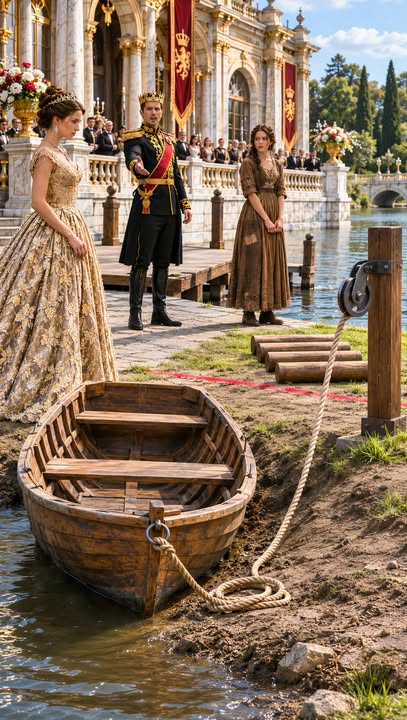
When Lina and Adrian exchanged their vows, the boat rested nearby on its wooden rollers.
It was no longer a test of who could pull hardest.
It was a reminder that a great weight could be moved when people understood where it rested, shared the work, and refused to let one person’s effort disappear beneath another’s name.
Afterward, the newly married pair entered the workshop together.
The first apprentices were already setting out pencils and measuring cords.
Lina paused at the doorway, listening to their voices rise beneath the high windows.
For years, she had carried her father’s drawings in a box, certain they were all that remained.
Now his work lived in the hands of people who had only just begun to imagine what they might build.
She stepped into the room.
The future was not a prize waiting at the end of a contest.
It was something they would make, together, one careful design at a time.
**–THE END–PLEASE
Share your thoughts or feedback to motivate us to create more stories ♥️
* * *
[PREVIOUS: PART 5](https://storyly.idolsgift.com/blog/part-5-the-secret-beneath-the-boat-057)
✓ Lynn R. Adams
Part 6 – The Work of Her Own Hands “Can the truth be made private,” Lina asked, “without becoming another payment for silence?” No one answered at once. The old receipt lay between them, its paper …