PART 6 (THE END): The Secret Beneath the Blue Cloth 052
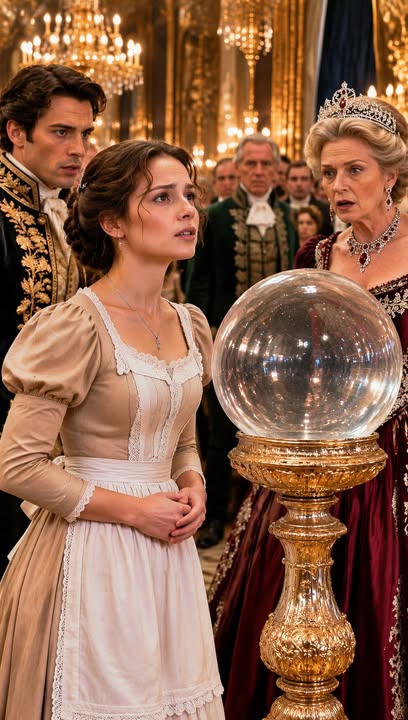
Part 6 – A Future Chosen
The nurse’s message was only one sentence.
“Richard, the courtier has discovered the child is alive.”
Elia read it again, tracing the worn letters with her eyes.
The words were hurried, the ink faded, but the hand was unmistakably the same as the writing on the note.
Margaret sat close beside her, one hand resting over Elia’s, while the candlelight trembled across the blue cloth.
“Then someone knew you were alive,” Margaret whispered.
“Someone knew I had been found,” Elia replied.
She looked at the note’s seal, so small and fragile after all those years.
“And the nurse trusted Richard enough to warn him.”
A quiet knock came at the door.
Richard entered only after Margaret invited him in, and stopped when he saw the opened envelope.
His gaze settled on the message.
For a long moment, he did not speak.
“I remember receiving this,” he said at last.
Eleanor, who had followed him down the corridor, went still in the doorway.
“You received it?”
“Yes.”
“Why did you not tell us?”
Richard’s eyes remained on the note.
“Because it arrived after the nurse had disappeared, and I believed the courtier’s people might be watching every message that reached me.”
“You could have shown it to me later,” Eleanor said.
“I should have.”
“Did you think the courtier had taken the child?”
“I thought he knew the child was alive, and I feared that any action I took openly would lead him to her.”
Elia lifted her eyes from the paper.
“Did the message say where the nurse had gone?”
“No.”
“Did it tell you what to do?”
“Only to keep the child safe.”
Richard’s voice was rough with age and regret.
“I understood that to mean I should not bring you back to the palace until I knew the danger had passed.”
“And you never knew?”
“I convinced myself that the danger had passed when the courtier died,” Richard said.
“By then, so many years had gone by that I feared any search would bring old questions back to the surface.”
Elia turned the note over.
There was nothing on the back, only a faint crease where it had been folded.
“Did you know the nurse survived?”
“No.”
“Did you look for her?”
“I searched for months. I found no trace.”
“Then you did not know what happened after she left me with Margaret.”
“No,” he said. “I knew only that you were hidden, and that someone had once tried to find you.”
Margaret glanced at him.
“You knew she was safe with me?”
“I learned that she had reached a cottage beyond the old east road. I did not know whose cottage it was until years later, when I found a list of households the courtier’s servants had questioned.”
“Why didn’t you come?”
“I thought the safest thing I could do was leave you where you were.”
He looked at Elia, not asking her to accept the answer.
“I was wrong to decide that without telling you.”
The queen’s face held both sorrow and anger, but she did not interrupt.
Elia folded the note carefully.
The message did not make the past simple.
It did not explain every silence, nor make the years of uncertainty disappear.
But it offered something the damaged accusations had not: a reason the nurse had fled, and a reason Richard had helped her.
“You were not trying to send me away from the palace because you thought I had no place here,” Elia said.
“No,” Richard replied. “I was afraid that the palace was what put you in danger.”
“And you thought keeping the truth from me would protect me.”
“I did.”
“It protected me from one danger and left me without another kind of truth.”
Richard lowered his head.
“Yes.”
Elia looked to Margaret, whose fingers had not left hers.
“I think that is something we will have to remember,” she said.
Margaret nodded.
“Love can make people afraid,” she replied. “And fear can make them think silence is kindness.”
The room was quiet except for the fire in the grate.
Eleanor stepped closer, but kept a respectful distance from the table.
“The council must hear this,” she said. “The note, the cloth, the pendant, and Richard’s account together may finally tell us what happened.”
Richard drew a breath.
“I will tell them everything.”
“Not because I command it,” Eleanor said.
“Because it is time,” he answered.
The next morning, the royal council gathered once more in the long chamber.
This time, Elia did not enter as a servant brought in by chance or as an answer the crystal sphere had claimed to provide.
She entered beside Margaret, carrying the small box herself.
The councilors rose when Eleanor came in, and then rose again when they understood that Elia had chosen to walk into the room without being summoned.
The royal archivist examined the seal on the nurse’s letter and compared it with the seal on the earlier note.
He found them consistent with the royal nursery records.
The faded writing, the blue cloth, and the pendant belonged to the same period and to the same household.
Margaret gave her account plainly, explaining how she had found Elia, what she had kept, and why she had hidden the note when strangers began asking questions.
She did not embellish what she remembered, and she did not pretend to know more than she did.
Then Richard stood.
He spoke of the letters that had revealed a courtier’s attempt to manipulate the royal household during the king’s illness.
He told them how the nurse had come to him with evidence, how the child had been carried from the palace, and how he had helped the nurse reach the eastern road.
He described the wound on his hand and the blood that had marked the document.
He admitted that he had withheld the truth from Eleanor, and that his silence had allowed suspicion to grow where explanation should have been.
“I thought I could keep danger away by keeping the truth hidden,” he said.
“I was afraid that speaking would expose the child, but I also feared what the truth would reveal about my own failure.”
He looked at the queen.
“I should have trusted you with that fear.”
Eleanor’s expression was pained, but she did not look away.
“Your silence cost us years,” she said.
“I know.”
“You cannot return those years.”
“No.”
“But you can stop hiding the truth now.”
“I will.”
The councilors asked their questions.
The archivist explained the limits of what the documents could prove, and the physician described the family resemblance as a supporting detail rather than a certainty.
No single piece of evidence settled the matter.
Together, however, the pendant made for the queen’s infant daughter, the nursery seal, the royal cloth, Margaret’s testimony, the nurse’s message, and Richard’s confession formed a consistent account.
At last Lord Pembroke rose.
“The council recognizes Elia Bennett as the daughter of Queen Eleanor and the late king, Princess Elia of Valmont.”
The words reached her slowly.
She felt Margaret’s hand close around hers.
Eleanor’s eyes filled, but she did not cross the room until Elia moved toward her.
Then the queen gathered her daughter into her arms.
She held Elia gently, as if she still feared that any sudden movement might make her vanish.
“I am sorry,” Eleanor whispered.
“I am sorry for the years I could not give you, and for every day you wondered where you came from.”
Elia’s face pressed against the queen’s shoulder.
“I didn’t know I was missing you.”
“No,” Eleanor said, her voice trembling. “You were too small to know.”
“I had a mother who loved me.”
“I know.”
Eleanor drew back enough to look into her face.
“I will never ask you to love Margaret less so that you can love me.”
Elia reached for the queen’s hand.
“I don’t know how to be a princess yet.”
“You needn’t learn all at once.”
“And I don’t know what to call you.”
“Then call me Eleanor until you are ready for something else.”
Elia nodded.
The name felt like a door left open, not a demand.
Across the chamber, Margaret wiped her eyes with the edge of her sleeve.
The queen turned toward her.
“Mrs. Bennett, I have no words worthy of what you gave my daughter.”
“I gave her what I had,” Margaret said.
“You gave her a home, a childhood, and a place to belong.”
“She gave those things to me as well.”
Eleanor stepped toward her.
“If you will allow it, I would like the court to honor you for raising Elia.”
Margaret’s gaze moved to Elia.
“I do not need a title.”
“Then I will give you no title you do not want,” the queen replied.
“But I will make certain no one forgets that Elia’s life was entrusted to you, and that you loved her as your own.”
Margaret’s chin trembled.
“That is all I could ask.”
The councilors approved an official record of the findings, and the royal archivist placed the documents in a secure case, with Margaret’s consent and Elia’s permission.
The crystal sphere was not included.
It remained on its pedestal in the ballroom, where servants had covered it with a soft cloth after the ceremony.
Later, Elia asked the queen to have it moved from the center of the hall.
“Not because it did anything wrong,” she said.
“But because I don’t want it deciding what people believe about me.”
Eleanor considered this, then agreed.
The sphere was placed in the royal collection, no longer displayed as an oracle or a promise.
It became a reminder that strange events could begin a question, but could not answer it for the people who had to live with the truth.
Richard spoke before the council once more, taking responsibility for his silence in the same room where he had once hidden behind it.
He did not ask for forgiveness.
He asked only that the record show what he had done, and what he had failed to do.
Eleanor did not restore the easy closeness they had shared in younger years.
Trust, she told him, could not be summoned by a confession.
It would have to be built again through patience and honesty.
Richard accepted that.
In the weeks that followed, he began visiting the queen only when invited, and he answered every question she asked without turning away.
Elia watched them learn a new way to speak to one another.
It was not reconciliation without pain.
It was something quieter and more believable: two people choosing not to let old hurt decide every conversation that remained.
Margaret was given rooms in the palace whenever she wished to stay, but she never surrendered her cottage.
She returned to it often, and Elia went with her whenever the royal duties allowed.
The first time they walked through the cottage door after the council’s decision, Margaret set a kettle on the stove and asked whether Elia still liked honey in her tea.
“I always did,” Elia said.
“I know.”
The ordinary words made Elia smile more than any royal welcome could have done.
At the palace, she learned the names of the household, the old customs, and the responsibilities that would one day come with her position.
She did not learn them all at once.
Some mornings she sat with Eleanor over letters and records.
Some afternoons she helped Margaret in the garden, where no one cared whether she held a title.
The court slowly learned to address her as Princess Elia.
Margaret continued to call her her girl.
Elia kept both names.
Alexander never asked her to make the crystal’s choice his.
He remained beside her at public gatherings, but never in front of her.
When the council raised the succession again, he told them he would not use an engagement to settle a question that had already been answered by evidence.
Elia was grateful, though she did not confuse gratitude with love.
Their friendship grew through smaller things.
They spoke in the library after the council had left, walked in the garden without an audience, and learned what made each other laugh.
Alexander listened when Elia spoke of Margaret’s cottage, and Elia listened when he admitted that he had never wanted the sphere to choose his future for him.
Months passed before he asked her whether she might wish to share a walk beyond the palace grounds.
“Not as a prince asking a princess,” he said.
“Only as Alexander asking Elia.”
She looked at him for a long moment.
“And what happens if I say no?”
“Then I will thank you for an honest answer and walk back alone.”
“And if I say yes?”
“Then I will be glad to have your company.”
Elia smiled.
“I would like to go.”
They walked beneath bare trees at the edge of the royal estate, where the autumn air smelled of wet leaves and distant woodsmoke.
They did not speak of marriage or the succession.
They spoke of books, of music, of the strange quiet that followed a great discovery, and of all the ordinary things they had not known to ask each other before.
Their affection did not arrive as a royal decree or a shining pattern in crystal.
It grew, carefully and freely, from attention, respect, and the ease of being seen as oneself.
One year after the night of the ceremony, the palace held a celebration for Elia’s return to the family.
The guests gathered in the same ballroom, beneath the same chandeliers, but the sphere stood no longer on its pedestal.
In its place rested a vase of roses from Margaret’s garden.
Elia wore a gown of deep blue, chosen with Margaret’s help and trimmed with a narrow line of silver thread.
At her throat lay the little rose pendant.
The sapphire caught the candlelight whenever she moved.
Eleanor stood at her side, her hand resting lightly on Elia’s arm.
Margaret stood on the other side, wearing a simple dress and looking slightly overwhelmed by the attention.
The queen leaned toward her.
“Would you like to escape to the garden?”
Margaret glanced at the guests, then at Elia.
“Not yet,” she said. “I want to see her dance.”
Alexander approached, and bowed to Elia.
“May I have this dance?”
“Are you asking because the council expects it?”
“No.”
“Because the sphere once glowed?”
“No.”
“Then yes.”
He offered his hand, and she took it.
As they moved across the floor, the guests watched, but Elia no longer felt their eyes deciding who she was.
She was the daughter of Eleanor, the beloved girl Margaret had raised, and the young woman who had chosen to stand in the ballroom as herself.
When the music ended, Alexander did not ask for a promise.
He only kept hold of her hand until she chose to let go.
Elia looked toward Margaret and Eleanor, who stood together beneath the chandeliers.
For a moment, she saw not the years lost but the love that had survived them.
Her family was not one simple story.
It was a collection of people who had loved imperfectly, made mistakes, kept secrets, and finally learned to tell the truth.
The silver pendant rested against her heart.
The crystal sphere was silent in another room.
And Elia, no longer waiting for destiny to name her, stepped into the future by her own choice.
**–THE END–PLEASE
Share your thoughts or feedback to motivate us to create more stories ♥️
* * *
[PREVIOUS: PART 5](https://storyly.idolsgift.com/blog/part-5-the-secret-beneath-the-blue-cloth-052)
✓ Lynn R. Adams
Part 6 – A Future Chosen The nurse’s message was only one sentence. “Richard, the courtier has discovered the child is alive.” Elia read it again, tracing the worn letters with her eyes. The words…