PART 6 (THE END): The Secret Behind “Welcome Back” 047
Part 6 – The Work We Leave Behind
Richard read the line again, his face drawn with the effort of holding himself still.
Marcus had already read it once, but the words seemed to deepen as they waited for the rest.
Richard, if you are reading this, then the Phantom has finally brought you back to the truth—and there is one more thing I need you to know.
“May I?” Richard asked, his voice barely above a whisper.
Nora passed him the page.
He held it by the edges, careful not to smudge the pencil, and read the rest in silence.
When he finished, he set the letter down between the unsigned transfer and David’s earlier note.
“What does it say?” Marcus asked.
Richard looked at him.
“Your father wrote that he knew the transfer had never been signed,” he said. “He says he left the Phantom here only under the display agreement, because he still believed I would make sure it was safe.”
The showroom seemed to quiet around them.
“He knew the car was here?” Elena asked.
“Yes. He says he visited once, after I had taken over the dealership, but he left before I arrived.”
Marcus’s gaze moved to the page.
“Why didn’t he contact me?”
“He writes that he meant to,” Richard replied. “He says he wanted to speak with me first, but he kept putting it off. He thought there would be another day when he could explain what happened between us.”
The phrase another day settled softly and painfully in Marcus’s chest.
Richard lowered his eyes to the letter.
“He says he was afraid I would hear his silence as an accusation. He knew he had left me with one, but he didn’t know how to undo it without asking me to carry the truth he had taken from me.”
Nora stood beside the table, her own hands folded around the empty envelope.
“I kept the transfer copy because I was afraid the unsigned page would be replaced or lost,” she said. “I didn’t know what the history was. I only knew no one could show me a completed transfer.”
Elena nodded.
“You did the right thing by preserving it.”
Nora’s eyes flicked to Richard.
“I could have pushed harder.”
“You did,” Richard said. “You raised the discrepancy, followed up, and kept a copy when you were told it had been handled.”
“I still left.”
“You had every right to leave.”
“I thought if I stayed, I might get someone to look at it.”
Richard took in a slow breath.
“I’m sorry I didn’t make it possible for you to do your job properly.”
The apology was not grand, and it did not ask Nora to comfort him.
She held his gaze for a moment, then nodded.
“Thank you for saying that.”
Elena arranged the unsigned transfer, the display agreement, and David’s letter side by side.
“The records now establish that the Phantom was never transferred to the dealership,” she said. “The display authorization remained the only valid agreement. The signature line is blank, and we have the original ownership documents confirming Marcus’s title.”
Richard looked down at the papers.
“And the note about the warning?”
“Nora’s report was routed to Graham Voss,” Elena said. “We’ll need to confirm what happened after that, but his statement that the ownership transfer had been cleared was unsupported. The records suggest the distinction between the dealership’s acquisition and the car’s ownership was concealed during the transition.”
“By Voss?”
“We can’t say that conclusively until we speak with him and review the complete correspondence.”
Richard nodded.
“I’ll make myself available.”
Nora slid the envelope toward Elena.
“There are also two emails I printed before I left,” she said. “One is from Graham. He says the Phantom was ‘covered under the transition understanding.’ The other is my reply asking for the signed title document.”
Elena read them carefully, then looked up.
“This will help establish the timeline.”
Richard’s expression remained troubled, but something had changed in it.
The uncertainty had not disappeared, yet it no longer seemed to be pressing him toward escape.
He was beginning to understand that the truth could be painful without being an invitation to surrender.
The following weeks brought no single dramatic revelation, but a steady accumulation of answers.
Nora met with Elena and the independent investigators, bringing her old notes and describing each time she had asked for proof of the transfer.
The investigators interviewed Graham Voss, reviewed the transition emails, and found that he had known the Phantom’s title was unresolved.
He had assured others that it would be settled later, then recorded the vehicle in internal inventory notes as a dealership asset without a signed transfer.
He had not created the original display agreement, and he had not sold the car, but his assurances had kept the discrepancy from receiving the scrutiny it needed.
Richard’s office had received an index entry noting that the matter should not proceed without signed confirmation, but there was no evidence Richard had personally seen it.
The review concluded that he had relied too heavily on the transition team and failed to verify the title before treating the Phantom as part of the dealership’s inventory.
It also found that no one at Sterling Crown had advertised the car for sale or attempted to transfer it to a buyer.
The dealership had failed to protect a boundary it had never been entitled to cross, but the evidence did not support the claim that Richard had knowingly stolen the prototype.
That distinction mattered.
So did the fact that he had humiliated Marcus before asking a single question.
The independent review of the old test accident took longer.
Marcus opened his father’s storage unit with Elena beside him, and together they sorted through boxes marked in David’s careful handwriting.
They found the original controller logs, test notes, and the full follow-up review Richard had never seen.
The files confirmed that the authentication module had behaved as designed.
The failure began in the integration layer Richard had created, where an emergency signal had not returned control correctly after the system entered a protective state.
The defect had been real, but it had involved the whole development process: testing that had not gone far enough, a system released under pressure, and leaders who had allowed fear of financial collapse to shape the conclusions.
David had accepted responsibility for his part in the work, then taken on more than his share when the company seemed unable to survive another accusation.
Richard had not asked him to do it.
He had not understood the full sacrifice.
But he had accepted its benefits, and he had failed to seek the whole truth afterward.
When the findings were complete, Richard read them in a quiet conference room at Sterling Crown.
He sat for a long time with the report open before him.
“I spent years believing he blamed me,” he said.
Marcus sat across from him.
“He might have been angry with you.”
“I know.”
“He also protected you.”
“I know that now.”
Richard’s voice held no attempt to turn that knowledge into an excuse.
“I let my fear tell me what he meant,” he said. “Then I used the story I had made up to stay away.”
Marcus looked through the glass wall into the showroom, where the Phantom stood behind a simple rope barrier.
“You can’t give those years back.”
“No.”
“But you can decide what you do with the truth now.”
Richard looked at the report.
“That’s what David would have wanted.”
“Maybe.”
Marcus had learned not to use his father’s wishes as a way to make difficult decisions seem easy.
David’s letter had not asked Marcus to excuse Richard, nor to keep the past quiet.
It had asked him to make room for the truth and judge what came afterward.
Richard turned a page.
“I’ll make my statement to the board,” he said. “All of it.”
“And accept their decision?”
“Yes.”
A week later, Richard stood before Sterling Crown’s employees in the service bay, beneath the old workshop photographs Emily had helped restore.
He did not speak from behind his office desk.
He stood among the people whose work depended on the dealership’s future and told them what the investigation had found.
He explained that the Phantom had been entrusted to the dealership for display, not transferred as property.
He explained that the transition manager had misrepresented the status of the paperwork and that the business had failed to verify the title before listing the car internally.
He told them that the review had not found evidence that he knowingly tried to steal or sell the prototype.
Then he told them about Marcus.
“I judged him by his clothes and by the assumptions I carried into the room,” Richard said. “I ordered security to restrain him instead of listening. That was wrong, whether or not I knew who he was, and whether or not the ownership records had been clear.”
His eyes moved to Marcus and then to Emily.
“I also failed to hear employees who tried to bring concerns forward. A business does not become fair because it says the right things in a meeting. It becomes fair when people can raise a problem without being ignored or punished for raising it.”
No one applauded.
No one had been asked to.
The silence held the weight of the words without making them into a performance.
The board required Richard to step down as managing owner while the dealership entered a period of independent oversight.
He cooperated with the transition, provided his records, and agreed to remain available to the investigators.
The board considered selling Sterling Crown, but the independent review found that the dealership could continue operating without the Phantom and without shielding anyone from the findings.
Its staff would not be made to pay for mistakes they had not made.
Richard’s departure from the day-to-day role was still a consequence.
So was the loss of authority he had once treated as proof that he was right.
He accepted both without demanding that anyone call him brave for doing so.
The dealership adopted a new customer policy that required employees to offer the same welcome and assistance regardless of how a visitor was dressed or what kind of car they drove.
It established an independent reporting line for staff, with written protections against retaliation.
Every vehicle file was audited, and managers had to verify title records before advertising or accepting a deposit.
The changes were not presented as a fresh start that erased the past.
They were built as a response to it.
Emily helped draft the customer policy with Elena and a small group of employees.
She included a simple instruction that became the first line of the new training: Ask what brings someone in before deciding what they can afford.
The first time she read it aloud in the showroom, her voice wavered.
The second time, it did not.
Richard apologized to Emily in private, not at a meeting and not in a way that asked her to reassure him.
“I dismissed you when you tried to speak,” he said. “Then I relied on the fact that you stayed quiet afterward, instead of asking why you had stopped.”
Emily listened, her hands resting flat on the table between them.
“I was afraid of losing my job,” she said. “And I was afraid that if I pushed too hard, people would decide I was difficult.”
“You should never have had to choose between speaking honestly and keeping your job.”
“No,” she said. “I shouldn’t.”
“I’m sorry.”
She held his gaze.
“I hear you.”
It was not forgiveness offered on command.
It was an acknowledgment that the apology had been made and would have to prove itself through what followed.
Richard accepted that too.
He apologized to the guards, acknowledging that his order had placed them in an ugly position and that they were still responsible for their own conduct.
The review found that one had been rougher than necessary while attempting to restrain Marcus, while the other had followed the instruction more cautiously and had stepped back as soon as the order was withdrawn.
Neither was dismissed.
Both received additional training, and both were required to follow the new rules for handling customer disputes.
Richard did not ask Marcus to meet privately, and Marcus did not seek him out to offer reassurance.
For a while, they spoke only when the review required it.
The distance between them was not hostility.
It was the honest space left by what had happened, and the time needed to see whether changed behavior would last.
The Phantom remained in the showroom for the rest of the season under a new, clearly labeled agreement.
The display described it as a privately owned prototype, built through the work of David Bennett, Richard Sterling, and the engineers who had helped bring their early ideas to life.
It did not say the project had been perfect.
It described the failed test, the design revisions that followed, and the importance of admitting what a system could not yet do.
Marcus wanted visitors to understand that innovation was not a story of people who never made mistakes.
It was a story of what they did after discovering one.
The car’s authentication system was never used as a spectacle again.
The dashboard was kept dark, except during scheduled demonstrations approved by Marcus and the institute that had preserved the original development records.
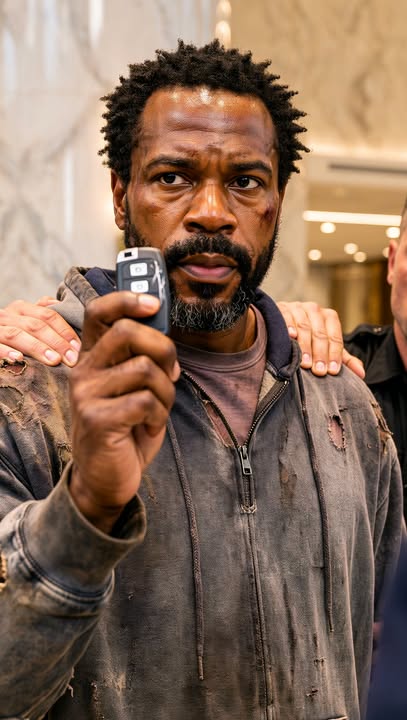
The old key fob stayed with him.
Its scratched surface had once seemed like a relic from a past he did not know how to enter.
Now it felt less like a key to a car and more like a reminder that the people who build things leave unfinished work for others to carry forward.
As David had requested, Marcus placed the future proceeds from the Phantom’s public displays into an automotive-engineering scholarship in his father’s name.
The program would fund tuition, workshop access, and mentorship for students who had talent but could not afford the expensive path into the field.
Marcus asked Emily to help lead the program.
She looked at him across the table in Elena’s office, where the first draft of the scholarship guidelines lay between them.
“Me?” she asked.
“You know what it’s like to notice a problem and wonder whether anyone will listen.”
“That’s not the same as knowing how to run a scholarship.”
“No,” Marcus said. “But we can find people who know the parts we don’t. I’m asking you to help make sure the program serves the students it’s meant for.”
Emily read the draft again.
“Why me?”
“Because when a room decided who I was before I spoke, you were the person who tried to make room for my voice.”
She looked down at the page.
“I didn’t do enough.”
“You did more than anyone else in that showroom.”
“That doesn’t mean it was enough.”
“It means you began.”
Emily’s eyes shone, but her smile appeared slowly, as if she were testing whether she could trust it.
“I’d like to try,” she said.
“Then we’ll do it together.”
She became the program’s first community director, working alongside educators, engineers, and people who had learned their craft in places far from polished showrooms.
At the first scholarship workshop, students gathered around a workbench to examine the Phantom’s early security components.
Marcus showed them the old key fob, not as a magic object but as a piece of a larger story.
“This was one of the first authentication keys,” he told them. “It did what it was designed to do. But no system is finished when it works once. You have to ask what it protects, who can use it, and what happens when something goes wrong.”
One student asked whether the Phantom had ever truly been finished.
Marcus glanced at the car’s dark windshield.
“No,” he said. “Not by itself. The people who work on it keep deciding what it should become.”
At the back of the room, Richard stood beside a display of the old workshop photographs.
He had come to help carry equipment and had remained at the edge of the group, letting the students ask their questions without turning the day into a story about himself.
When the workshop ended, he approached Marcus.
“I spoke with the board,” he said. “They’ve approved continued funding for the program through the dealership foundation.”
“Thank you.”
“I don’t expect that to make anything right.”
“It doesn’t.”
Richard nodded.
“I thought so.”
He looked toward Emily, who was showing a student how to read the scholarship application.
“She’s good at this.”
“She is.”
“I’m glad you asked her.”
“So am I.”
Richard’s gaze returned to the photographs.
“David would have liked seeing young engineers in that room.”
Marcus followed his eyes to the picture of his father and Richard in the old workshop, standing beside the unfinished car.
“I think he would have liked seeing what we do next.”
Richard’s face softened.
“I hope I get the chance to help.”
“You do,” Marcus said. “But the work comes first.”
“I understand.”
They stood together without pretending the past had been repaired completely.
It had not.
David was still gone.
The years of silence could not be returned.
The injury in the showroom, and the judgment that had preceded it, remained part of their story.
But the story no longer belonged only to what had been lost.
The Phantom’s display proceeds helped students enter the field.
The dealership’s new policies gave employees a way to speak before a small warning became a hidden problem.
Emily, once uncertain whether her voice could matter, helped young people find places where their questions were welcomed.
Richard, no longer running the showroom, spent some of his time mentoring the engineering students and answering for his part in the accident without asking them to admire his candor.
And Marcus learned that honoring his father did not mean copying every sacrifice David had made.
It meant carrying the truth farther than David had been able to, and making sure that protection did not require silence.
On the anniversary of the scholarship’s first workshop, the Phantom stood beneath the showroom lights with its doors closed and its engine quiet.
A small plaque beside it named David Bennett and Richard Sterling as the original co-creators of its security system, followed by the names of the engineers who had helped test and improve it.
Below their names were the words: Built by many hands. Made safer by what they learned.
Marcus placed the old key fob in a glass case beside the plaque, where visitors could see the worn edges and the small button that had once brought the car awake.
He did not lock it away from the world.
He let it remain visible, a reminder that recognition was only the beginning of trust.
Emily joined him, holding a folder filled with applications from the next group of scholarship students.
“They’ve already started asking whether they can visit the workshop,” she said.
“We’ll make it happen.”
“Some of them have ideas that are far beyond what we’ve funded before.”
“Then we’ll help them find the people and tools they need.”
She looked through the glass at the Phantom.
“Your father would have liked that.”
“I think he would.”
Richard came to stand beside them, carrying three paper cups of coffee.
He offered one to Marcus and one to Emily, then kept the third for himself.
For a moment, they watched the students gather around a table in the adjoining room, talking over sketches and laughing as they argued about a design.
The sound drifted into the showroom, warm and ordinary.
Marcus thought of the day he had walked through those doors wearing faded clothes, carrying an old key and believing he was there to test other people.
He had discovered that he was being tested too.
Not on whether he could punish someone who had wronged him, or whether he could afford the car that had never been for sale.
On whether he could hold a person accountable without making that person the whole story.
On whether he could protect the innocent without hiding the truth.
On whether he could accept that his father’s legacy was not a perfect past, but the chance to build something more honest from what remained.
The Phantom’s dark windows reflected the people gathered around it: the engineer’s son, the owner who had failed him, the employee who had spoken up, and the young dreamers who had yet to decide what they might make.
Its dashboard stayed silent.
It did not need to say welcome back.
They had already found their way here.
**–THE END–PLEASE
Share your thoughts or feedback to motivate us to create more stories ♥️
* * *
[PREVIOUS: PART 5](https://echoesofstories.idolsgift.com/blog/part-5-the-secret-behind-welcome-back-047)
✓ Lynn R. Adams
Part 6 – The Work We Leave Behind Richard read the line again, his face drawn with the effort of holding himself still. Marcus had already read it once, but the words seemed to deepen as they waited…