PART 6 (THE END): The Secret Behind the Hundredth Glass 070
Part 6 – The Hundredth Glass
The signature beside Eleanor’s belonged to Vanessa’s grandmother, Clara Whitmore.
For several seconds, nobody spoke.
Vanessa looked from the name to the small slip of paper, her face open with shock.
“My grandmother signed this?”
The steward nodded, though his eyes remained on the document.
“It appears to be an agreement between Mrs. Williams and Mrs. Whitmore.”
Mara studied the careful handwriting.
Her grandmother’s signature was familiar from the labels she had once written for jars of jam, and the same slanted strokes seemed to carry the weight of her hand across the years.
“What does the rest say?” Adrian asked.
The steward read quietly.
“Mrs. Williams agrees to allow the materials account to be settled by the Whitmore family, after which ownership and credit for the tower design are to be restored to her.”
Vanessa’s fingers tightened around the brooch.
“Then my grandmother knew.”
“She knew about the agreement,” Mara said gently.
“We don’t yet know everything she knew, or what she tried to do afterward.”
The steward turned the slip so they could read the lines beneath the signatures.
A brief note, written in Clara Whitmore’s hand, stated that she would see the account resolved and ensure Eleanor’s name was restored to the glassworks records.
At the bottom, a later clerk had added one sentence.
“Payment accepted; restoration of credit to follow.”
The ballroom seemed to hold its breath around them.
“The account was paid?” Vanessa asked.
The steward checked the ledger.
“The payment was recorded in the following year.”
“And the credit was never restored,” Mara said.
“No,” he replied.
“It was not.”
The revelation changed the shape of the past again.
The Whitmore family had not only taken credit and left it there.
At least one Whitmore had promised to correct the record, and the palace had recorded the payment without completing the promised restoration.
Mara looked at Vanessa.
Neither of them could know what Clara had intended, or why the correction had never been made.
But the signature offered something different from the simple story of a family taking what it wanted and never looking back.
It suggested an attempt—unfinished, perhaps thwarted, perhaps forgotten—to make things right.
Vanessa stared at her grandmother’s name.
“She may have tried to help Eleanor.”
“She may have,” Mara said.
The words did not erase the harm.
They did not return the years Eleanor had lost, or the place in the glassworks she had been promised.
But they gave the past another human face: a woman who had signed her name beside Eleanor’s and promised to restore what had been taken.
The chief steward closed the ledger carefully.
“The council will need to examine the original account and confirm the payment.”
“Then let them,” Adrian said.
“And let the correction begin now.”
He turned to the court, whose attention had gathered around the platform without anyone summoning it.
“The palace will recognize Eleanor Williams as the creator of the glass tower,” he said.
“The surviving records show that she designed it, that the materials account was settled, and that the promised correction to her credit was never completed.”
He looked toward Mara, then Vanessa.
“We will preserve the records and publish what we know, including what remains uncertain.”
No grand speech followed.
There was no demand for forgiveness and no easy declaration that the past had been settled.
Instead, the room seemed to exhale.
Vanessa stepped forward, still holding the brooch.
“I can’t speak for my grandmother,” she said.
“But I can help make sure her promise is finally kept.”
Mara met her gaze.
“Thank you.”
Vanessa’s eyes shone, though she did not look away.
“I’m sorry that my family’s name stood where your grandmother’s should have been.”
The apology did not ask Mara to make Vanessa feel better.
It did not reach backward and change what had happened.
Still, it mattered.
“Thank you for saying it,” Mara replied.
Vanessa looked down at the brooch in her hand.
“I think I need to learn who my family was, rather than simply repeat what I was told.”
“That sounds like a good place to begin.”
Her shoulders eased.
“And the glassworks could use help,” Mara added.
“If you mean that as an invitation, I’d like to take it.”
“I do.”
For the first time, Vanessa smiled without the polished confidence she had worn at the beginning of the evening.
It was uncertain, and all the more real for it.
The court did not break into applause at once.
Some guests were still absorbing what they had heard.
Others looked toward the old records, as if they had never considered that a palace might preserve a mistake alongside its fine silver and portraits.
Then Mara’s mother began to clap.
Her father joined her, his hands broad and steady.
The applause spread through the ballroom, not as a command from the throne but as a choice made one person at a time.
Mara watched the sound travel through the room.
She had once imagined being applauded as a way to prove that the people who laughed had been wrong.
Now the applause felt different.
It was not proof that everyone understood.
It was a beginning, offered by people willing to listen.
Adrian stood beside her, but he did not reach for her hand.
He let the moment belong to her and to the woman whose name had waited decades for its place.
When the gathering ended, the tower remained guarded overnight, surrounded by careful notes and fresh cords.
The records went to the palace archive, where the steward arranged for them to be copied, verified, and preserved.
By morning, the news had spread through the palace in the quiet, uneven way important truths do.
Some guests had heard the whole account.
Others knew only that the royal household had corrected the history of the glass tower.
The palace issued no grand claim that every question had been answered.
It announced that Eleanor Williams’s authorship was confirmed by surviving designs, correspondence, and appointment records, and that the Whitmore company’s materials account had been settled.
The announcement also stated that the palace had failed to carry out the promised restoration of credit.
Mara read the notice in the conservatory with Adrian beside her and Vanessa across the table.
The wording was careful, plain, and honest.
It named the mistake without pretending to know every intention behind it.
“My grandmother would have liked that,” Mara said.
“What part?” Adrian asked.
“That it doesn’t decorate the truth.”
Vanessa turned the page over.
“I used to think a family’s history was a thing you inherited whole.”
“And now?” Mara asked.
“Now I think you inherit the pieces, and then you decide whether to put them back together.”
She folded the notice and set it beside the old invitation.
“My grandmother’s name is on the announcement,” Mara said.
“It is,” Adrian replied.
“And the palace’s mistake is there too.”
“Yes.”
That was what made the correction feel real.
It had not polished away the palace’s part in the story.
The following weeks brought work rather than spectacle.
The records were checked against account books, staff lists, and surviving drawings.
The palace’s archivists found no evidence that Eleanor had ever been offered another appointment after her dismissal.
They did find a draft memorandum in which Clara Whitmore had asked for Eleanor’s design credit to be restored.
The request had been placed with the account papers and never entered into the main glassworks record.
No surviving document explained why.
Mara did not mistake the missing answer for permission to invent one.
She learned what the papers could tell her and let the rest remain uncertain.
That, too, was a form of respect.
The palace invited Mara to help prepare a public display about Eleanor’s work.
She accepted on the condition that the display include the appointment record, the agreement, the proof of payment, and the later failure to restore the credit.
The curator agreed.
Vanessa offered a family archive of letters and receipts for examination, and asked that anything relevant be included, even if it complicated the Whitmore reputation.
Her parents did not all welcome that choice.
Some relatives worried that opening the family papers would invite speculation.
Vanessa listened to their concerns, then explained that keeping the papers hidden would only leave the old account to speak for them.
It was the first time she had disagreed with her family without turning the disagreement into a performance.
Afterward, she came to the palace glassworks twice a week.
At first, she knew little beyond the names of tools and the proper way to tie back her hair.
She learned by watching, asking questions, and accepting correction without pretending she had already mastered a craft.
Mara taught her to check a shelf before placing weight on it.
Vanessa, in turn, used her family’s connections to help the glassworks obtain materials it had struggled to source.
Neither of them called it repayment.
It was simply useful work, done together.
Months later, the palace opened a small exhibit honoring Eleanor Williams.
Her original sketch rested beneath clear glass, its maker’s mark visible in a pool of soft light.
Beside it stood the old invitation, the letter, and a restored brass plate bearing her name.
The display included a note about Clara Whitmore’s agreement and the palace’s failure to honor it.
Visitors paused to read.
Some moved on quickly.
Others stayed, tracing the line of Eleanor’s design with their eyes.
Mara stood near the exhibit as her parents arrived.
Her mother touched the edge of the display case.
“She would have loved seeing this.”
“I wish she could have.”
“So do I.”
Her father put an arm around both of them.
“She would have liked that you didn’t let them turn her into a symbol instead of a person.”
Mara looked again at the sketch.
The design showed a tower that was both delicate and strong, its shelves balanced by a frame that did not hide its support.
“I think she wanted people to notice what held things together.”
“And now they can see the person who made it,” her father said.
Vanessa joined them, carrying a small bunch of pale garden flowers.
She placed them at the foot of the display, beside the plaque.
“My grandmother kept this color in her sitting room,” she said.
“I thought she might have liked it.”
Mara watched Vanessa straighten the stems.
“I’m glad you’re here.”
“So am I.”
Vanessa had changed, though not into someone unrecognizable.
She still stood with an air of confidence, and she still cared about how she was seen.
But she no longer treated those things as armor.
Sometimes, when someone at court praised her for being gracious about the records, she would say, “It wasn’t graciousness that mattered. It was the truth.”
She was learning that accountability did not require her to carry guilt for every act of her ancestors.
It did require her to decide what she would do with the benefit they had left her.
The palace’s restoration of Eleanor’s name was not the only thing to come from the discovery.
Adrian asked Mara to help establish a public workshop and scholarship for young craftspeople whose families could not afford private training.
The plan was not to create a decorative project for royal approval, but a working program with fair wages, instruction, and a place for apprentices to show what they made.
Mara agreed to help shape it.
She wanted the workshop to be useful even when no prince visited, and to belong to the people who entered it.
Adrian listened to every condition she set.
He did not call her difficult.
He called the plan better.
The first scholarship was named for Eleanor Williams.
The workshop itself opened in a restored room beside the old palace glassworks, where broad windows let the morning light fall across worktables and shelves of tools.
Mara spent more time there than in the ballroom.
She liked the smell of warm glass and clean wood, the quiet concentration of people learning something with their hands, and the way a room changed when everyone had a reason to care for it.
Vanessa became one of the workshop’s regular volunteers.
She had a talent for organizing supplies and persuading suppliers to offer fair prices.
Mara teased her that she had finally found a way to use the Whitmore name without hiding behind it.
Vanessa laughed.
“It’s a relief to use it for something that can be measured.”
Adrian visited often, but not as the owner of the place or the prince inspecting a project.
He came to carry boxes, talk with the apprentices, and listen when Mara said a shelf needed to be moved.
At first, she found herself waiting for the court to notice them together.
Then she stopped.
Their affection grew in quieter places: beside an open window after a long day, over cups of tea at the worktable, in the comfort of each other’s company when there was nothing to announce.
Adrian learned to ask before offering help.
Mara learned that accepting kindness did not require her to surrender her judgment.
They disagreed sometimes.
When they did, neither used the palace as a reason to win.
That mattered more to Mara than any formal promise.
One evening, as sunlight turned the workshop windows amber, Adrian found her checking the balance of a newly built display frame.
He held the far side steady while she tested the shelf.
“It leans a little to the left,” she said.
“I thought it looked straight.”
“That’s why we check.”
He shifted his hands as she adjusted one of the supports.
“Better?”
Mara tested it again.
“Much.”
He let go only when she nodded.
“I’ve been thinking about what you asked me,” he said.
“Which thing?”
“How I would stand beside you without making your life another palace announcement.”
Mara set down her small level.
“And what have you decided?”
“That I can’t promise the court will stop watching.”
“I didn’t ask you to.”
“I can promise I won’t use the court’s attention to decide who you should be.”
Mara turned toward him.
“That is a better promise.”
“And I can promise I want a partnership in which you can tell me when I’ve got something wrong.”
“I expect to tell you.”
“I know.”
He smiled.
The warmth between them felt steady, not because it demanded nothing, but because it made room for honesty.
Mara took his hand.
For a moment, they stood beside the frame, holding it together.
“I love you,” Adrian said.
He said it without a ballroom, without an audience, and without asking the words to solve anything.
Mara felt her own answer rise quietly and fully.
“I love you too.”
His thumb brushed the side of her hand.
“Will you build this life with me?”
“Only if we keep building it together.”
“Together,” he promised.
She believed him—not because he wore a title or had spoken beautifully, but because she had watched him keep showing up in ordinary moments.
The palace eventually asked whether they would announce their engagement.
Mara asked for time.
Adrian gave it to her without complaint.
When she was ready, they made their announcement in the glassworks rather than the ballroom.
The apprentices were there, along with Mara’s family, Vanessa, the steward, and a few people from the court who had learned to visit without expecting to be entertained.
There was no throne.
There were no rows of candidates in expensive gowns.
There was a long worktable, a half-finished window display, and an open place beside Adrian for Mara to stand if she chose.
She chose it.
Months later, the palace hosted a gathering to reopen the challenge display, now presented with Eleanor’s name beside it.
The restored tower stood at the center of the ballroom.
Its brass plaque named Eleanor Williams as its designer and described the work as a test of patience and careful judgment.
Below that, a smaller line acknowledged the Whitmore family’s role in supplying materials and the palace’s failure to restore proper credit during Eleanor’s lifetime.
Mara was grateful for the balance of it.
Nothing had been made perfect.
Something had been made true.
The court gathered around the tower, but this time the ceremony did not ask a line of young women to prove themselves beneath its gaze.
It asked everyone present to remember the craftswoman who had created it.
Mara stood beside her grandmother’s sketch.
Vanessa stood on her other side, no longer carrying the family name as something that must never be questioned.
Adrian waited near the platform, his hand open at his side.
The palace official invited Mara and Adrian to place the final glass together.
Mara looked toward her parents.
Her mother’s eyes were bright.
Her father smiled with the same patient pride he had shown when she was a girl learning to steady a cup between both hands.
Vanessa gave her a small nod.
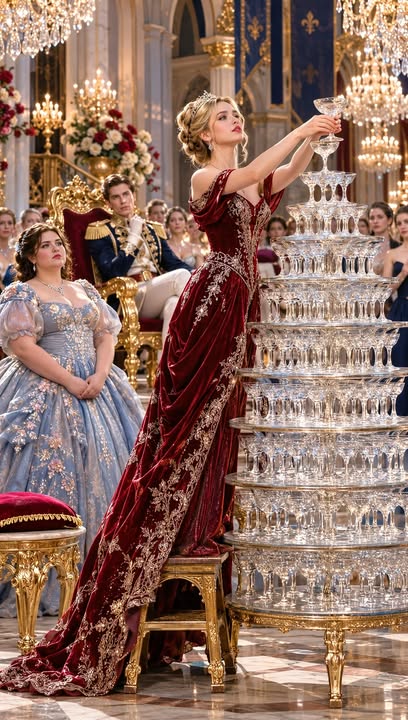
Mara took the hundredth glass from its velvet cushion.
It felt familiar, though she had held it only once before.
Adrian offered his hand, but did not guide hers.
She rested her fingertips lightly against the glass, and together they carried it to the tower.
The ballroom was quiet.
Not with the strained silence of people waiting for someone to fail, but with the tenderness of a room willing to witness.
Mara felt the glass settle into place.
For one suspended heartbeat, all one hundred pieces held.
Then the tower caught the light and gave it back in a hundred small reflections.
The applause began at once.
Her parents clapped.
Vanessa clapped, smiling through the shine in her eyes.
The steward joined them, followed by the apprentices and the guests who had once watched from beneath the chandeliers and now understood that the achievement was more than a perfect balance.
Adrian’s hand remained beside Mara’s, warm and unassuming.
She turned toward him, and they smiled at one another.
The applause surrounded them, but it did not belong only to the prince or to the girl who had climbed the stool.
It belonged to Eleanor, whose work had endured.
It belonged to Vanessa, who had chosen honesty over the comfort of an inherited story.
It belonged to every craftsperson who had been asked to make something beautiful and then watch someone else take the credit.
And it belonged to the people who had finally learned to look beyond the glass, toward the hands that had made it.
Mara rested her shoulder lightly against Adrian’s.
Together, steady-handed and smiling, they stood beneath the hundredth glass while the court applauded the person behind the achievement.
**–THE END–PLEASE
Share your thoughts or feedback to motivate us to create more stories ♥️
* * *
[PREVIOUS: PART 5](https://storyly.idolsgift.com/blog/part-5-the-secret-behind-the-hundredth-glass-070-1)
✓ Lynn R. Adams
Part 6 – The Hundredth Glass The signature beside Eleanor’s belonged to Vanessa’s grandmother, Clara Whitmore. For several seconds, nobody spoke. Vanessa looked from the name to the small slip of p…