PART 6 (THE END): The Secret Behind the Chime 069
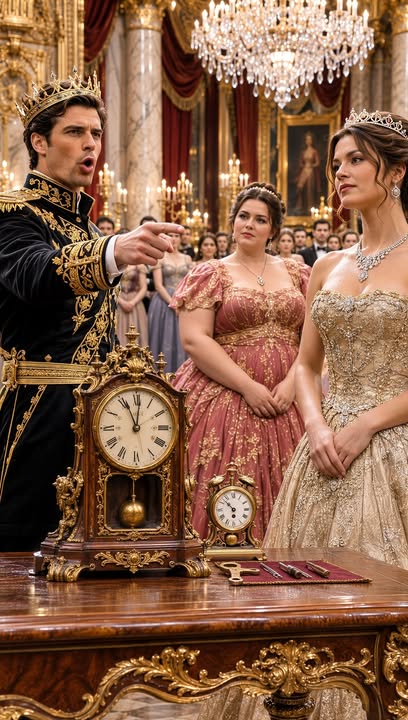
Part 6 – The Chime That Carried Home
“Begin with the people still waiting.”
Elara read the queen’s words once, then again, while the clock ticked softly beneath the ballroom’s golden light.
The second account was a single folded sheet, its edges brittle with age.
Mistress Wren lifted it carefully onto the archival tray, and Adrian stood beside her, reading without touching.
The account described more than the bridge at Willowmere.
Mara Vale had written of several villages whose petitions had been marked for later review, then quietly set aside when the court’s attention moved elsewhere.
Some asked for repairs to roads and wells.
Others asked for a schoolteacher, a safer ferry, or help restoring a mill that served three hamlets.
The details were ordinary, and that was what made them difficult to dismiss.
Each request came from people who had expected the palace to answer.
At the bottom, the queen had written that the petitions must be returned to the people who sent them, with a response that explained what could be done and what could not.
The final line read: “A promise is not kept because it is remembered. It is kept when someone acts.”
Adrian stood very still.
His expression held sorrow, but not the helplessness Elara had seen when the first petition was found.
“What happened to the other requests?” he asked.
Mistress Wren examined the account.
“Some were answered. Some may have been. This document doesn’t say.”
“Then we won’t pretend to know,” Elara said.
“We’ll find the records,” Adrian replied. “And we’ll ask the villages themselves what remains unfinished.”
Lord Vale looked down at Mara’s writing.
“I can help locate the district files,” he said. “I remember the old filing system better than anyone still in the household.”
Adrian met his gaze.
“You may help Mistress Wren find them, and give a complete account of the way the petitions were handled.”
“I will.”
“And after that, the council will decide what responsibility follows.”
Vale nodded.
“I understand.”
There was no easy forgiveness in the room, but neither was there a demand that he become a villain for everyone else’s comfort.
He had signed a denial, failed to tell the queen the whole truth, and let the matter disappear into the machinery of the palace.
He would have to answer for those choices.
He would also have the chance to help correct what could still be corrected.
Mistress Wren placed the second account beside the first petition.
“Her Majesty seems to have hoped the clock would lead you here,” she said.
Adrian looked toward the silent face.
“She left me a lesson, not a finished answer.”
“That may have been the answer she wanted you to find.”
Elara watched the pendulum swing.
The clock’s quiet rhythm no longer seemed like a puzzle waiting to be solved.
It sounded like time being given back to something that had been postponed too long.
That night, the palace sent a small team to Willowmere with a royal surveyor, emergency supplies for the temporary crossing, and a letter from Adrian explaining that the crown would listen before deciding what could be done.
He did not promise a new bridge before anyone had inspected the riverbank.
He promised that the people who used the crossing would be asked to help plan its repair.
It was a modest beginning, but it was a beginning made openly.
By morning, the story had spread through the court.
Not as a scandal or a tale of a contest gone wrong, but as an account of a silent clock, a hidden petition, and a prince who had chosen to listen before defending the palace.
The council assembled in the smaller audience chamber, where no chandeliers or musicians could soften the facts.
Adrian read the queen’s letter aloud.
He explained what Elara had discovered, what the records did and did not establish, and how Lord Vale had been involved in the handling of the petitions.
Vale stood and gave his own account without excusing the denial he had signed.
He said that he had believed the eastern road improvements would serve more people.
He said he had failed to tell the queen that the Willowmere bridge was left without a plan.
He said that, afterward, he had allowed time and silence to make the omission feel smaller than it was.
No one applauded him for admitting it.
No one jeered.
The council asked questions, and the records were entered into the royal archive so the matter would not vanish again.
Lord Vale was removed from his position as steward while the council reviewed his decisions.
He cooperated with the inquiry and agreed to assist Mistress Wren in locating the remaining petitions.
The consequence was real, but it was not made into a spectacle.
Celestine spoke before the court as well.
She admitted that she had removed the brass screw because she wanted an advantage in the contest.
She acknowledged that Lord Vale had described it as a harmless adjustment, but she did not use that as a reason to avoid her own part.
“I thought I could make a challenge easier for myself without harming anyone,” she said. “I was wrong. And I was unkind to Elara because I assumed her skills mattered less than mine.”
She turned to Elara.
“I’m sorry.”
Elara had once imagined that an apology would feel like a door swinging wide.
Instead, it felt like a small opening, one that could be entered only if both people chose to keep walking.
“I accept your apology,” she said. “I hope we can both remember this when we meet again.”
Celestine nodded, her eyes bright.
“I will.”
After the council, Adrian ended the marriage competition.
The decision surprised no one who had listened to him speak that morning.
He thanked the contestants for their time and explained that choosing a wife as the prize for a challenge no longer seemed right to him.
“I began this contest believing that a ruler should test the qualities of the people who might stand beside him,” he said. “I see now that I had arranged the question badly. A person is not a reward, and marriage is not a prize to be won.”
The words did not diminish the warmth between him and Elara.
They made it possible for her to trust it.
In the days that followed, Elara returned to the palace with her father’s journal and a small leather case of tools.
She and Mistress Wren compared the clock’s hidden notes with the household ledgers, while Adrian met with the district officers to learn which old requests still mattered.
The queen’s chime pattern had named the districts in the order their petitions had been received.
The long pause had marked Willowmere, the petition that had been refused and left unanswered.
The notes did not conceal a grand conspiracy.
They preserved the plain record of a decision and the people who had lived with its consequences.
The clock had been silenced at the queen’s request so its mechanism would remain intact until Adrian was old enough to understand what its chime represented.
Lord Vale had kept the queen’s instruction but failed to keep her purpose.
Celestine had moved the screw for her own advantage, without knowing what it concealed.
And Elara’s father had recognized Bellweather’s mark in the old journal because he had once studied the very mechanism that carried the message.
Every clue belonged to the same story.
That knowledge did not make the past easy.
It made the future clearer.
At Willowmere, the surveyor found that the old stone foundations could still support a safe crossing if they were repaired properly.
The residents showed the royal team where floodwater gathered and which path children used to reach the school.
Their observations changed the repair plan.
When Adrian received the report, he asked the council to fund the work and invited two villagers to review the design before construction began.
Among the residents who came to the palace was Mara Vale’s daughter, a thoughtful woman who carried a copy of her mother’s petition.
She met Lord Vale in the garden after the council had finished its session.
Elara did not hear their whole conversation, but she saw him listen without interrupting.
When they parted, he did not look absolved.
He looked as though, at last, he had stopped pretending the old hurt could be made smaller by silence.
A week later, the ballroom filled again.
The contestants returned, along with members of the court, palace staff, and representatives from several districts whose petitions had been found in the west archive.
The clock stood on its table, its back panel carefully secured.
Its original parts remained in place.
Elara had cleaned the mechanism, adjusted the worn catch, and checked each gear against her father’s notes.
She had not replaced a single piece that could still serve.
Adrian waited beside the clock, dressed not in the glittering uniform he had worn for the contest, but in a dark blue coat with the royal crest at his shoulder.
Elara wore her deep-rose gown again, altered at the cuffs where the fabric had caught on the workbench.
She had asked that no one announce her as the winner of anything.
Adrian had agreed.
When he addressed the gathering, his voice carried easily through the room.
“The clock has been restored, but its lesson does not belong to the palace alone,” he said. “It reminds us that listening is not complete until we respond. The petitions we found will be answered one by one, and the people who sent them will be told what the crown can do, what it cannot, and why.”
His gaze moved across the representatives from the districts.
“The palace will not mistake silence for agreement again.”
No flourish followed the promise.
Only a quiet, attentive stillness.
Then Adrian turned toward Elara.
“Would you do the honors?”
She stepped beside the clock.
The ballroom seemed very far from the small workshop where her father had first taught her to hear a mechanism before touching it.
She placed one hand near the clock’s side, not on its face.
“I’m going to let it run,” she said. “The mechanism is ready.”
Adrian held the brass key out to her.
She took it, wound the clock slowly, and stopped at the first hint of resistance.
The gears moved.
The pendulum began to swing.
The familiar ticking spread through the room, gentle and steady.
Elara listened.
The first chime rang clear.
A pause followed, then another note.
The sequence continued as it had before, carrying the districts through the ballroom in measured intervals.
At the final note, the sound seemed to rest in the heart of the room.
Then the clock settled into its ordinary rhythm.
No one spoke immediately.
The people from Willowmere listened with their hands folded.
Mistress Wren closed her eyes.
Celestine stood near the back, no longer dressed to draw every gaze, and listened without trying to claim the moment.
Lord Vale stood beside the archive table, his face turned toward the sound.
Adrian’s eyes were on Elara.
When the clock began ticking again, the gathering broke into warm, unhurried applause.
Elara looked at the clock, and thought of her father’s hands guiding hers over a workbench.
She could almost hear his voice telling her that a repair was not finished when the gears moved.
It was finished when the thing could do what it had been made to do.
The clock had done more than strike.
It had brought an old promise back into the open, and given a prince a chance to begin keeping it.
After the guests had begun to leave, Adrian found Elara beside the tall windows.
Beyond the glass, dusk softened the palace gardens into shades of green and blue.
“I have something to ask you,” he said.
“Is it another clock?”
“Not this time.”
She smiled, and some of the strain that had followed them through the week eased from her shoulders.
Adrian looked down at his hands before continuing.
“I once thought that if I chose someone to stand beside me, I should first decide whether she could meet the demands of a crown.”
“And now?”
“Now I think I should ask whether we can build a life in which neither of us must become smaller to make room for the other.”
Elara studied him.
“I don’t want to be a symbol of the lesson you learned.”
“You wouldn’t be.”
“I don’t want to be chosen because I found a secret.”
“I know.”
“And I won’t stop repairing clocks just because the palace has found other uses for me.”
“I wouldn’t ask you to.”
He met her eyes.
“I would like to ask you to build a future with me, as an equal. Not as a prize, and not because a court expects it. I want your counsel because I trust the way you look at the world, and I want your company because I am happier when you are near.”
Elara let the words settle.
The prince who had once offered marriage as the reward for a challenge was now asking without ceremony, without a crowd, and without pretending that affection could replace honest work.
“Will you keep listening when the answer is inconvenient?” she asked.
“I will try,” he said. “And when I fail, I hope you’ll tell me.”
“I will.”
“Then?”
She looked toward the ballroom, where the clock continued its steady, patient ticking.
“I would like to build that future with you.”
His smile was not the polished expression of a prince greeting a court.
It was a smile that belonged to Adrian, the grandson who had finally heard his grandmother’s message and the man who had chosen to answer it.
He offered his hand.
Elara placed hers in it.
Their relationship did not begin as a reward for solving a puzzle.
It began with the promise to keep asking, keep listening, and tell each other the truth even when it was difficult.
In the months that followed, Elara continued her father’s repair work.
She kept a workshop in the city, where people brought clocks, watches, music boxes, and the occasional kitchen timer that had outlasted its owner’s patience.
She also helped the palace establish a public office where petitions could be tracked from the moment they arrived until the person who sent them received an answer.
Adrian visited often.
Some days he came to ask about a report from the districts.
Other days he brought a clock with a loose spring or simply sat near the workbench while Elara worked.
He learned to wait through the quiet.
The restored bridge at Willowmere opened the following spring.
Mara Vale’s daughter stood beside the river when the first children crossed it on their way to school.
Lord Vale attended too, not as steward, but as a citizen asked to help account for the old records he had once overseen.
When he spoke of his sister, he did so without making her petition a shield for himself.
He remembered her as a woman who had written because she believed someone might listen.
Celestine began supporting the repair apprentices’ fund with money from her family’s estate.
She never asked Elara to tell the court that this made them friends.
Instead, she came to the workshop one afternoon with a small music box she had inherited and asked whether Elara would show her how its spring worked.
Elara did.
Their friendship grew slowly, built not on the fiction that nothing hurt, but on the knowledge that people could change when they were willing to admit what they had done.
The years did not make the palace perfect.
No ruler could answer every need, and no promise could prevent every hardship.
But under Adrian’s reign, the petitions no longer disappeared without a reply.
And when the council debated a decision that would affect a distant village, someone always asked what the people there had said.
On the evening of Adrian and Elara’s wedding, the ballroom filled once more beneath the golden chandeliers.
The clock stood above the gathered guests, its original mechanism polished but not remade.
Elara wore a gown of deep rose, simple at the waist and bright against the candlelight.
A small brass screw, old and carefully cleaned, had been set into the clock’s hidden panel.
No one in the room mistook it for a forgotten piece.
It was a reminder of the moment a young woman had stopped before forcing what she did not yet understand.
When the ceremony ended, Adrian and Elara stood together before the clock.
The guests waited quietly as the minute hand reached the hour.
The pendulum swung.
The clock chimed once, clear and warm, and its note traveled beyond the ballroom through the open doors.
It was heard in the corridor, in the courtyard, and by the people gathered outside the palace walls.
Elara rested her hand in Adrian’s.
The clock continued ticking, not as a relic preserved from the past, but as a promise carried into the future.
And this time, when it spoke, the palace was listening.
**–THE END–PLEASE
Share your thoughts or feedback to motivate us to create more stories ♥️
* * *
[PREVIOUS: PART 5](https://storyly.idolsgift.com/blog/part-5-the-secret-behind-the-chime-069)
✓ Lynn R. Adams
Part 6 – The Chime That Carried Home “Begin with the people still waiting.” Elara read the queen’s words once, then again, while the clock ticked softly beneath the ballroom’s golden light. The sec…