PART 6 (THE END): The Secret Behind the Bell 057
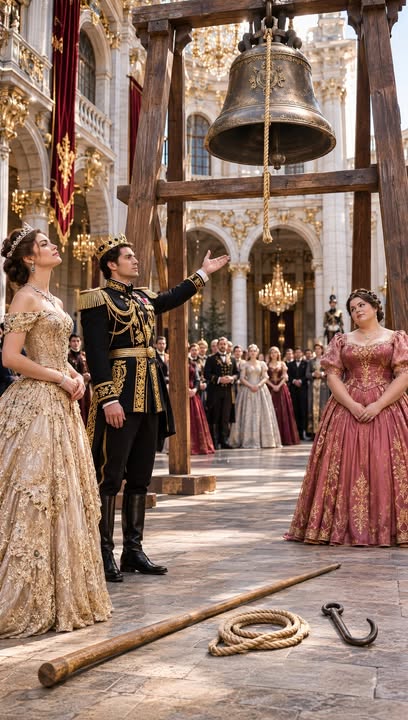
Part 6 – The Bell That Called Them Home
Emma’s hand closed over the brass tool inside her gown.
And beneath the letter’s title, written in the same careful ink, was a date from the year her father had died.
For a moment, the records room seemed to hold its breath.
Julian looked from the date to Emma.
“Do you want to open it?” he asked.
She felt the small tool’s familiar shape through the cloth, worn smooth by her father’s hand and, later, by her own.
“I want to know what he chose to tell us,” she said.
Mr. Vale examined the envelope without touching its seal.
“The archival note says it should be opened only when the royal family is prepared to hear the whole truth,” he said. “The queen’s authorization appears to meet that condition.”
Lord Harrow glanced toward Julian.
“Her Majesty should be present.”
“Then we’ll wait for her,” Julian replied.
Emma was grateful he did not reach for the letter or try to hurry her past the moment.
The next morning, Queen Eleanor joined them in the records room, where the letter had been placed on a clean table beneath the tall windows.
Victoria arrived soon after, carrying the copy of her family’s renovation agreement.
She laid it beside the old work order, ready to help establish how the bell’s rope had been altered.
The queen looked at the envelope for a long while before taking her seat.
“I remember your father,” she said to Emma. “Not his face clearly, but his kindness. He came to the infirmary after I had recovered enough to sit up, and he asked whether the bell had frightened me.”
Emma’s mouth softened into the smallest smile.
“That sounds like him.”
“He told me that a bell should call people toward one another, not frighten them away.”
The queen’s eyes rested on the sealed letter.
“I wish I had asked more.”
“So do I,” Emma said.
The words held no accusation, but neither did they make the regret vanish.
Queen Eleanor nodded, accepting both truths.
Mr. Vale carefully broke the old seal.
Inside was a single letter, written in her father’s familiar hand.
Emma knew the shape of his letters before she could read a word.
She had watched him label jars of screws, mark the edges of sketches, and write her name on the small wrapped gifts he brought home from the foundry.
For a moment, the ink blurred.
Julian remained still beside her.
When Emma was ready, Mr. Vale began to read aloud.
Thomas Bell wrote that he was grateful the princess had survived the fire, and that he had never considered the bell’s work a sacrifice.
He had made the mechanism because people should be able to call for help without being required to climb, reach, or risk injury.
The pulley system had been designed so the bell could be rung from the ground, even if smoke or debris blocked the usual route.
He described the small release fitting that allowed the cord to be guided safely through the frame.
Then he wrote about the promise of recognition.
He did not ask for money or a title.
He asked only that the palace preserve the mechanism and record the names of the people whose work had made the rescue possible.
The letter said that Sir Alistair Rowe had assured him a decree would be issued.
Later, Rowe had explained that public recognition might raise questions about why the royal household had not maintained safer emergency systems before the fire.
He had told Thomas that the palace needed to present the bell as a symbol of royal tradition, rather than as a reminder that its safety had depended on a craftsman’s design and the quick actions of servants.
Thomas had not agreed that those truths were in conflict.
He had written that a symbol should not become less meaningful because ordinary people had helped make it work.
The letter continued in a gentler hand.
Thomas said he had spoken with Princess Eleanor, who had thanked him sincerely.
He believed she understood that the promised decree was meant to honor his service.
But after Rowe’s office sealed the account, he learned that the pulley had been removed and the rope rerouted.
He wrote that the alteration made no sense to him, and that he feared the palace had mistaken the quiet of a bell no longer used for the safety of one that might be needed again.
Emma pressed her fingertips to the table.
Her father had understood what had happened.
He had understood, and still he had not let bitterness become the whole of his story.
The final lines were addressed to the future sovereign.
“If this letter is opened after I am gone,” Mr. Vale read, “please do not make my daughter carry the burden of correcting what I could not.”
Emma lowered her eyes.
“Let her be judged by her own work, and let the bell be made safe for anyone who needs it.”
A silence followed.
Emma felt her father’s absence as sharply as ever, but the silence no longer seemed empty.
His words had crossed the years with the same steadiness he had brought to a stubborn knot or a misaligned hinge.
The queen reached for the letter, then stopped before touching it.
“He asked that you not carry this burden,” she said. “And yet it is your right to decide what happens now.”
Emma looked at the old page.
“I don’t think correcting the record is a burden,” she replied. “But it cannot become my only responsibility. My father wanted the bell safe, and the workshops fair. He didn’t ask me to make the palace feel forgiven.”
“No one should ask that of you,” the queen said.
Julian’s expression was solemn.
“Then we’ll make the repairs and correct the record because they are right, not because they earn forgiveness.”
Emma looked at him.
That was the kind of answer she could believe in—not because it promised everything, but because it did not ask her to make the past easier for him.
Mr. Vale turned to the renovation documents.
The work order bearing Victoria’s family seal had been signed by a clerk in the former steward’s office, several months after the renovation agreement was finalized.
The clerk’s accompanying note showed that he had followed an old maintenance instruction without knowing that the original pulley had been removed under a sealed order decades earlier.
He had believed the upper support was the intended route.
No evidence suggested Victoria or her family had requested the alteration.
The discovery did not erase the careless decision, but it explained how an old act of concealment had become a practical mistake repeated by people who no longer knew its origins.
Victoria’s shoulders eased when Mr. Vale finished reading the records.
“I’m relieved to know my father did not approve it,” she said. “But I’m sorry the seal was used at all.”
“You have helped us trace it,” Emma replied.
Victoria’s gaze dropped to the work order.
“I used to think helping meant being seen doing something generous,” she said. “Now I’m beginning to understand it can mean staying long enough to find out what actually happened.”
“It can,” Emma said.
Victoria gave a thoughtful nod.
“Then I’ll stay.”
The palace engineer and a team from the royal workshops began restoring the bell’s original mechanism.
Emma was invited to advise them, not as a ceremonial guest but as someone who understood the tool, the drawing, and the way her father had designed the system.
She accepted after the queen confirmed that her work would be reviewed according to the same standards as everyone else’s.
For several days, Emma stood beside the engineers as they examined the frame, measured the fittings, and searched the workshop stores.
The missing pulley was found in a box of old metalwork, wrapped in canvas and tagged as an unused courtyard fitting.
It had been kept rather than discarded, though no one knew what it belonged to.
The mark on its pin matched the drawing and the brass tool.
When the pulley was cleaned, its worn wheel turned smoothly again.
Emma helped guide it into place, using her father’s tool to align the fitting without forcing the metal.
The engineer checked the assembly twice before threading a temporary cord through the frame.
Only when the mechanism had been tested and approved did they attach the new rope.
The old rope, weakened by friction against the beam, was preserved with the work records.
At the same time, the palace opened its account of the fire.
The public report named Thomas Bell as the designer of the safe pulley system and the craftsman who had rung the bell to summon help.
It also recorded that his contribution had been promised formal recognition, then omitted from the official history.
Queen Eleanor spoke first before the court.
She admitted that she had signed a preservation order without reading the account and had trusted the steward’s office to fulfill its promise.
She did not excuse herself with her youth or the pressure of the palace.
She said she should have asked what became of the record, and that the royal household had failed Thomas Bell.
Then Julian stepped forward.
He spoke without a prepared flourish.
He told the assembled court that he had turned the bell into a contest and treated marriage as though it could be offered as a prize for a public performance.
He said Emma had solved the challenge through patience and practical understanding, but that her success did not make the challenge fair.
The bell’s mechanism had been altered, he explained, and the original design had been hidden alongside the account of the man who built it.
“Emma did not prove that she was worthy of respect,” he said. “She deserved respect before she ever stepped into the courtyard.”
The court was quiet.
Julian continued.
“My family’s history has left out the work of people who served it. That omission was wrong. I will not ask anyone to forget it, and I will not make Emma responsible for repairing it alone.”
Emma listened from beside the restored bell, the brass tool resting in her palm.
She was relieved that he had not turned her into a symbol or told the story as though he had discovered a heroine who could redeem the crown.
He had named his own mistake.
Then he had made room for the people who had been left out.
Victoria stood among the court, her family’s statement of responsibility for the renovation seal included in the record.
She had not tried to shift blame onto a clerk or hide behind her father’s reputation.
When the palace announced that a review would be made of all workshop applications and appointments, she offered to help establish a public committee with clear rules and independent reviewers.
The reform was not completed in a day.
It began with written standards, open applications, and a process that made it harder for vague judgments about “presence” to stand in for skill.
Emma applied again.
She submitted drawings of the restored pulley, notes about its safety testing, and examples of her earlier work.
The panel included engineers, craftspeople, and a representative from outside the palace.
No one on it was told to favor her.
No one was permitted to dismiss her for reasons unrelated to the work.
When the decision came, Emma was offered a leadership role in the restoration of the bell and its records.
The title was modest.
The responsibility was real.
She accepted because the work mattered, and because she had earned the right to decide whether she wanted it.
Victoria came to her first day with two cups of tea and an untidy bundle of copied drawings.
“I was told these might be useful,” she said. “I may have made too many copies.”
Emma looked at the stack.
“You made enough for every person in the workshop.”
“I was trying to be thorough.”
“You were trying to be impressive.”
Victoria laughed, then gave a small, sheepish shrug.
“Perhaps.”
Emma took one of the cups.
“Thorough is useful,” she said. “Impressive is optional.”
“That may be the kindest correction anyone has ever given me.”
Over the months that followed, the workshop grew busier.
Young applicants arrived with portfolios from villages, city schools, family kitchens, and small local repair shops.
Some were shy.
Some arrived certain they would be turned away.
Emma made sure they were shown where to set their work down and given time to explain what they had built.
Victoria joined the review committee and learned to ask questions before assuming she already knew the answer.
She and Emma became friends gradually, through work, disagreements, shared meals, and the occasional laugh over how poorly a drawing could disguise a crooked hinge.
Neither pretended that their first meeting had been kinder than it was.
Instead, they built something better from what they had learned afterward.
Julian visited the workshop when his duties allowed.
He did not ask Emma to stop work so that he could be shown around.
Sometimes he brought a question for the engineers.
Sometimes he listened while she explained a design.
Once, he attempted to help sort fittings and spent an entire afternoon placing the wrong sizes in the wrong trays.
Emma made him start over.
He did, without complaint.
When the restored bell was ready, the palace gathered beneath the courtyard galleries once more.
This time there was no challenge and no clock.
The records of its design had been placed in a glass case beside the wooden frame, with Thomas Bell’s name clearly written at the top.
The report also named the attendants who had helped carry messages during the fire and the craftspeople who had maintained the bell through the years.
The bell was no longer presented as the work of a crown alone.
It had become what Emma’s father had believed it should be: a thing made safe through the work of many hands.
Queen Eleanor stood beside the courtyard entrance.
“I would like Thomas Bell’s daughter to ring it first,” she said.
Emma looked toward the restored rope.
She thought of the first afternoon, when the end had hung beyond her reach and a crowd had waited to see whether she would fail.
She thought of her father’s hands guiding hers around a knot, and of the letter that had crossed years to ask for honesty rather than revenge.
“I’d like to ring it with the people who restored it,” she said.
The engineers gathered beside her.
Victoria took a place on one side, the queen on the other.
Julian stood a little farther back, leaving the cord for Emma.
She touched the rope.
The mechanism moved easily through the pulley, guided and safe.
“Ready?” Victoria asked.
Emma nodded.
Together, they drew the cord.
The bell sounded in a deep, clear note that rose over the courtyard and beneath the palace galleries.
Its voice seemed fuller now, not because the bronze had changed, but because the story surrounding it had.
The sound rolled over the assembled crowd and beyond the palace walls.
Emma imagined her father hearing it.
She could not know what he would have said, but she could picture his small, pleased smile when a mechanism worked as it should.
When the note faded, the courtyard remained quiet for a moment.
Then the applause came—not the startled applause of a crowd surprised that Emma had succeeded, but a warm, steady sound offered to everyone whose work had brought the bell back to life.
Julian waited until the gathering had begun to disperse.
Then he approached Emma, careful not to step between her and the people congratulating her.
“Would you still consider that walk?” he asked.
Emma studied him.
There was no crown in his question, no audience waiting to interpret her answer, and no promise attached to it.
“I would,” she said. “But I want to know you slowly.”
“So do I.”
“And I won’t be anyone’s reward.”
“I know.”
“You’ll have to keep showing me.”
“I will.”
She smiled.
“Then we can begin with a walk.”
Their courtship grew in the quiet spaces between public duties.
They spoke about the things each had never learned to say at court, about the responsibilities they wanted to keep and the expectations they hoped to change.
Julian never asked Emma to be smaller, quieter, or more convenient.
Emma never asked him to pretend his responsibilities did not exist.
They learned to disagree without turning disagreement into a contest, and to listen without assuming the answer would be flattering.
Their affection took shape through time rather than spectacle.
Years later, when Julian asked Emma to marry him, he did so in the workshop courtyard after a long day spent reviewing the bell’s records.
There were no nobles watching, no challenge to win, and no promise that love would solve the work still unfinished.
He asked because he wanted to build a life with her.
Emma said yes because she wanted that life too.
When they married, the ceremony included no test of worth.
The restored bell rang afterward, its note carrying through the palace and over the city.
Emma and Julian stood together beneath the wooden frame, listening as the sound traveled outward.
The brass tool rested in Emma’s hand, its worn curve catching the light.
She thought of her father’s letter, and of the simple truth he had left behind: a bell should call people toward one another.
Then Julian offered her his hand, not to lead her, but to stand beside her.
Emma took it.
Together, they watched the bell settle into silence, knowing its voice and its history would no longer be hidden.
**–THE END–PLEASE
Share your thoughts or feedback to motivate us to create more stories ♥️
* * *
[PREVIOUS: PART 5](https://storyly.idolsgift.com/blog/part-5-the-secret-behind-the-bell-057)
✓ Lynn R. Adams
Part 6 – The Bell That Called Them Home Emma’s hand closed over the brass tool inside her gown. And beneath the letter’s title, written in the same careful ink, was a date from the year her father h…