PART 6 (THE END): The Seal Beneath the Ink 069
Part 6 – The Hand That Chose
“It was given by the prince himself.”
For a heartbeat, Adriano heard nothing but the rain beginning again against the high windows.
The words on the paper were small, written in a narrow hand that might have belonged to any clerk who had ever served the palace.
Yet they seemed to reach across the table and place an impossible question between him and the people he trusted.
“I never gave my seal to anyone,” he said.
Dame Isolde turned the strip of paper beneath the light.
“Then the note is either mistaken or deliberately misleading.”
The royal clerk stood very still beside the open box.
“I found the strip only because the lining had come loose,” he said. “I have never seen it before.”
Adriano looked at the wooden handle of the seal.
He remembered its weight in his palm from the morning he had taken his first formal oath.
He remembered setting it down in his private office after signing routine household orders.
That office had not been private in the way he had imagined.
“What does the handwriting tell us?” he asked.
The archivist, summoned from the records room, examined the note without touching its ink.
“It is not the late king’s secretary’s hand,” he said. “The line on the front was written by a clerk, perhaps some years ago. The reverse may be later still.”
“Can it be identified?”
“Not without comparison.”
Dame Isolde took possession of the paper.
“I will have it examined alongside the authorization and the seal impression.”
Adriano’s gaze moved to Sofia.
She had said nothing, but he could see the thought she was holding back.
“Say it,” he told her.
“I do not know who wrote the note,” she replied. “Neither does anyone else yet.”
“That is true.”
“And if the investigation is to be fair, the note must be treated as evidence, not as an answer.”
A quiet breath left him.
“Yes.”
The council members had not yet left the hall.
They had gathered in small groups near the doors, speaking in low voices as the clerk’s discovery passed among them.
One of them approached.
“Your Highness, perhaps it would be prudent to suspend access to your private office until this is resolved.”
“I agree,” Adriano said.
“Your secretary and chamberlain should be interviewed.”
“By Dame Isolde, not by me.”
The councilor looked surprised.
“Of course.”
“Everyone with access to the seal must be included, including anyone who served me. My own account of what I remember will be recorded and checked against the records.”
Dame Isolde inclined her head.
“That is the proper course.”
Adriano glanced at the empty glass case where the crown had been displayed.
He had once believed that a ruler’s authority rested in symbols he could hold.
Now his own seal sat on the table, familiar and troubling, while the crown remained untouched behind glass.
“What happens to the inquiry?” he asked.
“It continues,” Dame Isolde said. “The note raises a new question. It does not alter what we have already verified.”
The workers’ receipts still showed missing wages.
The contracts still carried Valerian’s approvals.
The reserve account still existed.
And the king’s unfinished memorandum still showed that he had begun investigating it.
No mysterious note could erase those facts.
That evening, Adriano ordered the seal secured under Dame Isolde’s authority.
He gave written consent for every relevant office record to be reviewed, then left the archive without asking for a private report.
Sofia found him later in the west corridor, where the old stone smelled faintly of rain.
“You did not know the seal had been used,” she said.
“No.”
“You might still be asked to answer for what your office allowed.”
“I should be.”
She studied his face.
He seemed tired, but not angry.
“I used to think that if I meant well, it was enough,” he said. “If someone acted in my name, I assumed the people around me would tell me. If the records were stamped, I assumed they were true.”
“And now?”
“Now I know that not asking can become its own kind of permission.”
Sofia rested one shoulder against the cool wall.
“Knowing that is a beginning.”
“I hope it is more than a beginning.”
She did not offer him a comforting promise.
Instead, she said, “Then keep asking, and let people answer honestly.”
He nodded.
For the first time, silence between them did not feel like distance.
It felt like the space in which neither had to pretend to know more than they did.
The inquiry continued for six weeks.
Dame Isolde worked with a team of provincial auditors and clerks who had never served in Lord Valerian’s office.
They compared the copied report with the original contracts, payroll receipts, repair orders, and old reserve books.
They examined the prince’s seal impression and the strip of paper found beneath the velvet lining.
They interviewed the chamberlain, the royal secretary, and every clerk who had handled household authorizations during the relevant months.
The note saying the seal had been given by Adriano himself was eventually traced to a draft written by a former office steward.
The steward had recorded that the prince had authorized the seal to be used for routine household papers while he was away from the capital.
No order named the reserve account.
No order approved the diverted payments.
The seal had been placed in the hands of the prince’s own office, where it was used without the careful verification the rules required.
The trail did not end with Valerian.
It led to a senior contract clerk in the treasurer’s department who had arranged false deliveries and concealed the destination account beneath the language of ordinary reserve transfers.
Several approvals had been signed by Valerian after being presented as routine payments.
Other approvals had passed through his office without his personal review.
His negligence had allowed the deception to continue, but the evidence did not show that he had designed it or knowingly received the stolen funds.
That distinction did not absolve him of responsibility.
The inquiry named it plainly.
Lord Valerian had failed to protect the treasury and had failed to notice the workers whose money disappeared under his authority.
He accepted the findings without trying to soften them.
He resigned as royal treasurer before the council could remove him, then appeared at the lawful hearing to answer questions about his office.
The senior contract clerk was also tried according to the kingdom’s laws.
The proceedings were careful, public, and supported by documents rather than rumor.
The clerk was found responsible for falsifying deliveries and diverting funds through contracts that had never been properly completed.
The court ordered repayment from the assets legally connected to the fraud and barred him from holding public office.
Valerian faced a separate review for his neglect of duty.
He was removed from the treasury and required to repay the penalties set by the court.
He did not ask Adriano to spare him.
“I believed that a well-kept ledger was the same as a well-governed kingdom,” he told the council. “I was wrong.”
It was not a grand confession, but it was an honest one.
The workers received their unpaid wages first.
The restoration took place in the kitchens, not the council chamber.
Mara checked each name against the list while Dame Isolde’s assistant counted the coins and recorded the payment.
When Mara reached her own, she held the purse in both hands for a long moment.
“This is what they owed me,” she said.
“It is,” Dame Isolde replied.
“Not a gift?”
“No.”
Mara looked across the kitchen at Sofia.
“Then I can accept it.”
Sofia smiled, and the tightness in her chest eased.
The roof above the ovens was repaired before the next heavy rain.
Copper pipes were replaced.
The kitchen staff chose two of their own to review the repair schedule and sign off when the work was finished.
For the first time, no one told them that the repairs had been completed merely because a report said so.
The palace also changed the way royal money was recorded.
No single office could approve a transfer, hold its record, and certify its own account.
The council created an independent audit board with members from the provinces, the royal household, and the workers’ guilds.
Every contract over a set amount required more than one authorization, and the names of the approving officials became part of a public register.
Adriano insisted that his own household accounts be reviewed first.
Some courtiers disliked the added questions.
The clerks welcomed them.
The workers, who had once learned about missing wages only after a promised payment failed to arrive, were given a clear place to ask for records and request an independent review.
It was not a perfect system.
It was, at last, a system that did not depend on one person’s reputation.
Celeste testified to the contract inquiry and submitted her family’s original invoices.
The auditors found that her family had delivered less stone than the contract claimed, though there was no evidence that Celeste herself had known.
Her father had relied on the treasurer’s recommendations and accepted payments without checking that every delivery had been recorded correctly.
He repaid the disputed sum and agreed to provide materials for the kitchen repairs at the verified cost.
He did not ask the court to hide the mistake.
Celeste stood beside him when he addressed the workers.
“My family benefited from records we did not question,” she said. “We are sorry.”
Mara listened, then replied, “Being sorry is a start. Bringing the stone is another.”
Celeste gave a small, solemn nod.
“Then we will bring it.”
She ended her engagement to Adriano with the same dignity with which she had once accepted it.
They spoke privately in the garden, beneath an arbor where the roses had begun to open.
“I think we were both trying to become what everyone expected,” she said.
“I thought the engagement was a choice because no one told me it wasn’t.”
“I thought agreeing meant I had chosen.”
He looked at her with affection, but not the kind that asked her to stay.
“I hope you find something that belongs entirely to you.”
“I hope you do too.”
They parted without bitterness.
Celeste returned to her family’s business and began working with the auditors to repair its records.
Over time, she helped make its contracts open to review, even when doing so cost her family some of the standing they had once hoped the engagement would secure.
Her father complained about the new forms until he learned to fill them out properly.
Beatriz came to the kitchens more than once.
The first time, she brought a written apology for Sofia and left it on the table rather than demanding a response.
The second time, she brought copies of her father’s old correspondence to the auditors.
It showed that she had hidden the ledger without understanding its contents, but also that her father had later known it was connected to public contracts.
The information mattered.
Beatriz gave it freely, even though she knew it would distress her family.
Her father was not charged with taking the missing funds, but he was required to answer for his role in concealing records.
Beatriz did not ask the court to spare him.
Nor did she turn away from him.
When the proceedings were over, she visited Celeste in the garden.
“I thought telling the truth would make me feel brave,” she admitted.
“And did it?”
“Not exactly. I was frightened the whole time.”
Celeste smiled faintly.
“Maybe bravery is not the feeling afterward.”
“What is it, then?”
“Doing the thing even while you would rather not.”
Beatriz considered that.
“I can accept that definition.”
Their friendship did not return to the way it had been before.
It became more honest than that.
They learned to say when they were afraid, when they disagreed, and when a quiet person in the room needed space to answer.
The old succession record took longer to verify.
Independent historians compared the writing, seals, dates, and family entries against parish books and records from the northern villages.
They found enough to establish that Sofia was indeed descended from Queen Elara’s younger sister, Princess Mara.
The line had been removed from the public rolls during the regency, but it had survived in private records and in the names passed from one generation to the next.
When the council formally recognized the record, Adriano asked Sofia what she wanted announced.
“Only what the documents establish,” she said. “I am Queen Elara’s descendant. I am not automatically the heir, and I do not want anyone to pretend that blood settles every question.”
The council accepted her wording.
It recognized her heritage and placed the succession record in the public archive, with the private details of living family members protected.
Sofia’s mother was invited to the palace, but not summoned.
She came by choice.
When she first entered the archive and saw the names of her family written in Queen Elara’s old register, she pressed one hand to her mouth.
“I thought my mother had made up the story about the northern road,” she whispered.
“Grandmother never said it was royal,” Sofia replied. “Only that our family once belonged somewhere else.”
Her mother looked at the old page for a long time.
“Perhaps she wanted us to belong here first.”
They stood together beneath the archive windows, not as a lost royal family returned to claim a throne, but as a mother and daughter discovering that their history had been larger than they knew.
Sofia’s mother did not ask for a title.
She asked whether the kitchen roof had been fixed.
When Sofia told her it had, she smiled.
“Then something useful came of all this.”
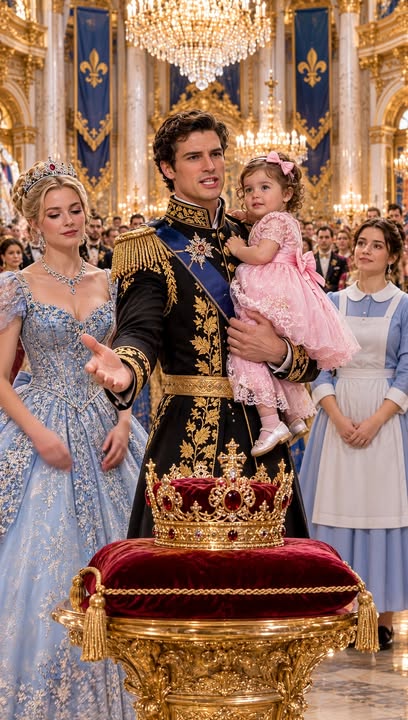
The crown was brought out of its glass case on the first spring morning after the audit ended.
The royal hall was full, but no one had gathered for an engagement or a coronation.
The workers stood beside councilors, clerks beside noble families, and people from the northern villages beside guests from the capital.
The crown rested on a cushion at the center of the room.
Its rubies looked deep and quiet in the morning light.
Adriano stood before the gathered court.
He did not wear the full ceremonial robe.
He had asked that the speech be short, and he began without reading from a prepared page.
“The crown has been used for generations as though its meaning belonged only to those who could wear it,” he said. “Queen Elara’s inscription tells us otherwise.”
He looked toward Sofia.
“It answers to the hand that serves without claim, and to the heart that will not use another’s silence as consent.”
Sofia stood near the front, not beside him and not behind him.
“Heritage has helped us recover a part of our history,” Adriano continued. “But no one’s ancestry can excuse a failure of duty, and no one’s lack of title should prevent the truth from being heard.”
He asked Sofia whether she would like to hold the crown again.
The hall waited, but no one laughed.
Sofia looked first at the crown, then at the people gathered around it.
Mara stood near the back with flour still dusting one sleeve.
Celeste was beside her father.
Beatriz stood with the archivist, her hands folded and her expression open.
Dame Isolde watched from the front row, carrying the worn notebook in which she had first recorded the missing ledger.
Sofia stepped forward.
She did not lift the crown onto her head.
She placed both hands beneath its cushion and raised it carefully, letting the weight rest in her palms.
The rubies brightened.
Not with the fierce blaze of the ceremony, but with a steady red light that touched the gold and the lines of her scarred fingers.
No one gasped.
No one whispered.
The light seemed less like a judgment than a memory the room had agreed to keep.
Sofia lowered the crown back onto its cushion.
“I do not want to rule because the crown once answered me,” she said. “I want us to remember what it asked of us.”
She turned to the council.
“Keep the records open. Keep the questions open. And when someone without a title says the books are wrong, do not ask what they stand to gain before you ask whether the books are true.”
The silence that followed was not the stunned silence of the engagement ceremony.
It was a listening silence.
The council later voted to display the crown in the royal hall, not as an invitation to claim power, but as a reminder that public service carried obligations no ornament could replace.
Its hollow lining remained intact.
The inscription was copied into the archive, where every clerk and council member could read it.
Months passed.
Adriano did not ask Sofia to become his queen.
He asked her to join the new audit board as a representative of the palace workers, with the same authority to question records and request evidence as any other member.
She accepted, provided that the position would not depend on her ancestry or her closeness to the prince.
“It must remain if I am gone,” she told him.
“It will.”
“And the workers must choose their own representatives.”
“They will.”
“And you must be reviewed too.”
“I expect no less.”
Sofia studied him, then smiled.
It was not a large smile, but it reached her eyes.
“Then I will try it.”
Their work brought them together often.
They spent long mornings reviewing contracts and late afternoons walking through the palace departments, asking staff what the reports left out.
Adriano learned that a useful question was often less impressive than a patient silence.
Sofia learned that a promise could be worth considering when the person making it accepted that she might verify it.
They disagreed, sometimes sharply.
When they did, Adriano no longer treated disagreement as disloyalty, and Sofia no longer assumed that every offer of help concealed a demand.
Trust did not arrive like a decree.
It gathered slowly, in small acts that could be repeated.
A chair left beside the open records.
A question asked without an audience.
A correction accepted without resentment.
A plan changed because someone with less power had noticed what the plan would cost.
One evening, after the audit board had finished its work, they walked through the garden as the last light slipped behind the palace roof.
The roses had grown thick along the stone path.
Sofia stopped beside a bench and rested her hands on its cool back.
“I used to think that if I stayed unnoticed, I could keep doing good work without asking anyone to change,” she said.
“And now?”
“Now I think good work sometimes means making sure someone else can see what needs changing.”
Adriano stood beside her, not touching her hand until she turned it toward him.
“You have taught me more than you know.”
“I hope you have learned something from the records too.”
“I have.”
He looked at her with no crown, no ceremony, and no audience between them.
“I do not want you because of your family name,” he said. “And I do not want you because the crown chose to shine. I want you because you make me want to listen when listening is difficult, and because you never ask me to be less honest than I should be.”
Sofia’s gaze stayed on his.
“I do not want to become a symbol in your story.”
“Then we will not make you one.”
“I want to keep the work.”
“So do I.”
“And if we choose each other, I want us to choose freely. Not for the kingdom, not for the council, and not because anyone expects a marriage to solve what honest work must solve.”
“I agree.”
His voice was gentle, without haste.
“Would you like to choose a beginning with me?”
Sofia looked past him toward the palace windows.
Beyond them lay the kitchens with their repaired roof, the archive with its open catalog, the audit office where the accounts could be questioned, and the hall where the crown no longer belonged to a single story.
She thought of the girl she had been, carrying meals to Master Tomas and believing that no one in the palace knew her name.
Then she looked back at Adriano.
“Yes,” she said. “A beginning. Not a promise that either of us will never be wrong.”
“No,” he replied. “A promise that we will tell each other when we are.”
She let him take her hand.
The scarred fingers that had once been hidden in her apron rested in his without being asked to become delicate, royal, or unmarked.
They chose each other slowly, and then again, in the ordinary days that followed.
When they eventually married, the ceremony was smaller than the one the court had planned for Celeste.
The workers stood in the front rows.
Dame Isolde signed the marriage register as a witness.
Celeste came with her family, and Beatriz sat beside her.
Mara brought fresh bread from the palace kitchens, still warm beneath a clean linen cloth.
No one placed the crown on Sofia’s head.
It rested on its cushion in the royal hall, its rubies glowing softly as the morning sun passed through the windows.
Sofia stood beside Adriano, not above the people they served, and not hidden among them.
She had not chosen a crown because the crown had answered her.
She had chosen a life in which no one’s voice would be dismissed before the evidence was heard.
And when the court later spoke of Queen Elara’s inscription, it no longer treated it as a riddle meant to discover who deserved to rule.
It remembered it as a promise the whole kingdom had to keep: that worth was shown through service, and that the hand which served without claim must never again be left unheard.
**–THE END–PLEASE
Share your thoughts or feedback to motivate us to create more stories ♥️
* * *
[PREVIOUS: PART 5](https://storyly.idolsgift.com/blog/part-5-the-seal-beneath-the-ink-069-1)
✓ Lynn R. Adams
Part 6 – The Hand That Chose “It was given by the prince himself.” For a heartbeat, Adriano heard nothing but the rain beginning again against the high windows. The words on the paper were small, w…