PART 6 (THE END): The Roots Beneath the Bark 058
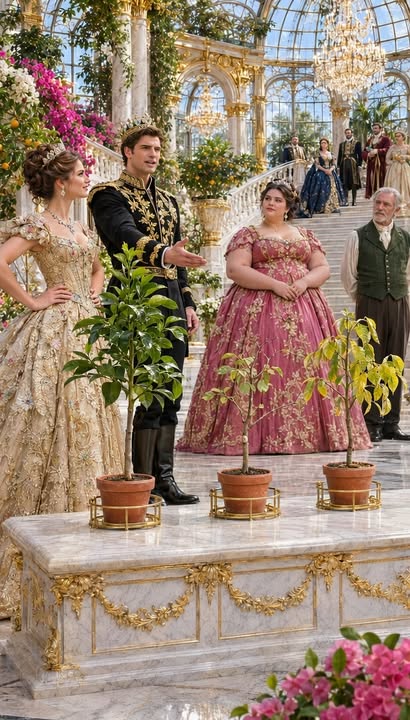
Part 6 – A Garden Shared
“For the day the tree comes home.”
The woman in pink held the metal tag in her palm, brushing away the last grains of soil.
Her mother’s name was clear beneath the old symbol, but the words below it seemed to belong to someone waiting across the years.
The prince crouched beside her, his attention fixed on the engraving.
“Do you know when it was placed here?” he asked.
“No,” she said. “I’ve never seen it before.”
The gardener knelt carefully and examined the earth around the spot.
“It may have been buried when the shelter was built,” he said. “The edges are worn, but the letters look deliberate.”
The noblewoman leaned closer without touching it.
“Could it have been meant as a marker for the tree?”
“Perhaps,” the gardener replied. “Though I would like to see what the old records say before we decide.”
The woman turned the tag over.
Its back was blank, except for a small indentation where a cord might once have passed through.
She thought of the notebook in her house, of her mother’s private marks and unfinished explanations.
All at once, the garden did not feel like a forgotten place.
It felt like a room her mother had left for her, with the door finally opening.
“We should take it to the records room,” the prince said. “And keep it safe.”
She closed her fingers around the tag.
“I’ll bring it myself.”
He nodded, understanding that the choice mattered to her.
The gardener finished marking the new bed while the prince and the noblewoman helped clear the old shelter.
They worked without ceremony, gathering broken branches and measuring the frame for the new glass panels.
When they finished, the three visitors left the garden with the woman in pink carrying the tag and her mother’s notebook.
The palace records room seemed different in the afternoon light.
What had been a place of ledgers and careful ink now held the promise of a connection neither family had known was still waiting to be found.
The gardener laid out the old orchard ledger, the nursery register, and the transfer file.
The prince stood beside him, while the noblewoman opened her folder and placed her copied page alongside the others.
The woman in pink set the metal tag down next to her mother’s notebook.
For a moment, the two objects lay together: the tag weathered and dark, the notebook faded blue, both marked with the same small circle and diagonal line.
The gardener went first to the nursery register.
“The sapling was brought into the conservatory under a common variety name,” he said. “But the entry made when it arrived says Mara Vale asked that the original name be retained.”
“Why would the label have been replaced?” the noblewoman asked.
“I found the work order,” the gardener replied. “It was changed during a repotting, when the old wooden tag split.”
He turned a page and pointed to a note in the margin.
“The gardener who made the new label copied the variety from a neighboring tree. The symbol was transferred from the old tag, but the name was not.”
“So it wasn’t an attempt to hide its identity?” the prince asked.
“Not according to this record. It was a practical mistake made by someone who didn’t know the symbol mattered.”
The woman felt the tightness in her chest ease.
For days, the changed label had seemed like a deliberate erasure.
Now it was a small error, one that had endured because no one knew what the tree’s mark meant.
The prince studied the work order.
“Who made the original tag?”
The gardener checked the older ledger.
“There’s no name, but the transfer file may tell us more.”
He opened the brittle folder and carefully unfolded a sheet tucked behind the queen’s note.
It was a brief inventory of items sent with the cutting when it left the palace orchard.
One line read: “One grafted sapling, one marked tag, one care book.”
The prince looked at the woman.
“Your mother’s notebook.”
She turned it open to the page with the narrow graft.
The gardener compared the handwriting in the inventory with the notes in the ledger.
“The care book was returned with the sapling,” he said. “It must have gone home with Mara and later come back here.”
The woman stared at the notebook.
It had always belonged to her mother, as far as she knew.
But perhaps it had once belonged to both women.
The prince lifted the metal tag and turned it toward the light.
“Could the final line have been added by my mother?”
The gardener examined the engraving.
“The lettering is deeper than the name, but I can’t tell whose hand guided the tool.”
The woman looked closely at the words.
“For the day the tree comes home.”
The letters were not elegant.
They were uneven at the ends, as though whoever made them had been learning as they went.
“My mother used to say that home was the place where someone remembered to water you,” she said.
The prince’s gaze softened.
“That sounds like her.”
“She may have made this tag herself,” the gardener said. “Or your mother may have helped her. The record won’t tell us which.”
“Perhaps they made it together,” the noblewoman said.
The prince looked at the two women’s marks side by side.
“That would fit everything else.”
The gardener read through the remaining entries in the transfer file.
The queen had entrusted the cutting to Mara Vale during the dispute over the orchard, but the tree was never meant to serve as evidence that the palace owned the work.
It was to remain alive, cared for outside the court, until it could be planted where its original purpose might continue.
The woman in pink traced the page with her eyes.
There was no hidden accusation, no lost claim waiting to overturn the past.
There was only a decision made by two friends who understood that love could be protected by letting go.
The prince read his mother’s note once more.
“‘Let the tree go where it can do the work we intended.’”
He folded the paper with careful fingers.
“I thought knowing the truth would tell me exactly what to do.”
“Sometimes it only gives you a better question,” the gardener said.
The prince gave a quiet, appreciative smile.
“Then the question is what work it can do here.”
He looked at the woman in pink.
“What do you think?”
She considered the tag, her mother’s notebook, and the words both women had left behind.
“I think the tree should be planted in the community garden, where it can be cared for by many people.”
She glanced at the prince.
“But I don’t want its story to belong only to the palace or only to my family.”
“It won’t,” he said. “We can tell the truth about both women and let the garden decide what the tree means to the people who care for it now.”
The noblewoman closed her folder.
“And the palace can provide what the garden needs without turning the help into a claim.”
The prince looked toward her.
“Yes.”
She met his eyes without the guarded pride she had once carried.
“I meant what I said.”
“I know.”
A week later, the old shelter had new glass.
The community garden had been cleared, the beds restored, and the soil amended with compost from both the neighborhood and the palace grounds.
The gardener had worked with local volunteers to prepare a raised bed in the warmest, most sheltered corner.
People arrived early on the morning of the planting.
Some had known Mara Vale and brought memories of her small garden.
Others had never met her, but had heard that she could coax fruit from trees that looked nearly finished.
Children gathered near the path with paper cups of water and questions for the gardener.
The noblewoman came in a plain green coat, carrying a box of gardening gloves.
She handed them out without ceremony, then joined a group of volunteers repairing the low wooden border around the new bed.
When one of the children asked whether a prince was really coming, she smiled.
“He is,” she said. “But today he’s here to work.”
The prince arrived a little later with no formal escort.
He wore a dark coat over his uniform, and his hands were bare.
He paused at the gate, taking in the garden’s busy paths and the low voices moving between the beds.
The woman in pink stood beside the prepared planting site.
“Are you ready?” he asked.
“I think so.”
“Does that mean yes?”
“It means I’m ready to do it carefully.”
He smiled.
“That sounds like the right answer.”
The gardener brought the sapling from the sheltered cart.
Its leaves were still sparse, but a new shoot had appeared above the graft since the move into the prepared bed.
The tiny green bud below the seam remained as well.
The gardener set the pot beside the hole.
“Before we begin,” the woman in pink said, “I’d like to put the tag here.”
She held the metal marker in her palm.
The prince nodded.
Together, they fixed it to a short wooden stake at the edge of the bed, where it could be seen without touching the tree.
The engraved words faced the path.
For the day the tree comes home.
The woman stepped back to read them.
The phrase no longer felt like a message sent from one person to another.
It felt like an invitation.
The gardener showed the volunteers how to support the root ball and loosen the pot without disturbing the pale roots.
The prince took one side.
The woman in pink took the other.
This time, she had no oversized gloves to fold back, and she needed no one to tell her where to place her hands.
The noblewoman stood nearby, ready to help if asked, but did not crowd them.
“On my count,” the gardener said. “Slowly, and keep the roots together.”
They lifted.
The root ball slid free of the terracotta, held in a bed of dark soil.
For an instant, the sapling seemed suspended between them.
Then they lowered it into the prepared earth.
The gardener guided the roots into place, and the prince steadied the trunk below the graft.
The woman in pink filled the first space with soil.
A child beside the path offered a small handful of compost.
“Is this enough?” the child asked.
“It’s a good beginning,” the gardener replied.
More hands joined.
The neighbors took turns adding soil, pressing it lightly, and leaving room for water to move through.
The noblewoman worked beside an older volunteer who had brought a trowel from home.
The prince knelt in the earth with the rest of them, listening when the gardener corrected the depth and laughing softly when a clump of soil landed on his sleeve.
At last, the sapling stood in its new bed.
The gardener poured water around its base, slowly enough for the earth to drink.
The woman in pink placed one hand on the edge of the shelter post.
She did not touch the tree.
The prince stood beside her, his sleeve dusted with soil.
“My mother would have liked this,” he said.
“So would mine.”
“Do you think they knew we would be here?”
She looked through the shelter glass at the thin branches, then at the people gathered around them.
“I think they hoped someone would come after them.”
His eyes held hers.
“And now we have.”
The gardener invited everyone to gather near the tag.
The prince spoke simply, without a royal announcement or a formal speech.
He told them that his mother and Mara Vale had chosen the graft together, and that the queen had entrusted it to Mara when the orchard faced an uncertain future.
He spoke of the records, the crossed-out lines, and the long years in which the tree had been cared for without its full story being known.
Then he looked toward the woman in pink.
“This tree was found because she noticed what others had overlooked,” he said. “She did not mistake healthy appearances for strength, and she did not pretend to know more than she did.”
The woman felt the gathered faces turn toward her.
This time, their attention did not feel like judgment.
The prince continued.
“The tree survived because two women cared for it together, and because that care continued beyond the palace walls. We are grateful to Mara Vale, to my mother, and to everyone here who will tend it from this day on.”
The applause began among the neighbors, not the courtiers.
It was warm, unhurried, and joined by the people who had brought tools, compost, food, and memories.
The woman in pink looked down, blinking against the bright light beneath the glass.
The noblewoman stepped forward after the applause had quieted.
“I would like to add something,” she said.
She looked first at the woman in pink.
“I judged her before I understood how much she was seeing. I was wrong, and I’m sorry.”
The apology was clear enough for the people nearby to hear, but it was not offered as a performance.
“I also believed that the most beautiful thing in a garden was the thing most worth saving,” she continued. “I have learned that beauty is not always easy to see, and that caring for something matters more than being praised for choosing it.”
The woman in pink met her eyes.
“I accept your apology.”
The noblewoman’s shoulders eased.
“Thank you.”
“And you’re welcome here,” the younger woman added. “If you’re willing to keep working.”
The noblewoman smiled, and this time the smile held no contest.
“I brought gloves.”
The gathering slowly became a garden afternoon.
The prince carried planks to the side of the shelter with two volunteers.
The noblewoman helped repair a sagging path marker.
The gardener showed the children how to check the soil without pulling at the roots.
Someone brought bread and fruit, and people gathered beneath the shelter to share it.
The woman in pink found herself sitting beside the prince on the low stone wall.
Beyond them, the sapling stood upright in the newly settled earth.
Its small leaves shifted in the light breeze.
“Do you think it will take?” he asked.
The gardener, nearby, heard him.
“It has a good chance,” he said. “The roots are alive, the soil is ready, and more than one person knows how to care for it.”
The prince glanced toward the woman in pink.
“That sounds like a good answer.”
“It is an honest one,” she said.
He looked at the new shoot above the graft.
“I used to think the tree was the last piece of my mother’s orchard.”
“Perhaps it was a piece of her,” she said. “Not the last piece.”
He considered that, then looked around at the neighbors.
“I think you’re right.”
The woman rested her hands on the stone between them.
“My mother never told me the whole story.”
“Do you wish she had?”
“Sometimes.” She watched a volunteer fill a watering can. “But I understand why she kept it private. She wanted the tree to be cared for, not argued over.”
“My mother’s note says much the same thing.”
They sat quietly, without needing to fill the space between them with certainty.
Across the garden, the noblewoman was laughing with the child who had offered the compost.
The gardener was answering a question about the graft.
The tag stood at the edge of the bed, weathered letters facing the path.
The prince turned toward the woman in pink.
“I’m glad you came to the conservatory that day.”
“So am I.”
“I was going to ask whether you might visit again sometime.”
She glanced at him, amused.
“Somewhere with fewer courtiers?”
“Somewhere we can talk without an audience.”
“That sounds nice.”
“Then may I ask you to have supper with me?”
The invitation was simple, and so was his patience while he waited for her answer.
“Yes,” she said. “But I’d like to come back here tomorrow morning first.”
“To check on the tree?”
“To check on the soil.”
“And after that?”
“After that, supper.”
His smile brightened.
“Then I’ll meet you here.”
The garden’s people began to drift home as the afternoon softened.
Before leaving, the gardener checked the soil one final time and showed two volunteers how much water the sapling would need the next morning.
The prince remained until the last tools had been returned and the shelter door had been latched.
The woman in pink stood by the wooden tag.
“For the day the tree comes home,” she read aloud.
“Do you think today was the day?” the prince asked.
She looked at the tree, then at the garden where their mothers’ work had found new hands.
“I think coming home is something it will keep doing.”
He offered her his arm, not as a prince leading someone through a court, but as a man asking whether she would walk beside him.
She took it.
Together, they followed the garden path beneath the new glass shelter, past the bed where the sapling had taken root.
Behind them, the tiny green bud held to the stem, small and bright against the old graft.
Ahead of them waited the next morning, another careful look at the soil, and the beginning of a life neither had to grow alone.
**–THE END–PLEASE
Share your thoughts or feedback to motivate us to create more stories ♥️
* * *
[PREVIOUS: PART 5](https://storyly.idolsgift.com/blog/part-5-the-roots-beneath-the-bark-058)
✓ Lynn R. Adams
Part 6 – A Garden Shared “For the day the tree comes home.” The woman in pink held the metal tag in her palm, brushing away the last grains of soil. Her mother’s name was clear beneath the old symb…