PART 6 (THE END): The Room That Had Waited 056
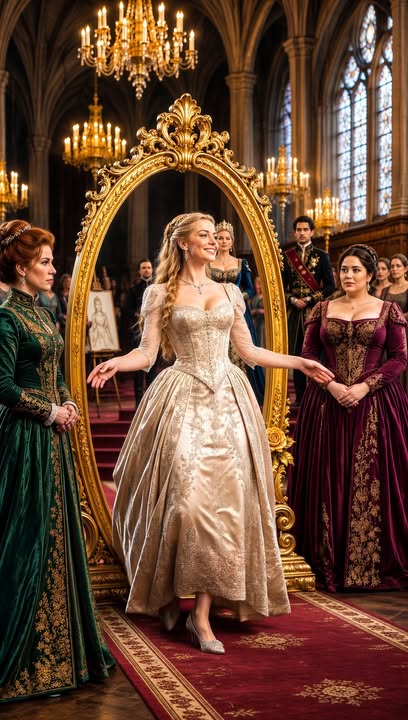
Part 6 – The Door Left Open
Adrian held the new brass key in his palm, turning it until the word scratched into its bow caught the light.
“Together,” he said.
The Queen’s hand rose to her lips, and for a moment she seemed unable to draw breath.
Lucía watched the three of them standing beneath the hall’s high windows, surrounded by a court that had just heard the truth and did not yet know what to do with it.
Then Adrian closed his fingers around the key.
“We should answer her,” he said.
Elara looked toward the open doors.
“Yes.”
“Not with another letter that might take days to reach her.”
“No,” the Queen said. “Not if she is close enough to hear.”
Adrian’s eyes moved to Lucía.
“Do you think the key means she wants us to find her?”
“I think it means she wants you to make the next step together,” Lucía replied. “I would not ask it to say more than that.”
He nodded, accepting the caution.
The messenger had waited near the doors, but he had no further news about the rider or the letter’s origin.
The Queen thanked him and asked him to stay nearby in case another message arrived.
Then she turned to her son.
“Where would you like to begin?”
For nine years, Adrian had imagined a thousand ways of finding his sister.
Now that she might be near, he did not rush toward the gates or send riders down every road.
He looked at the brass key and seemed to hear the request inside it.
“Not with a search,” he said. “With an invitation.”
Elara’s eyes softened.
“Then we will send one.”
The clerk brought paper, ink, and a fresh seal.
Adrian wrote the first line, then stopped.
He looked at his mother.
“You should write the rest.”
Elara did not reach for the pen at once.
“What should I say?”
“That you are sorry,” he answered. “And that she can come back without having to explain anything she doesn’t want to explain.”
The Queen sat at the table and began.
She wrote slowly, leaving room between each sentence as if she wanted every word to have space to be chosen.
She told Isolde that the court had been informed, that the false account was no longer being upheld, and that no one would be asked to reveal her route or the people who had helped her.
She told her she could enter the palace as a daughter, not as a princess required to resume a place she had never chosen.
At the end, Elara paused.
Adrian took the pen from her and added one line.
I have missed you, and I will listen.
He returned the pen.
The Queen read what he had written, then signed her name beneath it.
They sealed the letter together, using the small rose stamp the messenger had brought with the first note.
The messenger agreed to carry it to the eastern gate, where the rider had left the earlier message.
He did not promise when it would be delivered.
The family did not ask him to promise.
That evening, Adrian walked with his mother through the east tower corridor.
The chamber door stood open.
No seal crossed its seam now, and no one had asked the steward to close it.
Inside, the morning light had faded from the curtains, leaving the room quiet beneath the lamps.
The desk remained open, the letter to Adrian resting beneath a sheet of protective paper.
The portrait-shaped space on the wall was still empty.
Adrian stood before it for a long time.
“I used to think that if I could keep the room exactly as she left it, I could keep her close,” he said.
Elara came to stand beside him.
“And now?”
“Now I think I kept myself from learning what she needed.”
His mother did not reach for him.
She waited.
After a while, Adrian took her hand.
They stood together before the empty wall, not trying to fill it with promises.
The next morning, the Queen summoned the appointment committee.
Lucía entered the chamber carrying her workshop’s records, prepared to answer questions and accept whatever judgment followed.
Her palms were damp against the folder.
She thought of her apprentices and of the work still waiting at home, where the familiar smells of linseed oil and damp paper had always steadied her.
The senior committee member asked about the restored frame, the chain of custody for Isolde’s letters, and Lucía’s decisions during the examination.
She answered without embellishment.
When asked whether she had ever acted without permission, she described each step, including the places where she had stopped rather than force a hidden panel.
The Queen listened without interrupting.
Adrian sat beside her, his face tired but composed.
At last, the senior member closed the file.
“Lady Vale, your appointment was not made for your ability to step through a presentation frame,” he said. “It was made for your ability to see what needs protecting, and to know when not to force it.”
Lucía’s breath caught.
“The committee appoints you Keeper of the Royal Gallery,” he continued. “Your workshop’s contract will be renewed, with the understanding that the apprentices who have worked on the palace’s collections remain part of the team.”
For a moment, Lucía could not find her voice.
She thought of the young restorers who had trusted her when the contract was uncertain, and of the careful work they would now be allowed to finish.
“Thank you,” she said at last. “I will do the work well.”
The committee member smiled.
“We expect nothing less.”
Lord Veyne stood near the window.
His own workshop’s hopes had not been granted, but he looked neither defeated nor angry.
He approached Lucía after the meeting.
“Your appointment was earned,” he said. “I hope you will allow my workshop to assist with future projects when the palace needs more hands.”
“I would welcome good work,” Lucía replied. “And careful records.”
Veyne gave a small, rueful smile.
“Fair enough.”
The Queen waited until he had gone before offering Lucía her hand.
“Your family has kept these collections safe for years,” she said. “Now you will have the authority to care for them as you think best.”
“I’m grateful, Your Majesty.”
“You need not call me that when we are alone.”
Lucía looked at her, then smiled.
“Then I’m grateful, Elara.”
The Queen’s fingers closed warmly around hers.
A week passed.
The palace made no announcement about a date for Isolde’s arrival, and no search was sent out to find her.
Elara’s public statement was copied into the royal records, where the old account of the storm had stood for nine years.
The amended record said plainly that Isolde had left by choice, with her mother’s help, and that her destination had been kept private at her request.
It did not name the people who had assisted her.
It did not repeat the private words she had written.
The court had questions, but the Queen answered only what belonged to the public truth.
When an older nobleman asked whether Isolde would resume her former duties, Elara said that was for Isolde to decide.
When another asked whether the palace would restore the old engagement, the Queen replied that no such arrangement existed and none would be made on Isolde’s behalf.
Adrian stood beside her at each gathering.
He did not speak for his sister.
He did not ask the court to pity him.
He listened.
In the gallery, Lucía began the careful restoration of the Queen’s Frame.
She cleaned the carved gold with soft brushes and mild solutions, revealing the delicate leaves beneath years of smoke and handling.
The hidden compartment remained open during the work, protected by a fitted support.
Lucía refused to seal it away again.
Instead, she designed a discreet cover that would preserve the papers while leaving the secret panel visible to anyone who knew where to look.
The old rose was cleaned and strengthened, but she did not make every petal identical.
The brightest one, the one that had released the first key, retained a subtle difference in color.
“That petal should stay as it is,” Adrian said when she showed him the finished surface.
“It will,” Lucía replied. “The repair should not erase the mark that helped us find it.”
He regarded the rose with a tenderness he had not shown the frame before.
“Isolde would have liked that.”
“Then I’m glad.”
The missing portrait remained a mystery no one attempted to solve by force.
The Queen told Lucía that it had not been in the tower chamber when the room was sealed, though she had no memory of where it went afterward.
The household accounts offered no record of its removal.
The restoration register’s cut page could not be recovered.
Lucía made a note of each fact, and of each uncertainty.
She did not fill the gaps with guesses.
The old portrait itself was not found.
But one afternoon, while examining the back of the damaged sketch from the desk, Lucía noticed faint blue marks where the paper had been folded.
They were not part of the drawing.
Under angled light, the marks formed a handful of strokes that might once have been notes about the frame’s repair.
The writing was too faint to read as a sentence, but a small rose had been drawn beside it, with one petal left uncolored.
Lucía placed the sketch in the archive beside the letters.
Some mysteries, she knew, could be carried without being solved.
On the ninth day after the Queen’s statement, a messenger arrived at the eastern gate shortly before noon.
This time he carried no envelope.
He carried only a small sprig of rosemary tied with blue thread.
The palace messenger brought it to Adrian and the Queen.
The rosemary’s scent was fresh and sharp, and the blue thread was knotted with a single loop.
Elara touched the sprig as if it were a hand.
“She used to tuck rosemary into her books,” she said.
Adrian looked toward the entrance.
“Did the messenger see the rider?”
“No,” the messenger said. “A traveler left it at the gate and asked that it be given to the Queen. They said the traveler would return before sunset.”
No one sent a guard to follow the road.
No one asked the traveler’s name.
The family waited in the gallery, where the Queen’s Frame stood restored but still open along its inner rim.
Lucía continued working at the table nearby, though her attention wandered each time footsteps sounded in the corridor.
Adrian paced once, then stopped.
He went to stand beside the golden rose.
“I don’t know what I’ll say,” he admitted.
“You can say what is true,” Lucía replied.
“What if the truth is only that I missed her?”
“Then that is enough to begin with.”
The Queen sat beneath the windows.
She held the rosemary in both hands, careful not to crush its leaves.
The afternoon passed slowly.
At sunset, the gallery turned amber, and the last light gathered along the carved edges of the frame.
Footsteps sounded beyond the entrance.
Adrian stopped moving.
The messenger appeared first, then stepped aside.
A woman stood behind him, dressed in a travel-stained gray cloak with a small leather case in one hand.
Her dark hair had been cut shorter than it was in the portrait Adrian remembered.
A faint silver thread shone near one temple.
She looked first at the Queen, then at the frame, and finally at her brother.
No one rushed toward her.
For one suspended moment, they all seemed to be making room for the person she had become.
Then Adrian said, “Isolde.”
She smiled, though her eyes were already bright.
“Adrian.”
He took a step toward her and stopped.
“May I—?”
“Yes,” she said.
He crossed the space between them and embraced her.
His arms closed around her carefully, then more tightly when she rested her head against his shoulder.
She held him in return.
The years between them did not disappear.
They were there in the way he hesitated before touching her hair, in the way she kept one hand around the handle of her travel case, and in the tears neither of them tried to hide.
But she was real, and she was there, and she had come without anyone having to drag her home.
When they separated, Adrian kept both hands at her shoulders.
“I’m sorry I thought the locked room could keep you close,” he said.
“I’m sorry I left you with only an unfinished letter.”
“I read it.”
“I hoped you would.”
“It took me a long time to understand it.”
“You didn’t have to understand it all at once.”
The Queen had risen, but she did not move nearer until Isolde looked toward her.
“Mother,” Isolde said.
Elara’s voice trembled.
“I told the truth.”
“I heard.”
“I should have done it sooner.”
“Yes.”
“I know.”
Isolde put down her case.
For a moment, neither of them spoke.
Then Elara asked, “May I hold you?”
Isolde went to her.
The Queen wrapped her arms around her daughter, and Isolde rested her cheek against Elara’s shoulder.
Elara closed her eyes.
“I will not ask you to stay,” she whispered.
“I know.”
“I will not ask you to tell me where you have been.”
“Thank you.”
“I only want to know what you want now.”
Isolde drew back enough to meet her mother’s eyes.
“I want to stay for a while. I want to see Adrian without the court deciding what our reunion means. I want to work, and to leave when I need to leave.”
“You may,” Elara said.
“Then I would like to begin with supper.”
Adrian laughed, a sound bright with relief and disbelief.
“Supper I can manage.”
“Good,” Isolde said. “I’ve had a long day of traveling.”
Lucía came around the worktable.
Isolde looked at her.
“You found the key.”
“I did.”
“And the room?”
“We found your letter.”
“I wondered if you would.”
“Your note led us to the frame.”
Isolde smiled faintly.
“The rose remembers.”
“It did.”
Her gaze settled on the restored frame.
“Did you keep the compartment?”
“Yes,” Lucía said. “It is protected, but not hidden.”
“Good.”
Lucía hesitated.
“Your portrait is still missing.”
“I know.”
“Would you like us to search for it?”
Isolde considered the question.
“Not yet. I may decide I want it someday, but I don’t want my return to begin with another search.”
“Then we won’t search,” Lucía said.
“Thank you.”
Isolde glanced toward the rose at the frame’s base.
“Does it still open?”
Lucía pressed the brightened petal.
A small click sounded beneath the carving.
The hidden compartment shifted gently outward, revealing the place where the iron key had rested.
Adrian smiled.
“Some doors should stay easy to open.”
“And some should be opened only when everyone agrees,” Isolde replied.
They stood together before the frame, the Queen beside her children, Lucía nearby with pigment on her fingertips and the work of the gallery waiting in the quiet around them.
No one suggested that the lost years could be returned.
No one asked Isolde to make them easier to bear by pretending they had not mattered.
When supper was ready, she left her travel case beside the doorway and walked with her family toward the palace rooms.
She did not promise to remain forever.
They did not ask her to.
In the gallery, the Queen’s Frame held its secrets in the open, its golden rose catching the last light.
For the first time in nine years, the east tower chamber would not need to be kept ready for a ghost.
And for the first time in nine years, the door to it was left unlocked.
**–THE END–PLEASE
Share your thoughts or feedback to motivate us to create more stories ♥️
* * *
[PREVIOUS: PART 5](https://storyly.idolsgift.com/blog/part-5-the-room-that-had-waited-056)
✓ Lynn R. Adams
Part 6 – The Door Left Open Adrian held the new brass key in his palm, turning it until the word scratched into its bow caught the light. “Together,” he said. The Queen’s hand rose to her lips, and…