PART 6 (THE END): The Ribbon in the Portrait 053
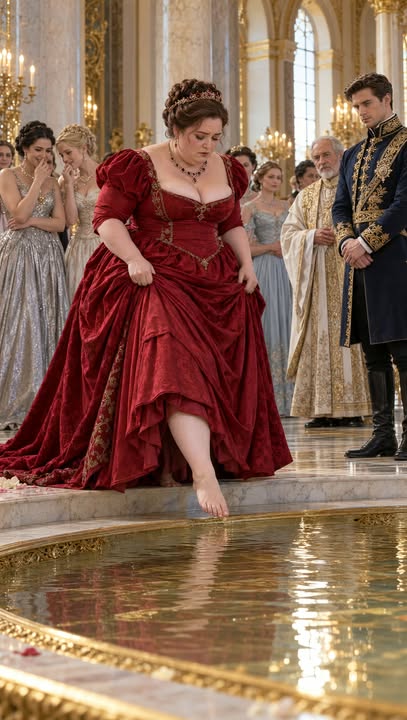
Part 6 – A Future of Their Own
The king’s summons brought them back to the council chamber before anyone could discover what the key opened.
Celene walked beside Isabella, holding her mother’s folded petition as if its weight had changed since she learned it had been submitted.
“I didn’t ask for this,” she said quietly.
“I believe you,” Isabella replied.
“I thought my family might want the record preserved. I never thought they would ask the court to make me a claimant.”
“Perhaps they thought they were protecting you.”
“Perhaps,” Celene said. “But I wish they had asked what I wanted.”
The words lingered between them, familiar in a way neither had expected.
Inside the chamber, the king sat at the head of the table.
He was a thoughtful-looking man with silver at his temples, and he listened without interruption as Soren explained the discovery behind Queen Elara’s portrait.
The brass key rested on a folded cloth beside the sealed petition.
When Soren had finished, the king looked at Celene.
“Did you authorize your family to submit this?”
“No, Your Majesty.”
“Do you wish to claim the throne?”
“No.”
“Would you accept it if the council asked you to?”
Celene drew a steady breath.
“I would ask why the council believed my blood gave it the right to ask.”
A few ministers shifted in their seats.
The king did not.
“And you, Lady Isabella?” he asked.
“I have already said I will not claim the ancient throne.”
“Is that still your answer?”
“Yes.”
The king looked toward the travel ledger and the copies of Queen Elara’s letters.
“Then we will not make either of you answer for your families’ choices.”
Lord Halvern leaned forward.
“Your Majesty, the kingdom still needs a clear understanding of the succession.”
“It needs more than an understanding,” the king said. “It needs a succession that does not depend on guessing what a pool means or turning a family record into a command.”
His gaze moved to the brass key.
“Do we know what this opens?”
“Not yet,” Soren said.
“Then let us find out before we draw more conclusions.”
The king gave permission for the key to be tried against the locks in Queen Elara’s rooms and the private archive.
It fit neither.
Soren asked the archivist to search the old inventory for any mention of a small lockbox, cabinet, or writing desk that had belonged to the queen’s sister.
Master Vale returned from the archive with a thin catalogue, its pages carefully marked.
“There is one item not accounted for,” she said. “A cedar dispatch box listed among Princess Mara’s personal belongings.”
“Where was it kept?” Adrian asked.
“The catalogue says the west gallery, before the renovations.”
They crossed the palace together, with the king’s permission and the archivist carrying her record book.
The west gallery was smaller and less grand than the rooms where portraits of monarchs lined the walls.
It had once served as a quiet passage between the royal apartments and the gardens.
A narrow writing desk stood beneath a window, its drawers empty except for a scatter of old paper clips and a dried orange blossom.
Master Vale examined the desk.
“Nothing here is listed as belonging to Princess Mara.”
“Could the dispatch box have been moved?” Isabella asked.
“Almost certainly,” Soren replied. “The question is where.”
Adrian traced the edge of the desk with his eyes.
“Mother used to bring letters here when she wanted to read without being disturbed.”
“Did she mention the box?”
“No. But she kept a cedar chest in her bedroom.”
They returned to Queen Elara’s former rooms, now preserved but rarely used.
A small cedar chest stood beneath the window, its wood darkened with age.
The brass key turned in its lock.
Inside lay a bundle of letters, a pressed orange blossom, and a modest silver pin shaped like a sprig of leaves.
There was no crown, no royal seal, and no document declaring an heir.
At the top of the letters lay a card in Queen Elara’s handwriting.
For Mara, and for anyone who needs to remember that love is not ownership.
Soren lowered his eyes.
The king read the card, then carefully lifted the first letter.
“May I?” Isabella asked.
He handed it to her.
The letter was addressed to Princess Mara, written in the weeks before she left the kingdom.
“My dearest sister,” Isabella read aloud, “I am sorry that the court has made your refusal sound like a problem to be solved. You do not owe your life to the plans other people have made for you.”
The room became very still.
The letter continued in the same clear hand.
“If you leave, I will miss you every day. I will also know that you have chosen your own path, and that is a better inheritance than any title I could place in your hands.”
Isabella paused.
The line carried the quiet strength of a woman who loved her sister enough not to ask her to stay.
She thought of Miriam’s letter, of the words she had left for a future she could not see.
Tell her the truth before anyone asks her to carry a crown.
Soren took the next letter and turned it gently over.
“This one is from Mara,” he said.
The date was several years later, and the handwriting was different from the note tucked into the archive.
Princess Mara wrote of a modest home near the sea, of work she enjoyed, and of a daughter who had learned to recognize the pattern on the yellow ribbon.
She wrote that she had married by choice.
She wrote that her daughter Anna had inherited the ribbon and that she hoped the women after them would inherit the freedom it represented.
Near the end, she added a sentence in the margin.
“If one of them returns to the palace, let it be because she wishes to visit, never because the palace has called her home.”
Isabella pressed her fingers to the edge of the page.
There it was: the missing meaning of the ribbon, not a mark of rank but a promise between sisters.
The pattern had traveled through the family because it was precious.
It had survived because women had chosen to carry it, not because a palace had claimed it.
“Does this prove the line?” the king asked Soren.
“It confirms the family connection, and the chart in the archive traces the descendants,” he replied. “The letters are consistent with the records and with the keepsake Isabella remembers.”
“But not every generation is documented.”
“No,” Soren said. “There are gaps. The family’s history was protected, not formally recorded.”
Isabella looked at the king.
“My mother’s birth papers may fill some of those gaps.”
“Then we can ask for them,” he said.
“I will share what I choose to share,” she replied. “They belonged to the woman who raised me.”
“Of course.”
There was no disappointment in his expression, no demand for more.
The king’s answer did not make the past simple, but it allowed Isabella to feel that her privacy could remain part of her inheritance.
They made copies of the relevant letters and sent a careful request to America for the records Miriam had kept.
Weeks passed before the response arrived.
Isabella spent those weeks learning the kingdom not through ceremonies, but through ordinary days.
She visited the palace school and listened to children read aloud beneath a mural of the old gardens.
She walked through the villages Queen Elara had once supported and found that the repaired bridge still carried families across the river.
She met with archivists, gardeners, and local council members, hearing the stories that never appeared in royal ledgers.
Adrian joined her when invited and stayed away when she asked for time alone.
He did not turn their work into a courtship.
That became, in its own quiet way, the beginning of trust.
Sometimes they argued about how much the palace could change at once.
Sometimes they agreed to disagree and returned to the same question days later.
Neither of them used their disagreements as proof that the other was unworthy.
Celene remained in the capital while her family petition was reviewed.
She spoke with her mother, then wrote to the council asking that her lineage be recorded without naming her as a claimant.
The request was not immediately granted, but she did not withdraw it.
“I’m learning that telling the truth is easier than deciding what everyone else will do with it,” she told Isabella one afternoon in the garden.
“I’m learning that refusing a role doesn’t mean the role disappears,” Isabella replied.
Celene smiled.
“Perhaps we can help the next person refuse it sooner.”
The king called a public assembly at the end of the season.
He did not announce a new heir to the ancient line.
Instead, he acknowledged that the pool had confirmed a family connection, while the letters revealed that the women of that family had repeatedly chosen lives beyond the palace.
He also read Queen Elara’s words about the ribbon and her sister.
The old tradition, he said, would no longer be used to judge a woman’s worth or determine whether she should marry.
The golden pool would remain open to the public as a place of remembrance, not a test.
Then Isabella stepped forward.
She had not planned to make a speech, but when she saw the faces gathered across the courtyard, she understood that silence could allow the old story to take its place again.
“I was told the pool might show who I was,” she said. “It showed that my family belonged to a history this palace had forgotten.”
She paused, looking toward the pool.
“But it did not tell me what to do with that history.”
The water lay gold beneath the afternoon sun, quiet and ordinary.
“My ancestors were not preserved because they stayed in a palace,” she continued. “They were remembered because they chose, and because the people who loved them did not confuse love with ownership.”
She saw Adrian at the edge of the crowd.
He was listening, but he did not stand beside her as if her words belonged to him.
“The pool will be a symbol,” she said. “It will remind us that every person has a choice. It will not decide who is worthy to lead, whom anyone should marry, or what future a family must accept.”
The king stood and asked the assembly to support a charter reflecting those principles.
The charter would establish a council that included representatives from across the kingdom.
It would make succession a matter of public law rather than private bloodline claims, and it would protect the right of any member of the royal family to decline a title or position.
The ancient pool would be preserved, but its green light would no longer be treated as a verdict.
The response came slowly.
There were questions, disagreements, and several difficult months of public discussion.
Some nobles worried that tradition was being discarded.
Others believed the change did not go far enough.
The king allowed the debate to continue, and Celene spoke for the right to preserve family histories without turning them into obligations.
Soren presented Queen Elara’s letters to the council, not as proof of who should rule, but as evidence of what the old rules had cost.
In the end, the charter passed with revisions and safeguards that would require future rulers to seek the council’s consent.
It did not solve every problem.
It gave the kingdom a way to face problems without assigning a woman’s life as their answer.
The papers from America arrived several weeks later.
Inside the package were Miriam’s birth certificate, a handful of letters, and a small envelope wrapped in soft tissue.
The yellow ribbon was folded inside.
Its stitched border matched the pattern in Queen Elara’s portrait, the tiny diamonds crossed by three short lines.
Isabella held it in both hands.
For a while, she could not speak.
The cloth was thinner than she remembered, worn smooth at the fold.
It smelled faintly of cedar from the box where Miriam had kept it.
Alongside it was a note from Miriam, written in the same hand as the letter from the archive.
“My dear girl,” it began, “I never wanted this ribbon to become a road that led you away from the life we made together. I wanted it to remind you that you were loved before you knew your name, and that you could always choose what came next.”
Isabella read the note twice.
Miriam had known that the ribbon connected their family to Queen Elara’s sister.
She had not known what the pool might do, nor that the palace would one day find Isabella.
She had kept the secret imperfectly, out of love and fear of an old history returning with old demands.
Isabella wished she could ask why Miriam had waited.
She wished she could tell her that the truth had hurt and helped in equal measure.
Most of all, she wished she could thank her.
Instead, she folded the note and held the ribbon against her heart.
The mysteries had not led her away from Miriam.
They had shown her how much of her mother’s love had been hidden in the care she took to leave Isabella free.
That evening, Isabella found Adrian in the eastern garden, beneath the orange tree where they had first spoken alone.
He was holding no flowers, no ring, and no speech prepared for the court.
He stood when she approached.
“Did the papers answer your questions?” he asked.
“Some of them.”
“Did they give you the answer you wanted?”
“I don’t know what answer I wanted.”
He accepted that.
They walked beneath the branches, where the small oranges were beginning to ripen.
The courtyard beyond the garden was quiet.
No one was waiting to learn what the pool had chosen.
No council had summoned Isabella to declare a future.
For the first time since she had arrived, the palace seemed to make room for uncertainty.
“I want to ask you something,” Adrian said.
She looked at him.
“Before you do, tell me what has changed.”
He considered the question carefully.
“I used to think doing the right thing meant keeping the court steady,” he said. “I thought if I avoided conflict, I was protecting the people around me.”
“And now?”
“Now I know that peace without choice can become another kind of pressure. I’m still learning how to lead without deciding what other people need for them.”
Isabella watched his face.
He did not sound finished.
That was one reason she believed him.
“And what do you want?” she asked.
“To stand beside you, if you choose it,” he said. “Not because our families make a useful story, and not because a pool changed color.”
“Would you still want that if I never wore a crown?”
“Yes.”
“Would you still want it if I went back to America for a while?”
“Yes.”
“Would you still want it if I changed my mind about staying?”
“Yes,” he said. “I would be sad, but I would want you to choose honestly.”
The answer moved through her more deeply than a promise that he would never be sad.
She had spent so long guarding the space around her choices that she had not realized how much she wanted someone to stand there without closing it.
Adrian took a breath.
“Isabella, will you marry me?”
The question was gentle, and it belonged to him at last—not the court, the council, the pool, or a plan for uniting two lines.
She felt the old hesitation rise, then settle into something clearer.
“Yes,” she said. “But not as the ancient line’s answer, and not as the kingdom’s solution.”
“Only as yourself,” he replied.
“And only as yourself.”
“Then yes.”
She smiled, and this time the smile did not come from relief or from anyone else’s expectation.
It came because she wanted to be there.
Adrian did not reach for her until she offered her hand.
When she did, he held it as if it were a choice he understood could be changed, though he hoped it would not.
They did not announce the engagement that evening.
They kept it between them for a little while, enjoying the rare sweetness of a decision that belonged to no one else.
Months later, they married in the palace garden beneath the orange trees.
Celene attended, carrying no family document and standing not as a rival but as a friend.
Lord Soren sat near the front, with a copy of Queen Elara’s letter tucked safely in the archive behind him.
The wedding was small enough for laughter to reach the vows.
There was no golden pool ceremony.
Afterward, Isabella and Adrian walked to the pool together, where the water reflected the open sky.
It remained gold.
Isabella did not ask it to change.
The court had begun to understand that the pool’s greatest gift had never been the power to select a ruler.
Its meaning lay in the choice it could not make for anyone.
As the evening light settled over the garden, Isabella thought of Mara, Elara, Miriam, and all the women whose names had been left out of official records because they had wanted a life no title could provide.
Their history had traveled through a ribbon, a few letters, and the love of a mother who had tried to protect her daughter’s freedom.
Now it would be remembered openly.
Not as a claim.
Not as a command.
As a promise that the future could belong to the person who had to live it.
**–THE END–PLEASE
Share your thoughts or feedback to motivate us to create more stories ♥️
* * *
[PREVIOUS: PART 5](https://storyly.idolsgift.com/blog/part-5-the-ribbon-in-the-portrait-053-3)
✓ Lynn R. Adams
Part 6 – A Future of Their Own The king’s summons brought them back to the council chamber before anyone could discover what the key opened. Celene walked beside Isabella, holding her mother’s folde…