PART 6 (THE END): The Rhythm Beneath the Drums 069
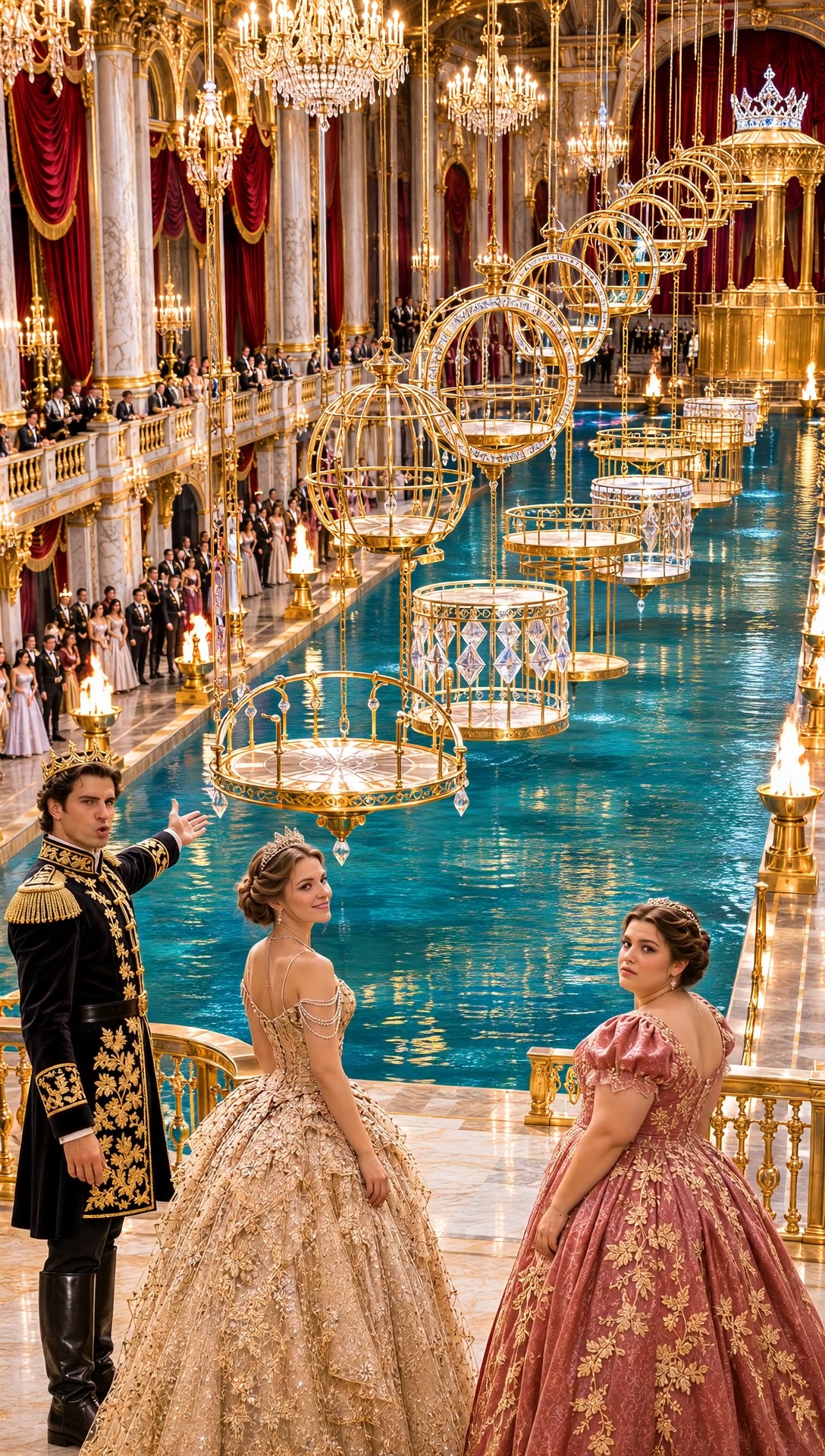
Part 6 – The Song That Brought Them Home
“Wait for the one who turns back.”
Mara read the words once, then again, while the ballroom held its breath around her.
The crown’s open panel revealed a slender lever, its brass handle worn smooth by time.
Beside it, the engraved notes began with three quick marks, followed by a rest and a pair of notes that rose and fell like a question.
Adrian came to stand at her side, careful to leave her room.
“Do you recognize the handwriting?”
Mara bent toward the panel without touching it.
“The shape of the letters looks like my father’s work,” she said. “But I can’t be certain from here.”
The engineer raised his lantern.
“May I examine it?”
Mara stepped aside, and he leaned close enough to study the lever and the notes.
“The panel appears to be part of the original stopping assembly,” he said. “It is not connected to the replacement gear, at least not directly.”
“Could pulling the lever halt the course?” Adrian asked.
“I don’t know.”
The engineer’s answer was measured, but the uncertainty seemed to deepen the silence.
He traced the outside of the panel with a careful glance.
“The mechanism is under tension. We should not touch the lever until we know how the final measure works.”
Mistress Orla opened the queen’s letter again, reading the lines by lantern light.
“I found the missing measure,” she said. “It is written at the bottom of the second page, but the ink is faint.”
“Can you read it?” Celestine asked.
Mistress Orla tilted the paper.
“Three quick notes, then a rest. Two notes, then another rest. The final instruction says, ‘Hold until the answer is given.’”
Mara’s gaze returned to the lever.
“An answer from what?”
“Perhaps the machinery,” the engineer said. “Perhaps the musicians.”
“Or perhaps the person who turns back,” Celestine murmured.
Her shoulder was still tender, but she stood without leaning on the physician.
The words on the panel seemed to have been waiting for her, too.
Mara glanced at her.
“You turned back from the course when you realized what the note meant.”
“I didn’t turn back very gracefully.”
“You still did.”
Celestine’s eyes softened.
The engineer looked from the panel to the mechanism above the pool.
“If this lever releases the last tension, the frames may settle. But I can’t guarantee that until we compare its linkage with the full score.”
“Can we inspect it without moving anything?” Adrian asked.
“Yes, if the counterweights remain secured.”
“Then we inspect it.”
The engineer signaled to his assistants, who moved the lanterns closer and examined the panel from either side.
They uncovered a narrow line of tiny lettering along the brass edge.
Mara leaned in, careful to keep her hands to herself.
The letters were worn, but several remained legible.
“Not for the first to arrive,” she read.
“Not for the last to wait.”
The final words had been partly polished away.
Adrian looked at the engraved instruction.
“Wait for the one who turns back.”
The engineer studied the small linkage.
“Whoever designed this wanted the person who reached the crown to decide whether to stop the course.”
Mara stared at the lever.
The crown had never been merely a prize at the end of the path.
It was also where the course could be safely ended.
Perhaps the true measure was not whether someone could reach the crown, but what they did once they had the chance.
“Could this be Queen Elara’s work?” Celestine asked.
“The engraving is old,” the engineer said. “The mechanism may be older still.”
Mara thought of the new gear, its polished edges and hurried return.
That piece had not belonged to the original design.
It had changed the timing, obscured the old measure, and made the course appear to reward speed.
The words on the panel said something different.
Wait.
Listen.
Turn back when someone needs you.
“I think the lever is part of the stopping sequence,” Mara said. “But we need the full music and the course at rest before we use it.”
The engineer nodded.
“Agreed.”
Adrian addressed the attendants.
“Keep the area clear, and make sure Celestine is taken to the physician’s room.”
“I can walk there,” Celestine said.
“I know,” he replied. “But I would still like someone with you.”
Celestine glanced at Mara.
“I’ll go after we know the course is secure.”
The physician gave her a patient look.
“You can help by letting me check your shoulder.”
Celestine relented, and an attendant guided her toward a seat near the ballroom doors.
Mara watched her go, then turned back to the engineer.
“Can I help?”
“You can help us listen,” he said. “But please stay behind the inner rail until the counterweights are settled.”
She agreed.
The assistants continued their careful work, releasing one locking pin at a time and lowering each counterweight into its resting cradle.
The ballroom grew quiet enough for every small sound to be heard.
A pawl clicked.
A chain whispered through its guide.
Somewhere within the course, an old spring gave a soft, tired sigh.
The musicians waited on their raised platform, instruments and drums silent before them.
Mistress Orla stood with the queen’s score, her fingers resting lightly on the edges of the paper.
Adrian remained beside Mara.
They did not speak for several minutes.
Mara watched the golden frames settle one by one, and for the first time that evening she did not feel compelled to prove that she belonged in the room.
She had reached the course because she had wanted to show them what she could do.
She had stayed on it because she wanted to understand what it was asking.
Now the room was listening with her.
The final counterweight lowered into place.
The engineer checked its pin and gave a small nod.
“Everything is secured.”
“Can we open the panel?” Adrian asked.
“Yes.”
The engineer returned to the crown platform with two assistants.
He examined the lever’s outer casing, then removed a small cover with a narrow tool.
Beneath it sat a line of old gears, dark with age and close-fitting.
A thin cord ran from the lever into the crown pedestal.
“It connects to the central release,” he said. “If the counterweights are settled, the lever should let the remaining pressure out through the lower brakes.”
“Should?” Adrian asked.
“I would rather be honest than certain.”
“That is the answer I want.”
The engineer looked at Mara.
“The final measure may tell us when to move it.”
Mistress Orla held the score beside the engraved notes.
“They match,” she said. “The three quick notes, the long rest, the pair, then another rest.”
“And the answer?” Adrian asked.
The archivist turned the page.
“‘Hold until the answer is given.’”
Mara read the line again.
“What answer did Queen Elara expect?”
No one replied.
The engineer had the practical answer of the mechanism.
The archivist had the answer of the record.
The prince had the answer of the family history.
Mara had only the rhythm, waiting beneath the silence.
Adrian looked at the crown platform.
“What if the answer is a choice?”
“What kind of choice?” Celestine called from her seat.
She had returned with the physician, who had wrapped her shoulder and declared it sore but not seriously injured.
“The choice to finish,” Adrian said. “Or the choice to stop.”
Mara thought of the words on the panel.
Wait for the one who turns back.
“The answer may be that reaching the crown isn’t the point,” she said.
“The course doesn’t ask who arrives first. It asks what they notice when they get there.”
Adrian looked at her.
“And what should we answer?”
Mara studied the crown, the moving frames, and the stopped gears.
“We answer by choosing not to continue until everyone can trust the course again.”
The prince’s expression softened.
“Then that is what we’ll do.”
The musicians waited for his instruction.
Adrian turned to them.
“Play the measure as Queen Elara wrote it.”
Mistress Orla placed the score where the lead drummer could see it.
The musicians began with three quick notes.
The sound traveled through the ballroom and into the suspended course.
A rest followed.
The frames did not move.
The musicians played the pair of notes, one low and one high.
Then they held the silence.
The brass disk beneath the crown turned a fraction.
A small wheel inside the pedestal clicked.
The engineer glanced toward the counterweights.
“Everything remains settled.”
The final rest held.
Mara watched the engraved line.
Hold until the answer is given.
She stepped closer to the rail but did not climb onto the course.
“We’ve answered,” she said quietly.
Adrian stood beside her.
“We have.”
The musicians repeated the measure.
This time, when the pair of notes sounded, the crown platform answered with a single, clear tone.
The tone rang through the ballroom, gentle as a bell at the end of a lullaby.
The lever shifted inside its housing.
The engineer’s face brightened with recognition.
“Now,” he said. “The release is ready.”
He turned to Adrian.
“Would you like me to pull it?”
Adrian looked at Mara.
She considered the moving course, the old measure, and the line of people waiting to see what would happen.
“Yes,” she said. “But slowly.”
The engineer gripped the lever and eased it down.
A series of soft clicks moved through the crown pedestal.
The golden frames lowered a few inches, then stopped.
The counterweights settled fully into their cradles.
One by one, the suspended structures came to rest, no longer turning or swinging above the water.
The final frame descended into its support with a smooth, controlled motion.
The course was still.
No one cheered at first.
The quiet felt too important to interrupt.
Then Celestine began to clap.
The sound was gentle, but it filled the ballroom.
The attendants joined her.
The musicians followed, tapping their hands against their instruments.
The applause spread through the gathered guests, not as a roar for a victor, but as a response to the course’s safe, final stillness.
Mara looked up at the golden structures.
For the first time, they seemed less like a challenge and more like something beautiful waiting to be understood.
The engineer and his assistants began a full inspection the next morning.
With the counterweights settled and the course safely at rest, they removed the altered gear and found a second replacement hidden within the return assembly.
Both pieces had been made recently.
Neither bore an authentic maker’s mark.
The tiny notch that resembled Mara’s father’s method had been copied, down to the angle of its cut.
The discovery eased a weight Mara had carried since the gear was first uncovered.
Her parents had not built the altered parts.
Their work had simply been imitated by someone who knew that a familiar mark might make a new piece look trustworthy.
The service records held another clue.
A maintenance order had been signed in Lord Veyne’s name, but the signature had been traced from an older document.
The palace archivist compared it with his letters and confirmed the difference.
The note hidden behind the diagram had not been written by Veyne himself.
It had been left by a former assistant from the royal office, someone who had worked under him when the drums were changed.
The assistant had written the words years later, after learning that Veyne intended to present the simplified course as Queen Elara’s approved design.
The faint sentence in the observatory, claiming that the queen herself ordered the change, had been added by the same person as a mark of correction.
It did not mean Elara had altered the drums.
It meant that the writer had once believed she had, then discovered the truth and marked the sentence to show that it was wrong.
The small crossed note beside it was an old archival symbol for an error to be amended.
With that detail understood, the hidden line no longer accused the queen.
It pointed toward the misunderstanding that had allowed the altered story to survive.
Lord Veyne had ordered the official drumbeat simplified and the course adjusted to favor a family whose support he wanted to secure for the prince.
He had argued that the changes would make the contest easier to follow.
The changes had instead concealed the machinery’s true rhythm and made a certain contestant seem destined to win.
The assistant who left the evidence had been ashamed of waiting so long to correct the record.
He had feared that no one would believe an unsigned note against the word of a powerful adviser.
After seeing the course nearly become dangerous again, he had decided that silence was no longer the safer choice.
The records also confirmed what Mara’s parents had contributed.
Her father, Master Rowan Voss, had helped design the course’s original timing wheels.
Her mother, Liora Vale, had adapted Queen Elara’s lullaby into the pattern that guided the moving frames.
They had not designed a test of speed, nor a contest that singled out one family.
They had helped create a course meant to teach attention, patience, and cooperation.
The queen’s sealed account explained why the last line had been hidden in the crown pedestal.
It was a final instruction meant to be read only after someone had reached the end and chosen to look beyond the prize.
The one who turned back would understand that the course could not be completed by a person who cared only about arriving.
Adrian read that passage in the palace archive, with Mara and Celestine beside him.
He remained silent for a long while after the archivist finished.
“I thought I was continuing my mother’s plan,” he said at last. “I was carrying forward a story someone else had told me about her.”
Mara sat across from him at the long oak table.
“You believed someone you trusted.”
“That explains it. It doesn’t excuse what I asked the contestants to do.”
“No,” she said. “But listening now matters.”
He looked at her carefully.
“I will cancel the competition.”
Celestine lowered her gaze to the queen’s letter.
“Will the other contestants be told why?”
“Yes,” Adrian said. “Every one of them will hear the truth from me.”
He kept his word.
The following afternoon, the ballroom was opened again, but the course remained locked and motionless above the pool.
The princesses and noblewomen who had attempted it gathered beneath the chandeliers.
The spectators returned, quieter than before.
Adrian stood before them without a crown or ceremonial sash, dressed simply in black and gold.
Mara stood to one side in a clean rose-colored gown, no longer borrowed.
Celestine stood beside her, her injured shoulder resting in a sling.
“The competition is canceled,” Adrian announced.
A murmur moved through the ballroom, but he waited until it passed.
“The course was altered without my knowledge, and the official rhythm did not match the machinery. That made the contest unfair, and it made it unsafe. I should have examined the course before asking anyone to trust it.”
He did not point to Veyne, the former assistant, or the old service records as a way to shift responsibility.
He spoke of what he had done and what he should have done.
“My mother’s original design was not a test of speed or strength,” he continued. “It was a lesson in attention, patience, and cooperation. I failed to preserve that purpose.”
He looked toward the contestants.
“I am sorry for asking you to enter a course whose truth I had not verified.”
The apology was not wrapped in ceremony.
It was plain enough for everyone to hear.
The twelve princesses exchanged glances.
One of them stepped forward.
“I was frightened when the cage moved,” she said. “I thought I had failed.”
“You did not fail by stopping when you felt unsafe,” Adrian replied.
The princess bowed her head.
Another contestant asked whether the course would be dismantled.
“No,” Adrian said. “It will be repaired according to my mother’s original plans. It will not be used to decide anyone’s marriage.”
His gaze moved to Mara and Celestine.
“And the women who helped us discover what had happened deserve recognition for more than their performance on the course.”
Mara felt the room turn toward her, but this time she did not have to stand alone inside its attention.
Celestine was beside her.
Adrian continued.
“Lady Celestine received information she did not understand, and she had the courage to admit that her confidence had been misplaced. She helped us recover the note and uncover the altered timing.”
Celestine’s chin lifted.
She did not look proud of her earlier advantage.
She looked grateful to be seen for what she had chosen to do afterward.
“And Mara listened when the course was telling us something was wrong,” Adrian said. “She crossed farther than any contestant, but what I will remember most is that she turned back when someone needed her.”
The ballroom fell quiet.
“She did not save a contest,” he continued. “She helped save the people in it.”
Mara lowered her eyes, not to hide, but to hold steady beneath the warmth rising in her chest.
Adrian presented neither woman with a crown.
Instead, he gave each a copy of Queen Elara’s restored design, bound in dark blue leather and marked with the queen’s seal.
“It seems only right that those who helped restore the truth should help decide what happens next,” he said.
Celestine ran her fingers over the cover.
“I would be honored.”
Mara looked down at the book.
On its first page, beneath the title, someone had written the names of her parents as the original designers of the timing system.
Mara’s breath caught.
For years, their work had been treated as something lost with their position.
Now it had been recorded in the palace archive, not as a rumor or a family claim, but as part of the course’s true history.
“They deserved to be remembered,” Adrian said.
Mara looked at him.
“Thank you.”
“I should have looked for their names before now.”
“You can’t mend what you didn’t know was broken,” she said. “But you can help keep it from being broken again.”
He nodded as though he meant to remember the words.
The restoration took several months.
Mara did not leave her work as a palace maid at once.
She did not want her new place in the palace to depend on a sudden title or on the prince’s favor.
Instead, Adrian arranged for the old music-and-clockwork workshop to be reopened under the archivist’s care, and Mara was invited to work there as a paid restoration assistant.
She accepted the position only after the terms were written clearly and the workshop was opened to other apprentices.
Celestine volunteered to help catalog the old designs.
At first, she was clumsy with tools and impatient with the careful pace of restoration.
Mara taught her how to listen for the small change in a spring’s sound, and Celestine taught Mara that asking for help did not make her less capable.
Their friendship grew slowly, built from shared work rather than grand promises.
The palace staff began coming to the workshop during their breaks.
Some came because they were curious about the queen’s lullaby.
Others came because they had never seen a clockwork bird spread its wings.
The painted bird above the music gallery received a new spring.
When it opened its blue wings for the first time, it gave a clear, delicate note that carried through the corridor.
Mara stood beneath it with her eyes closed.
The tune her father had hummed returned to her, joined by her mother’s melody and the queen’s old measure.
She did not try to keep from crying.
Adrian had come to the gallery quietly, without a retinue.
He waited until the last note faded before speaking.
“It sounds as though it remembers you.”
“It remembers them,” Mara said. “I’m only learning the song again.”
He stood beside her, not in front of her.
“I’ve been thinking about what you asked me after the course.”
“What did I ask?”
“You asked whether I would have let you claim the crown if you had reached it before the frame shifted.”
“I remember.”
“I still don’t know what the answer would have been then.”
He looked toward the open music gallery, where late-afternoon light touched the restored mechanisms.
“But I know this: I don’t want you to be chosen because you crossed a course, or because a room decided you deserved a prize.”
Mara’s heart gave a small, uncertain turn.
“What do you want?”
“To know you.”
He did not say it like a prince making an offer.
He said it like a person making a request that could be refused.
“I want to hear about the workshop you remember, the life you built after your family left, and the things you want that have nothing to do with my title.”
Mara studied his face.
“And if I tell you I don’t want a crown?”
“Then I’ll be relieved that you told me the truth.”
“And if I tell you I want more than an invitation to dinner?”
“Then I’ll listen.”
Her smile came slowly.
“I want partnership,” she said. “Not gratitude, not a reward, and not a place beside you that I have to earn by being useful.”
“I understand.”
“Do you?”
“I’m still learning.”
She appreciated that answer more than a perfect one.
“Then we can begin there,” she said.
Adrian offered his hand, palm open.
Mara took it.
They did not hurry into a story the palace could admire from a distance.
They spent evenings in the music gallery, talking between lessons and repairs.
Adrian learned to keep time badly on the drums, and Mara learned that he could be made to laugh at himself.
He listened when she spoke about her parents, including the parts that were neither inspiring nor easy.
She listened when he spoke about a mother he loved but had known too briefly, and a crown he had been taught to treat as a personal inheritance rather than a responsibility.
They learned each other by choice.
The course reopened the following spring, not as a marriage contest but as a public demonstration of Queen Elara’s design.
The altered gears were gone, the timing marks restored, and the old lullaby played exactly as written.
No one crossed it alone.
Pairs of volunteers moved through the frames with an attendant guiding the rhythm from the side.
Some stopped halfway to ask questions.
Some turned back and tried again.
The audience applauded every careful pause as warmly as every successful landing.
Celestine crossed with one of the princesses who had frozen at the swinging cage.
When they reached the final platform, they did not touch the crown.
They helped one another step down.
Mara watched from the edge of the pool, shoulder to shoulder with Adrian.
“Do you miss the contest?” he asked.
“I miss the moment before I stepped onto the first platform.”
“What moment was that?”
“The moment when I knew I had the right to decide whether I would try.”
Adrian turned toward her.
“And do you still feel you have that right?”
Mara took his hand.
“Yes.”
They were married a year later, not in the ballroom beneath the restored course, but in the music gallery where the wooden bird had once refused to sing unless the room was warm.
The ceremony was small enough for their families and friends to hear one another’s voices.
Celestine stood beside Mara, smiling through her tears.
Mistress Orla read a short passage from Queen Elara’s letter about the crown being a burden to carry together.
When the music began, the old lullaby filled the gallery.
Mara’s father had helped build its rhythm.
Her mother had helped shape its melody.
The queen had trusted it to outlast her.
Adrian offered Mara his hand, and she took it because she wanted to—not because a course, a crowd, or a crown had decided for her.
Together, they stepped into the first measure.
Neither rushed ahead.
Neither was left behind.
They listened, and the music carried them home.
**–THE END–PLEASE
Share your thoughts or feedback to motivate us to create more stories ♥️
* * *
[PREVIOUS: PART 5](https://storyly.idolsgift.com/blog/part-5-the-rhythm-beneath-the-drums-069)
✓ Lynn R. Adams
Part 6 – The Song That Brought Them Home “Wait for the one who turns back.” Mara read the words once, then again, while the ballroom held its breath around her. The crown’s open panel revealed a sl…