PART 6 (THE END): The Question No One Could Answer 052
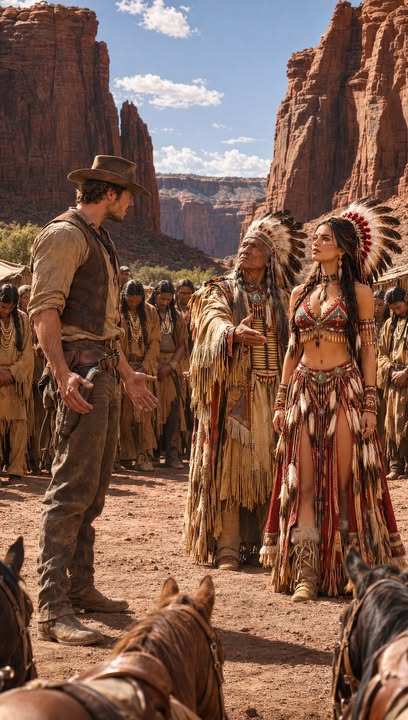
Part 6 – The Choice of Home
“The neighboring band,” Ethan repeated, staring beyond Agent Harlan at the approaching riders.
The agent’s expression tightened.
“They say they came to stop the company from taking the road.”
“Did they say that to you?”
“They said they wanted to hear what the surveyors were doing before they decided what to believe.”
The answer gave Ethan a breath of hope, though not enough to settle him.
“Then we should ride to the village together,” he said.
“I was hoping you’d say that.”
They turned toward the canyon, Agent Harlan matching Ethan’s pace as the second group of riders drew nearer.
The headman at their front raised a hand in greeting.
Ethan returned it, still watching for any sign that the agreement Nahimana had worked to build might yet be lost to fear.
But the riders did not raise weapons or hurry toward the village.
They kept a measured distance, and their leader waited until the two men had reached him.
“I am Haska,” he said.
“I know,” Ethan replied.
“I had agreed to meet the chief at the boundary spring.”
“So I was told.”
“I came to learn why surveyors are near our land.”
Agent Harlan introduced himself and explained that the company had sent a small party ahead to mark the old mining road.
He said they had claimed to possess permission from the territorial office, though he had not approved any final survey.
Haska listened without interruption.
When the agent finished, the headman looked at Ethan.
“Is that what you learned?”
“It is,” Ethan said.
“And Caleb Rusk has given a statement about how the company found the route.”
Haska’s eyes narrowed slightly.
“Where is Rusk?”
“Back at the Bar S,” Ethan said.
“He agreed to tell the chief and you everything he knows.”
Haska held his gaze for a moment, measuring the answer.
“Then we will hear him.”
They rode together toward the village, not as allies yet, but as people who had chosen to arrive and listen before deciding what the other side intended.
As the canyon walls came into view, Ethan could see a small group gathered near the village’s outer path.
Nahimana stood beside her father.
The chief’s sister was with them, and Will waited a few paces behind, his hat held in both hands.
Beyond them, several surveyors had stopped beside their horses.
The company men wore no uniforms, and their instruments were packed away.
A folded notice lay in the chief’s hand.
When Ethan dismounted, Nahimana’s gaze found him at once.
“You came back,” she said.
“I said I would try.”
“You did.”
There was no reproach in her voice, nor any easy relief that made the earlier choice disappear.
She had been standing on her own ground, and she had kept standing there.
That mattered more than his return.
Ethan handed the leather case to the chief.
“Rusk’s statement, the survey map, and the agent’s papers.”
The chief opened the case while Agent Harlan explained that the company’s claim was under review.
The surveyors had been told to halt their work until the boundary and water rights could be examined with representatives from both communities present.
Haska listened, then turned to the chief.
“We came because someone said your riders were moving east.”
The chief’s face grew weary.
“We sent no riders east.”
“Someone told us that you had agreed to let the surveyors pass.”
“We did not.”
Haska glanced toward the company men.
“Then someone has been speaking for both of us.”
The words landed with the force of a truth that had been waiting for a place to rest.
Nahimana stepped forward.
“Caleb Rusk knows who led men to the ridge years ago, and he has told us how the company’s people found the road.”
“Does he know who attacked you?” Haska asked.
“Not yet,” Ethan answered.
“His statement may help us find out, but it does not prove that the company ordered the attack.”
Nahimana nodded.
“We should not accuse anyone beyond what we know.”
The chief looked at the surveyors.
“Did you know the people of this village had not agreed to your work?”
One of the men, older than the others and visibly uncomfortable, removed his hat.
“We were told the land agent had settled the matter.”
“Did you ask anyone here?”
“No.”
“Did you ask the eastern band?”
The man glanced toward Haska.
“No.”
Haska’s expression remained controlled.
“Then you were sent to measure a road through two homes without asking either family.”
The surveyor lowered his gaze.
“We were told it was permitted.”
Agent Harlan took the notice from the chief and examined its seal.
“This document gives the company permission to inspect the old mine, not to establish a road or survey the surrounding land.”
The chief’s sister read the page over his shoulder.
“And the agent who approved it?”
“Not me,” Harlan said.
“The signature is from a clerk whose authority does not extend to communal land.”
The company men exchanged uneasy looks.
No one shouted.
No one moved toward the surveyors.
The truth did not need anger to make itself heard.
The chief folded the notice and handed it back.
“Your work stops here until the proper authority has spoken with both communities.”
The lead surveyor nodded.
“We will leave our equipment packed.”
Haska turned toward the gathering.
“My people will not cross your boundary unless invited.”
“And ours will not cross yours,” the chief replied.
The simple exchange did not mend every old injury.
It did something more useful.
It gave both sides a rule they had chosen together.
Tiva arrived with Sani from the upper trail, bringing word that two riders had seen unfamiliar men near the old mine road the previous evening.
Their description matched the hired hands Caleb had warned them about.
The men had been paid by Harlan’s associate to keep anyone from reaching the village before the survey party arrived.
They had been told to delay travelers, not to harm anyone.
When Nahimana had ridden toward the village, they tried to frighten her off the trail.
Her horse panicked at the shots and fell.
The two riders had fled when Ethan appeared, leaving her trapped beneath the wounded animal.
It was not an excuse for what they had done.
It was an explanation that could be checked, and the men’s employer was named in Caleb’s signed account.
Agent Harlan sent for the territorial deputy who had authority to take statements and hold the company’s papers for review.
The hired riders were found at a camp near the mining road.
They admitted their part after learning that their employer had not been honest about the purpose of the job.
Their testimony confirmed the company’s plan to make the communities appear divided and unprepared.
The company’s claim was suspended while the territorial office examined the contracts, land records, and false assurances made to the two bands.
The old mine remained where it had always been, but the promised road was not built.
No one could know whether the company would return with another plan.
This time, however, neither community would be asked to face it alone.
Caleb Rusk came to the boundary spring the following day.
He arrived without his rifle and without the brass spur that had fallen from his boot.
He spoke first with the chief, then with Haska, and finally with Nahimana.
He told them he had led the earlier survey crew to the ridge, believing he could steer them away from the village.
He admitted that he had failed to ask whether the route he chose would place anyone else in danger.
He also explained that he had stayed silent afterward because he feared losing his place at the ranch and the respect of the men who had hired him.
“I cannot undo what I helped begin,” he said.
“But I can tell you the truth while it still has the chance to matter.”
Haska asked him questions about the old route.
The chief asked him about the company’s recent visits.
Nahimana asked him why he had sent Ethan the map instead of coming himself.
Rusk did not evade the answer.
“Because I thought Ethan could carry the truth without making it worse,” he said.
“That was another way of asking someone else to do what I was afraid to do.”
Nahimana listened in silence.
When he had finished, she said, “Your truth is useful.”
Rusk lowered his head.
“It is not forgiveness.”
“No,” she replied.
“It is not.”
The restraint in her answer gave him no easy absolution, but it gave him a path to take responsibility.
He agreed to provide a full statement to the territorial office and to give up his position at the Bar S while the inquiry continued.
Will chose to remain at the ranch and help the younger hands learn how the company’s papers had been used to mislead them.
Ethan did not ask him to leave.
There were enough paths in the world without deciding for one another which road was the only honest one.
A few days later, the chief invited Haska and his people to share a meal near the boundary spring.
No one called it a celebration of peace.
They called it a first conversation.
The two communities spoke of the missing horses, the stolen grain, and the stories each side had been told.
They learned that the same strangers had taken from both groups, hoping each would blame the other.
The chief admitted that his promise to give Nahimana in marriage had been an attempt to quiet a feud before it grew.
He said it plainly, before the elders and the visiting headman.
“I believed I was protecting my daughter and my people,” he said.
“I was wrong to promise her choice before I had asked for it.”
No one rushed to comfort him.
He did not ask them to.
He turned to Nahimana.
“You have the right to decide your own path, whether it leads away from this village or keeps you here.”
Nahimana stood beside her aunt, her golden eyes clear in the afternoon light.
“I know,” she said.
“Now I want everyone else to know it, too.”
The chief bowed his head.
“You are right.”
Haska spoke next.
“No marriage between our families will be made to settle a quarrel.”
“If two people choose one another, that is their matter.”
“If they do not, the peace must stand without them.”
The chief agreed.
Nahimana did not look toward Ethan.
She did not need to.
Her choice was hers before it could belong to anyone else.
That evening, the chief’s sister opened the wooden chest again.
She spread the old letters and faded cloth across a clean blanket while the firelight moved gently over them.
Ethan brought the silver clasp from his coat.
The small leaves crossed over their darkened stone, worn smooth from years in his pocket.
His mother’s letter lay nearby, its ink faded but still legible.
“She wanted you to have it,” the aunt said.
“I know.”
“She also wanted you to understand that it did not make you responsible for each other.”
“I know that, too.”
Nahimana touched the clasp lightly.
“My mother held it when she was frightened.”
Ethan looked at her.
“How do you know?”
The aunt smiled with sadness.
“She told me she used to press her thumb against its little scratch and remember that someone had helped her without asking what she would owe.”
Nahimana’s fingers hovered over the silver.
“My mother taught me that a gift can be given freely,” she said.
“Your mother taught you the same.”
The two women had never met as adults, and yet their private act of trust had traveled through the years without becoming a bargain.
Ethan turned the keepsake over.
The crooked mark on its back caught the light.
“Perhaps I should return it to the chest,” he said.
The aunt looked at him.
“Perhaps you should ask Nahimana what she wants.”
Ethan lifted his eyes to her.
“Would you like it here?”
Nahimana considered the clasp, then looked toward the chest.
“I would like to know where it is.”
“That is not quite the same thing.”
“No,” she said, a small smile touching her face.
“It isn’t.”
She glanced toward the doorway, where the evening opened onto the canyon.
“Keep it for now.”
“Are you sure?”
“I am.”
He placed it back in his pocket.
The choice was small.
It still felt like the first time he understood what the object truly meant.
The days that followed brought no sudden transformation.
The village still had work to do.
The neighboring band still had horses to recover and stores to rebuild.
The territorial office sent a clerk to record the boundaries and hear testimony from both communities.
Ethan stayed long enough to help guide the survey party along the routes that had been agreed upon, and long enough to see that their work was witnessed by people from both sides.
Then, when the official records were in order, he rode to town to testify about the Bar S, the marked map, and the company’s false claim.
He returned with a copy of the territorial order, which halted the proposed road until the land rights could be properly reviewed.
He also returned with a small letter from the owner of the Bar S.
The ranch owner had dismissed Caleb Rusk from his position and offered Ethan the foreman’s place.
The letter promised steady pay, a room, and a future at the ranch if Ethan wanted it.
Ethan read it outside the chief’s lodge, then folded it and put it away.
Nahimana found him there at sunset.
“Is it a good offer?” she asked.
“It is.”
“Do you want it?”
“I don’t know.”
She tilted her head.
“That answer sounds different now.”
“It is.”
“How?”
“Before, I might have taken it because it was offered.”
“And now?”
“Now I want to know what I would choose if no one were waiting to judge the answer.”
Nahimana sat beside him on the low stone wall.
The sun was sinking behind the western ridge, turning the canyon’s red walls into muted gold.
“What do you want?” she asked.
Ethan did not rush to answer.
“I want work I can be proud of.”
“That sounds reasonable.”
“I want a place where people know my name for more than the trouble I can solve.”
“That sounds harder.”
“I want to stop leaving before anyone has a chance to ask me to stay.”
Nahimana’s expression softened.
“Would you stay here?”
“I would, if you wanted me here.”
“And if I wanted you to leave?”
“Then I would listen.”
She studied him, searching his face for a hidden promise or an expectation dressed as respect.
“What if I did not know yet?”
“Then I would not ask you to decide tonight.”
The space between them held no bargain.
For the first time, that made it possible for something tender to grow there.
Nahimana looked out over the village.
“When I was a child, people stared at my eyes as if they were a sign that belonged to them,” she said.
“Some said they meant I was dangerous.
Some said they meant I had been marked for a particular purpose.”
Ethan waited.
“I used to think I had to become whatever they feared or whatever they hoped for.”
“What do you think now?”
“I think they are my eyes.”
The firelight warmed her face.
“They are part of my mother and part of her family.
They do not choose my life for me.”
Ethan thought of the first time he had seen them, the hush that had fallen, and the way every warrior had lowered his gaze.
“I’m glad I can see them now without thinking I need to understand them.”
“You may understand some of it,” she said.
“My mother used to tell me the golden color came from one of our ancestors, though no one knew which one.”
“Does it matter which?”
“No.”
She looked at him.
“It matters that she was not ashamed of it.”
The next morning, the chief called the village and the visiting families together near the main fire.
He spoke of the agreement with Haska’s band and of the territorial order that had stopped the survey.
Then he turned to Nahimana.
“I made a promise on your behalf,” he said.
“Today I take it back.”
He did not phrase the words as a gift.
He said them as a correction to a wrong he had done.
“No one here may decide whom my daughter will marry, where she will live, or what work she will do.”
Nahimana met his eyes.
“Thank you for saying it before everyone.”
The chief’s voice softened.
“I should have done so before everyone, too.”
She stepped forward and embraced him.
It was not the end of their hurt, but it was the beginning of a conversation neither of them would have to carry alone.
Later, when the people had dispersed and the sun had begun to decline, Nahimana found Ethan near the trail above the village.
He had the Bar S letter in one hand and his mother’s keepsake in the other.
“I have been thinking,” she said.
“So have I.”
“I want to remain here for a while.”
“Because your father needs you?”
“No.”
“Because the village needs you?”
“They do, but that is not the only reason.”
She looked toward the canyon, where the neighboring riders were beginning their journey home.
“I want to help rebuild trust between the two communities.
I want to learn what my mother knew about the old routes and the promises made here.
And I want time to understand what I want when no one is trying to turn it into an answer for them.”
Ethan nodded.
“That sounds like a good choice.”
“It is my choice.”
“Yes.”
“And I want you to know that I have not chosen it because I think you will leave.”
Ethan looked at her.
“I am not asking you to wait.”
“I know.”
“I could take the foreman’s position and still return here.”
“You could.”
“I could also refuse it and stay nearby.”
“You could.”
“What would you want me to do?”
Nahimana watched him carefully.
“I want you to choose the life you can live honestly.”
“And if that life brings you here?”
“Then we will speak about it when it happens.”
There was a gentleness in her answer that did not soften its truth.
Ethan had thought love would come as a clear road, marked in advance.
Instead, it seemed to begin with two people leaving the road open.
“I would like to court you,” he said.
“Not because of what my mother did for yours.
Not because your father once offered you to me.
Not because I think staying means you owe me anything.”
Nahimana’s face grew still.
“What do you think courtship means?”
“To spend time with you, if you wish it.
To learn who you are when no one is asking either of us to become a symbol.”
“And if I say no?”
“Then I will accept it.”
“And if I say not yet?”
“Then I will wait without calling it a promise.”
She was quiet long enough for the evening wind to pass between them.
Then she said, “I would like to spend time with you.”
Ethan’s breath left him slowly.
“But I will not make a decision about marriage now,” she continued.
“I will not promise where I will live, or what I will do, simply because you have decided to stay.”
“I would not ask you to.”
“And I want you to know that my life will remain mine, even if I choose to share it with you.”
“It should.”
She looked at him, searching once more.
Then she smiled.
It was not the unsettling smile she had given him when the blanket fell.
It was the beginning of something neither of them had named yet.
Ethan reached for her hand, then stopped before touching it.
Nahimana saw the hesitation.
She offered her hand herself.
He took it gently.
The contact was quiet, warm, and entirely chosen.
Months later, when the first cool air returned to the canyon, Ethan declined the foreman’s position at the Bar S.
He did not refuse because he was afraid of the ranch or because he needed to prove he belonged elsewhere.
He had considered the work carefully and decided it was not the life he wanted.
Instead, he accepted a smaller post helping the territorial surveyor maintain the boundary records, with time set aside to assist both communities as they rebuilt the old roads and water crossings.
Nahimana chose to stay in the village.
She worked with the chief’s sister to preserve her mother’s letters and helped Haska’s people restore the shared spring.
When Ethan was away, she did not promise to wait.
When he returned, he did not assume she had.
They chose each other again in ordinary ways: over cups of water at the evening fire, along the trail between the village and the spring, and in the patient work of making trust something people could practice.
The neighboring band returned the stolen horses after the riders’ testimony revealed where they had been taken.
The village sent grain to replace what had been lost.
Neither act settled every old disagreement, but both communities learned that a wrong could be repaired without turning it into another feud.
The company’s claim was eventually rejected.
The mine remained quiet, and no road was built across the shared land.
Years later, children from both communities still gathered at the spring, where the water ran clear through the warm months.
They knew the story of the stolen horses and the false map, but they also knew what happened after: two families had chosen to ask before accusing, and one daughter had spoken for herself until the people around her learned to listen.
Ethan kept the silver clasp in a small wooden box beside the letters his mother had left behind.
Nahimana sometimes wore it on a thin chain, then returned it to the box when she wished.
It never became a symbol of what either family owed the other.
It remained what their mothers had intended: a reminder of kindness offered freely.
When Ethan and Nahimana finally married, the gathering was small, held beneath the broad shade of a cottonwood near the boundary spring.
No one gave her away.
Her father stood beside her because she had asked him to.
The chief’s sister placed the old letters in Nahimana’s hands, and Ethan carried the silver clasp in his pocket until Nahimana chose to wear it.
Afterward, the chief sat beside them as the fire burned low.
“I thought safety meant deciding before danger could reach us,” he said.
“I know now that safety without listening is only another kind of fear.”
Nahimana rested her hand in his.
“Then keep listening.”
He covered her hand with his own.
Ethan watched the firelight move across her face.
Her golden eyes held the warm colors of the canyon at sunset, belonging to no curse, no bargain, and no story strangers had made for her.
They belonged to her.
And when she looked at Ethan, he did not see a mystery he was meant to solve or a life he was meant to claim.
He saw the woman who had chosen her own road, and who had, freely and in her own time, invited him to walk beside her.
**–THE END–PLEASE
Share your thoughts or feedback to motivate us to create more stories ♥️
* * *
[PREVIOUS: PART 5](https://storyly.idolsgift.com/blog/part-5-the-question-no-one-could-answer-052)
✓ Lynn R. Adams
Part 6 – The Choice of Home “The neighboring band,” Ethan repeated, staring beyond Agent Harlan at the approaching riders. The agent’s expression tightened. “They say they came to stop the company …