PART 6 (THE END): The Question Behind the Royal Chair 069
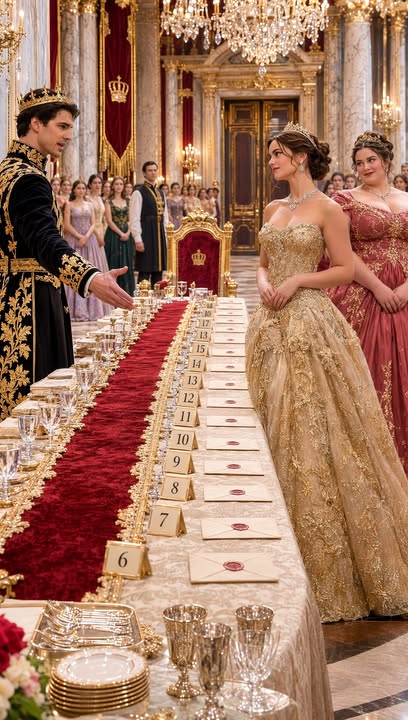
Part 6 – A Table Set for Everyone
The name on the page seemed to empty the hall of sound.
Rowan stared at the signature as if the ink belonged to a stranger.
Mara, standing beside him, felt the document box grow heavy in her hands.
“Your name,” she said quietly.
“Yes,” he answered, his voice roughened by disbelief. “My name.”
The archivist looked from Rowan to the page, his expression careful.
“The ledger identifies the office, not necessarily the person who wrote the instruction,” he said. “We should be precise about what it proves.”
Rowan lifted his eyes.
“Then let us be precise.”
He turned to the gathered council members, who had paused at the hall’s doors.
“The instruction was issued in my name,” he said. “I was a child when this banquet took place. I could not have directed it.”
Mara looked again at the signature.
The capital R was familiar from the prince’s name, but the hand was older and more formal than his own.
“Could someone have used your name as the authority for the change?” she asked.
“That is what it appears to show,” the archivist replied. “The original request was routed through the prince’s office. The final notation was approved by a senior household secretary, but the approval line is incomplete.”
“Do you know who held that post?” Rowan asked.
The archivist opened the ledger to another page.
“Lord Ashcombe was acting secretary that season.”
Several people in the hall exchanged glances.
Lord Ashcombe, now an elderly council member, had been standing near the doorway.
He stepped forward without waiting to be called.
“I was acting secretary,” he said.
His voice held no anger, only the strain of a man who had known this question might one day find him.
“Do you remember the banquet?” Rowan asked.
“I remember Mrs. Wetherby’s request. I remember being told that the seating changes had been approved through your office.”
“By whom?”
“I cannot say with certainty.”
The archivist turned another page and laid a second record beside the first.
“This receipt is dated the day before the banquet,” he said. “It records a note delivered to the secretary’s office from Mrs. Wetherby’s personal attendant.”
Lord Ashcombe studied the page.
“Yes,” he said. “I remember the attendant bringing it.”
“What did the note request?” Mara asked.
“A place near the royal family for Mrs. Wetherby’s party,” Lord Ashcombe replied. “She had promised a substantial donation to the charity fund and was concerned that her guests not be separated.”
“Did she ask that the other guests be moved?” Celestine asked.
“No. Not in the note I saw.”
“Then who changed the seating plan?”
Lord Ashcombe let out a slow breath.
“I did.”
The admission was quiet, but it traveled across the hall.
“I believed the change would prevent a disagreement on the night,” he continued. “I told Mr. Hales to give the revised instructions to Mr. Vale. I used the prince’s office as the authority because I thought it would make the request easier to carry out.”
Mara’s fingers tightened around the document box.
“You put the instruction in my father’s hands,” she said.
“Yes.”
“And when the banquet went wrong, you let the report say he had caused the errors.”
Lord Ashcombe looked down.
“Yes.”
The prince’s face had settled into a grave stillness.
“Why did you not correct it afterward?”
“I was ashamed,” Lord Ashcombe said. “Then the report became part of the official record, and correcting it seemed likely to damage the household and Mrs. Wetherby’s donation. I told myself Mr. Vale had found work elsewhere, and that the matter would do him no good if revived.”
Mara felt her mother’s words echo inside her: it hurt less to believe he had made a mistake than to think people knew he was innocent and said nothing.
“How could you decide that for him?” she asked.
“I had no right to.”
He did not look for an excuse.
The simple answer did not erase what had happened, but it left no fog around it.
Lord Ashcombe turned to Rowan.
“I am willing to sign a full account of my actions and provide every record I still have.”
“You will,” Rowan said. “And the household will preserve it alongside the correction.”
“I understand.”
The council members remained quiet.
There was no dramatic outcry, no demand for punishment that could make the old harm disappear.
Only the slow recognition that a small decision made for convenience had shaped a family’s life, and that a dozen people had helped keep the result in place by choosing not to question it.
Rowan looked toward Mara.
“I’m sorry,” he said. “My office was used to give the instruction authority, and my household allowed the false account to stand. I know that does not mean I personally ordered it, but it does mean the title I hold was part of what made it possible.”
Mara met his gaze.
“Thank you for saying exactly what you know, and not pretending to know more.”
He nodded, taking the words as the measure they were.
The council agreed that the archive would complete its review, but no one asked for the public correction to be withdrawn or delayed.
By the following afternoon, a revised notice was read in the palace hall.
It named Lord Ashcombe’s role in authorizing the seating changes under the authority of the prince’s office.
It stated that Thomas Vale had followed the revised instructions, had raised concerns about the treatment of guests with particular needs, and had been wrongly blamed for the confusion that followed.
It acknowledged that the royal household had preserved that account without examining the supporting records and had failed to restore his reputation.
Rowan stood beside the reader, not on the dais but at the same level as the gathered servants, clerks, courtiers, and guests.
When the statement was finished, he stepped forward.
“My household took a careful man’s good name and left it in the wrong story for fourteen years,” he said. “We cannot return those years to him or his family. We can correct the record, honor the people who tried to speak, and change the way this court listens.”
Mara stood beside her mother.
Her mother’s hand rested over hers, warm and steady.
When the official record was presented to them, it was bound in a new cover bearing Thomas Vale’s name.
Mara’s mother ran her fingertips over the letters.
“He would have liked that his notes were kept,” she whispered.
“He would have liked the truth being read aloud,” Mara replied.
Her mother leaned her shoulder against Mara’s.
“I think he would have liked both.”
The household also placed a copy of the corrected account in the archive’s public reading room, where any member of the court could consult it.
A smaller notice went to the families and guests named in the old banquet records.
Celestine’s family sent a letter of their own, acknowledging that they had repeated the false account without examining it.
Celestine read it aloud to Mara in the palace garden, then folded it carefully.
“I don’t expect a letter to make up for anything,” she said.
“It doesn’t have to,” Mara replied. “It can be the beginning of doing better.”
Celestine smiled, a little uncertainly.
“I’m still learning how.”
“So am I.”
In the weeks that followed, the palace reviewed how guest requests were collected, checked, and delivered.
The steward’s office began confirming each instruction with the person who had made it whenever possible.
Staff members were invited to raise concerns without waiting for a superior’s permission to notice what was plainly wrong.
Edwin was asked to help oversee the new process.
He accepted only after Rowan made clear that the position would include authority to question the records, not merely carry them from one desk to another.
“I don’t want to be given a louder place to remain quiet,” Edwin said.
“You won’t be,” Rowan replied. “And if the system makes it difficult for you to speak, then the system needs changing too.”
Elias returned the plain glass to the palace.
He brought it wrapped in the same clean cloth, and set it on Mara’s mother’s kitchen table when he visited with Edwin.
“I thought it belonged somewhere it would be remembered,” he said.
Mara looked at the simple glass, its rim catching the afternoon light.
“Would you like it to stay here?”
“If your family doesn’t mind.”
Her mother smiled.
“We have room for a glass with a good story.”
Elias gave a small laugh.
The sound seemed to loosen something in him.
He told them he had begun sitting with his mother during supper instead of standing in the doorway until everyone else had finished.
“She says the household is trying to learn,” he said. “She still prefers a plain cup.”
“Then the household can set her a plain cup,” Mara replied.
Elias nodded.
“That’s what I told them.”
When the council finally decided not to resume the marriage competition, Rowan made no attempt to replace it with another contest.
The candidates were released from their obligations, and the palace returned their personal belongings and travel expenses without asking them to explain their choices.
Lady Celestine was one of the last to leave.
She and Mara stood together in the ballroom, where the table from the first challenge had been cleared.
“I thought winning would prove I belonged here,” Celestine said.
“What do you think now?”
She considered the empty chairs.
“I think belonging shouldn’t depend on winning.”
Mara smiled.
“That sounds like a lesson worth keeping.”
Celestine held out her hand.
“I hope we’ll keep in touch.”
Mara took it.
“I hope so too.”
Their handshake became an embrace, warm and brief, with no need to pretend they had always understood one another.
After Celestine left, Rowan found Mara near the open doors that led to the gardens.
“I’d like to ask you something,” he said.
“You can ask.”
“I don’t want you to feel that the answer is owed to me.”
“Then ask without making it sound like a decision has already been made.”
He nodded.
“Would you allow me to court you, slowly, and as your equal?”
The word court seemed newly modest after the grandeur of the competition.
Mara watched him carefully.
“What would courting mean to you?”
“Time together without a contest surrounding it. Honest conversations. The freedom for either of us to say no.”
“And no place in the royal household promised as a reward?”
“No reward, no title offered as payment, and no expectation that you must accept me because I am a prince.”
“Would I be able to disagree with you?”
“I hope you will.”
“Even when other people are listening?”
“Especially then, if I need to hear it.”
She looked past him toward the ballroom.
The royal chair had been removed from the center of the room.
In its place stood an ordinary chair among the others.
Mara thought of Elias’s hands clasped in his lap, of her father’s careful note about the draft, of the years a false account had remained untouched because people found it easier that way.
She thought, too, of Rowan listening when the truth had cost him comfort.
“I will let you court me,” she said, “if you remember that listening is not a gesture you make once. It is work.”
“I will remember.”
“And if you forget, I’ll tell you.”
“I hope you do.”
Her smile came slowly, but it came.
“Then we can begin.”
Their first months were not a fairy-tale parade through palace rooms.
They walked in the garden when the weather allowed and drank tea in her mother’s kitchen when it did not.
Rowan learned that Mara preferred to finish a story before hearing a solution.
Mara learned that Rowan could be thoughtful without being certain and that uncertainty, when admitted honestly, did not make him weak.
They disagreed about how quickly the household should revise old policies.
He sometimes wanted to wait for complete information before changing anything.
She reminded him that waiting could preserve harm as surely as acting carelessly could create it.
Sometimes he changed his mind.
Sometimes she did.
Each time, they listened again.
The palace announced that the next royal banquet would honor the workers who had served the household across generations.
Elias’s mother was invited as a guest, not as a member of the serving staff.
She chose a place beside her son, away from the musicians and within easy reach of the garden doors.
Elias chose a plain glass.
No one asked him to explain.
Mara’s mother was invited too, along with several families whose names had appeared in the old banquet records.
Celestine attended with her grandmother, who greeted Mara’s mother with a quiet apology and the promise to tell the corrected story whenever someone repeated the old one.
Lord Ashcombe came as well.
He did not sit at the head of the table, and he did not make a speech about how much he regretted the past.
He helped the household place the chairs.
When the evening arrived, the ballroom glowed beneath its golden chandeliers, as bright as it had been on the day of the challenge.
Yet the table was different.
The seating had been chosen around the guests’ stated needs, not their rank.
Those who needed more room had it.
Those who wished to sit together were placed together.
The musicians played softly enough for everyone to speak.
A clear path remained open to the garden doors, and an extra chair stood beside the wall for anyone who needed to rest between courses.
Elias took his place beside his mother.
Mara watched them settle, then glanced at the simple glass beside his plate.
Her mother sat nearby, her hand resting close to the small glass Elias had returned.
Rowan approached Mara without ceremony.
“Is everything as you hoped?” he asked.
“No,” she said.
His expression flickered with concern.
“Not perfectly. There are still people we haven’t heard from, and changes we haven’t made.”
“That’s true.”
“But it’s more honest than it was.”
He offered his hand.
“Would you dance with me?”
Mara looked around the room.
The guests had begun to rise, some dancing, some laughing from their seats, some content to watch.
The prince’s hand remained open, not demanding an answer.
“Yes,” she said.
They stepped onto the floor as the musicians began a gentle waltz.
Rowan placed one hand lightly at her back, leaving her space to choose how close to stand.
“You may lead,” he said.
“I thought princes were taught to lead.”
“They are.”
“Then it may be good for you to learn something else.”
A quiet smile crossed his face.
“It may.”
Mara guided him through the first turn, and he followed, attentive to her pace.
Around them, the banquet carried on with the ease of people who did not have to pretend they were all the same.
Celestine danced with her grandmother.
Edwin shared a joke with Elias’s mother.
Mara’s mother laughed as Rowan’s aunt asked her for the recipe of the pear cake.
The plain glass caught the light beside the royal seat, not as a symbol of a test but as the simplest proof that a request had been heard.
Mara leaned closer to Rowan as the music softened.
“Do you remember what you asked me in the ballroom?” she said.
“I asked what you saw in the envelope.”
“You asked whether a guest’s title should settle the question.”
“I remember.”
“And now?”
“Now I know the title may make it more important to ask.”
She looked at him, warmth rising in her smile.
“That is a good beginning.”
They turned beneath the chandeliers, moving not as prince and prize, nor as judge and contestant, but as two people learning the same careful step.
At the table, every chair had been chosen with someone in mind.
And for once, no one was asked to earn the right to be heard.
**–THE END–PLEASE
Share your thoughts or feedback to motivate us to create more stories ♥️
* * *
[PREVIOUS: PART 5](https://storyly.idolsgift.com/blog/part-5-the-question-behind-the-royal-chair-069)
✓ Lynn R. Adams
Part 6 – A Table Set for Everyone The name on the page seemed to empty the hall of sound. Rowan stared at the signature as if the ink belonged to a stranger. Mara, standing beside him, felt the doc…