PART 6 (THE END): The Proof She Kept 034
Part 6 – The Family We Choose
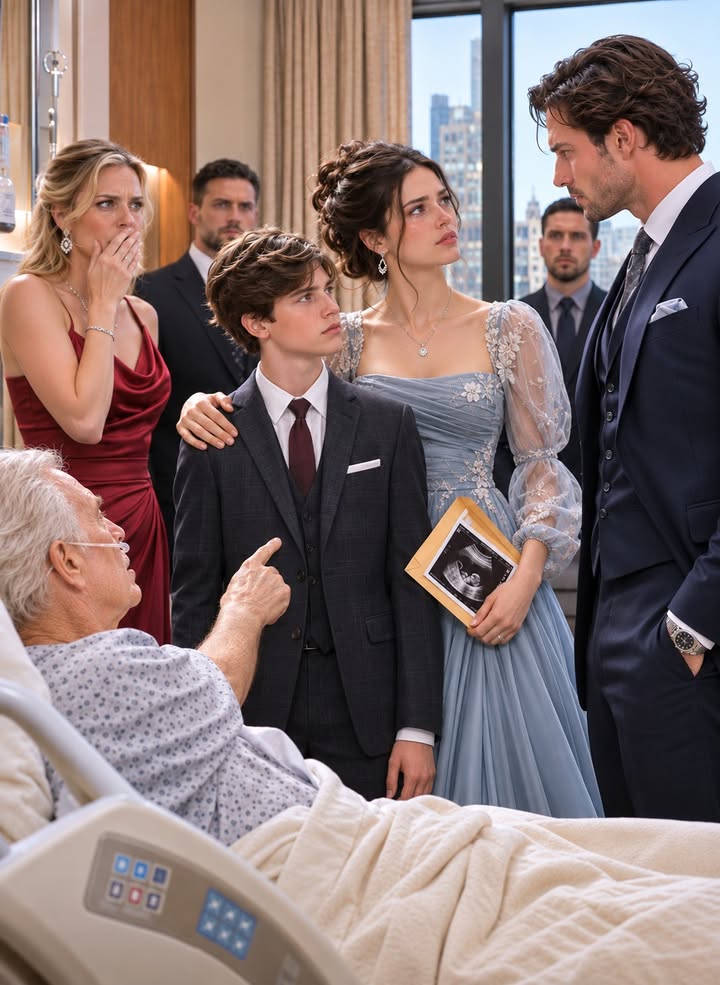
For a moment, no one moved.
Alexander stared at his father, the old words seeming to gather in the small hospital room between them.
Then he looked at me, and I saw the question he could not yet ask: Had the lie gone even further than we knew?
Arthur swallowed, his breath faint against the oxygen line.
“I didn’t understand what I was signing,” he said. “Olivia told me the baby was not Alexander’s, that you had been seeing someone else before the divorce.”
“That isn’t true,” I said.
“I know that now.”
Alexander’s hand tightened around the back of the chair.
“Why would you believe something like that without asking Claire?”
“Because I was told she had already left, and because I wanted the matter to be settled,” Arthur replied. “I was afraid the family would be pulled into a scandal. I let that fear make me careless.”
The old man’s eyes rested on mine.
“I changed the trust because I thought I was protecting Alexander from a claim that would cause trouble. I did not know the child was his.”
Daniel stood quietly near the door, his face pale but composed.
“Does that trust still exist?” he asked.
Arthur nodded.
“It does. The change can be reviewed. It should never have been made without the truth.”
“I don’t want anyone changing things for me,” Daniel said. “I don’t want to be treated like a claim.”
“You shouldn’t be,” Arthur replied. “You are a person, not a name in a document.”
Alexander moved closer to his son.
“Nothing about the trust will decide who you are to us,” he said. “And you will never be asked to accept anything you don’t want.”
Daniel looked at him for a long moment.
“Good.”
Arthur closed his eyes, overcome by the effort of speaking.
The nurse came in, checked his breathing, and gently reminded us that he needed to rest.
As we stepped into the corridor, Alexander held the door for Daniel, then turned to me.
“I’m sorry,” he said.
“You didn’t make that change.”
“I let our family’s name and reputation matter more than asking the questions that might have protected you.”
“You know that now.”
“I do.”
I thought of the years behind us, the letters returned, the payments redirected, and the story of a baby who had supposedly been lost before he could be known.
There was no single villain who could carry all the blame and make the rest of us innocent.
Olivia had made deliberate choices.
Arthur had accepted them without checking.
Alexander had mistaken silence for an answer.
And I had left with a truth that I was too frightened to put into his hands directly.
None of that changed what had been taken from us.
But for the first time, every part of the story was in the open.
“What happens now?” Daniel asked.
“Now we let Grandpa rest,” I said. “And we take things one step at a time.”
Alexander nodded.
“One step at a time.”
The next morning, Arthur’s condition worsened.
The hospital called before sunrise, and Daniel and I reached his room just as the nurse was helping him sit more comfortably.
Alexander was already there, his coat still buttoned, his face drawn with worry.
Arthur opened his eyes when Daniel came to the bedside.
“You came,” he whispered.
“I said I would.”
The old man’s fingers moved against the blanket, and Daniel gently placed his hand over them.
“I’m glad,” Arthur said.
Daniel pulled the chair closer and took the book from his bag.
“Do you want me to read?”
“If you don’t mind.”
Daniel began where he had left off, his voice quiet at first, then steadier as he found the rhythm of the story.
Arthur listened with his eyes closed.
Alexander stood beside the window, watching his father and son, while I sat near him without touching his arm.
When Daniel finished the chapter, Arthur opened his eyes.
“I wish I could have known you sooner,” he said.
“I wish that too,” Daniel replied.
“I’m sorry.”
Daniel looked down at their joined hands.
“I know.”
It was not forgiveness made complete, but neither was it refusal.
It was the honest answer a boy could give an old man near the end of his life.
Arthur’s gaze shifted toward me.
“Thank you for bringing him.”
“I’m glad he came.”
“And you?”
“I’m here because I chose to be.”
A faint smile crossed his face.
“That is the best reason.”
He rested for a while, and we stayed close, speaking softly when he was awake and allowing quiet to fill the room when he was not.
Near midday, a doctor came in and explained that Arthur’s body was tiring.
The words were gentle, but none of us mistook their meaning.
Alexander bowed his head.
Daniel squeezed his grandfather’s hand, then leaned closer.
“I’ll come again,” he said.
Arthur looked at him.
“If you can.”
“I can.”
“Then I’ll wait for you.”
Daniel’s voice caught, but he kept his eyes on Arthur’s face.
“Okay.”
We left the hospital only when the nurse assured us that Arthur was comfortable and that she would call if anything changed.
That evening, Alexander drove us back to the apartment.
At the door, he stopped rather than following us inside.
“Would you like me to stay nearby?” he asked.
“Not tonight,” I said. “Daniel and I need some quiet.”
“Of course.”
He looked at our son.
“Call me if either of you needs anything.”
Daniel nodded.
“I will.”
Alexander started to turn away, then paused.
“I’ll come tomorrow, if that’s still all right.”
Daniel considered the question.
“Tomorrow is okay.”
“Thank you.”
When the door closed behind him, Daniel leaned against it for a moment.
“I’m glad he asked instead of just coming in.”
“So am I.”
“He’s trying.”
“Yes.”
“I don’t know yet what I’ll feel about him later.”
“You don’t have to know.”
He took off his coat and hung it beside mine.
“I’m going to keep reading Grandpa’s book.”
I watched him go to his room, carrying the novel under one arm.
For the first time since we had returned to Chicago, the apartment did not feel like a waiting room.
It felt like a place where my son could set down his uncertainty and still be at home.
Arthur died two days later, in the early hours of the morning.
Alexander called me from the hospital, his voice quiet and unsteady.
I woke Daniel, and we went at once.
The nurse met us outside Arthur’s room and told us he had been peaceful, with Alexander beside him.
Daniel stopped in the doorway.
Alexander sat in the chair next to the bed, one hand resting on the blanket where his father’s had been.
He looked up as we entered.
“He was awake for a little while,” he said. “He asked me to tell you he was grateful you stayed.”
I moved to his side.
“I’m grateful we had the time.”
Daniel stood at the foot of the bed, still holding his coat.
“Did he say anything to you?”
Alexander’s eyes shone.
“He told me not to confuse regret with a reason to control what comes next.”
Daniel looked toward his grandfather.
“That sounds like him.”
“It does.”
The nurse gave us time alone.
Daniel stepped closer and touched the edge of the blanket, a small gesture of farewell.
“I’m glad I met you,” he whispered.
I placed my hand between his shoulder blades, and he leaned into me for a moment before straightening.
Arthur’s funeral was private, as he had wanted.
The family gathered in a quiet chapel beneath high windows that let in the pale winter sun.
Daniel sat beside me, with Alexander on his other side.
Olivia came in alone.
She wore a simple dark coat and carried no flowers.
When she saw us, she stopped at a respectful distance.
“May I sit here?” she asked.
I looked at Daniel.
He gave a small nod.
Olivia took the seat at the end of the row, leaving a space between us.
During the service, Alexander read a passage about forgiveness and responsibility.
His voice faltered once, but he continued without pretending grief made the past disappear.
Afterward, Olivia approached me in the courtyard.
“I’m sorry for what I did,” she said. “I’m not asking you to forgive me.”
“I know.”
“I’ve given Alexander the bank records and every letter I could find. His solicitor has the details about the savings account.”
“Good.”
“The money will stay where it is until you decide what you want done with it.”
“I don’t want it for myself.”
“I understand.”
She looked at Daniel, who was standing with Alexander near the gate.
“I’m sorry you were kept from your father,” she said to him. “And from your grandfather.”
Daniel listened without looking away.
“Thank you for saying that.”
“I know words aren’t enough.”
“No,” he said. “They aren’t.”
Olivia accepted the answer, her eyes wet.
She did not ask him to comfort her, and she did not ask me to explain what might happen next.
In that, at least, she had learned to leave the choice where it belonged.
The following weeks were made up of practical conversations, quiet visits, and decisions that did not need to be rushed.
Alexander’s solicitor arranged for the trust documents to be reviewed and corrected according to Arthur’s original intentions.
Daniel was told about the trust in plain language, without presenting it as a prize or a debt.
He asked that any decision about his future remain his to make when he was older.
Alexander agreed.
The redirected payments were handled separately.
With the help of our lawyers, we arranged for the money to be placed in an account for Daniel, where it could be used for his education or anything else he chose when he was ready.
It was not compensation for the childhood he had lived without his father.
It was simply money that had been meant for him and had finally reached the right future.
Olivia cooperated with the review and accepted the consequences of her choices within the family and the company.
She did not make excuses.
Alexander did not pretend that her honesty now erased what she had done before.
Their relationship changed, and neither of them asked me to repair it for them.
As for Alexander and me, we did not move back into the story we once had.
We began a different one, slowly and without vows made in the heat of guilt.
He called Daniel at the times they had agreed upon.
Sometimes their conversations lasted ten minutes.
Sometimes Daniel had a question about school, science, or one of the books Arthur had left behind.
If Daniel said he was busy, Alexander accepted it.
If he asked to meet, Alexander showed up.
He came to a science exhibition at the museum and let Daniel explain each display without pretending to know more than he did.
He attended a school meeting by video when we returned home, sitting quietly in the background and taking notes.
He learned which foods Daniel liked, which subjects made him lose track of time, and how long to wait before asking a follow-up question.
He did not call himself Dad until Daniel began using the word naturally, first in a sentence about the past, then later in a question about the present.
The first time Daniel said it directly, Alexander did not make a celebration of it.
He simply answered, “I’m here.”
And then he kept being there.
I returned to my medical work after our temporary stay in Chicago.
My career did not become a gift from the Moretti family or a place Alexander arranged for me.
I chose where to work, and I kept my own home.
Alexander supported that choice without asking me to make it convenient for him.
For a while, we lived in different cities, with visits planned around Daniel’s school and my schedule.
Chicago remained part of our life, but it did not become the only place we could be a family.
Months after Arthur’s death, a letter arrived for Daniel in a plain envelope marked in his grandfather’s handwriting.
Alexander had found it among Arthur’s personal papers while helping the solicitor sort through the family records.
He brought it to us during one of his visits, then waited while Daniel decided whether to open it.
Daniel chose to read it at the kitchen table with me beside him.
My dear Daniel,
I wish I had known you when you were small, but I am thankful for the days we were given.
You do not owe this family a title, a name, or a future you did not choose.
You are welcome because you are yourself.
Take your time with your father.
Let him earn your trust by showing up, and let yourself change your mind when you need to.
I am proud of you for asking questions and for being kind without pretending nothing was wrong.
Your life belongs to you.
I hope it is full of good books, honest work, and people who make room for the truth.
With love,
Grandpa Arthur
Daniel read the letter twice.
Then he folded it carefully and placed it inside the book they had shared at the hospital.
Alexander sat across from him, his hands resting on the table.
“He knew what to say,” Daniel murmured.
“He learned it late,” I said. “But he learned it.”
Daniel nodded.
“I’m glad he wrote this.”
“So am I.”
Alexander looked at the letter but did not ask to read it.
Daniel slid it across the table.
“You can read it.”
Alexander did so in silence.
When he finished, he returned it with the same care.
“My father would have been glad you found it,” he said.
“I think so.”
That summer, we returned to Chicago for a family gathering in the garden behind Arthur’s old home.
The city was warm, the trees full and green, and the house no longer felt like a place built to keep our lives separate.
Alexander’s relatives had been told the truth without any attempt to turn Daniel into a symbol of the family’s future.
He was introduced by his name.
Not as an heir.
Not as proof of what had gone wrong.
Not as a child meant to heal anyone else.
As Daniel, a student who liked science, good books, and asking questions no one could answer quickly.
Olivia came to the gathering too.
She greeted Daniel with a quiet hello and did not try to touch his shoulder or claim a closeness he had not offered.
Daniel spoke with her briefly, then returned to the table where his cousins were arguing over a game.
Later, he asked her whether she remembered the book Arthur had read to him at the hospital.
“I do,” she said. “He told me he liked hearing you read.”
Daniel smiled faintly.
“I liked reading to him.”
“That’s a good memory,” she said.
He agreed, and the conversation ended without anyone demanding it become more.
Alexander spent most of the afternoon helping Daniel and the others set up a small telescope on the patio.
When one of the children turned it toward a bright patch of evening sky, Daniel adjusted the focus and explained what they were seeing.
Alexander listened, asking questions instead of reaching for the answer first.
I watched them from the garden table, a glass of lemonade in my hand, and felt no need to step between them.
They had found their own pace.
As the gathering began to wind down, Daniel came over and stood beside me.
“Are you ready to go?” I asked.
“In a little while.”
“Your choice.”
He looked across the garden at Alexander, who was packing the telescope into its case.
“Do you think he’ll keep showing up when we’re not in Chicago?”
“Yes,” I said. “I think he will.”
Daniel considered that.
“Me too.”
Alexander glanced up and met my eyes.
There was still history between us, and hurt, and a tenderness that had never been entirely erased.
But there was also something new: no demand that either of us pretend the past had been simple, and no promise that the future had already been decided.
He came over and stopped beside us.
“Would you like me to drive you back to the hotel?” he asked.
“We’re staying at our place,” I said.
For a moment, his expression brightened, then he checked himself.
“Of course. I meant, would you like a ride?”
“We have the car.”
“Right.”
Daniel laughed softly.
“He’s getting better at asking.”
“So am I,” Alexander said.
Daniel turned toward the house to say goodbye to his cousins, leaving us alone beneath the garden lights.
Alexander rested his hands on the back of a chair.
“I don’t know what we’ll be to each other a year from now,” he said.
“Neither do I.”
“I’m not asking you to decide.”
“Good.”
“I want you to know I’m grateful you came back.”
“I came for your father,” I said. “I stayed because Daniel chose to.”
“And because you chose to.”
“Yes.”
He nodded, as though he understood that the distinction was not a correction but part of the truth.
“I’m glad you did.”
“So am I.”
The words did not make us married again.
They did not erase the years or turn sorrow into something beautiful simply because it had finally been understood.
They were only honest words, spoken between two people who had learned not to mistake hope for permission.
Daniel returned, carrying Arthur’s old book under one arm.
He had asked to keep it after the gathering, and Alexander had said it was his.
“Ready?” I asked.
“Ready.”
Alexander walked us to the car.
At the door, Daniel turned back toward him.
“Call me this weekend?”
“I will,” Alexander said. “Would Saturday work?”
“Saturday’s good.”
“Then Saturday.”
Daniel climbed into the car, leaving the door open for a moment.
Alexander looked at him, waiting.
“Good night, Dad,” Daniel said.
Alexander’s face softened, but he did not turn the words into a ceremony.
“Good night, Daniel.”
I closed the car door gently.
As I drove through the streets of Chicago, the city lights opening ahead of us, Daniel rested the book on his lap and leaned back in his seat.
For fifteen years, I had believed that the life we lost was the only one we might have had.
Now I understood that what came next would not be a return to the past, nor a reward for surviving it.
It would be something we built by telling the truth, respecting one another’s choices, and showing up when we said we would.
And as my son carried his grandfather’s book home, with his father’s next call already waiting on the calendar, I felt the quiet, steady warmth of a family that had not been restored to what it was.
It had been given the chance to become something chosen.
**–THE END–PLEASE
Share your thoughts or feedback to motivate us to create more stories ♥️
* * *
[PREVIOUS: PART 5](https://puretales.idolsgift.com/blog/part-5-the-proof-she-kept-034)
✓ Lynn R. Adams
Part 6 – The Family We Choose For a moment, no one moved. Alexander stared at his father, the old words seeming to gather in the small hospital room between them. Then he looked at me, and I saw th…