PART 6 (THE END): The Promise Hidden in the Music 041
Part 6 – A Home for the Truth
“The person who has been maintaining Adrian’s accounts knows you have the records,” Carlo said.
Vincent held Mia close, feeling the soft weight of her cheek against his shoulder.
“And they say they have the missing page from Isabella’s letter.”
Mrs. Bennett’s face paled, but her voice remained steady.
“Who is it?”
Carlo glanced at the sealed case.
“Julian Mercer. He handled the family’s books after Adrian died.”
“Is he part of the organization?” Vincent asked.
“He worked for the companies, but I don’t know what he knew about the old accounts.”
“Then we find out without making assumptions.”
Carlo nodded.
“He asked to meet tomorrow morning.”
“Where?”
“The accounting office. He says he wants to hand over the page and explain the records.”
Vincent looked toward the sleeping child in his arms.
“Then we’ll meet somewhere neutral, with counsel present.”
Carlo’s eyes lowered to Mia.
“I can arrange—”
“No,” Vincent said gently. “Our attorney will arrange it. No one else.”
Carlo accepted the correction.
It was a small thing, but Vincent noticed it: his father did not reach for control of the decision again.
The attorney took the sealed case to secure it, and Vincent asked him to contact the appropriate authorities about the proposed meeting.
He insisted that Julian be given a safe, private way to come forward, without pressure from the family or anyone acting on its behalf.
When the arrangements were settled, Mrs. Bennett led Mia upstairs.
Vincent remained in the sitting room with Carlo, the Christmas lights glowing softly around them.
“Did you know Julian had the page?” Vincent asked.
“No.”
“Did Adrian ever tell you he had kept part of Isabella’s letter?”
“No.”
“Do you know why he would have it?”
Carlo looked at his hands.
“I can only guess that he wanted to keep control of what people knew.”
“Then we wait for facts.”
“Yes.”
It was not the answer Vincent would have given a week earlier.
He might have demanded the page at once, or sent people to search every office Adrian had used.
Now he understood that urgency could become another way of taking choices from others.
Mia deserved a safer world, but safety could not be built from the same old fear.
Before leaving, Carlo paused by the stairs.
“May I see her tomorrow?” he asked.
Vincent considered him.
“You can ask Mrs. Bennett, too.”
“I will.”
The next morning, snow rested in quiet lines across the garden wall.
Mrs. Bennett met Vincent in the hallway while Mia sat on the rug, stacking blocks into a tower.
“I’d like to hear what Julian has to say,” she told him.
“You can come, if you want.”
“I want to.”
He crouched beside Mia.
“Will you be all right with Nana while I’m gone?”
She placed a block carefully on the tower.
“Nana and castle.”
“Sounds like a good plan.”
“Come back.”
“I will.”
She held out a wooden block for him to place on top.
Vincent set it down, and the crooked tower stood for a moment before tipping gently onto the rug.
Mia laughed.
He laughed with her, then stood.
The meeting took place in a small conference room at the attorney’s office, chosen for its privacy and its distance from the family’s businesses.
A representative from the authorities was present, along with the attorney and an independent counsel for Julian.
Julian arrived carrying a slim folder.
He was a quiet man in his late fifties, dressed plainly, with the careful manner of someone who had rehearsed the words he needed to say.
He did not try to defend himself before anyone asked a question.
“I worked for Adrian for years,” he said. “After he died, I found the page among his personal papers.”
“Why didn’t you bring it forward then?” Vincent asked.
Julian looked down at the folder.
“I was afraid of the consequences.”
“Of whom?”
“Of the family, of the people who still depended on the accounts, and of losing the work that supported my own household.”
He spoke without asking them to absolve him.
“I told myself it was only one page and that it could do no good after so many years,” he continued. “But when I heard the records were being reviewed, I understood that keeping it was no longer neutral.”
He placed the folder on the table and slid it toward the representative.
The page inside had been folded and preserved between two sheets of archival paper.
Its lower edge was torn.
The handwriting belonged to Isabella.
Vincent’s hands remained at his sides while the representative examined it, confirmed its condition, and made a record of its arrival.
Only then was Vincent invited to read it.
The page began in the middle of a sentence.
I have asked again for the truth about my treatment.
The next line was faded, but legible.
Carlo says I must stay home until the danger has passed.
Then the writing grew more uneven.
Adrian says the clinic has been watched, and that if I go, they may follow me to Vincent.
I do not know whether this is true.
I do know the doctor has offered to bring me in safely.
Vincent read slowly, each line opening another small door into his mother’s fear.
She had not simply been told that travel was dangerous.
She had been told by Adrian that the clinic was watched, while Carlo had repeated the warning in a different form.
Yet she had also been offered safe transport.
The page did not say whether Adrian believed his warning, whether he had invented it, or whether he had twisted a real concern to keep Isabella from asking questions.
The final lines were written in a steadier hand.
I want to see my son.
If I cannot, please do not let him believe I chose to leave him.
Vincent stopped reading.
For a moment the room’s quiet became so complete that he could hear the faint movement of papers at the far end of the table.
He closed his eyes.
He had spent years with a simple story: his mother had become ill, the doctors had tried, and she had died before he was old enough to understand.
Now he knew that, near the end, she had wanted to see him and feared she might not be able to.
He also knew she had written something that she hoped would survive.
Not a weapon.
Not a final judgment.
A plea that her son know she had not chosen to leave him.
When he opened his eyes, Mrs. Bennett was watching him.
“She wanted you to know she loved you,” she said.
“She did.”
Vincent folded the page only along its existing crease and returned it to the archival sleeve.
Julian looked toward him.
“I’m sorry I kept it.”
Vincent considered the man before answering.
“Your decision helped keep part of the truth hidden.”
“I know.”
“What you do now matters.”
Julian nodded, accepting the weight without argument.
He turned over the remaining records he had kept and answered the questions put to him by the authorities.
Some of his statements matched the account books.
Others would need to be checked.
Nothing was settled that morning, and no one pretended otherwise.
After the meeting, Vincent walked with Carlo and Mrs. Bennett to the entrance.
Carlo had been quiet throughout, listening as the page was read.
Outside, he stopped beneath the awning, where the snow fell in fine, drifting flakes.
“I told myself she chose to stay home,” he said.
“You knew the choice had been made under fear,” Vincent replied.
“Yes.”
“You could have told her the doctor had offered another way.”
“Yes.”
Carlo looked down at the snowy pavement.
“I have no defense for that.”
“You don’t need one from me.”
“I know.”
Vincent watched his father for a moment.
“Tell the investigators everything you remember, even the parts that make you look worse.”
Carlo nodded.
“I will.”
“And don’t make promises to protect people by keeping them in the dark.”
“I won’t.”
The assurance was not enough to repair the past.
It was, at least, a beginning he could be held to.
In the weeks that followed, the investigation widened carefully.
The authorities reviewed the financial records, the old medical correspondence, and the surviving company files.
Vincent cooperated, answering questions and surrendering documents he had once believed belonged only to the family.
He did not ask anyone to shield him from the consequences of what he had inherited.
He also made sure that employees were interviewed individually, that their actions were not judged by their association alone, and that anyone who needed independent counsel could obtain it.
The process moved more slowly than he wanted.
It was complicated, frustrating, and often painfully ordinary.
There were forms to sign, dates to verify, meetings to attend, and long periods when no new answer arrived.
But the facts did not disappear.
Adrian’s records showed that he had moved money through family companies and concealed the transfers from Isabella when she began asking questions.
The evidence also showed that he had told her the clinic was watched, though no reliable proof of such surveillance was ever found.
Carlo confirmed that he had repeated the warning and declined the doctor’s offer of safe transport.
He had not caused Isabella’s illness.
He had, however, helped deprive her of a treatment that might have given her more time.
The distinction mattered to the investigators, and it mattered to Vincent.
It did not make the loss smaller.
It made the truth more honest.
Carlo admitted that he had concealed the financial misconduct for years, first because he believed he could contain it, and later because admitting the extent of it would expose the family’s failures.
He cooperated with the investigation and accepted the consequences that followed.
Some of the family’s companies were dissolved.
Others were transferred to independent management.
Assets tied to the concealed accounts were recovered where possible, and the remaining matters were handled through the courts.
Vincent’s name appeared in the investigation because he had inherited authority and had once benefited from systems he had not questioned.
He answered every inquiry.
He did not pretend that his ignorance erased his responsibility to act once he knew.
It cost him businesses, comfort, and the certainty of a life arranged around power.
It also freed him from having to guard a version of his family that had never been true.
Mrs. Bennett chose to move with her daughter to a quiet apartment in a neighborhood where they already had friends.
The independent protection team helped them assess the building and gave them choices about what arrangements they wanted.
She refused a larger residence and accepted a smaller one with a sunny kitchen and a little balcony.
“I don’t need to disappear,” she told Vincent when he asked if she was sure.
“I know.”
“I need to live somewhere I can decide when to open the door.”
“Then that’s what we’ll help make possible.”
Mia kept her grandmother’s hand in hers whenever they visited.
She made the apartment her own by placing a stuffed rabbit on the windowsill and declaring the kitchen her castle.
Vincent came often.
At first he arrived with gifts, as if he could make up for the years Mrs. Bennett had been kept away by bringing enough bright toys and picture books.
She thanked him, then gently told him Mia preferred time to presents.
After that, he came with nothing but himself.
He learned that Mia liked to choose which book they read, even if it meant beginning the same story twice.
He learned that she liked the silver music box but understood when it needed to be put away.
He learned that her laughter came more readily when no one rushed her to answer.
And he learned that loving a child was not a matter of keeping her close every moment.
It was listening when she reached for him and trusting Mrs. Bennett to care for her when he had to leave.
One afternoon, he asked Mrs. Bennett whether she regretted returning to his house.
“I regret the years we lost,” she said. “I don’t regret coming back.”
“Neither do I.”
She smiled.
“Your mother would have liked seeing you say that.”
Vincent lowered his eyes, moved by the gentleness in her certainty.
“Would she have liked seeing me lose the business?”
“She would have liked seeing you tell the truth about it.”
He sat with that answer.
It was not praise, and it did not ask him to feel proud.
It gave him something quieter: the sense that his mother’s trust had not been entirely misplaced.
Carlo began visiting the apartment only when Mrs. Bennett invited him.
The first time, he brought no expensive gift and offered no explanation.
He sat on the floor with Mia and let her teach him how to build a block tower.
She called him “Grandpa Carlo” after he helped her make a roof that did not fall down.
When he left, he asked Mrs. Bennett if he could come again.
“We’ll see,” she said.
He accepted that answer.
It was the first time Vincent had seen his father wait without trying to change someone’s mind.
Their own conversations remained difficult.
There were days when Vincent could hear Carlo’s regret more clearly than his reasons, and days when the old silence between them seemed as wide as ever.
Neither tried to declare forgiveness complete.
They spoke instead about what could be done next: the records that still needed organizing, the people who needed answers, the times Carlo would call before visiting.
It was not an easy reconciliation.
It was a truthful one.
As the months passed, Vincent began building a different life around the responsibilities that remained.
He worked with legitimate companies and independent advisers, making decisions that could be examined instead of concealed.
He sold what he could not manage without returning to the old structures.
He spent long days answering questions and shorter evenings reading stories to Mia when Mrs. Bennett invited him to stay.
For the first time, his life did not depend on making every room quiet when he entered it.
At Christmas, he brought the silver music box to Mrs. Bennett’s apartment.
It had been restored and checked by a careful conservator, who assured him that its mechanism was sound.
The hidden compartment remained beneath the base.
The original letter and the newly found page were kept safely in an archive, where they could be preserved without being passed around like family curiosities.
Vincent kept a copy of both.
He kept the music box, too, not as a sealed relic but as something that could be opened when the people around it wanted to hear it.
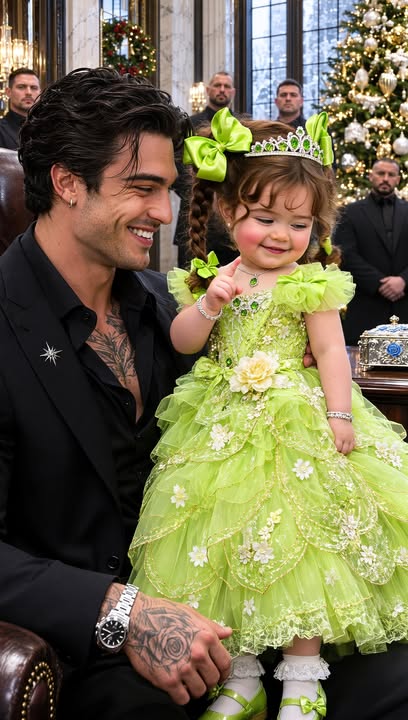
Mia wore a bright green dress with a little embroidered flower at the waist.
Her curls were tied into two pigtails, each secured with a satin bow she had chosen herself.
She sat beside Mrs. Bennett on the rug while Vincent placed the music box on the low table.
“Song?” Mia asked.
“Yes,” he said.
He wound the key and lifted the lid.
The lullaby unfolded into the small room, gentle and familiar.
Mrs. Bennett sang softly with the tune.
Vincent listened.
He could imagine his mother humming the same melody beside his childhood bed, her palm resting against his back as she kept time.
The memory was still incomplete.
It was also no longer empty.
When the last notes began to fade, Vincent leaned closer to Mia.
“I want you to know that your great—”
“Shhh,” Mia said, pressing one finger to his lips.
He paused.
“Let the song finish.”
Vincent looked at her solemn face, then at Mrs. Bennett, who was laughing softly through shining eyes.
He sat back and let the final note settle in the room.
When the music ended, Mia placed both hands on the music box.
“Again.”
Vincent wound the key once more.
The song began, and this time he did not try to speak over it or explain what it meant.
He listened with them, surrounded by the people who had chosen to stay.
When Mia finally turned toward him, he opened his arms.
She climbed into his lap and tucked herself against his chest.
Vincent held her carefully, no longer afraid of how much he loved her.
“We’ll make a home where you’re always safe,” he whispered.
Mia blinked up at him.
“And the truth,” he added. “The truth will always be safe here, too.”
She rested her cheek against him as the music box’s last note faded.
Mrs. Bennett reached across the rug and laid her hand over Vincent’s.
For a moment, the three of them sat together in the lamplight, with snow gathering quietly beyond the window and Isabella’s song filling the spaces that silence had once occupied.
Vincent kept the music box open.
**–THE END–PLEASE
Share your thoughts or feedback to motivate us to create more stories ♥️
* * *
[PREVIOUS: PART 5](https://echoesofstories.idolsgift.com/blog/part-5-the-promise-hidden-in-the-music-041)
✓ Lynn R. Adams
Part 6 – A Home for the Truth “The person who has been maintaining Adrian’s accounts knows you have the records,” Carlo said. Vincent held Mia close, feeling the soft weight of her cheek against his…