PART 6 (THE END): The Promise Beneath the Silver Heart 046
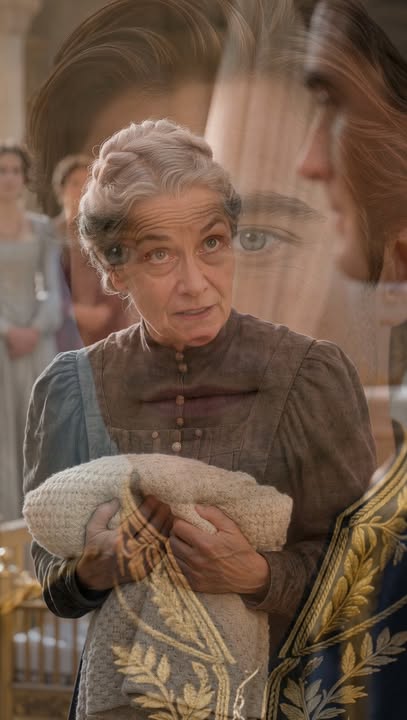
Part 6 – The Place Where Her Name Belonged
Alexander read the clinic register again, as if the words might alter themselves if he gave them another chance.
“It says Eleanor left the clinic alive.”
The archivist nodded, careful not to draw more from the document than it could bear.
“It records her discharge date and a second name used for travel. The regional archive will need to authenticate the register and locate any surviving medical files.”
“How long will that take?” Alexander asked.
“I can’t promise a date, Your Highness, but the request can be sent today.”
Alexander glanced toward Oliver, asleep in Mrs. Bell’s arms, and then toward the paper.
He had spent years believing that the last page of Eleanor’s life was a grave in the palace garden.
Now another page had appeared, written in a place he had never known to look.
“Send it,” he said. “And tell them we want the truth, not a version shaped to make it easier for us.”
The archivist gathered the documents.
“I’ll make that clear.”
After he left, Alexander remained at the table, one hand resting beside the silver heart.
Mrs. Bell shifted Oliver gently against her shoulder.
“He was with her,” she said. “At least for a while.”
Alexander closed his eyes.
“He was.”
It was not much, and it was more than he had known the day before.
I watched him take in the difference, allowing it to hurt without turning away from it.
The inquiry continued over the following weeks.
The palace released the relevant records to the independent panel, and the panel contacted the regional archive in Florence.
The clinic had closed long ago, but its files had been preserved by a medical institution that had taken custody of them.
The record keepers replied with questions about identity, dates, and the authority under which the original documents had been transferred.
Alexander answered each one.
He did not ask the archivists to hurry because the uncertainty was painful, nor did he ask them to soften what they found.
He asked only that the papers be examined carefully.
While the inquiry moved forward, life in the nursery continued in small, ordinary steps.
Oliver began sleeping longer when the room was quiet and the curtains were drawn before the afternoon light reached his crib.
He learned to clap when Alexander finished reading a story, though sometimes he clapped in the middle because he liked the sound of his own hands.
He discovered that the wooden horse could be pushed across the rug and that a block tower was much more interesting when it fell.
Alexander learned to sit on the floor without worrying about whether his clothes creased.
Mrs. Bell began singing the lullaby aloud, not only humming it beneath her breath.
I returned to Boston twice to check on the bookstore and arrange for my aunt to help keep it open.
Each time, the palace car waited only because I had agreed to the ride.
No one told me when to return.
No one asked me to leave the pendant behind.
Alexander asked whether I wanted a room reserved for the next week, and accepted my answer when I said I would decide after I had checked the shop.
The choice remained mine, and that made staying feel possible.
One afternoon, while Oliver napped, Alexander found me in the garden with a stack of letters my grandmother had kept.
The sun had softened the winter chill, and a narrow ribbon of water moved beneath the ice along the edge of the pond.
“I’ve been thinking about what Eleanor wrote,” he said.
“So have I.”
“Her final request was that Ruth be told she had kept her promise.”
I looked down at the faded handwriting.
“My grandmother never knew.”
“No.”
“Maybe the letter would have changed how she understood their friendship.”
“Perhaps.”
“Maybe she would have told me everything.”
“Perhaps,” he repeated, with no attempt to fill the unknown with comfort.
I appreciated that he let the unanswered parts remain unanswered.
He lowered himself onto the bench beside me.
“I used to think that if I understood every detail of Eleanor’s last day, I would know how to grieve her,” he said.
“And now?”
“Now I think I may have to grieve the parts I will never know, too.”
The words carried no surrender.
They sounded like a man learning that love could remain real without becoming complete knowledge.
I rested the letters on my lap.
“She trusted my grandmother,” I said. “I wish she’d had a chance to meet me.”
“I think she would have liked that you don’t pretend to know more than you do.”
A smile came before I could stop it.
“That sounds like something you’ve learned recently.”
“It does.”
He looked toward the nursery window.
Oliver was asleep inside, safe with Mrs. Bell close by.
“I’ve also learned that you don’t belong to a letter,” Alexander said. “Or to a promise made before you were born.”
“I’m glad.”
“I want you to know that if you decide the bookstore is where you belong, I’ll help make the transition simple.”
“I know you will.”
“And if you decide to stay, I want it to be because the life here is one you choose.”
“I know that too.”
He did not ask what I would choose.
We sat together until the sunlight moved beyond the garden wall.
Several days later, the independent panel requested a meeting with Alexander and me.
The panel included a historian, a physician with no connection to the palace, and a records specialist from outside the kingdom.
Mrs. Bell attended because she had been present during Eleanor’s final hours at the residence.
Beatrice came as well, bringing her own papers and answering questions about the household’s response after the birth.
The panel’s first conclusion was careful and limited.
It confirmed that the death certificate had been issued after the original examination recorded Eleanor alive.
It confirmed that an unnamed patient had been moved under confidential medical authorization the following morning.
It also confirmed that a child from another family had been buried in the royal plot under the name attached to Eleanor’s official death.
The child’s identity was established through hospital and burial records.
The family had been informed privately and with respect, and their permission was being sought before any identifying details could be released.
“They deserve to have their child remembered under the right name,” Alexander said. “They also deserve to decide how much of their story becomes public.”
The panel agreed.
As for Eleanor, the documents from the clinic supplied the rest.
The intake register, nursing notes, and a physician’s report confirmed that she had arrived alive, severely ill, and exhausted after childbirth.
She had received treatment for several months.
Her condition improved, then worsened again the following year.
The final record stated that she died in Florence, with a nurse and physician beside her.
There was no evidence that she had ever returned to the palace or that she had chosen to leave her husband and child.
Her resting place was listed in a small cemetery outside the city, where patients who had been treated at the clinic were buried.
Alexander read that line without speaking.
Mrs. Bell held one hand over the other in her lap.
Beatrice looked down at the papers before her.
I watched Alexander’s face as the last uncertainty closed around the one answer that could no longer change.
Eleanor was dead.
She had not died where he had been told.
She had not been buried beneath the royal name.
But she had lived long enough to hold Oliver, to ask whether he was breathing, and to hope that the truth would reach the people she loved.
Alexander stood and walked to the window.
No one followed him.
When he returned, his eyes were wet, but his voice was steady.
“Thank you,” he said to the panel. “Please continue until every record that can be corrected has been corrected.”
The panel’s final report took another month.
During that time, Alexander asked the royal household to prepare a statement that accepted responsibility without turning the inquiry into an accusation against people who were no longer able to explain their decisions.
He met with the medical staff and with the families affected by the false burial record.
He listened more than he spoke.
Beatrice provided every letter and household note she could find.
Mrs. Bell gave a full written account of what she remembered, including the parts she wished she had said sooner.
She did not excuse her silence, and Alexander did not demand that she punish herself for it.
Instead, he told her that her loyalty to Oliver had mattered, even if fear had kept her from telling the truth.
At last, the panel confirmed every essential part of Eleanor’s letter.
She had survived Oliver’s birth.
A royal adviser had arranged for her to be taken abroad for confidential treatment, fearing that uncertainty about her health and the infant prince would destabilize the kingdom.
A stillborn baby from another family had been buried under Eleanor’s name.
Eleanor had died later in Florence, and the palace had maintained the false account long afterward.
The silver heart had belonged to Eleanor’s mother, who had quietly helped run a Boston children’s charity with my grandmother.
The lullaby had passed between them through years of letters and visits.
Eleanor had asked that the pendant reach Ruth’s granddaughter because she trusted the calm and kindness her mother had found in that family.
She had not chosen me as a replacement for herself.
She had hoped that Oliver might one day be comforted by someone whose grandmother had understood the value of a quiet room and a patient heart.
When the report was ready, Alexander asked me to sit with him in his study.
The final statement lay on his desk.
“Before this is released, I need you to know what it says,” he told me. “It names no private details about you or your grandmother beyond the charity connection. It does not describe Oliver’s routines or use him as proof of anything.”
“Does it explain the grave?”
“It says that the remains there belong to another infant, whose family is being consulted about how the record should be corrected.”
“And Eleanor?”
“It says she died in Florence and that her resting place has been independently confirmed.”
He drew a breath.
“I will accept responsibility for the palace’s failure to preserve the truth. I won’t pretend I knew about the deception, but I was the person in a position to ask more questions once the inconsistencies appeared.”
I looked at the statement.
“It doesn’t make you responsible for every decision made before you knew.”
“No. But the crown must be accountable for what it preserves.”
“You could still keep parts of it private.”
“I will protect the families and Oliver from unnecessary attention,” he said. “I won’t protect the institution by pretending the false account was harmless.”
His hand rested beside the page.
“Are you comfortable with the statement?”
“I am.”
“Are you comfortable staying here when it becomes public?”
“I’m not sure what the days afterward will feel like.”
“That’s fair.”
“People may want me to explain the pendant.”
“I won’t ask you to.”
“People may look at Oliver and try to decide what his mother’s story means for him.”
“I will not let the household offer him up as an answer.”
I met his eyes.
“Then I’ll stay through the announcement.”
“Thank you.”
“That isn’t a promise to stay forever.”
“I know.”
He had learned to hear the difference.
The statement was released the next morning.
It was clear, restrained, and honest.
The palace acknowledged that the official account of Eleanor’s death and burial had been false, though the deception had begun before Alexander knew of it.
It confirmed that Eleanor had survived childbirth, received treatment abroad, and died in Florence.
It explained that the inquiry had verified the records and that the burial record would be corrected in consultation with the family of the infant who had been placed in the royal grave.
The palace also asked for privacy for Oliver and for the family whose child had been wrongly named.
There were questions from the press, but Alexander did not hold a public appearance with Oliver beside him.
He released a written statement, then entrusted further updates to the independent panel.
When reporters asked whether I would become part of the royal family, the palace did not answer on my behalf.
Alexander did not ask me to stand beside him.
For the first few days, the household felt quieter than usual, though I knew it was not the same quiet Oliver had needed before.
This quiet carried the weight of people waiting to see what would happen next.
Alexander continued reading to Oliver.
Mrs. Bell continued caring for him.
I continued to help because I had chosen to, not because anyone had placed a title beside my name.
The first time I returned to the bookstore after the announcement, a few customers asked whether the letters were real.
I told them that the inquiry had confirmed the important facts and that I would not share private family correspondence.
They accepted the answer.
My aunt had kept the front room tidy, and the old bell still rang twice when I opened the door.
I stood beneath it for a long moment, remembering my grandmother behind the counter and the boxes of books she had set aside for children who could not afford them.
The silver heart rested beneath my collar.
It did not feel like a key anymore.
It felt like a small piece of my grandmother’s life, and a reminder that kindness could travel farther than the person who first offered it.
When I returned to the palace that evening, Oliver was awake in the nursery.
He lifted both arms when he saw me.
I picked him up, and he pressed his cheek against my shoulder.
Alexander looked up from the rug, where he had been helping Oliver fit wooden shapes into a box.
“He missed you,” he said.
“I missed him too.”
Oliver reached for Alexander, so I passed him across.
His father tucked him close, and the boy settled easily between us, one hand resting against Alexander’s shirt and the other curled around my sleeve.
No one named the moment.
No one turned it into evidence of anything.
It was simply a child finding comfort with the people he trusted.
A week later, Alexander asked whether I would travel with them to Florence.
The inquiry had arranged for Eleanor’s memorial to be visited privately before it was formally recorded in the palace’s public history.
“I would like Oliver to come,” he said. “But only if you think the journey is manageable for him.”
“I think he’ll be all right if we keep his routines as close as we can.”
“I can do that.”
“You’re good at the routines now.”
“I’ve had a patient teacher.”
“I think Oliver taught you most of it.”
“He did.”
He looked at me with a softness that had become more natural between us.
“Would you come with us?”
“Yes.”
We traveled in the early spring, when the air in Florence was mild and the hills beyond the city were beginning to show green.
The cemetery lay on a quiet slope beyond the old clinic, surrounded by cypress trees and pale stone walls.
There were no cameras.
No officials waited at the entrance.
Only the archivist, who had come to confirm the final record, and Mrs. Bell, who carried a small bouquet of white flowers.
Beatrice had chosen to remain at the palace with the household papers, saying that Eleanor deserved a moment without the weight of royal business around her.
The memorial was modest.
Eleanor’s name had been carved into a clean stone, with the dates of her life and a simple line beneath them.
Alexander stood before it for a long time.
Oliver rested in his arms, watching the movement of leaves overhead.
I stood a little behind them, giving Alexander room to be both a husband who had lost his wife and a father who had found the truth.
At last he lowered his head.
“I’m sorry I wasn’t there,” he whispered. “I’m sorry I didn’t know where to look.”
The wind moved softly through the cypress trees.
He lifted Oliver so the child could see the flowers Mrs. Bell had placed near the stone.
“Your mother heard you breathe,” he told him. “She held you, and she loved you.”
Oliver reached toward the bright petals.
Alexander guided his hand without letting him pull them apart.
Mrs. Bell rested a hand against her heart.
“She would have wanted him to know,” she said.
“Yes,” Alexander answered. “He’ll know as much as he needs, when he’s ready to understand.”
I looked at the inscription.
For years, a false grave had stood in the palace garden, holding the wrong child beneath Eleanor’s name.
Now the truth had given her a place that belonged to her.
It did not return the years Alexander had lost.
It did not answer every private question Eleanor might have left behind.
But it made room for her to be remembered as she was: a mother who had fought to protect her child, a woman who had accepted help when she was ill, and a person whose love had reached home even when she could not.
Alexander turned toward me.
“I’m glad you came.”
“I’m glad you asked.”
His gaze held mine, open and careful.
“I don’t want to rush what has grown between us,” he said. “I don’t want gratitude or grief to make a decision for either of us. But when the time is right, I would like to know you better, with no expectation that you become anyone other than Mara.”
I looked at Oliver, who had begun to lean against his father’s shoulder.
“I’d like that,” I said. “Slowly.”
“Slowly,” he agreed.
The months that followed were not a story of one person being saved by another.
They were days of meals, books, work, and choices made with care.
I returned to Boston when the bookstore needed me and came back to the palace because I wanted to.
Alexander learned to ask before making plans that involved my time.
I learned that his silence did not always mean distance; sometimes it meant he was listening for what he had not yet understood.
Their affection grew without a declaration meant to solve the past.
There were no promises to replace what Eleanor had been.
There was only the possibility of something new, allowed to take shape at its own pace.
Oliver grew steadier.
He began to sleep through the night more often, though he still woke on certain evenings and wanted to be carried near the window.
When that happened, Alexander held him and hummed the lullaby, while I sat nearby and sang the words when he forgot them.
The day Oliver first called me “Mama” did not arrive in a grand room or before an audience.
It came months after our visit to Florence, on a rainy morning in the palace nursery.
I was kneeling beside him, helping him turn the pages of a picture book, when he looked up and said the word softly.
“Mama.”
I did not answer at once.
Alexander, sitting across the rug, went still.
Oliver touched my cheek with his fingertips, the same way he had on the day we first met.
I held his hand gently.
“Do you mean me, sweetheart?” I asked.
He smiled and leaned into my shoulder.
Alexander’s eyes shone, but he did not speak for him.
He did not tell Oliver what to call me or what the word should mean.
He waited, giving his son room to choose.
I looked at Alexander.
He gave the smallest nod, not permission but understanding.
So I gathered Oliver close.
“I’m here,” I whispered.
The silver heart rested against my collarbone, warm from the room.
Its place in my life no longer depended on mystery.
It belonged to my grandmother, to Eleanor, to a promise carried across years, and to the quiet love that had brought us all to the same small, bright room.
Somewhere beyond the palace windows, the rain eased.
Oliver settled between us, held securely by the family he had chosen in his own time, while Eleanor’s name rested at last in the place where it belonged.
**–THE END–PLEASE
Share your thoughts or feedback to motivate us to create more stories ♥️
* * *
[PREVIOUS: PART 5](https://echoesofstories.idolsgift.com/blog/part-5-the-promise-beneath-the-silver-heart-046)
✓ Lynn R. Adams
Part 6 – The Place Where Her Name Belonged Alexander read the clinic register again, as if the words might alter themselves if he gave them another chance. “It says Eleanor left the clinic alive.” …