PART 6 (THE END): The Promise Beneath the Music 046
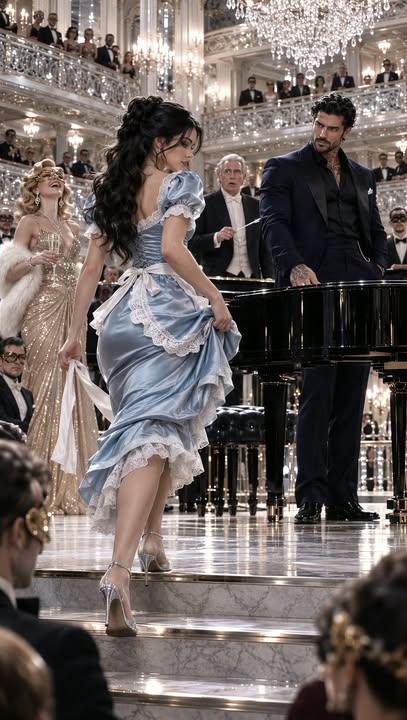
Part 6 – The Last Note
“I’m sorry,” the woman said again, her voice trembling as she stepped onto the stage.
The audience remained hushed, unsure whether the music had ended or merely paused.
I looked at the envelope in her hand, then at the page of music tucked beneath it.
“Who are you?” I asked.
“My name is Clara Bell. I was your father’s closest friend.”
The name stirred a faint memory: my father once mentioning a friend who had helped him through a difficult winter, though he had never told me where she went.
Clara came nearer but stopped well beyond the piano.
“I’m sorry I waited so long,” she said. “Thomas asked me to keep this safe, but he also asked me not to give it to you unless you chose to play the concerto.”
I looked at the final page before me.
“You knew I might.”
“I hoped you would have the choice.”
The envelope was sealed with a small circle of wax. My hands had begun to shake, so I set them in my lap.
“May I?” I asked.
Clara nodded.
I broke the seal and drew out a letter, its paper worn soft along the folds.
The first words were my name.
Elena, if this has reached you, then the music has found its way back to you.
I read the line twice before I could continue.
My father explained that Clara had kept a copy of the final page, written before Falk took the score to arrange it.
He had asked her to preserve it because he feared the original might be changed, misplaced, or claimed by someone else.
The page before me contained the ending I had begun to play, but it was not the ending I had expected.
At the very end, after the final chord, my father had written a quiet coda of three measures.
The music returned to the seven opening notes, softened almost to a whisper, then resolved in a new harmony.
Beside it, he had written: Wait for the second note.
I looked up at Clara.
“What does that mean?”
She glanced toward the audience, where the committee sat in attentive silence.
“It means the first note is not the answer.”
Her voice was gentle, almost private, yet the hall was so quiet that every person could hear her.
“Thomas told me the melody came to him when he was young,” she continued. “He said he understood what it meant only years later, when you were born. The first notes were the question. The second note was the answer he found in you.”
I looked back at the page.
There, in the coda, the opening melody returned, but one note had changed.
A small, luminous turn in the phrase, almost hidden beneath the final chord.
It was the note my father used to hum when I was a child, the one he always added when I asked him to play the melody again.
The audience had heard the opening before.
They had heard Falk’s version, polished and grand, with its different ending.
Now they were waiting to hear whether I would continue.
Clara placed the envelope on the piano beside the score.
“You don’t have to play it,” she said.
“I know.”
“Thomas wanted that to be clear.”
I looked at the page, then toward the darkened rows.
The people in the hall had come to decide whether my father had written the music.
They could not hear his memories.
They could not know the sound of the old upright piano in our apartment, or how he played the seven notes when he wanted to tell me that the day was over and I was safe.
But I could give them the ending he had written.
Not to force them to believe.
Not to punish Falk.
To let the music return to the person who had made it.
I placed the page on the stand.
“Thank you for keeping it,” I told Clara.
Her eyes shone.
“I should have brought it to you sooner.”
“You kept your promise to him.”
“I hope I did.”
“So do I.”
I drew a breath and set my hands on the keys again.
The room settled around me.
I began where I had stopped, allowing the melody to rise toward the final chord.
The missing page gave the music its full shape.
The quiet passage opened into the coda, and the seven familiar notes returned, no longer the beginning of a question but the answer that had waited all these years.
My hands found the changed note.
I held it gently, letting it ring.
Then I played the final chord.
It did not crash through the hall.
It settled there, clear and warm, like a light left on in a window.
For several seconds, no one moved.
Then Clara began to cry.
The committee chair rose first, not with applause but with a slow, deliberate nod.
Vincent stood beside him.
His mother stood, too, and Vivian followed.
The applause came only after that, growing from the back of the hall toward the stage, not as a demand that I smile or bow, but as an acknowledgment that the music had reached them.
I remained seated until the last note faded completely.
When I looked up, Vincent was watching me with an expression I could not have mistaken for pride in himself.
He looked relieved.
He looked grieving.
He looked as though he had finally stopped trying to protect the past from the truth.
The committee chair returned to the stage and asked Clara if she would be willing to give a statement about the page and my father’s work.
She agreed.
The archivist confirmed that the page was consistent with Thomas’s known handwriting and with the paper used in the original score.
The score, the letters, the photograph, the invoice, and the fragments found inside the piano were all preserved and examined by independent experts.
Falk did not storm out or make a scene.
He remained in the hall as the evidence was reviewed, listening while the people he had once persuaded began asking questions he could no longer answer with a practiced smile.
When the examination was complete, he issued a statement acknowledging that Thomas Marlow had written the concerto and that he had taken credit for the work after being entrusted with its arrangement.
He also admitted that Thomas had never tried to blackmail him.
The accusation, he said, had grown from his own fear of losing the career he had built on the music.
His admission did not mend the years of silence or return the life my father might have lived beneath his own name.
But it gave the truth somewhere to stand.
Vincent’s father’s part in the concealment was made public as well.
The Moretti family released the letter he had written and acknowledged that he had kept the original score while allowing suspicion to remain on Thomas.
Vincent spoke at the press conference, but he did not try to turn his family’s confession into a performance of virtue.
“My father preserved the manuscript,” he said. “He also failed to return it and failed to correct the false accusation. Both facts belong in the record.”
His voice caught slightly on the word father.
He took a breath and continued.
“The truth does not become less necessary because the person who hid it is gone, or because we loved him.”
I watched from beside the archivist, hearing the words settle over the room.
Vincent had chosen honesty without pretending it cost him nothing.
That mattered more than an easy apology could have.
In the months that followed, Thomas Marlow’s name was added to the concerto’s official record as its composer.
Falk’s name remained as the arranger who had once been trusted with the work, not the man who had created it.
The original score was placed in a public music archive, where it could be studied and performed with proper attribution.
Clara gave the archive her copy of the final page, though she kept the letter my father had written to her.
She visited me in Brooklyn a week later and sat at my kitchen table while I made tea.
For a while, we spoke about my father in small, ordinary ways: the jokes he repeated, the way he forgot where he had left his glasses, the songs he hummed while repairing a stubborn key.
She told me stories I had never heard, and I told her the ones I had saved.
Grief changed shape as we spoke.
It did not become smaller, exactly.
It became less lonely.
Vincent did not arrive with gifts or promises to solve my life.
He called to ask whether I wanted to see him, and when I said I was busy, he accepted it without turning my answer into a test.
When we did meet, we walked beside the river, ate from paper cartons, and talked about things that had nothing to do with the Morettis or the concerto.
Sometimes we spoke about our fathers.
Sometimes we let the conversation wander.
He learned that I disliked being hurried, even when I was late.
I learned that he kept an old photograph of himself with a child-sized violin in the study and had never admitted he wanted to learn another instrument.
“You could try piano,” I told him one afternoon.
“I’m not sure the piano would survive.”
“It survived my first year.”
“That sounds like a warning.”
“It’s an invitation.”
He accepted it, though he still approached the keys with more caution than confidence.
Vivian became a friend in the slow, unshowy way I had learned to trust.
She helped organize the archive’s first public program about overlooked composers and insisted that her family’s support for Falk be included in the history.
When I thanked her, she said she was not helping to earn forgiveness.
“I’m helping because the story should be told properly,” she said.
“That’s a good reason.”
“It took me a while to find it.”
“It took all of us a while.”
By the following spring, the medical debt that had once sat like a locked door between every month and the next had been settled.
The Moretti family offered to help through a fund established in Thomas’s name, with no conditions attached.
I asked an independent adviser to review the arrangement before I accepted.
Vincent did not object.
The money came without a request for my time, my gratitude, or my future.
I used some of it to close the old medical account and the rest to build the first small version of the program I had begun imagining.
The Thomas Marlow Music Room opened in a community center in Brooklyn, in two bright classrooms with secondhand keyboards and a wall of windows facing a courtyard.
The name on the sign made me pause the first time I saw it.
My father had spent so much of his life trying not to let his name become a burden.
Now it stood above a doorway where children could come in, sit down, and make music without needing permission from anyone who had already decided what they were worth.
On opening day, Clara came.
So did Vivian and her father, Vincent’s mother, the archivist, and people from the neighborhood who had never heard the old story at all.
Vincent carried a box of music stands through the doorway and assembled them badly enough that one of the children had to show him how the clips worked.
I laughed when he insisted he had been given a defective set.
“You’re not very convincing,” I told him.
“I’m trying to preserve my dignity.”
“Then you should have tightened the screws.”
He looked at the child, who had fixed the stand in less than a minute.
“I see I’ve been outclassed.”
The little boy grinned and ran off to tell his friends.
That evening, after the doors had closed and the chairs were stacked, Vincent and I stayed by the piano.
It was not the grand instrument from the Moretti ballroom or the one from the estate.
It was an upright with a scuffed side and two keys that sounded slightly different from the rest.
I had chosen it because it reminded me of home.
Vincent sat beside me on the bench.
“Would you play the concerto?” he asked.
“Which ending?”
“The one you chose.”
I placed my hands on the keys.
“Then stay for the whole thing.”
“I will.”
I played the first notes softly.
This time there was no ballroom watching, no wager waiting at the end, and no warning tucked beneath the music stand.
There was only the small room, the darkening windows, and Vincent sitting beside me without asking the music to prove anything.
When the concerto reached its final movement, I played it without stopping.
The last note belonged to me, just as my father had written.
It belonged to the room, too, and to every child who would one day learn the melody without knowing it had once been hidden.
When the sound faded, Vincent did not applaud.
He reached for my hand.
I let him take it.
“I want to ask you something,” he said.
“You can ask.”
“I don’t want to offer you a promise that sounds like a reward, and I don’t want you to feel that what happened between our families has placed an obligation on you.”
“Good.”
“I want to build a life with you, if you want that, too. Not because you played the music. Not because of what you found. Because I love the way you choose your own direction, even when it would be easier to let someone else choose for you.”
I looked at him, at the man who had once made a foolish wager to amuse a ballroom and had since learned that keeping his word meant more than keeping a promise made for applause.
I thought of my father’s warning, the score hidden in the cabinet, and the ending I had chosen to play.
“I won’t be anyone’s prize,” I said.
“I know.”
“I won’t be asked to soften the truth for your family.”
“I know.”
“And I won’t give up this room or the work I’m building because someone else thinks love should take up all the space.”
“I wouldn’t ask you to.”
I searched his face for a condition he had not spoken aloud.
There was none.
“Then yes,” I said. “I want to find out what we can build together.”
His smile was quiet and unguarded.
He leaned closer, then paused long enough for me to meet him halfway.
When we kissed, it was not a promise made to a crowd.
It was a choice made between two people who had learned that love could not erase the past, but could meet the future without hiding from it.
Outside, evening settled over Brooklyn.
Inside the music room, my father’s concerto waited on the stand, its title written in the name he had once been denied.
I turned the page and began again, freely, with no one telling me where the music had to end.
**–THE END–PLEASE
Share your thoughts or feedback to motivate us to create more stories ♥️
* * *
[PREVIOUS: PART 5](https://echoesofstories.idolsgift.com/blog/part-5-the-promise-beneath-the-music-046)
✓ Lynn R. Adams
Part 6 – The Last Note “I’m sorry,” the woman said again, her voice trembling as she stepped onto the stage. The audience remained hushed, unsure whether the music had ended or merely paused. I loo…