PART 6 (THE END): The Portrait in the Forgotten Wing 053
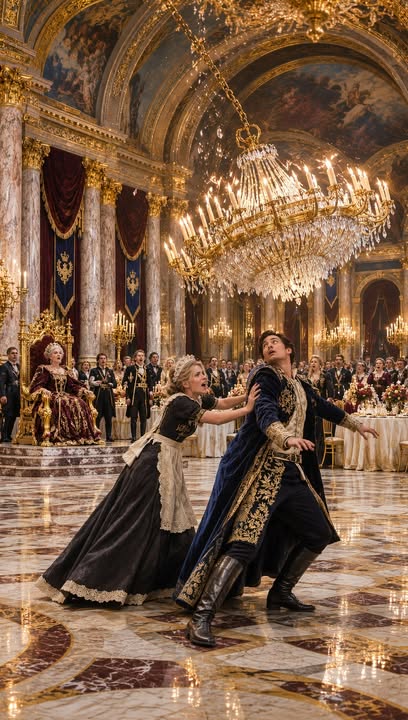
Part 6 – The Doors Open
The name was not the Queen Mother’s.
It was Alexander’s.
For a moment, the council chamber seemed to hold its breath around that single word.
Alexander stared at the declaration, his face unreadable, while the senior minister read the lines beneath it again.
The founding charter granted the council authority to examine any succession claim that might unsettle the realm, including the claim of a child whose identity had been concealed.
It also stated that the king’s eldest acknowledged heir could not be displaced without a formal hearing.
The room shifted from certainty to questions.
“This does not say Alexander’s claim is stronger,” the senior minister explained. “It says the council must examine both claims before reaching a conclusion.”
The Queen Mother looked at her grandson.
“Your father believed the charter could be used to challenge you,” she said. “He feared that if Emily were named openly, ambitious families would force the council to choose between you.”
Alexander’s eyes lifted from the document.
“Did he write this to protect me?”
“I believe he wrote it because he was afraid of what the council might do.”
“And did he tell you to hide Emily?”
“No.”
The answer came quietly.
The Queen Mother looked down at her clasped hands.
“He told me he had arranged for the child to be taken to safety. He said the question of her claim would be settled when the danger had passed.”
“But you did not tell the council she survived,” I said.
“No.”
“You said she had died.”
“Yes.”
The Queen Mother did not try to soften the truth this time.
The senior minister leaned forward.
“Your Majesty, you have acknowledged concealing the child’s survival and ordering the destruction of records.”
“I have.”
“Do you deny that this harmed Princess Eleanor’s daughter and distorted the succession?”
“I do not.”
The words seemed to cost her something, though not enough to undo what she had done.
Alexander stood.
“What will happen now?”
“The council will not decide the succession today,” the senior minister said. “We will appoint an independent inquiry to examine the charter, the royal records, and the testimony of those involved.”
He glanced toward the Queen Mother.
“Until that inquiry is complete, no one will be asked to renounce a claim, accept a title, or leave Aurelien.”
The Queen Mother nodded once.
“I will cooperate.”
The council members began speaking among themselves, but their voices had changed.
The room no longer sounded like a court preparing to declare a winner.
It sounded like people beginning the difficult work of listening.
I looked at Alexander.
He had spent the morning discovering that his father’s love had been tangled with fear, secrecy, and impossible choices.
Now he was facing the possibility that the crown he had been raised to inherit might not be his alone.
“Are you all right?” I asked.
He gave a small, weary smile.
“I’m not sure.”
“Neither am I.”
“That may be the most honest thing either of us has said today.”
The corner of my mouth lifted, though tears were pressing behind my eyes.
The senior minister called the council back to order and asked for my account.
I spoke of the chandelier, the torn sleeve, and the moment Alexander had recognized the mark on my wrist.
I spoke of Mrs. Bell’s testimony and the portrait in the forgotten wing.
When I reached Eleanor’s letter, my voice faltered.
I took a breath and continued.
I did not call for the Queen Mother’s punishment.
I did not ask to be named heir before the inquiry.
I asked only that the council stop repeating a story it now knew was false.
“Let the people know Princess Eleanor’s child survived,” I said. “Let them know the truth is still being examined. I do not want the rest of my life decided in a room where I am not allowed to speak.”
The senior minister bowed his head.
“The council will issue that statement before the day is over.”
I turned toward the Queen Mother.
“Will you correct your account?”
She met my eyes.
“Yes.”
It was not forgiveness.
It was not the same as trust.
But it was a beginning.
The council session ended without a new ruler, a renunciation, or a grand announcement.
Instead, it ended with a list of records to be reviewed, witnesses to be heard, and doors that had been closed for too long finally opening.
Over the weeks that followed, the inquiry brought the past into the light carefully, one document at a time.
The archivists examined Eleanor’s letters, the nursery ledger, the king’s order, and the charter.
Mrs. Bell told the council what she remembered of the fire and the princess’s final hours in the palace.
Margaret spoke of carrying me beyond the servants’ gate, wrapped in a wool blanket while the sky above the eastern wing glowed with smoke.
She described the king waiting in a plain carriage, his ceremonial coat replaced by a dark traveling cloak.
“He did not ask me to forgive him,” she told the inquiry. “He only said he was sorry I would have to carry the secret too.”
The king had given her a small purse of money and a letter addressed to me, to be opened only when she believed it safe.
Margaret had kept the letter hidden in the lining of an old sewing box, but time and repeated moves had worn the paper until its ink could no longer be read.
She had never told me about it because she feared that the smallest proof of my birth could lead someone to find us.
The inquiry also confirmed that the fire had been deliberately set in the archive corridor to destroy the records supporting Eleanor’s claim.
No one was injured in the blaze, because the nursery had already been emptied.
Eleanor had escaped the eastern wing before the smoke spread, but she died several months later from an illness that had weakened her during the months of secrecy and travel.
She had not been murdered.
She had not died in the fire.
She had spent the last months of her life believing I was safe.
When the inquiry’s findings were shared with the council, the Queen Mother did not deny her part in ordering the fire.
She admitted that she had believed the records would divide the realm and that fear had led her to make a choice she could not undo.
The council removed her from her ceremonial duties while it considered the consequences of her actions.
She accepted its decision without argument.
There was no public spectacle and no triumph in the chamber.
Only a quiet accounting of what had been done, and a promise that the same silence would not be allowed to shape the future.
The council examined the founding charter for nearly three months.
Its members found that the old wording did not provide a simple answer to the question of the throne.
Eleanor’s claim had been real, but she had never presented it before the council.
The king’s declaration had recognized that the charter required a hearing, not that either Emily or Alexander should be placed above the other without discussion.
As for Alexander, he had been raised as the heir and had served the people faithfully.
As for me, the council recognized me as Eleanor’s daughter and acknowledged my hereditary claim.
Neither of us was asked to defeat the other.
The settlement that followed changed more than the succession.
The council revised the charter so that no person’s place in the realm could be erased without a public record and a hearing.
The crown would continue under a shared constitutional agreement, with the council holding stronger authority and the people given a voice in decisions that had once belonged to a few families.
The question of who would wear the crown was left open until I had met with the council and the people of Aurelien.
When the day came, the palace’s great hall was filled with members of the council, household staff, citizens, and representatives from the surrounding towns.
I wore a simple ivory gown embroidered with subtle gold leaves.
For the first time, I chose not to cover my wrist.
The three-pointed mark rested in the open air, no longer a warning or a secret, only a part of me.
Alexander stood at my side.
Margaret and Mrs. Bell sat together in the front row, their hands clasped.
Lady Victoria was there too, no longer wearing the jeweled colors of an expected bride.
She had helped the council verify several of the Queen Mother’s private records and had given an honest account of the search she had joined.
She had not asked me to forgive her, but she had stopped trying to become someone the court would approve of.
When the senior minister invited me to speak, I looked across the hall.
The faces before me were not all royal, noble, or familiar.
Some were curious.
Some were uncertain.
A few looked at my birthmark as if it might explain everything.
It did not.
I had been a child in the palace nursery, a girl raised by a housekeeper, a servant carrying a tray beneath a chandelier, and a woman who had learned that every version of her life could be true at once.
“I know what it is to have other people decide who you are,” I began. “I know what it is to be protected by a secret and wounded by it too.”
Margaret’s eyes shone.
“I will not pretend that discovering my birth has made me ready to rule alone. It has made me understand how easily power can confuse silence with peace.”
I glanced at the council.
“If the people and the council believe I should serve Aurelien, I will do so with them, not above them. I will not take a throne as repayment for what was hidden from me.”
The hall remained quiet.
“I want a council that listens before it decides, and a palace that does not mistake closed doors for safety. I want every child in Aurelien to know that their place in this country does not depend on the name written beside their cradle.”
When I finished, no one rushed to place a crown on my head.
The senior minister rose and asked the council to approve the proposed settlement.
One by one, the members agreed.
Then the people assembled in the hall answered with a rising warmth that felt less like applause than a welcome.
The council recognized me as Eleanor’s daughter and rightful heir, and I accepted the responsibility of serving as Aurelien’s first sovereign under the new shared charter.
Alexander declined the title of king, but remained at my side as family and partner, free to choose a life that was not measured against mine.
When the hall had emptied, he found me beneath the portrait of Eleanor.
For the first time, the painting hung in a place where sunlight could reach it.
“She would have liked your speech,” he said.
“You think so?”
“I think she would have liked that you did not pretend to be certain.”
I looked at the painted woman holding the baby.
“I wish I had known her.”
“I wish I had known her too.”
We stood together in the quiet.
His shoulder touched mine, not as a prince guarding a claim, but as the person who had taken my hand when the guards came forward and then learned to wait for me to choose whether I wanted to offer it back.
I rested my fingers against his.
This time, I did not pull away.
“You know we still have a great deal to figure out,” I said.
“I was hoping for that.”
“You were hoping for uncertainty?”
“I was hoping for a life we choose ourselves.”
Outside, bells rang from the chapel tower.
The sound carried across the courtyard and through the open windows, reaching the gardens and the streets beyond the palace walls.
Later that month, the palace opened its eastern gates to the people for the first time in generations.
The old nursery was restored, not as a royal chamber but as a reading room for children.
The painted stars remained on the ceiling.
The cradle was placed behind glass, not as a relic of a lost heir, but as a reminder that no child should have to disappear in order to be safe.
In the courtyard, a memorial was dedicated to Eleanor.
Its inscription was simple.
She chose love over power, and truth over fear.
Margaret stood beside me as the cloth was lifted from the stone.
Her hand trembled in mine.
“I never thought I would see this,” she whispered.
“Neither did I.”
Mrs. Bell joined us, carrying Eleanor’s silver locket on a velvet cushion.
The archivists had restored its hinge and preserved the little blue ribbon inside.
At my request, it would be displayed in the reading room with a letter explaining its history.
Victoria stood among the guests, speaking with several council members.
She had chosen not to return to the engagement she had once been expected to accept.
Instead, she had taken up work helping the council make its records public, beginning with the papers that had been hidden from her as well as from me.
When she approached, she looked at the memorial and then at my uncovered wrist.
“I’m glad the mark no longer has to be hidden,” she said.
“So am I.”
She gave a small, uncertain smile.
“I hope I can earn your trust one day.”
“You can start by keeping the records open.”
“I can do that.”
It was not a perfect reconciliation, but it was an honest one, and that felt worth more.
As evening settled, the people drifted through the palace gardens.
For once, the guards stood back from the doors instead of blocking them.
Children ran beneath the stone archways, their laughter rising into the open air.
Margaret sat with Mrs. Bell on a bench near the chapel, sharing stories of Eleanor that I had never heard before.
Alexander joined me at the garden gate.
Beyond it, the city glowed with lamps and late sunlight.
“What do you think?” he asked.
“I think the palace feels different when the doors are open.”
“That may be because people are finally allowed through them.”
I looked down at the small crown on my wrist.
For years, I had covered it because someone had taught me that being seen was dangerous.
Now it was visible, but it no longer defined my whole life.
I was Eleanor’s daughter.
I was Margaret’s child in every way that love could make me.
I was a servant no longer, though the kindness I had learned in service would remain with me.
And I was not alone.
Alexander offered his hand.
I took it.
Together, we walked through the open gates toward the people waiting beyond the palace grounds, while the bells continued to ring over Aurelien.
For the first time, I entered the light without fear of being sent back into the shadows.
**–THE END–PLEASE
Share your thoughts or feedback to motivate us to create more stories ♥️
* * *
[PREVIOUS: PART 5](https://storyly.idolsgift.com/blog/part-5-the-portrait-in-the-forgotten-wing-053)
✓ Lynn R. Adams
Part 6 – The Doors Open The name was not the Queen Mother’s. It was Alexander’s. For a moment, the council chamber seemed to hold its breath around that single word. Alexander stared at the declar…