PART 6 (THE END): The Photograph in the Envelope 027
Part 6 – A Place for the Light
Elena’s hands trembled as she opened the envelope the rest of the way.
Inside was a second paper star, folded from yellow paper just like the one Matthew had kept, though this one was smaller and its points were still sharply creased.
For a moment, no one spoke.
The little girl leaned toward it, her eyes wide with wonder, while Daniel steadied the edge of the table with one hand.
I looked at the writing on the envelope.
Arthur had written my name.
Beneath it, in my daughter’s hand, were the words: “Mom can have this one when she’s ready.”
My breath caught, and I reached for the chair.
Elena set the envelope down between us, careful not to let the paper star slide out.
“I found it among Matthew’s things after he died,” she said. “Arthur had given it to him to keep safe. I didn’t know what was inside until I opened the envelope yesterday.”
I looked at her.
“Arthur gave Matthew another star?”
“He told me it was something your daughter had made for you,” Elena replied. “He said he didn’t want it to get lost while everything was being moved around at the hospital. Matthew kept it in his box because Arthur asked him to.”
The story rearranged itself in my mind, not as a new secret, but as the missing piece of an old kindness.
My daughter had made one star for Matthew and another for me.
She had known I would need something to hold, too.
I reached out and lifted the second star from its envelope.
Its paper was delicate, but the folds had held.
One point was slightly crooked, and in the center, where the creases met, there was a faint smudge of blue crayon.
I held it in my palm.
The little girl watched me with the stillness of someone who understood that this was important, even if she could not know why.
“She wanted me to have it,” I whispered.
Elena nodded.
“Yes.”
I turned the star gently, searching for another message, but there was none.
There did not need to be.
For years, I had kept the things our daughter left behind because I feared that if I let anything go, I would lose another piece of her.
Now I understood that she had left me something meant to be kept, and something meant to travel.
The first star had gone to a frightened boy.
The second had waited for me.
They had both been folded by the same small hands, carrying two different forms of love.
I pressed the star against my palm and closed my fingers around it.
This time, the ache that came was joined by warmth.
“I think I’m ready,” I said.
Elena’s eyes filled, but she did not reach for me.
She let the words belong to me.
“Ready for the garden?” Daniel asked quietly.
I looked at the paper flower his daughter had brought, still resting beside the photograph.
“Ready to begin.”
The following week, Elena and I met at the community garden behind the old library.
It was a modest place, tucked between two brick buildings, with a gravel path, a handful of raised beds, and a wooden bench beneath a maple tree.
We had chosen it because it was peaceful without being hidden.
People passed through on their way to the library, and children sometimes stopped to look at the flowers.
Arthur would have liked that, I thought.
He had never believed remembrance needed to be grand to matter.
Elena carried Matthew’s wooden box, and I brought the blue tin, the little card my daughter had written, and both stars wrapped in soft tissue.
I had also brought the blue button, though I had no intention of leaving it there.
It rested in my coat pocket, cool against my fingers whenever I reached for it.
We had talked about the garden for several days, changing our minds about the details and then changing them back.
In the end, we agreed to keep it simple.
A narrow bed of flowers.
A small plaque with both children’s names.
A place for the paper stars to be remembered, without leaving the original paper out in the weather.
The garden volunteer had offered to help us plant a young dogwood near the bench, and I had chosen a few hardy flowers that could return each spring.
I could not bring every object from the closet.
I did not want to.
The blue sweater, the wooden horse, and the drawings I could still picture my daughter making would stay with me.
I would keep the blue button in its tin and her little card in the drawer beside my bed.
The rest of her belongings did not all have to remain untouched for her to remain loved.
Elena and I stood beside the empty flower bed while the volunteer marked the ground.
For a while, we spoke about practical things.
How deep the soil should be.
Whether the dogwood would have enough light.
Where the plaque might sit so people could read it without stepping among the flowers.
Ordinary decisions made the work easier.
They gave our hands something to do while our hearts caught up.
Then Elena glanced at the tissue-wrapped stars in my arms.
“Would you like to place them together?” she asked.
I unfolded the paper.
The two stars rested side by side in my hands, one softened by years of being carried and the other still holding its crisp folds.
I thought of my daughter at the table, making them with all the concentration she could gather.
I thought of Matthew carrying one through his childhood, keeping it safe in the way children keep the things that tell them they are brave.
I thought of Arthur, afraid to tell me and yet unwilling to let the promise disappear.
Then I thought of the woman standing beside me, who had carried her own grief through years of uncertainty and had brought the star back without asking me to surrender anything.
“Let’s place the copies in the garden,” I said. “The originals should stay protected.”
Elena smiled softly.
“I think Matthew would have liked that.”
“So would my daughter.”
We had arranged for two small glass-fronted cases to be set beneath the plaque, sheltered from rain and close enough for people to see the paper inside.
The originals would rest there together, along with a copy of my daughter’s note and a small card bearing Matthew’s name.
I had hesitated over the wording for the plaque.
At first, I wanted something that explained everything: the hospital, the letters, the promise, the years of silence.
But no inscription could contain a whole life, and I did not want our children’s names to become an explanation of their deaths.
In the end, we chose a single sentence.
“Two bright hearts, still passing kindness forward.”
It was Elena’s suggestion, and when I read it, I knew it was right.
The volunteer finished setting the cases in place.
Elena opened the wooden box and lifted Matthew’s star.
I took my daughter’s star from the tissue.
We placed them together beneath the clear glass.
The older star had faded toward cream, and the newer one remained a richer yellow.
Their points almost touched.
I rested my fingertips against the glass.
For one impossible instant, I imagined my daughter’s small hand on the other side, pressing the star into place.
Then I remembered that she had already done so, long ago.
She had made the gift.
Matthew had carried it.
Arthur and Elena had kept their promise.
And now I had chosen to let the story be seen.
The planting began after that.
I knelt in the soil, though my knees complained, and helped set the flowers into the bed.
Elena worked beside me, her sleeves rolled to her elbows.
The volunteer brought a small watering can, and Daniel’s little girl carried it proudly from the path.
She poured carefully, too carefully at first, directing a thin stream of water toward each plant as if each one needed to be asked before it could drink.
When she finished, she looked up at me.
“Did I do it right?”
“You did beautifully,” I told her.
She grinned, and Daniel laughed behind her.
The sound carried through the garden with an ease I had not heard in my house for a long time.
A month earlier, I might have felt guilty for noticing it.
Now I let myself listen.
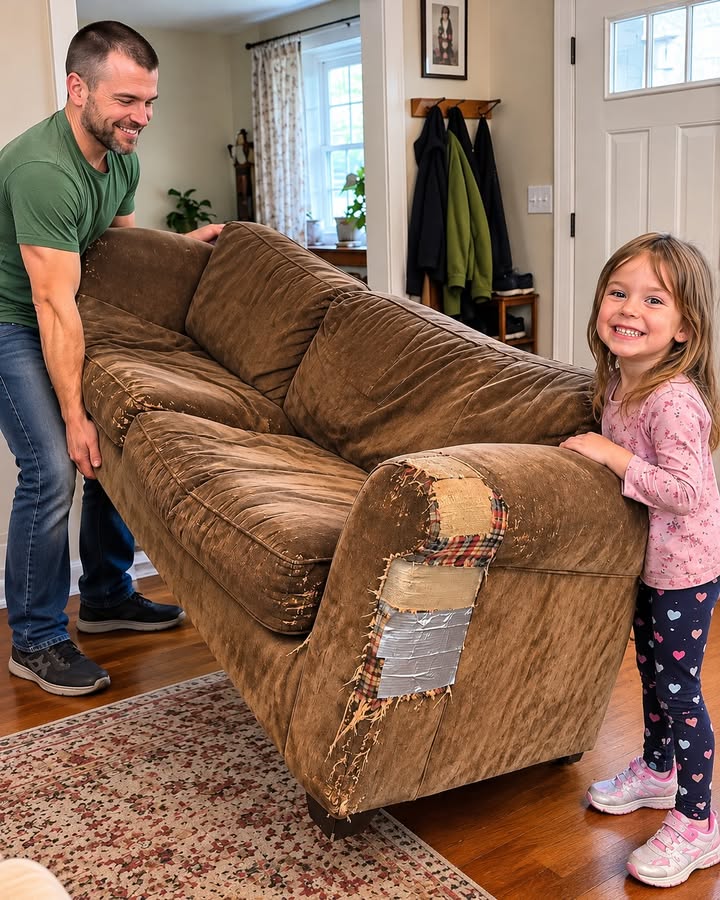
Daniel had come back to check on the couch twice since the day he found the package.
The first time, he brought a photograph of his daughter asleep across the cushions, one arm flung over the place where he sat.
The second time, he brought a small repair kit because one of the couch’s springs had begun to squeak.
“You should keep the twenty dollars,” I had told him when he tried to return it again.
He had smiled and said he had used it to buy his daughter a lamp for her new room.
“She likes to read on the couch now,” he explained.
“I think Arthur would have liked that,” I replied.
At the garden, Daniel’s daughter had brought another flower, folded from paper this time, yellow with a green stem.
She placed it beneath the plaque.
“It can stay here,” she said. “It won’t get wet.”
“That’s right,” I told her.
She looked at the glass cases.
“Are those the stars?”
“Yes.”
“Can I make one too?”
“Of course.”
We had brought sheets of yellow paper for that very reason.
I sat on the bench beside her and showed her how to fold the first corner.
She followed my hands closely, her tongue caught between her teeth with concentration.
The memory of my own daughter at the kitchen table rose gently, not like a wave that knocked me down, but like sunlight moving across a familiar floor.
I showed the girl how to crease the paper without pressing too hard.
When she had finished, one point was longer than the others, and the middle sat slightly crooked.
She held it up with satisfaction.
“It looks a little like the one in the box,” she said.
“It does.”
“Maybe I’ll make another one for my dad.”
Daniel’s face softened.
“I’d like that,” he said.
I watched them together, father and daughter, with the paper star between them.
They were not replacing the family Arthur and I had lost.
They were not filling an empty place or asking me to pretend that grief had become simple.
They were simply there.
Their presence gave the garden another kind of life.
When the last plant was settled, Elena and I stepped back from the flower bed.
The new soil was dark and damp, the small flowers lifting their faces toward the afternoon light.
The dogwood stood near the bench, its slender trunk supported by two stakes.
It would take time to grow.
I liked that.
“I kept thinking the garden would be an ending,” I said.
Elena looked at the plaque.
“And now?”
“Now it feels like a place where the story can go on.”
She nodded.
“I think that’s what Arthur wanted.”
“I think so too.”
I did not say that I wished he had trusted me enough to tell me while he was alive.
The wish was still there.
It would always be there, perhaps, along with the hurt.
But it no longer stood between me and the love I had known.
Arthur’s silence had been a mistake made from fear.
His letters had shown me that he had been trying to honor our daughter, trying to support Elena, trying to keep a promise, and trying—clumsily, painfully—to spare me.
I could understand his reasons without excusing his choice.
I could miss him and still be angry with him.
I could love the man he had been without pretending he had never failed me.
That, too, was a kind of honesty.
When the garden volunteer left, Elena and I remained on the bench.
Daniel’s daughter sat on the path with her father, carefully arranging her paper star beside the flower she had brought.
The afternoon moved around us in ordinary sounds: a bicycle bell, a distant door closing, leaves stirring above the bench.
“What will you keep?” Elena asked.
“The blue button,” I said. “The sweater. A few drawings, and the card.”
“And the star?”
I looked at the glass case.
“I’ll keep the memory of making it with her, even though I didn’t know I was part of the story until now.”
Elena reached over and rested her hand briefly on mine.
“I’m glad you came to find me.”
“So am I.”
We sat without speaking for a while.
This time, the quiet did not feel like something either of us was afraid to disturb.
It was simply the space between two people who understood that grief did not always need words.
When I returned home that evening, the house was quiet, but it no longer felt as though it had been sealed against the world.
The couch was still gone.
The hall closet still held the box of things I had chosen to keep.
Arthur’s letters rested in a folder on my desk, no longer scattered or hidden.
I had not decided whether I would read them all again.
I might.
I might also put them away for a time.
There was no deadline.
In the bedroom, I opened the drawer where I kept the blue tin.
Inside lay the button, my daughter’s card, and the blue ribbon from her fifth birthday crown.
I placed the second paper star’s envelope beside them, though the star itself remained in the garden.
Then I closed the drawer gently.
For the first time in years, I did not feel that the drawer needed to be locked against time.
The next morning, I woke before the alarm and opened the curtains.
Sunlight spread across the floor.
I made coffee and stood by the kitchen window, looking out at the small yard where Arthur had once tried to grow a gardenia bush.
It had not survived the winter, as he had written in his letter to Elena.
For a long time, I had thought that was simply one more thing he had forgotten to tell me.
Now I could see him standing there with the young plant, probably turning the soil and hoping it would take.
I could imagine him coming back inside with dirt on his hands and a story he meant to share later.
I wished he had told me about the hospital, the letters, the star, and the promise.
I wished he had trusted me with the truth before he ran out of time.
But the love was there, too, unmistakable in the way he had preserved our daughter’s words, in the care he took with the letters, and in the final note he had written when he finally understood that silence was not enough.
That morning, I did not ask myself whether letting go meant forgetting.
I knew the answer.
My daughter lived in the small things I kept, in the people she had helped, in the star behind glass, and in the kindness that continued to move from hand to hand.
I poured a second cup of coffee before I remembered that Arthur was not coming downstairs.
Then I stood with it for a moment, feeling the old ache rise.
It remained.
So did the warmth.
A few days later, my daughter visited and brought lunch.
We ate at the kitchen table, where I showed her the card from the blue tin.
She read it carefully, her eyes bright.
“She was always trying to take care of people,” she said.
“Yes,” I replied. “Even when she was little.”
My daughter touched the edge of the card.
“Dad must have loved knowing she had asked him to keep his promise.”
“He did.”
“And he must have been afraid you’d hear it as goodbye.”
“I think he was afraid of a great many things.”
She nodded, then folded the card back along its old crease.
“Do you forgive him?”
I considered the question.
“I’m still learning what forgiveness means when someone is gone,” I said. “I don’t think it means I stop wishing he had chosen differently.”
“No,” she said. “I don’t think it has to.”
“I can forgive the fear without pretending it didn’t hurt.”
“That sounds like you.”
I smiled at her.
For years, I had thought of our family as a house with one chair missing, every room arranged around the absence.
Now I could see that the house still held our daughter’s laughter, Arthur’s quiet tenderness, and my living daughter’s hand reaching for mine.
There was space for Elena, too.
There was room for Daniel and his little girl to come by on a Sunday afternoon.
There was room for new flowers, new conversations, and memories that did not erase the old ones.
The following Sunday, we all returned to the garden.
Daniel’s daughter ran ahead, carrying two paper flowers.
She placed one beside the plaque and gave the other to me.
Elena brought a small bunch of white flowers from her yard.
My daughter brought a candle in a glass jar, though we did not light it until the sun began to lower.
We stood together beneath the maple tree, not as people who had finished grieving, but as people who had found a way to remember without closing every door.
The girl sat on the bench and swung her feet.
Daniel leaned beside her, one hand resting on the back of the seat.
Elena stood near me, her shoulder close enough to touch.
I took the blue button from my pocket and held it between my fingers.
It caught the light, turning from deep blue to a brighter shade, like a small piece of sky.
I would take it home again.
Some things were meant to remain with me.
The stars would stay in the garden, protected behind glass, where anyone who needed a little hope could see them.
I had not given my daughter away.
I had let one of her gifts continue.
As the light softened across the flowers, I looked at the two names on the plaque.
For years, I had believed Arthur’s couch held the secret of a betrayal.
It had held a promise, hidden beneath hand-sewn fabric because he had been afraid to open the door to grief.
The promise was not perfect.
Neither had our love been perfect.
But love had been there—in the child who made the stars, in the boy who kept one, in the woman who protected them, in the man who finally tried to speak, and in the stranger who brought the package back to my doorstep.
I thought of the couch now in Daniel’s apartment, its sagging cushions holding a father and daughter side by side.
I could almost hear the little girl calling for him to sit closer.
The thought made me laugh softly.
When she noticed, she looked up at me.
“What are you thinking about?”
“I’m thinking that some old things still have a lot of life left in them.”
She considered that, then leaned against her father’s arm.
The sun slipped lower, and the glass over the stars caught one final warm gleam.
I let myself stand there, surrounded by new friendship and old love, and feel the next day waiting beyond the grief.
Not as a replacement for what I had lost.
As a life that was still mine to enter.
**–THE END–PLEASE
Share your thoughts or feedback to motivate us to create more stories ♥️
* * *
[PREVIOUS: PART 5](https://puretales.idolsgift.com/blog/part-5-the-photograph-in-the-envelope-027)
✓ Lynn R. Adams
Part 6 – A Place for the Light Elena’s hands trembled as she opened the envelope the rest of the way. Inside was a second paper star, folded from yellow paper just like the one Matthew had kept, tho…