PART 6 (THE END): The Photograph in His Wallet 046
Part 6 – The Song That Brought Them Home
Adrian read the solicitor’s note again, then rested it on the desk as if the paper had become too heavy to hold.
For a moment, no one spoke.
Vivienne stood near the window, her hands clasped before her, while I watched the rain gather in thin trails on the glass.
“What does it mean?” I asked.
“It means my father anticipated that the child’s identity might one day be questioned,” Adrian said.
His voice was measured, but I could hear the hurt beneath it.
“Perhaps he was trying to protect you,” Vivienne said.
“Or protect the trust,” Adrian replied. “We won’t know until we speak with the solicitor.”
He looked toward me.
“We’ll ask Mrs. Chen to arrange a meeting. You’ll decide what you want to hear and what you don’t.”
I nodded.
“I want the truth. But I don’t want this to turn into a fight over who gets to claim me.”
“Then we won’t let it,” Adrian said.
That evening, Mrs. Chen confirmed that the retired solicitor, Mr. Bell, was willing to meet with us.
He had handled Adrian’s father’s affairs for decades and had kept the trust records in secure storage.
He did not sound eager to revisit the past, but he did not refuse.
The meeting was arranged for the following week, at Mrs. Chen’s office, with no one else present.
Until then, the family kept to its quiet routines.
The twins asked me to come each morning, and I did.
They were beginning to laugh more easily, though grief still visited them in small, unpredictable ways.
Sometimes a song on the radio made them go quiet.
Sometimes they asked about their mother while we built a tower of blocks, and Adrian answered as best he could.
He no longer hurried away from those questions.
He told them about Clara’s laugh, her untidy music notebooks, and the way she used to leave books in every room.
He told them she had been brave, though not always sure of herself.
The boys listened without needing every story to end neatly.
One afternoon, Leo asked whether Clara had known me.
Adrian looked at me before answering.
“She knew you when you were very small,” he said. “And she loved you.”
“Did she sing to me?”
“She did.”
I touched the edge of the piano.
“I think she did,” I said. “And Rosa carried the song with me.”
Tomas leaned his shoulder against mine.
“Then the song knows all of us.”
The thought was so simple that it made my eyes sting.
“Yes,” I said. “I think it does.”
When the day came to meet Mr. Bell, I brought the hospital card and the copies of Clara’s letter.
Adrian came with me, but he left the first questions to me.
Mr. Bell was a slender man with white hair and a soft voice.
He had placed a worn leather case on the table, its brass clasp polished by years of use.
“I have thought about this meeting for a long time,” he said. “Though I did not expect it to happen like this.”
“Did you know Rosa?” I asked.
“I met her once, briefly. Your mother, Clara, trusted her completely.”
He opened the case and removed a folder.
“Your grandfather asked me to prepare certain documents after the hospital records were corrected. He did not explain everything, but he made clear that the infant’s identity had to remain protected.”
“Protected from whom?” Adrian asked.
Mr. Bell glanced down at the papers.
“From anyone who might use the child’s existence to influence the family trust.”
He chose his words carefully.
“Your grandfather had learned that a distant relative was making inquiries about the estate and the children’s future inheritance. There was no direct threat, and no evidence that the person intended harm, but your father believed discretion was the safest course.”
“Why not tell Clara?” I asked.
“I cannot answer that. I can only tell you what was written in the file.”
He turned one page toward us.
The note was in Adrian’s father’s handwriting.
It stated that the hospital had reported a serious identification error after the birth of Clara’s twins.
One infant had been moved under the wrong chart, and a mistaken report had led the family to believe the baby had died.
By the time the error was discovered, Rosa had already taken the surviving child into her care.
“Why would Rosa leave with me?” I asked.
“According to the file, Clara asked her to,” Mr. Bell said. “The hospital wanted to investigate the error before making any public correction. Your grandfather feared that an announcement could expose the child’s identity before they understood who had access to the records.”
“Did Clara know I was alive?” Adrian asked.
Mr. Bell’s expression grew sorrowful.
“Not for long.”
He found a letter dated several days after my birth.
It was addressed to Adrian’s father, written by Clara.
Mr. Bell did not read it aloud.
He slid it across the table so I could choose whether to read it myself.
The letter said Clara had been told that one of her babies had died.
She had been shown a record bearing the wrong identification and had believed it.
Rosa, who had been present during the transfer, suspected the mistake.
She had taken the infant home under the arrangement they had made before the delivery: if either baby faced a medical or family danger, Rosa would care for her until the truth could be safely established.
Clara’s letter asked Adrian’s father to investigate quietly and to tell her the moment he knew anything certain.
A note in the margin, written later, said the investigation had confirmed the error, but the attending physician had advised waiting until the records could be corrected without exposing the child to further confusion.
Then, in another hand, a final line had been added.
Clara was never told the investigation had succeeded.
The room seemed to lose its edges.
“She thought I was dead,” I said.
Adrian lowered his gaze.
“She believed what the hospital told her.”
“And Rosa knew?”
“Rosa knew you were alive,” Mr. Bell said. “She did not know whether the correction could be made safely, or whether telling Clara would draw attention to you. The file says she was warned that a relative had begun asking questions about the family’s future inheritance.”
“Who was it?” Adrian asked.
Mr. Bell shook his head.
“There is no name in the record. Only a solicitor’s note that the inquiries stopped after your grandfather placed the trust under seal.”
The mystery was not solved with a villain or a confession.
It ended with an error, frightened people making careful choices, and a silence that grew harder to break with every passing year.
“What happened to the trust?” Adrian asked.
“It was created to protect the child’s identity and preserve her rights until she was old enough to choose what she wanted,” Mr. Bell said.
He set another document before me.
The trust held no claim over me.
It held no condition that I return to the family or take a share of the estate.
It had been kept in place only so that, if the truth came to light, my identity and my legal interests could be safeguarded.
My grandfather had left instructions that the records should be given to me if I ever came forward.
“I’m sorry,” Mr. Bell said. “The file was meant to protect you, but it also prolonged the silence.”
I looked at the letter in Clara’s hand.
“Did Rosa know Clara believed I had died?”
The solicitor hesitated.
“She knew Clara had been told the baby was gone. She believed it would be more dangerous to correct the story until the hospital’s investigation was complete.”
“But it never was.”
“It was completed,” Mr. Bell said gently. “The information simply never reached Clara.”
I closed my eyes.
I could picture Rosa holding me in a small room, listening for footsteps in the hall.
I could picture Clara in this house, grieving a child who was alive somewhere beyond her reach.
Neither woman had meant to abandon me.
Both had been trying to keep me safe, and both had been left with a loss they did not deserve.
When I opened my eyes, Adrian was watching me.
“Do you want to stop?” he asked.
“No,” I said. “I want to know everything that is mine to know.”
Mr. Bell answered each question he could.
He gave us copies of the documents and signed a statement confirming that the trust had been created for protection, not possession.
Mrs. Chen later arranged the legal review.
It confirmed my identity and gave me the choice to amend my records without requiring me to surrender the name I had lived under.
I kept Marquez.
My name remained Elena Rosa Marquez Vale, with Rosa’s name at its center and Clara’s family acknowledged beside it.
I did not change it for inheritance.
I did not change it for the newspapers, though a few reporters eventually learned that Adrian Vale had an adult daughter.
Mrs. Chen handled the inquiries with care, and Adrian refused to discuss my private life.
When I agreed to speak publicly, it was through a brief written statement.
I said I had been raised and loved by Rosa Marquez, and that I had learned she and Clara Vale had shared a deep friendship.
I said I was grateful to discover the truth, but I would not turn either woman’s choices into a spectacle.
Then I stopped answering questions.
The custody challenge never came.
The trust review closed with the confirmation that no one had a legal claim over me and that the twins’ home would not be drawn into a dispute.
The old fear of an unnamed relative faded as the records were secured and the family’s legal affairs were clarified.
But paperwork could not return the years.
It could not put Clara in the room to hear me sing.
It could not let Rosa explain why she had kept the past quiet.
What it could do was give me a place to stand without asking me to choose which mother had mattered more.
Adrian understood that better than anyone.
He never called me his daughter in public unless I had first said I was comfortable with it.
At home, he called me Elena.
The word felt warm in his voice.
When I spoke about Rosa, he listened.
When he spoke about Clara, I listened.
We did not pretend the two women had made every choice perfectly.
We did not need them to have been perfect to honor what they had done.
A few months after the records were settled, we held a family gathering in the garden.
It was small, just the people who had helped care for the boys, a few of Clara’s old friends, and the family who had come to accept that love had taken an unexpected path.
Vivienne placed a framed photograph on the table.
It showed Clara and Rosa together, laughing beneath the old oak tree.
“I found it in a box at my apartment,” she said.
“Do you remember when it was taken?” I asked.
“Not exactly. But I remember Clara loved it.”
She hesitated, then added, “I’m glad she kept it.”
“So am I.”
Adrian had placed two small arrangements of white flowers beside the photograph.
One was for Clara.
The other was for Rosa.
The twins helped arrange them, though they kept changing their minds about which flowers looked best.
Leo chose a cluster of blue blossoms.
Tomas added a yellow one because he said the table needed something sunny.
When the guests had eaten and the garden began to glow with late afternoon light, Leo asked me to sing the moon song.
I felt the old nervousness rise in me.
The song no longer belonged to memory alone.
It belonged to the women who had made it, the children who had carried it, and the family we were still learning to become.
I looked at Adrian.
“Would you like me to?” I asked.
He nodded.
“If you want to.”
The boys sat on the grass beneath the oak tree.
Vivienne stood behind them, her eyes bright.
Adrian remained near the table, his hands resting at his sides.
I began with the verse my mother had sung to me.
Sleep beneath the silver light,
While the quiet stars keep watch tonight.
The twins leaned toward each other.
I continued into Clara’s verse.
When the river turns to glass,
I will sing until the shadows pass.
Then I reached the lines I had once only half remembered.
The river carries moonlight home,
Past sleeping reeds and fields of foam.
Though distant shores may hide from view,
The song will always lead to you.
As I sang, Adrian’s face changed.
He knew the words.
He knew the melody.
But for the first time, he was not hearing them as a song that belonged to a life he had lost.
He was hearing it as something that had endured.
When the final note faded, the garden stayed quiet for a moment.
Then Tomas rose and held out his hand to Leo.
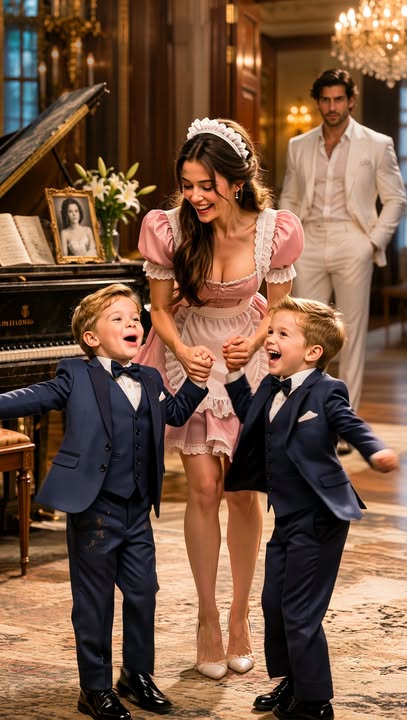
They began to sway, first awkwardly, then with the easy rhythm of children who had stopped worrying about whether anyone was watching.
I offered my hands to them.
They pulled me into their dance.
The boys laughed, and this time the sound did not startle them.
Adrian crossed the grass and joined us.
He did not dance well.
The twins corrected his steps, and I laughed when he pretended their instructions had made him an expert.
Vivienne came forward, too, and soon the old song had gathered all of us beneath the tree.
I looked toward the framed photograph on the table.
Rosa’s smile rested beside Clara’s, just as it had in the picture Adrian carried in his wallet.
For years, I had believed my mother’s silence meant the story ended before my birth.
Now I understood that it had been a thread, carefully carried through fear and distance until it found its way back to us.
Clara had made the song.
Rosa had kept it alive.
The boys had remembered it.
And I had brought it home.
As the twins danced between us, Adrian reached for my hand.
I took it, holding on to my brothers with the other.
The song that had begun in one mother’s heart and been guarded by another finally belonged to all of us.
**–THE END–PLEASE
Share your thoughts or feedback to motivate us to create more stories ♥️
* * *
[PREVIOUS: PART 5](https://echoesofstories.idolsgift.com/blog/part-5-the-photograph-in-his-wallet-046)
✓ Lynn R. Adams
Part 6 – The Song That Brought Them Home Adrian read the solicitor’s note again, then rested it on the desk as if the paper had become too heavy to hold. For a moment, no one spoke. Vivienne stood …