PART 6 (THE END): The Photograph Between Them 041
Part 6 – The Place We Chose
“Matteo is alive, and he has asked me to bring him home.”
Luca read the sentence once more, then lowered the page.
For a few seconds, the only sound in the kitchen was Sofia arranging her toy cups and humming to Bunny.
I held her close, feeling the warmth of her cheek against my shoulder, while Luca studied the handwriting as if it might vanish if he looked away.
“Does it say where he is?” I asked.
Marco shook his head.
“The forwarding instruction lists a contact address, but the archive hasn’t confirmed whether it’s current.”
“Then we follow the records,” Catherine said. “The authorities can verify the address and contact the people there. No one should go alone or arrive without warning.”
Luca gave a small, thoughtful nod.
“Agreed.”
It was the first time I had heard him accept a limit without needing to test its edges.
He looked toward me.
“If they locate him, would you want to meet him?”
The question was careful, but its weight was immense.
“I don’t know,” I said honestly. “I want to know the truth. I want to know why he never came back. But I can’t promise what I’ll feel when I see him.”
“You don’t have to promise anything.”
His gaze moved to Sofia.
“And she doesn’t owe him a meeting either.”
Something inside me eased.
“Thank you.”
The investigation took months, not days.
The forwarding address led the authorities to a small rehabilitation residence near the Wisconsin border, but Matteo had left it years earlier.
The staff remembered a quiet man who used another name, walked with a cane, and kept a small photograph of a baby in the drawer beside his bed.
They did not know where he had gone.
The address on file was old, and the name he had used there led nowhere.
For weeks, the search seemed to circle the same handful of facts.
Matteo had survived.
He had left St. Agnes after several months of treatment.
Peter Vale had known he was alive and had been instructed not to contact Luca until Matteo was found.
But the records did not explain whether Vale had ever found him.
They did not reveal who had arranged the crash, or whether that person still posed a danger.
They did not say why Matteo had stayed away after the immediate threat faded.
Meanwhile, Catherine worked with the authorities to preserve the hospital records and trace the closed reimbursement account.
Marco’s review of the household payroll uncovered a separate, more recent theft.
The former financial director had used the false medical-reserve code to divert employees’ deductions into an account controlled through a consulting company.
He had also altered reimbursement records, using Rosa’s old case number as cover for transactions that should never have been charged to the staff.
The pattern explained why my wages had quietly shrunk and why a record bearing my mother’s name had appeared in the payroll folder.
It did not explain every hidden entry.
Some of the older payments had been made for legitimate medical care, including my mother’s treatment.
Others had been added later, without a clear patient or provider.
The investigation found that Peter Vale had not stolen the employees’ wages.
He had, however, closed the old foundation account and kept its records under his control, believing that the information about Matteo and the baby could endanger them if it became known.
He had not told Luca.
He had not told the authorities.
And by keeping the records hidden, he had left a trail that the former director eventually learned to exploit.
When Vale was interviewed, he admitted that he had found Matteo alive through a hospital contact several months after the crash.
Matteo had asked him not to tell Luca until he could be certain the people responsible for the accident could no longer reach the family.
Vale had agreed, believing it was a temporary precaution.
Then Matteo disappeared again before Vale could bring him home.
Instead of telling Luca what had happened, Vale kept searching privately and let the family continue to believe the official report.
He had convinced himself that silence was protection.
It had been a choice made from fear, and it had cost all of us years we could never recover.
The former director had later found the reimbursement file while reviewing old accounts.
He realized that Rosa’s case number connected to the baby Matteo had tried to protect.
Rather than report the irregular entries, he used them to monitor the Rossi name and steal from employees, assuming no one would examine a closed account closely.
The authorities recovered most of the stolen wages and medical contributions.
The former director and the people who had helped him were charged through the proper process.
Vale cooperated with the investigation, surrendered the remaining records, and acknowledged the harm his silence had caused.
His actions did not become harmless simply because he had meant to protect someone.
But learning the truth allowed Luca to separate his brother’s choices from the decisions other people had made on his behalf.
When Luca read Vale’s statement, he sat with it for a long time.
“He decided that I couldn’t be trusted with the truth,” he said.
I sat across from him at the library table, the same table where we had first looked at my mother’s photograph.
“Maybe he thought he was keeping the danger away from you.”
“Maybe.”
He turned the page over.
“That doesn’t make it right.”
“No.”
“I spent six years believing I had lost Matteo. Then I spent all this time wondering whether he had chosen to disappear.”
“Now you know he was afraid, and that he trusted Rosa to protect Sofia.”
Luca looked toward the photograph on the shelf.
It stood in a simple wooden frame now, beside a smaller portrait of Rosa that I had brought from home.
“Knowing why doesn’t give us back those years,” he said.
“No,” I replied. “But it gives us a more honest place to start.”
He absorbed that quietly.
Then he nodded.
The report on the crash was eventually reopened.
The original identification had relied on belongings recovered from the scene, not a reliable medical or dental match.
The vehicle had been deliberately tampered with, though the authorities could not prove who had arranged it.
The evidence was old, incomplete, and partly lost.
They found no reason to believe Luca had been involved, and no evidence that the former director had arranged the crash.
The truth was serious, but it did not become the sprawling conspiracy we had feared.
It was enough to explain why Matteo had been frightened, why Rosa had made her promise, and why the family had been told there was no one left to search for.
It was not enough to bring him back.
Nearly eight months after the hospital letter surfaced, a caseworker called Catherine with news.
An older man matching Matteo’s description had been receiving care at a small assisted-living center several counties away.
He had been admitted under the name he used during rehabilitation, but a recent records review had uncovered a second identity in an old medical file.
The authorities confirmed the match through archived hospital records and a family identification process.
Matteo had died there, quietly, two years earlier.
He had no close relatives listed, only a request that his personal papers be kept with his effects.
The news reached Luca first.
He asked me to come to the estate before he called the others.
When I arrived, he was standing alone in the library.
On the table lay a sealed envelope with Matteo’s name written across it.
“The caseworker found this among his papers,” he said. “It was addressed to Rosa.”
I looked at the envelope.
My mother had been gone four years.
“He may have written it before he knew she had died,” I said.
“Yes.”
“Do you want me there when you open it?”
Luca’s eyes met mine.
“I want you to decide whether it’s yours to read.”
“It was meant for my mother.”
“And she asked you to keep her papers.”
I reached for the envelope but did not break the seal.
“I think she would want us to read it together.”
He nodded.
We sat side by side at the library table.
For a moment, neither of us moved.
Then I opened the envelope carefully and unfolded the letter.
The handwriting was uneven in places, as if Matteo’s hand had grown tired while he wrote.
He began by calling Rosa his bravest friend.
He thanked her for keeping the baby safe when he had been unable to protect her himself.
He apologized for leaving her with a promise that had no clear end.
He wrote that the people who had arranged the crash had not been brought to justice, and that he feared any contact with Luca would draw danger back toward the family.
He had planned to return when he could be certain the threat was over.
By the time he believed the danger had passed, he had learned that the people who had once been closest to him were scattered, and he no longer knew how to step back into their lives.
The letter did not excuse his absence.
It did not say that fear had been the only reason he stayed away.
It said that shame had joined fear, and then time had made the silence harder to break.
Near the end, his words softened.
He wrote that he had heard the child had been named Sofia.
He said he hoped she had a kind laugh, a safe home, and people who never asked her to earn their love.
Then he wrote of me.
“Rosa, you gave my daughter the life I could not give her,” he had written.
“Tell Elena, if she ever wants to know, that I did not stay away because she was unwanted.”
I stopped reading.
The words blurred, and I pressed the letter flat against the table.
Luca’s hand rested beside mine, not touching until I turned my palm toward him.
Then he covered it gently.
We sat in silence until the sharpest edge of the news began to soften.
“I wish he had found a way to come back,” Luca said.
“So do I.”
“I wish I had looked harder.”
“You believed the report.”
“I knew Matteo. I should have questioned it.”
“You did question it when the photograph appeared.”
“Six years too late.”
I squeezed his fingers.
“You didn’t know what the report had left out. You can’t carry every choice other people made.”
He looked down at our joined hands.
“I’m trying to learn that.”
The letter ended with a message for Sofia.
It said that if she ever asked about him, she should be told that he had loved her from the moment he knew she existed.
He had carried her photograph for years.
He hoped she would grow up knowing that her life belonged to her, and that she could choose what family meant.
I folded the letter and placed it beside Rosa’s picture.
My mother had kept her promise.
Matteo had not come home, but the care he had asked Rosa to give his daughter had become a life, a home, and a child who ran through the kitchen with a repaired blue shoe.
That was not the ending he had hoped for.
It was still something beautiful.
By the end of the year, the remaining parts of the case were settled.
The former director and his accomplices were held responsible for the stolen wages and false medical entries.
The employees received repayment from recovered funds and the estate’s insurance coverage.
Luca did not ask anyone to be grateful for money that had already belonged to them.
He simply made sure the payroll system was rebuilt, independently reviewed, and explained in plain language to every worker.
I received the wages that had been taken from me.
The amount mattered, especially with rent and bills waiting.
But more than that, I received a written account of what had happened and an apology from Luca that did not hide behind the phrase “mistakes were made.”
“I should have known what my employees were being asked to pay,” he said. “I trusted the reports and failed to check what they meant to the people living on them.”
“You didn’t create the theft,” I told him.
“No, but I was responsible for the system that let it continue.”
That was the kind of answer I could respect.
He offered me a position managing the estate’s household operations, with regular hours, a fair salary, and the ability to bring Sofia whenever her care arrangements fell through.
The offer was in writing.
It included clear duties, paid leave, and no expectation that I would become part of Luca’s private life.
I read every page before deciding.
Then I asked for a few changes.
He accepted them all.
When I signed, it was not because I owed him.
It was because the job made sense for me, and because I wanted it.
Sofia’s ongoing medical care was arranged through a transparent trust established in Matteo’s name.
The trust had independent oversight, a written purpose, and no conditions about where we lived or how often we visited the estate.
The account would cover her prescriptions and future treatment without making her medical needs a favor anyone could withdraw.
Catherine reviewed every document.
Luca did not attend the meeting unless I asked him a question.
I signed with a steady hand.
Then I took Sofia home and told her that her medicine would be taken care of.
“Like magic?” she asked.
“Not magic,” I said. “People making sure you have what you need.”
She considered that.
“Good people?”
“People who are trying to do the right thing.”
“Like Uncle Luca?”
“Yes.”
She nodded, satisfied.
It was not a grand ceremony when she first called him that.
We were in the garden, where Sofia had been running between the rose bushes while Luca tried to teach her how to toss a soft ball.
She threw it backward.
It bounced off his shoe and rolled into the grass.
Sofia laughed so hard she had to sit down.
“Uncle Luca, you missed!”
“I did,” he admitted.
“You’re not good at catch.”
“I’m learning.”
She ran to retrieve the ball, her blue ribbons trailing behind her.
I watched Luca look at the child Matteo had left in Rosa’s care.
There was grief in his face, but it no longer closed around him like a locked door.
He had not become Sofia’s father.
He had not tried to take my place, or Rosa’s.
He had simply become someone who showed up, kept his word, and let a little girl decide how close she wanted him to stand.
Months later, Sofia brought him something she had hidden beneath her pillow.
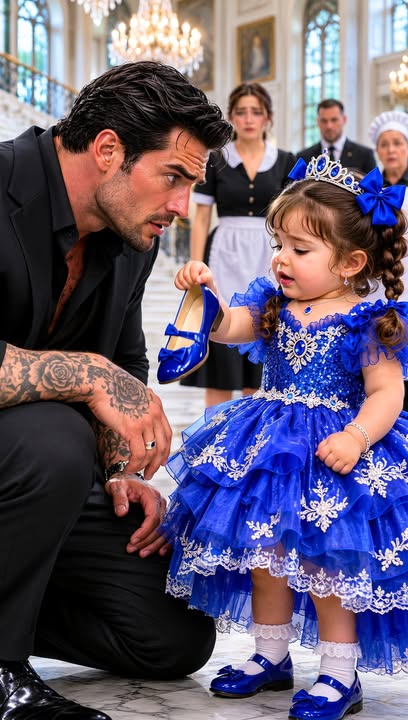
It was the royal-blue shoe she had once held up in the kitchen, the original one with the cracked sole and the glue marks from her first repair.
The cobbler’s careful stitching had kept it wearable for years, but now Sofia’s foot had grown beyond it.
She held the shoe in both hands.
“It’s too small,” she told Luca.
“It served you well.”
“It was my princess shoe.”
“I remember.”
She turned it over, tracing the dark blue stitches with one small finger.
“You keep it,” she said.
Luca looked at her.
“Are you sure?”
“Mm-hm. So you remember when I was little.”
His expression softened.
“I don’t think I could forget.”
She placed the shoe in his hands.
He accepted it with the seriousness of someone receiving a keepsake from a museum, then thanked her.
Sofia ran off to show Mrs. Lombardi a new drawing.
Luca set the shoe on the shelf beneath the framed photograph of Rosa and Matteo.
The two pictures stood side by side now.
One showed the beginning of a promise.
The other showed what that promise had protected.
The following spring, the estate’s courtyard filled with people.
The cooks brought trays of food outside.
Marco helped hang strings of lights between the old trees, while Mrs. Lombardi organized a table of pastries and fruit.
Former staff members came with their families, many of them smiling now that the wage review had brought the hidden deductions into the open and returned what was owed.
No one was asked to speak about the investigation.
No one had to explain what their family had suffered or prove that they belonged.
The gathering was simply a celebration of Rosa, whose photograph had brought the first truth into the light, and of the family that had grown around the promise she kept.
Sofia wore a new royal-blue dress, though she insisted on carrying Bunny under one arm and wearing the repaired shoe’s little silver buckle as a bracelet.
Luca had placed Rosa’s photograph near the center of the courtyard, where the afternoon sun touched the frame.
Beside it stood a small portrait of Matteo, found among the papers he had left behind.
There was no pretense that the family had been whole all along.
They had lost years.
They had made mistakes.
Some questions would never receive complete answers.
But the people gathered there had chosen to meet one another without asking anyone to surrender the life they had built.
Mrs. Lombardi brought out the cake.
Sofia helped her set it down, then looked up at Luca.
“Uncle Luca, can we make a wish?”
“We can.”
“What should we wish for?”
“That we keep finding our way back to one another.”
Sofia thought about it.
“I wish for more cake.”
“That’s an excellent wish too.”
She laughed, and the sound lifted easily through the courtyard.
I stood beneath the old rose trellis, listening to the voices around me.
For years, home had meant a small apartment and the careful work of making each dollar reach the end of the week.
It had meant the place where Rosa’s photograph rested, where Sofia slept safely, and where I had learned not to expect rescue from anyone.
I still believed in earning my own way.
I still knew how to stand on my own.
But being strong did not mean refusing every hand offered in kindness.
Luca came to stand beside me, leaving a little space between our shoulders.
“Do you feel safe here?” he asked.
I looked toward Sofia, who was trying to convince Bunny that cake could be eaten without a plate.
“Yes,” I said. “And I know I can leave whenever I want.”
His smile was quiet.
“That matters.”
“It does.”
He glanced at the photographs.
“I’m sorry you had to discover everything this way.”
“I wish my mother could have told me.”
“So do I.”
“But I understand why she chose what she chose.”
He nodded.
“I think she wanted you to have a life before the truth demanded anything from you.”
“She gave me that.”
“Then maybe we can honor her by letting you keep it.”
I looked at him, and for the first time, the place around us did not feel like a mansion belonging to a powerful man.
It felt like a home people had chosen to share.
Sofia darted over with frosting on her nose and a plate in her hands.
“Mommy, Uncle Luca, cake!”
She reached for my free hand, then held out her other one to Luca.
He took it.
Together we followed her beneath the lights, toward the table, the photographs, and the warm noise of people who had found their way back to one another.
Above us, Rosa’s portrait caught the evening glow.
And beside it, Matteo’s photograph stood with the face of a man who had not made it home in time, but whose daughter had found a family built from the promise he once entrusted to Rosa.
Sofia squeezed our hands.
For once, I did not feel that safety required me to close every door.
I felt, instead, that home was the place where I could open one—and still remain entirely myself.
**–THE END–PLEASE
Share your thoughts or feedback to motivate us to create more stories ♥️
* * *
[PREVIOUS: PART 5](https://echoesofstories.idolsgift.com/blog/part-5-the-photograph-between-them-041)
✓ Lynn R. Adams
Part 6 – The Place We Chose “Matteo is alive, and he has asked me to bring him home.” Luca read the sentence once more, then lowered the page. For a few seconds, the only sound in the kitchen was S…