PART 6 (THE END): The Photograph Across the Way 056
Part 6 – The Light We Leave On
Megan stared at the address on the strip of paper, and for a moment the room seemed to grow smaller around us.
It was the house where she had spent the first six years of her life, a narrow, white clapboard place on Briar Lane that her mother had sold long before Megan and I met.
“Why would my mother write that?” she asked.
I reached for the photograph, careful not to disturb the paper.
“Maybe she wanted someone to ask about it.”
“But who?”
The question hovered between us.
The address was familiar to Megan, but the house itself belonged to a time she remembered in fragments: a lilac bush by the steps, a kitchen window with a blue curtain, her mother calling her in before the streetlights came on.
She turned the strip over again, as if another sentence might appear.
“If they ask about the house, tell them,” she read softly.
“Maybe your aunt knows what it means,” I said.
Megan looked toward the front window.
“Arthur should see this.”
She called him, and he came over less than twenty minutes later.
When he saw the two handwriting styles on the paper, he held it under the lamp, studying the address.
“That was your childhood house?” he asked.
“Yes.”
“My mother wrote the address,” he said, touching the corner with one finger. “Your mother wrote the rest.”
They looked at each other, both trying to fit the clue into a story whose shape had already changed several times.
“What happened at that house?” Arthur asked.
Megan closed her eyes, searching her memory.
“I remember moving away. I remember my mother saying the landlord wanted to sell, though I don’t know if that’s true.” She paused. “I remember a room at the back with a little door that didn’t open properly.”
Arthur’s face altered.
“Was there a cellar entrance beneath the pantry?”
Megan looked at him.
“I don’t remember a cellar.”
“My mother talked about that house once. She said your mother had helped her there.”
He took a breath, then continued.
“She said there was a small room downstairs where she could rest without anyone asking questions.”
Megan’s hand moved to the photograph.
“Your mother stayed in our house?”
“I think so. I was too young to understand it, and my mother never gave me details.”
He looked again at the note.
“Maybe that’s what she gave up. The house was hers, or she had a claim to it, and she let my mother stay there.”
Megan shook her head slowly.
“Our family didn’t own it. We rented it.”
“Then perhaps your mother gave up something else,” I said. “A room, privacy, a place to stay. Maybe the house was part of the help, not the sacrifice.”
Arthur nodded.
“My mother was ill and couldn’t care for me for a while. Your mother may have taken me in, too.”
Megan’s eyes widened.
“You were in our house?”
“I don’t know. I remember a woman’s kitchen, and a little girl with a yellow coat.” His smile was faint. “I thought it was my aunt’s house.”
Megan looked at the photograph, where the child beside her mother stood with one button missing from her coat.
“Maybe it was my kitchen.”
The thought entered the room gently, but it seemed to reach them both at once.
Arthur sat down.
“If I was there, your mother didn’t just help mine. She helped me.”
Megan lowered herself into the chair opposite him.
“She did.”
Neither of them spoke for a while.
There was no grand revelation in the words, no dramatic confession, only the quiet possibility that the two families had once been closer than either child had been allowed to understand.
Megan’s mother had made space in her home for a woman in trouble and a little boy who needed somewhere safe to be.
Arthur’s mother had carried the gratitude for years, preserving the photograph and letters because she could not bear to let that kindness disappear.
And somewhere in the middle, two women had made a promise to keep their children from believing they had been abandoned.
Megan reached across the table and placed the note beside the photograph.
“We should speak to our aunts,” she said. “Together.”
Arthur nodded.
“I’ll call Ruth.”
“And I’ll call Claire.”
They agreed to meet the following afternoon at Megan’s house.
Before he left, Arthur asked whether he could keep the little strip of paper until then.
Megan hesitated, then gave it to him.
“Only because it’s your mother’s handwriting on the address.”
“I’ll bring it back tomorrow.”
“I know.”
The answer came easily, and I saw Arthur notice that she had trusted him without needing to make a point of it.
After he left, Megan sat with the photograph in her lap.
“I keep wondering what else we’ll find,” she said.
“Whatever it is, we can decide what to do with it when we know.”
She turned to me.
“You’re not going to tell me we should stop asking questions?”
“I might ask whether the questions are helping you,” I said. “But I’m not going to decide for you.”
A small smile touched her face.
“That’s different.”
“I’m trying to learn.”
“So am I.”
She leaned her shoulder against mine.
The photograph lay between us, held carefully in her hands, and in the woman’s smile I could see something I had never noticed before: not only happiness, but the ease of someone standing beside a person she trusted.
The next day, our dining room filled with the rustle of coats, the scrape of chairs, and the cautious voices of people meeting around an old story.
Claire arrived first, carrying a tin of biscuits she had made herself.
She was Megan’s mother’s younger sister, a warm-faced woman with the same dark eyes and a habit of smoothing her hair when she was nervous.
Ruth came with Arthur, wearing a wool scarf despite the mild weather.
She had her brother’s silvering hair and a steady, thoughtful manner that made her seem quietly observant of everyone at once.
They greeted each other politely, then looked at the photograph on the table.
Claire touched her fingers to her lips.
“I haven’t seen that picture in years,” she said.
Megan turned toward her.
“You have seen it?”
“Not this copy. But I remember the day it was taken.” Claire looked from the photograph to Ruth. “Your mother brought us into the garden after a difficult winter. She wanted us to smile for the camera.”
Ruth’s expression softened.
“My mother kept this in the desk beside her bed.”
“Do you remember what happened between them?” Megan asked.
Claire sat down slowly.
“I remember the family saying there had been a falling-out. I was old enough to hear it, but too young to know the details.” She glanced at the letters. “Your mother never spoke bitterly about Margaret. She simply said some things were private.”
Ruth folded her hands in her lap.
“My mother said almost the same thing. She told me that Megan’s mother had helped her through the hardest time of her life, but she wouldn’t say how.”
Arthur sat beside Ruth.
“You knew she was ill?”
“I knew there had been an illness,” Ruth replied. “I didn’t know how serious it was. I was a girl myself, and the adults kept things from us.”
She looked at Megan.
“Your mother let Margaret stay in the room beneath the pantry at Briar Lane, didn’t she?”
Megan glanced at Arthur.
“That’s what we think.”
Ruth nodded slowly.
“She was away for a while. I remember people saying she was staying with a friend. My mother had already arranged for me to live with our aunt, and Arthur was with relatives for some of that time.”
Arthur looked at his sister.
“You never told me.”
“I didn’t know the whole story,” Ruth said gently. “And my mother asked me not to repeat what I did know. She said it wasn’t my story to tell.”
Arthur absorbed that.
“Did she ever say what Megan’s mother gave up?”
Ruth looked down at the table.
“Not in a way I understood. I remember my mother saying Margaret had taken a chance on her when other people thought she should keep her distance.” She paused. “Perhaps she gave her a place to stay. Perhaps more than that. I don’t know.”
Megan’s eyes were lowered to the photograph.
“My mother never told me.”
“She may have thought she was protecting Margaret’s privacy,” Claire said. “Your mother was very careful with other people’s stories.”
“And with her own,” Megan replied.
Claire reached across the table and touched her hand.
“Yes. With her own too.”
Ruth glanced at the letters.
“Is that what you wanted to tell us?”
Megan took a breath.
“We found out that the friendship didn’t end because of a betrayal. The women stayed in contact, and they planned to bring the families together again when they thought it was the right time.”
“Then the story we heard was wrong,” Claire said.
“It was incomplete,” Megan replied. “Maybe people saw them stop visiting and decided there had been a quarrel.”
Ruth nodded.
“My mother never said she was angry with your mother. She spoke of her with affection.”
“People in my family thought your mother had turned away from ours,” Megan said. “Some of them blamed her.”
Ruth’s eyes filled with sadness.
“I wish they hadn’t.”
“So do I.”
Megan placed the promise note on the table.
“The letters mention a promise to protect the children from believing the other family chose to leave. My mother and your mother thought we shouldn’t carry the reasons for what happened.”
Claire read the note, then closed her eyes for a moment.
“That sounds like your mother,” she said. “She could take a burden onto herself and call it kindness.”
Ruth touched the edge of the letter without lifting it.
“My mother did the same.”
Arthur looked at the two women.
“Do you think they meant for us to find out eventually?”
“I think they hoped we would meet again,” Claire said. “Whether they expected the rest of us to learn the details, I can’t say.”
Megan glanced at Arthur before continuing.
“We also found a letter about your mother’s illness and the help my mother gave her. I don’t want to share the private details. Arthur hasn’t decided what he wants to know, and I don’t think the rest of us need to know everything to understand the truth.”
Ruth looked at Arthur.
“You can read the letters if you want to. I won’t ask you to tell me what they say.”
He nodded, visibly grateful.
“Thank you.”
Megan opened the box and showed them the tied bundle.
“The letters are going to stay with Arthur for now. There are some we haven’t read. One packet was marked for the family, but my mother wrote that only the truth they were kept from should be shared.”
Claire’s eyes moved to the note.
“What truth?”
“That the women didn’t betray each other. That they remained friends, and that my mother helped yours. That they wanted the families to come together again.”
Megan hesitated before adding, “I think we can say that without telling everyone why your mother needed help or what she and my mother went through.”
Ruth looked at her nephew.
“Would that be enough for you?”
Arthur took his time answering.
“Yes,” he said. “For now. If I need to know more about my mother, I’ll decide that for myself.”
His voice was steady, though emotion rested beneath it.
“I don’t want her illness to become a story everyone repeats. I want to remember that someone stayed beside her when she needed it.”
Megan’s eyes glistened.
“That’s what I want too.”
Claire leaned toward the photograph.
“Your mother would have liked that.”
They did not try to read every letter together.
They did not demand the details the two women had chosen to keep private.
Instead, they sat around the table, shared tea and biscuits, and told the small memories they still held: Margaret’s habit of humming while she mended clothes, Megan’s yellow coat, the garden where the photograph had been taken, and the way Megan’s mother had always kept an extra key near the back door.
Each remembered detail gave the women a little more of their lives back.
The family version of the falling-out began to loosen, not through one perfect explanation, but through a collection of ordinary kindnesses remembered aloud.
When Claire left, she kissed Megan’s cheek and held her a moment longer than usual.
“I’m glad you found this,” she whispered.
“So am I.”
Ruth left with Arthur, carrying no papers and asking for nothing.
At the door she turned to Megan.
“Your mother gave mine something she never forgot,” she said. “Whatever else remains private, I hope you know that.”
Megan nodded.
“I think I do.”
When the house was quiet again, Arthur remained with us.
He had not decided whether he would read the rest of the letters.
He said he might wait a few days, or perhaps a few weeks, until the new knowledge had settled.
Megan told him there was no rush.
He looked at the photograph on the table.
“I’d like you to keep it,” he said. “My mother kept it because she wanted the friendship remembered. I think it belongs with your mother now.”
Megan looked at me.
We had talked about where it might go, though neither of us had wanted to make the decision before the family gathering.
“Would it be all right if we framed it?” she asked.
“I’d like that.”
We found a frame the following weekend, one with a simple wooden border and enough room for the photograph to sit safely without being pressed against the glass.
Megan chose a place on the wall near the stairs, beside a picture of her mother taken years later, when Megan was grown.
The old photograph showed a younger woman with one hand resting on a little girl’s shoulder.
The newer one showed her mother laughing at something outside the frame.
Megan stood between the two pictures after we hung them.
“She looks different in each one,” she said.
“She is different.”
“I know. But I think I’ve been trying to remember her as the person who kept the secret, rather than the person who made the promise.”
I stood beside her.
“She could have been both.”
Megan leaned her head against my shoulder.
“I’m glad we didn’t leave the curtains closed on this.”
I looked toward the upstairs window, where the curtains were drawn now against the fading evening light.
“So am I.”
A few days later, Arthur came over to say he had decided to read the rest of the letters privately.
He had not found any new explanation for the sacrifice, and he did not seem troubled by that.
He said he wanted to know his mother as she had been, not only as a keeper of secrets.
Megan told him she understood.
He gave her a small envelope containing the narrow strip of paper that had been tucked behind the photograph.
“Your mother’s words,” he said. “I thought you should keep them.”
Megan placed the strip in the frame’s backing, where it would remain protected but not hidden from her.
Arthur looked at the photograph on the wall.
“My mother would have liked knowing this was here.”
“She would have liked knowing you came back,” Megan said.
Arthur’s gaze softened.
“I think she did know, in the way people know things when they keep hoping.”
After he left, Megan and I went upstairs together.
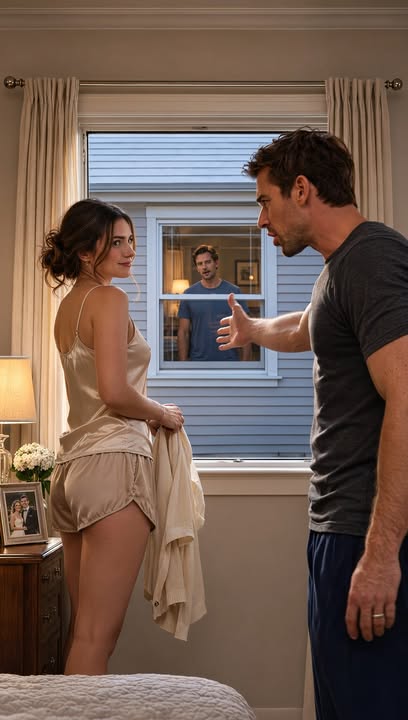
The bedroom window was open to let in the cool evening air.
Across the way, Arthur’s curtains were drawn, and the room behind them was dark.
Megan moved to the window, then paused.
“Shall I close ours?”
I looked at the curtains, then at her.
“If we’re changing, yes,” I said. “If we’re just looking out at the evening, I don’t mind.”
She studied me for a moment, then smiled.
“That seems fair.”
She drew the curtains halfway, leaving the window open to the quiet street.
Later, when we were ready for bed, she closed them fully without my asking.
I turned off the lamp.
In the darkness, I reached for her hand.
She found mine at once.
“I’m sorry I made you guess,” she whispered.
“I’m sorry I let fear tell me the answer.”
“We’ll try to ask each other first.”
“We will.”
Outside, a breeze lifted the edge of the curtain and let it settle again.
Our home did not feel safer because every window was shut or every question had been answered.
It felt safer because we had learned how to speak before silence could write a story for us.
Beside the stairs, in the soft light from the hall, Megan’s mother smiled from two different years of her life.
Between the pictures rested a small strip of paper, holding the last instruction she had left behind.
Not every detail had needed to be told.
The truth that mattered had been enough: two friends had kept faith with each other, and the kindness they shared had outlasted the years in which no one knew how to name it.
**–THE END–PLEASE
Share your thoughts or feedback to motivate us to create more stories ♥️
* * *
[PREVIOUS: PART 5](https://storyly.idolsgift.com/blog/part-5-the-photograph-across-the-way-056)
✓ Lynn R. Adams
Part 6 – The Light We Leave On Megan stared at the address on the strip of paper, and for a moment the room seemed to grow smaller around us. It was the house where she had spent the first six years…