PART 6 (THE END): The Pendant the Queen Mother Remembered 061
Part 6 – A Place at the Table
“I don’t believe a family becomes stronger by hiding what it has done,” I continued.
My voice shook, but it did not break.
“I believe it becomes stronger when it is willing to tell the truth and make room for the people who have lived with the consequences.”
The hall remained quiet.
Then, from somewhere near the back, came a single soft clap.
A second joined it, then another, until the sound filled the room—not like a celebration of a princess, but an acknowledgment of a woman who had chosen to speak for herself.
I looked toward the Queen Mother.
She had tears in her eyes, though her chin remained lifted.
She did not reach for me or ask me to stand beside her.
She simply waited.
When I stepped back from the lectern, she made room for me at her side.
The two of us stood together, not as if the past had been repaired, but as if we had agreed to face what remained of it honestly.
In the days that followed, the royal family released the full independent review.
The report confirmed that Princess Eliza’s letter, the sealed birth record, and the surviving nursery entry were authentic.
It confirmed that the infant had been carried from the residence before the fire reached the nursery, and that the later report claiming her death was unsupported by the surviving evidence.
It did not claim to know who had written every note or removed every page.
It did not pretend that the mystery had been simple.
But it made clear that the family’s old account could no longer stand.
The Queen Mother gave a public apology.
She spoke of the grief she had carried, and of the questions she had failed to ask.
She did not excuse her silence by saying she had been afraid, though she admitted that fear had helped keep it in place.
She thanked Mrs. Ansel for preserving what she knew, and Mrs. Bennett for raising the child she had been asked to protect.
She called Mrs. Bennett by name.
That mattered to me more than any title ever could.
Lord Harrow’s private correspondence was examined separately.
The review found records showing that he had copied confidential household letters and passed information to people outside the kingdom.
Some of the papers had been sold for money.
Others had been shared in exchange for favors and influence.
Eliza had discovered the scheme and gathered evidence before the fire.
Harrow had arranged for the fire to begin in the country residence’s east wing, then used the confusion to make the deaths appear certain.
He had also paid a trusted household worker to carry the baby away and deliver her to someone who could keep her beyond the palace’s reach.
The worker had been Mrs. Bennett’s brother, Thomas.
I learned that from a letter found among the household steward’s papers, written years earlier and never delivered.
It explained that Thomas had brought the baby to Mrs. Bennett because she lived far from the castle and had no ties to the royal household.
He had told her the child needed safety, not a name anyone could trace.
Mrs. Bennett had accepted me without asking for a reward or a promise.
She had only asked that Thomas make certain the people searching for me would not find me.
He had returned to the castle and kept silent.
After the inquiry began, Thomas was found living quietly in a coastal town several hours from Aurelien.
He was an old man by then, his hands unsteady and his hair white at the temples.
He came to the castle with Mrs. Ansel, who had recognized his name in the old household papers.
The first time I saw him, he stood in the doorway of the blue sitting room and looked at me as though he were afraid even to take one step closer.
“I’m sorry,” he said.
I thought he would explain himself.
Instead, he lowered his eyes.
“I brought you to Mrs. Bennett because I believed it was the only way to keep you safe. I should have found a way to tell you when you were older.”
“Did you know she kept the letter?” I asked.
“No. I thought Eliza had kept it in the pendant.”
His answer settled another piece into place.
When he had carried me from the fire, the pendant was still fastened inside the blanket.
The letter had gone with it.
No one could say exactly when the letter was removed from the pendant or how it came to rest among Mrs. Bennett’s belongings.
Mrs. Bennett’s note suggested she had been given it with me.
Perhaps Thomas had handed it to her.
Perhaps it had slipped from the pendant before he left the castle.
The old years had blurred the details, and no record could restore every lost moment.
But Thomas confirmed that he had delivered the baby to Mrs. Bennett.
He confirmed that the child had been alive.
He confirmed that she had been given the royal blanket and Eliza’s pendant.
With Mrs. Ansel’s testimony, the birth record, the birthmark, the lullaby, and the letter, there was no reasonable doubt about who I was.
“You don’t have to forgive me,” Thomas said.
“I don’t know what forgiveness means yet,” I replied. “But I’m glad you came.”
He raised his eyes.
“That is more than I expected.”
“It’s what I can give you honestly.”
He nodded, and something in his shoulders eased.
“I would like to hear about Mrs. Bennett,” he said. “If you’re willing.”
So I told him about her kitchen and her gentle scolding, about the way she sang while mending clothes and the way she always gave me the larger piece of bread.
I told him she had loved ordinary days and believed a person’s worth showed most clearly in how they treated those who could offer them nothing.
He listened without interrupting.
When I finished, he said, “She sounds like the bravest person in this story.”
I thought of the frightened young woman who had taken in a baby without knowing whether danger would ever pass.
“Yes,” I said. “She was.”
The inquiry concluded that Lord Harrow had acted against the royal household and had helped conceal the truth about the fire.
He faced justice through the kingdom’s ordinary legal process.
The Queen Mother refused to allow his case to be handled in secret, and she did not ask that his actions be softened to protect the royal name.
Harrow admitted to selling confidential information.
He also admitted to arranging the fire and falsifying the account of the baby’s death.
He said he had believed that the false report would keep attention away from the child and give him time to hide the evidence of his dealings.
That explanation did not erase what he had done.
It did, however, settle the mystery of why Eliza had sent me away and why the household report had been changed.
It also answered the question that had followed me since the ballroom:
I had not been meant to die.
I had been meant to survive somewhere no one could use me to silence my mother.
The question of Eliza’s fate remained.
The overseas correspondence folder revealed that she had reached a town on the southern coast after leaving Aurelien.
There were letters written under another name to an old friend, describing a modest life by the sea and a hope that she might someday return.
The last letter was dated several years after the fire.
It mentioned a long illness, and a wish that her daughter might be well, wherever she was.
No later letter could be found.
The Queen Mother and I traveled to the town together, accompanied by Alexander and a local historian who had helped with the records.
We visited the small cemetery on a hillside above the water.
The name on the stone was not Princess Eliza.
It was the name she had used while living beyond the royal court.
The date showed she had died several years before I was old enough to remember anything.
The Queen Mother stood before the grave for a long time.
She carried no grand arrangement of flowers, only a handful of white blooms from the castle garden.
“They were her favorites,” she said.
I knelt and placed one small flower at the foot of the stone.
I did not feel that I had found my mother.
I had not.
But I had found the place where her long search had ended, and I had learned that she had spent her final years believing I might still be alive.
That knowledge hurt.
It also gave me something I had never possessed before: a clear image of her life beyond the fire.
A letter in her own hand.
A name she had chosen for safety.
A garden where she had planted flowers.
The Queen Mother touched the gravestone with her fingertips.
“I should have kept looking,” she whispered.
I stood beside her.
“Yes,” I said.
She closed her eyes.
“I know.”
“I can’t give you back those years.”
“No.”
“But I can be here now.”
When she opened her eyes, there was sorrow in them, and gratitude, and nothing like a demand.
“Thank you,” she said.
That evening, Alexander walked with me along the coast path.
The sea was quiet beneath a pale sky, and the wind lifted the edge of my shawl.
“I thought finding her grave would make me feel more certain,” I said.
“Does it?”
“It makes me certain she loved me. It doesn’t make me feel less sad that we never met.”
“Both can be true.”
I turned toward him.
“You’ve become very good at saying that.”
“I’ve had a good example.”
I smiled.
For a while, we listened to the waves.
Then he said, “Grandmother hopes you will come back to the castle as often as you like.”
“Does she want me to live there?”
“She wants you near. But she knows wanting something does not make it yours to give.”
“That’s new.”
“She is trying.”
“So are you.”
He nodded.
“I am.”
I looked at the sea, then at the path behind us.
“I want to come back,” I said. “But I don’t want to move into the royal apartments or be presented as a newly discovered princess.”
“You won’t be.”
“I want to keep working with the household staff.”
“Then you should.”
“And I want to help children who have been left without safe homes.”
His expression warmed.
“What are you imagining?”
“A place where children can stay while people decide what comes next. Somewhere safe, with good teachers and people who ask before making decisions for them.”
“A foundation.”
“Yes. But not one that puts my portrait over the door.”
“I think we can manage that.”
“I don’t want it to be a royal project used to make the family look generous.”
“Then you will have a say in how it is built.”
“I will have the say.”
He laughed softly.
“You will.”
It was the first time we had laughed together without grief standing close beside us.
When we returned to Aurelien, I spoke with the Queen Mother about the foundation.
She offered part of an unused estate outside the city, with a garden, a small library, and enough rooms to begin.
I accepted only after the proposal was reviewed by people who worked with vulnerable children and after the funding was placed under independent oversight.
The Queen Mother did not argue with the conditions.
She said she was glad I had set them.
We called the foundation the Lantern House.
The name came from a story Mrs. Bennett used to tell me when I was little, about a woman who left a lamp burning in her window so anyone lost on a dark road would know there was a place to stop.
The first time I entered the finished house, sunlight lay across its wooden floors.
There were no portraits of the royal family in the entry hall.
Instead, the walls held children’s drawings, bright and uneven, each one hung at the child’s chosen height.
A long table stood in the kitchen, wide enough for every child and staff member to sit together.
Mrs. Ansel planted roses outside the library.
Thomas helped build a reading bench beneath the old apple tree.
The Queen Mother came to the opening without a crown or a formal speech.
She sat at the long table, listened while the children told her about their drawings, and stayed for the whole supper.
No one called her “Your Majesty” at the table.
One little boy asked whether she liked apple cake.
“I do,” she said.
“Then you can have the biggest piece,” he told her.
She accepted it with a solemn nod, and the children laughed.
I watched her from the kitchen doorway, my heart full in a way I had never expected.
The woman who had once stared at my pendant as if it were a ghost now sat among the children, asking about their favorite stories.
She had not become a different person.
She had simply stopped hiding behind the old story.
My own place in the castle took shape slowly.
I kept the small room in the servants’ wing where I had lived for years, though I no longer worked every day in the laundry or kitchens.
I helped the household staff establish better support for those who needed housing, education, or a chance to choose a different path.
Some called me Lady Eliza.
Some called me Princess Ella.
Most called me Ella.
I answered to the name Mrs. Bennett had given me.
The Queen Mother never corrected anyone.
She called me her granddaughter when we were alone and Ella when others were present, unless I asked her to do otherwise.
Alexander called me cousin whenever it came naturally.
The first time he did so in front of the household staff, I turned to look at him.
He smiled as if he understood that the word still carried a little surprise.
Then I smiled back.
One year after the night of the glass-slipper fitting, the castle held a celebration for the opening of the Lantern House’s new learning rooms.
The ballroom was full again, but this time the guests included teachers, cooks, gardeners, nurses, and children from the foundation.
The chandeliers glittered overhead.
The orchestra played a tune Mrs. Ansel recognized from the old nursery.
The Queen Mother sat at the center table, not above anyone but among them.
She had asked that the nursery records be displayed in the family archive, including the missing-page copy and the old report that had declared the baby dead.
The documents were no longer hidden in a private cabinet.
They were part of a public record, open to anyone who wished to understand what had happened.
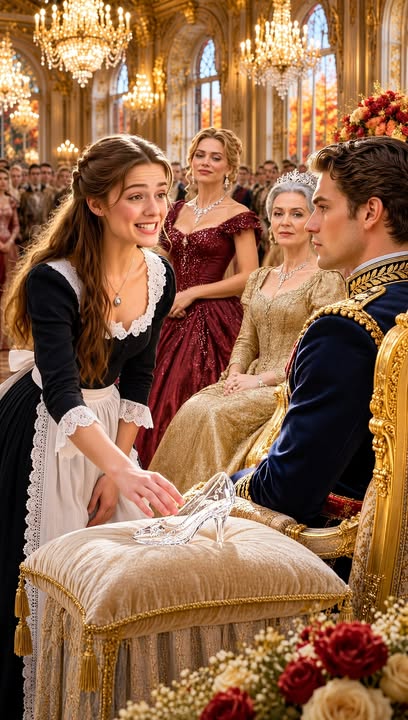
Near the ballroom doors, a glass case held the slipper from the fitting.
The Queen Mother had asked whether I wanted it displayed.
I agreed, on one condition.
A small plaque beside it explained that the slipper was not a token of royal approval or a promise of marriage.
It marked the night a servant had stepped forward and asked for the chance to try.
A young girl stood before the case, studying the slipper.
She wore a simple green dress and kept one hand curled around the sleeve of an older woman beside her.
“Do you think it would fit me?” she asked.
I crouched beside her.
“It might,” I said. “But you don’t need it to prove you belong here.”
She considered that, then nodded.
“Can I still try?”
“Of course,” I said. “If you want to.”
She smiled, and we asked the attendant to bring the display slipper to the fitting cushion.
The girl slipped her foot inside.
It was much too small.
She laughed at the discovery rather than shrinking from it, and the people nearby laughed with her.
The room seemed to brighten.
The Queen Mother watched from across the ballroom.
Her eyes met mine, and she lifted her glass.
I raised mine in return.
Later, when the music softened, I stepped onto the balcony to breathe.
Alexander found me there, holding two cups of cider.
He offered one only after I held out my hand.
“Are you happy?” he asked.
I looked through the open doors at the ballroom, where children danced between tables and the old nursery tune rose above the conversation.
“I am,” I said. “Not because everything came back as it should have. It didn’t.”
He leaned his elbows on the railing.
“But because you have your place.”
“Because we made one,” I replied.
He considered the difference, then nodded.
“Because we made one.”
I glanced at the pendant resting against my collar.
For years, I had worn it as the only object I possessed from a life I could not remember.
Now I knew it had belonged to a mother who had loved me before she knew my face, a sister who had lost her daughter and spent too long believing the worst, a guardian who had hidden a letter because fear and love had become tangled together, and a family that had finally chosen to stop letting silence decide what belonged to whom.
The silver had not given me a crown.
It had given me a path back to the truth.
And the glass slipper had not made me a princess.
It had marked the moment I had first stood where I wanted to stand.
Inside, the music changed.
The Queen Mother rose from her chair, and several children immediately gathered around her to invite her onto the floor.
She looked toward me, her expression asking a question without words.
I nodded.
She joined them.
Alexander held out a hand to me, then paused.
“Would you like to dance, cousin?”
This time the word felt entirely natural.
“Yes,” I said.
I took his hand, and together we stepped back into the ballroom—not as a prince and a lost princess, not as strangers caught inside an old mystery, but as family beginning again.
The music carried us beneath the chandeliers.
Around us, the people of the castle moved together, no longer separated by titles or uniforms, and the laughter of the children rose warm and bright through the room.
For once, nobody was invisible.
**–THE END–PLEASE
Share your thoughts or feedback to motivate us to create more stories ♥️
* * *
[PREVIOUS: PART 5](https://storyly.idolsgift.com/blog/part-5-the-pendant-the-queen-mother-remembered-061-2)
✓ Lynn R. Adams
Part 6 – A Place at the Table “I don’t believe a family becomes stronger by hiding what it has done,” I continued. My voice shook, but it did not break. “I believe it becomes stronger when it is wi…