PART 6 (THE END): The Pawn That Could Not Be Saved 052
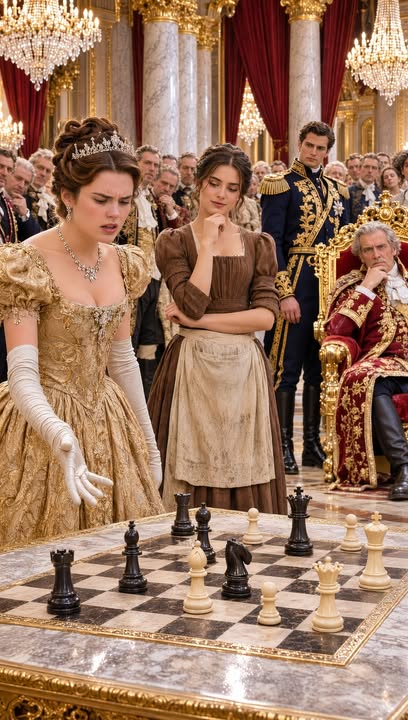
Part 6 – A Future Freely Chosen
Victoria held the paper out, but did not step toward the throne.
Her gaze remained on Eleanor.
“I found this in the archive after the secretary brought out the restoration register,” she said. “It was tucked inside the cover of the cabinet inventory. I should have brought it forward sooner.”
The king accepted the page, his expression grave but not angry.
“Thank you for bringing it now.”
Victoria’s fingers stayed on the edge of the paper for a moment before she let go.
“I was afraid it would make the court look foolish,” she said. “And I was afraid of what the truth might mean for me.”
The paper was old, its corners softened by time.
The chief adviser came to stand beside the king, and together they read the faint writing.
The room waited.
At last, the king turned the page so the light fell across its lines.
“It is a note from Thomas,” he said. “Written after the puzzle was withdrawn from the records.”
Eleanor felt her breath catch.
“May I read it?”
The king offered her the page.
She accepted it with careful hands.
Her father’s handwriting seemed to gather the whole ballroom into a smaller, quieter place.
“Your Majesty,” she read, “if the position is ever shown again, do not let anyone mistake its purpose. It was not made to prove that a ruler can never be wrong, nor that an adviser must always be right. It was made to remind us that a just conclusion may be a draw, and that a person who changes their mind has not necessarily lost.”
Eleanor paused.
The ink was faded, but the next lines remained clear.
“If my name is not restored in my lifetime, let the record be restored without asking my daughter to earn it. She has no duty to finish my work, defend my choices, or accept a place that does not feel like her own.”
The silence that followed was different from the silence before.
It held grief, but also a kind of release.
Eleanor lowered the letter.
Her father had known that the palace might fail him.
Even so, he had left her no demand to fulfill, no burden disguised as a legacy.
Only the freedom to choose.
The king bowed his head.
“I will make those words part of the official record.”
“Please do,” Eleanor said. “And keep them with the original account.”
“I will.”
Victoria stood with her hands clasped before her.
“I am sorry, Eleanor,” she said. “I mocked you before I knew anything about your father, and I nearly kept this page because I thought it might protect my own standing.”
Her voice trembled, but she did not hide behind a smile.
“I cannot ask you to forgive me at once. I only wanted you to hear that I was wrong.”
Eleanor studied her.
There was no easy friendship waiting between them, and no reason to pretend the earlier hurt had vanished.
But Victoria had chosen to bring the page forward when it would have been easier to keep it hidden.
“Thank you for telling the truth,” Eleanor replied.
Victoria’s shoulders eased, though her eyes remained lowered.
“I hope one day I can do better.”
“I hope so too.”
The king turned to face the court.
“The final page confirms what the other records already showed,” he said. “Thomas Vale devised this position at my request and recorded its intended draw. His name was unjustly placed under suspicion because I allowed fear to guide my judgment.”
He held the old note in both hands.
“I also failed to correct that wrong when I had the opportunity. I will not make another promise and leave it waiting in a drawer.”
The chief adviser stepped forward.
“The original record and its accompanying pages will be entered into the public archive,” he said. “The accusation against Thomas Vale will be formally withdrawn, and the official account will state that the puzzle was never unsolvable.”
The king looked over the assembled nobles.
“I will also review the authority of the royal advisers, so that counsel cannot become a substitute for a ruler’s own responsibility.”
There were no cheers at first.
The truth had not been offered as a performance, and the court seemed to understand that a confession did not become noble merely because it was spoken beneath chandeliers.
Then the prince came to stand beside his father.
“I will support that review,” he said. “And I hope we will listen more often to people who have not been invited to speak.”
Several advisers exchanged looks.
The chief adviser lowered his head in agreement.
“If the court is to serve the kingdom well, Your Highness, then its counsel must be open to correction.”
The king glanced at him.
“Even when correction is uncomfortable.”
“Especially then, Sire.”
Eleanor felt the pressure in the room begin to loosen.
The king turned toward her.
“You asked whether I was offering you a future or asking you to make my past easier to forget.”
“I did.”
“I am offering you nothing tonight.”
A murmur moved through the court, but he continued.
“The marriage reward is withdrawn. A person cannot be made a prize, and a promise made without that understanding should not bind anyone.”
The prince remained beside him, his expression calm.
The king looked at Eleanor with a humility that did not ask her to comfort him.
“If you ever choose to join this family, it will be because you freely want that life. If you do not, I will respect your decision. Your father’s name will be restored either way.”
Eleanor looked at the prince.
He did not reach for her hand.
He did not plead.
He simply waited.
“You are giving me room to say no,” she said.
“Yes,” the king answered.
“And room to say yes later?”
“Yes.”
She turned back to the prince.
“What would you ask me if there were no crown, no contest, and no audience?”
He took a slow breath.
“I would ask whether you might walk with me tomorrow,” he said. “Not as a servant, not as a contestant, and not as someone promised to me. Just as Eleanor.”
Her heart gave a quiet, uncertain turn.
“And if I say I need time?”
“Then I will give you time.”
“And if time changes my answer?”
“I will hear that answer too.”
The court had gone quiet again, though this time no one seemed to be waiting for a grand declaration.
Eleanor thought of her father’s note, of the pawn he had marked, and of the patient lesson hidden in the final position.
A draw was not a failure to choose.
It was the honest result when neither side could claim victory.
But her own heart was not a board, and the prince was not an opponent.
She wanted to know him beyond the ballroom, beyond the puzzle, beyond the strange promise that had brought them together.
“I will walk with you tomorrow,” she said.
The prince smiled, and the warmth in it held no triumph.
“Thank you.”
“That is not an answer to everything.”
“I know.”
“It is only a beginning.”
His smile softened.
“I would be grateful for a beginning.”
The king looked toward the chessboard.
“Then perhaps the puzzle has given us the answer it was meant to give.”
“Not quite,” Eleanor said. “The position gave us a draw.”
“And the rest?” he asked.
“The rest belongs to the people who have to live with what they choose.”
The king nodded, accepting the distinction.
The court began to stir.
Some guests approached Eleanor with apologies for having dismissed her knowledge before she had spoken.
Others simply bowed their heads, uncertain how to address the woman who had entered the ballroom in a servant’s gown and left it with no title at all.
She accepted each gesture without mistaking it for a repair of everything that had come before.
The chief adviser asked whether she would help oversee the copying of Thomas’s records.
“I would like to read them first,” Eleanor said. “Then I can help if I believe it would be useful.”
“Of course,” he replied. “The archive is open to you.”
The king heard and added, “And the position will be preserved with the account of its true purpose.”
Eleanor looked at the old chess set on its velvet tray.
“My father should be remembered as more than the man who made this puzzle.”
“He will be,” the king said.
The prince glanced toward the other guests.
“Perhaps the first step is to let the servants hear the truth at the same time as the court.”
Eleanor looked at him, surprised.
“Why?”
“Because they live here too,” he said. “And because your father’s work should not be known only by those who dine beneath these chandeliers.”
The idea touched her.
The king gave a slow nod.
“Tomorrow, the announcement will be read in the servants’ hall as well as the ballroom.”
“And in the archive,” Eleanor said. “For those who come after us.”
“It will be recorded in both places.”
Victoria approached them again, quieter than before.
“If you agree, I could help arrange the public readings,” she said. “Many of the charitable committees already visit the servants’ quarters. I could ask them to make room for the announcement.”
Eleanor looked at her.
“You need not do it for my approval.”
“I know,” Victoria said. “I would like to do it because the people who work here should not learn the truth last.”
It was not an apology completed in a moment.
It was a choice to begin differently.
Eleanor inclined her head.
“Then I hope you will.”
Victoria gave a small, grateful nod.
She would have to show, over time, that she meant what she said.
For the first time, Eleanor believed she might.
The king asked the secretary to arrange a meeting with the archivists the following morning.
He instructed the chief adviser to prepare a clear account of the records and the decision to restore Thomas’s name.
No one was told to hide the king’s part in the matter.
No one was asked to soften the language.
As the room gradually emptied, Eleanor found herself alone with the prince beside the chess table.
The board still held the final position.
The black king had nowhere to move.
The white king stood unharmed, with no attack upon him.
“What do you see now?” the prince asked.
Eleanor looked at the pieces.
“Not a victory.”
“What, then?”
“A position no one can honestly call a loss.”
He followed her gaze.
“I think your father would have liked that answer.”
“I think he would have asked me to prove it.”
The prince laughed softly.
“Would you?”
“Tomorrow.”
“Then I will be ready.”
They left the ballroom together, walking slowly through the gallery.
At the servants’ stair, Eleanor paused.
“I should return to my room.”
“Of course.”
The prince did not ask her to stay.
He did not seem disappointed that she had not followed him toward the royal apartments.
Before she stepped away, he said, “Tomorrow, then?”
“Tomorrow.”
The word was small, but it carried a promise she had made herself.
That night, Eleanor slept in the room she had occupied for years, beneath its familiar sloping ceiling.
The palace felt different, though none of its walls had moved.
For the first time, she could imagine staying because she chose to, rather than because she had nowhere else to go.
In the morning, the king kept his promise.
He spoke first in the servants’ hall, with the archivists, cooks, attendants, and housekeepers gathered around him.
He read Thomas’s letter in full.
He explained that his father had been wrongfully accused, that the king himself had failed to correct the record, and that the archive would preserve the truth without concealing the king’s responsibility.
No one applauded.
Some of the older servants looked down, remembering the years when Eleanor had carried water and polished silver beside them.
The housekeeper came to her afterward and held her hands.
“He should have been spoken of properly long ago,” the woman said.
“Yes,” Eleanor replied.
There were tears in the housekeeper’s eyes, but her voice remained steady.
“And now he will be.”
At the archive, the chief secretary showed Eleanor the original record and the new public entry.
Thomas Vale’s name appeared clearly, beside the words: “Archivist and designer of the royal stalemate position, whose intended solution was preserved in his own hand.”
The entry also recorded that the previous accusation had been withdrawn because it was unsupported and had been made under pressure from those who wished the puzzle to serve another purpose.
The king’s confession was included.
Eleanor read every line.
Then she asked that her father’s letter be placed beside the record, not beneath it.
The secretary agreed.
Over the next days, the court learned the full history of the puzzle.
Some advisers resented the change in their standing.
Others welcomed a system in which advice could be questioned without being treated as disloyalty.
The chief adviser began holding open reviews of important proposals, inviting clerks and archivists to identify missing records before decisions were made.
The king, for his part, stopped speaking of certainty as though it were the same thing as wisdom.
He still ruled, and his decisions did not become effortless.
But when he did not know, he began saying so.
The prince asked Eleanor to walk with him the day after the contest.
They took the path through the palace garden, where the early roses had begun to open.
There was no audience, no chessboard, and no promise of a crown between them.
He asked about her father, and she told him stories she had never thought would matter to a prince.
She described the way Thomas tapped each piece twice before beginning a game.
She remembered how he praised a careful question more often than a clever move.
She told him about the small board he had kept in their home, and how she had given it away when she could no longer afford to keep it safe.
The prince listened without interrupting.
When she had finished, he asked whether she would like him to help search for it.
“If it is still in the storerooms, I would like to see it again,” she said.
They found the board a week later, wrapped in a faded cloth and stored among old household goods.
Its corners were worn smooth, and one square was cracked.
Eleanor brushed the dust away with her sleeve.
For a moment, she could almost feel her father beside her.
The prince stood back, giving her room for the memory.
“Would you like to keep it in the archive?” he asked.
“No,” she said. “I would like to play on it.”
“Then we shall.”
They began meeting regularly in the small library.
Sometimes they played chess.
Sometimes they read old letters or talked through the day’s decisions.
The prince continued to ask her questions, and Eleanor continued to ask him to explain what he meant when his answers sounded too easy.
Their affection grew not from a single dramatic moment, but from the accumulation of ordinary kindness: a chair pulled close to the window, a disagreement neither tried to win, a shared laugh when the prince made an obvious mistake and Eleanor refused to let him blame the board.
Victoria began her own quiet work.
She visited the servants’ hall, not to distribute favors as though kindness were a performance, but to ask what the palace could do better for those who kept it running.
At first, some of the servants received her cautiously.
She did not demand their trust.
She returned, listened, and learned which improvements mattered most.
She later apologized to Eleanor once more, this time without an audience.
“I thought being admired was the same as being valued,” Victoria said. “I was afraid that if someone else was seen, there would be less room for me.”
“There is room for more than one person to be seen,” Eleanor replied.
Victoria’s eyes brightened.
“I am trying to remember that.”
“Then keep trying.”
“I will.”
The seasons shifted.
The king kept Thomas Vale’s chessboard in a glass-fronted case in the royal library, beside a copy of the original notation.
The old ivory pawn rested beside it, its small mark turned toward the room.
A plaque beneath the case explained the puzzle’s purpose: not to demonstrate the triumph of one side, but to teach that a draw could be the most just conclusion.
Eleanor visited it often, though she never felt that the display belonged to her alone.
The palace had begun to change in small, lasting ways.
Servants’ concerns were brought before the royal household council.
Archivists were consulted before records were altered.
The prince learned to ask not only what a decision would achieve, but who would bear its cost.
The king did not regain the years in which Thomas had been misunderstood.
He did not ask Eleanor to tell him that everything was forgiven.
Instead, he honored the promise he had made: he spoke her father’s name plainly and kept the evidence where no one could quietly remove it.
Eleanor appreciated that he understood the difference between remorse and repair.
Months later, the prince asked her to walk with him in the palace garden again.
The evening light lay warm across the paths, and the first stars had begun to show above the rooftops.
“I have asked you to walk with me many times,” he said. “May I ask something more?”
Eleanor smiled, though her heart beat faster.
“You may ask.”
“Will you marry me?”
He held out no ring at first.
He did not speak of the crown.
He simply stood before her, earnest and a little uncertain.
“I love you,” he said. “I would like to build a life with you, if that is what you want. You may say no, and I will still be grateful for every day you have given me.”
Eleanor looked at him and saw the young man who had listened at the chessboard, who had made room for her questions, and who had once stepped back so her answer could belong to her.
She thought of her father’s words.
She should be free to make her own choices.
“I choose you,” she said. “Not the reward, and not the crown. You.”
The prince’s face filled with joy.
Only then did he offer the ring.
She accepted it.
Their marriage was held in the palace ballroom, beneath the same crystal chandeliers where Eleanor had first spoken over the chessboard.
The court gathered again, but the room felt different now.
No one watched her as a servant who had wandered into the wrong place.
No one treated her as a prize to be won.
She entered as herself, in a gown chosen because she loved its gentle blue, with her dark hair loosely pinned and her father’s old chessboard displayed near the flowers.
The king stood with her before the ceremony.
“I cannot repay Thomas for what I took from him,” he said quietly.
“No,” Eleanor answered. “But you can remember what he taught you.”
“I will.”
“And keep listening.”
“I will try.”
“That is all anyone can promise honestly.”
The king bowed his head, grateful for the mercy in her words and the truth beside it.
The prince waited at the far end of the ballroom.
When Eleanor reached him, he did not take her hand until she offered it.
Their vows were spoken simply.
They promised to listen before assuming, to respect each other’s judgment, and to make room for truth even when it changed what they believed.
Afterward, the prince led her to the chessboard.
A game had been arranged there, not the old puzzle, but an open position with no hidden test.
“White or black?” he asked.
Eleanor looked at the pieces.
“Neither,” she said. “We will take turns.”
He smiled.
Around them, the ballroom filled with music and conversation.
Victoria stood among the guests, helping an older kitchen maid find a place near the musicians.
The chief adviser spoke with one of the archivists about a newly reviewed record.
The king watched from beside the window, no longer trying to hold the whole room beneath his certainty.
Eleanor set one hand on her father’s worn chessboard.
For years, she had believed she had lost nearly everything that made a home.
Now she understood that the lessons Thomas had given her had traveled with her, through every room where she had been told to remain quiet, and into the one place where the kingdom finally listened.
The board had not taught her how to seize a crown.
It had taught her how to question what a crown was worth, how to see the person hidden behind a title, and how to choose a life without owing it to anyone.
Beside her, the prince waited for her first move.
Eleanor looked into his eyes, then down at the board.
This time, no one was watching to judge whether she deserved to be there.
She moved a pawn, and he answered with one of his own.
Their game began as the music rose around them, and the future opened not as a reward, but as a promise they would make together.
**–THE END–PLEASE
Share your thoughts or feedback to motivate us to create more stories ♥️
* * *
[PREVIOUS: PART 5](https://storyly.idolsgift.com/blog/part-5-the-pawn-that-could-not-be-saved-052)
✓ Lynn R. Adams
Part 6 – A Future Freely Chosen Victoria held the paper out, but did not step toward the throne. Her gaze remained on Eleanor. “I found this in the archive after the secretary brought out the resto…