PART 6 (THE END): The Page That Was Missing 061
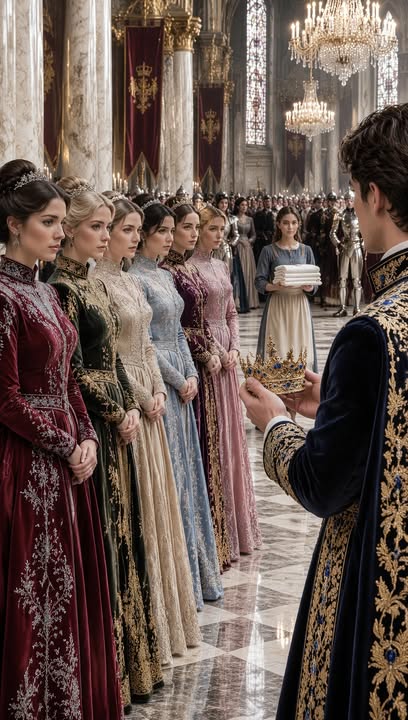
Part 6 – A Crown Freely Given
The council chamber remained silent as the note passed from hand to hand.
Elena watched each councilor read her mother’s sentence, and saw uncertainty spread across their faces in place of the certainty they had worn only moments before.
“Do not trust the account that bears my name,” Adrian read aloud.
Marcus lowered his gaze to the page.
“I have never seen that note,” he said.
It was the first time he had sounded less like an adviser protecting his position and more like a man who had discovered that even the secrets he kept had secrets of their own.
Elena looked at the disputed account.
The entry that appeared to bear her mother’s name had been used to suggest that Mara had authorized the transfer of the relief funds after her dismissal.
But the figures on the page did not match the original book, and the handwriting had already been shown to be a later copy.
“Could the note be genuine?” Victoria asked.
“It could,” Elena replied. “But we should not decide that because it sounds like something my mother might have written.”
Adrian nodded.
“Then we will have it examined along with everything else.”
The council agreed to appoint an independent panel before the hearing began, with an auditor from outside the palace, a representative chosen by the southern district, and a records scholar recommended by Victoria.
Elena kept the original documents in her possession until the panel was assembled.
For the first time, the palace’s most powerful people had to wait while a servant’s daughter decided how her mother’s papers would be handled.
No one called it a royal favor.
That mattered to her.
The hearing began three days later in the great chamber, with its doors open to the public and its windows thrown wide to admit the autumn air.
Families from the southern district filled the back rows, alongside clerks, council members, and noble households whose names appeared in the account book.
The crown rested on a velvet cushion beside the dais, no longer hovering above Elena’s head.
She had asked that it be left there.
She would not let its glow speak for her.
Adrian sat at the center of the council table, with the independent examiners beside him.
Marcus sat across from them, no longer in his usual place at the prince’s right hand.
He had not been dismissed from the inquiry by rumor or spectacle.
He had been asked to answer the evidence under the same rules as everyone else.
The panel began with the original account book.
The auditor compared its entries with surviving district receipts and treasury records, while the records scholar examined the ink, paper, and handwriting.
The district representative, a woman named Sera whose family had lost their home in the flood, asked that every sum be explained in ordinary language.
Elena was grateful for that.
She did not want the hearing to become a contest of titles and figures that left the people most affected unable to follow what had happened.
The first day established that the relief money had indeed been transferred through private accounts.
It did not establish who had ordered every transfer.
The second day brought the duplicate ledger, the half-burned inventory, and Pell’s testimony.
Pell explained how Marcus had told him to clear the box from the passage, and why he had believed the papers were to be destroyed.
He spoke plainly, without exaggerating his certainty or hiding his confusion.
When he finished, Marcus thanked him for his honesty.
Pell looked startled by the courtesy, but he did not withdraw a word.
Victoria testified next.
She described seeing Marcus with the archive clerk and hearing the instruction to destroy the box before morning.
She also presented her family’s accounts for examination, acknowledging that one payment listed in the book had reached her household.
The payment had been recorded as a loan to repair a damaged bridge, though the bridge had already received public funds.
Victoria’s face was pale as she explained that she had not known the source of the money.
“My family benefited from an account we did not question,” she said. “I cannot claim that ignorance makes the benefit harmless.”
Elena met her eyes across the chamber.
Victoria had once called the crown’s choice a disgrace.
Now she was risking her family’s standing to help uncover a truth that might implicate them.
It did not erase the hurt of the ballroom, but it changed what Elena could see in her.
The handwriting examination confirmed that the entry bearing Mara’s name had been copied after her dismissal.
The scholar also found that the disputed note on the back of the later payment list had been written with the same distinctive crossbar on the numeral seven as Mara’s original records.
That proved the note was likely hers.
It did not, by itself, explain why she had written it.
The answer came from the final papers hidden in the account book’s lining.
The panel had opened each sheet carefully, then compared them with the royal letter and the surviving treasury records.
One was a small transfer schedule bearing Marcus’s initials.
Another was a copy of a request Mara had sent to the king, asking for the original account book to be moved to a secure location because she believed the finance office had created a false account in her name.
The note on the back of the disputed list referred to that false account.
Mara had not authorized the transfer.
She had been warning the king that someone was using her name to make the transfer appear legitimate.
The figures in the account book showed how the deception worked.
The stolen relief money had been routed through payments to several powerful households, with some of the funds used to cover private debts and failed investments.
Marcus had overseen the transfers, though not every recipient had understood where the money came from.
Once Mara discovered the scheme, she recorded the original figures and sent copies to the king.
Marcus intercepted her appeals and the royal order, then arranged for a later copy of the ledger to make it appear that Mara had continued handling the account after her dismissal.
He intended the copied entry to settle the matter quietly, leaving her reputation to bear the blame.
The king had learned enough to believe her, but he died before he could clear her name publicly.
His private letter had been hidden in the correspondence cabinet, while the original account book remained concealed behind the map cabinet as Mara had instructed.
The altered order, the returned appeals, the copied ledger, and the false account all pointed toward the same conclusion.
Marcus had not acted alone in every transfer, but he had built the concealment that kept the truth buried.
When the panel presented its findings, the chamber did not erupt.
People listened.
Some lowered their heads.
Some looked toward the families named in the records.
A few of those families stood to answer for what they had received, while others offered their ledgers and agreed to repay any funds they could not account for.
Marcus rose only when the panel asked whether he wished to respond.
He did not deny the initials or the instructions.
“I believed I could contain the damage,” he said, looking toward Adrian. “I told myself that the money would be replaced, that the families involved would repay what they owed, and that the kingdom would be spared a scandal that could undo years of careful alliances.”
“Did you believe Mara Venn had taken the funds?” Adrian asked.
Marcus held his gaze.
“No.”
The admission passed through the chamber more quietly than an accusation would have.
“Then why did you allow the accusation to stand?” Elena asked.
Marcus looked at her.
For a moment, there was no court adviser in his expression, no carefully arranged calm.
Only a tired man who had spent too long mistaking control for protection.
“Because she had discovered what I was doing,” he said. “And because I thought a single person could bear the cost while I prevented a larger collapse.”
“My mother bore that cost for seven years,” Elena said.
“I know.”
“No,” she replied. “You know the length of time. You do not know what it was like to watch people decide she was a thief without ever hearing her.”
Marcus bowed his head.
“I cannot ask you to forgive me.”
“You should not.”
Adrian ordered Marcus removed from his advisory post pending trial before the royal court.
The families involved were required to return the misused funds, and those responsible for falsifying records were referred for formal charges.
The decision was not made in triumph.
It was made with care, in full view of those whose lives had been touched by the missing aid.
By the end of the week, the crown treasury had sent the first restoration payment to the southern district.
The money could not repair every lost home or restore every year of hardship, but it arrived with a public record of where it came from and what it was meant to do.
Elena insisted that district stewards oversee the distribution.
She also insisted that the names of the families who had received aid be kept private, so no one would have to prove their need to a curious court.
The city’s official account of the hearing named Mara Venn as the records keeper who had uncovered the diversion and preserved the evidence.
Her former title was restored in the royal records.
Her name was cleared in the square where the old notice of her dismissal had once been posted.
Elena stood beside the stone steps while the clerk read the correction aloud.
She had imagined that vindication would feel like a door bursting open.
Instead, it felt like a long-held breath leaving her body.
When the reading was done, a woman from the southern district approached with a small basket of river pears.
“My father received flour from your mother before the accusations began,” she said. “He always said she counted every sack twice because she wanted to be sure none went missing on the way to us.”
Elena took the basket with both hands.
“Thank you for remembering her.”
“I’m sorry it took us so long to say it.”
The woman’s regret was gentle and sincere.
Elena understood that the people in the district had lived with the same uncertainty her family had.
They had been given a story that seemed official, and they had been left to make sense of what was missing.
She held the basket close and felt, for the first time, that her mother’s name belonged not only to the family but to the people she had tried to protect.
Adrian stood several steps away, allowing her the moment without taking it over.
When the crowd began to disperse, he approached.
“I wanted to tell you that the council has offered you a place on the reform commission,” he said. “But you should hear the offer as a choice, not as an expectation.”
“What would the commission do?”
“Review how relief money is tracked, make the records easier for district stewards to inspect, and ensure that petitions are acknowledged rather than disappearing into an office.”
Elena looked at him.
“Will it be allowed to question the crown’s own accounts?”
“Yes.”
“Even if the answers embarrass the palace?”
“Especially then.”
She studied his face, remembering the prince who had looked through her at the gates, and the man who had stood beside her in the council chamber without asking her to soften the truth.
“I would like to help,” she said. “But I don’t want to be placed on it because the crown chose me.”
“You will serve because you understand what it means when a record is kept out of reach.”
“Then I accept on those terms.”
Adrian inclined his head.
“I would have it no other way.”
In the weeks that followed, the court found a new rhythm.
Victoria assisted Elena with the reform commission, using her knowledge of the noble households to identify where old procedures could conceal new abuses.
She remained sharp in council, but her sharpness no longer seemed designed to keep everyone at a distance.
One evening, while they reviewed a stack of petitions, Victoria set down her pen.
“I was cruel to you in the ballroom,” she said.
“You were unkind.”
“I know.”
“Why did you do it?”
Victoria considered the question.
“I had spent years being told the crown would choose someone like me. When it chose you, I felt as though everything I had been taught about my place in the kingdom had been made ridiculous.”
Elena rested her hands on the papers.
“It was never your place that made me afraid.”
“What did?”
“That the court would decide my life for me, then call it an honor.”
Victoria nodded slowly.
“I understand that better now.”
They returned to the work.
It was not friendship made from a single apology, but it was the beginning of a respect neither of them had expected to find.
Adrian changed, too, though not in ways that could be praised at a ceremony.
He began attending council sessions without Marcus’s summaries and asked the clerks who prepared the records to explain them directly.
When a petition arrived from a village beyond the northern hills, he asked who had received it, when it had been answered, and whether the petitioner had been given a reason for the delay.
Sometimes the answer was uncomfortable.
He learned to sit with that discomfort instead of asking someone to make it disappear.
He also apologized to Elena more than once for the day at the gates.
The second apology came after a long meeting, when the two of them had remained in the archive to review a new system for copying public records.
“I keep thinking that if I had stopped that day, your mother might have been cleared sooner,” he said.
“Perhaps,” Elena replied. “But we cannot know.”
“I still wish I had.”
“So do I.”
He looked at her, uncertain whether she meant she wished it or that she understood.
She reached for a file.
“You don’t have to spend the rest of your life apologizing to prove you have changed.”
“What should I do instead?”
“Keep listening when the answer is not easy.”
He nodded.
“I can do that.”
“Then do it for the people who come after me.”
Their affection grew in the quiet spaces between official duties.
It grew while they walked through the repaired southern district and listened to residents explain what they needed next.
It grew over late cups of tea in the archive, where Adrian learned that Elena preferred honey and she learned that he read the last page of every report first.
It grew in the small, ordinary moments when he asked what she thought and waited for the whole answer.
Elena discovered that Adrian could laugh without worrying how it sounded in a courtly room.
Adrian discovered that Elena’s silence was not an invitation to fill the space for her.
Neither of them spoke of marriage.
Neither tried to turn the crown’s choice into a promise.
A year after the hearing, the first public relief ledgers were opened in the southern district hall.
Elena stood before a table crowded with local stewards and showed them how to trace every payment from the treasury to its final use.
The records were plain, legible, and available for anyone to inspect.
Beside the entrance hung a new brass plaque honoring Mara Venn, records keeper of the crown, who had preserved the truth when others tried to bury it.
Elena touched the engraved name with her fingertips.
Adrian waited beside the doorway, giving her the same space he had given her in the council chamber.
When she turned back, he offered his arm.
She took it.
The walk to the river was brief, but the day was bright, and the water moved below the embankment without the warning roar she remembered from her childhood.
Families gathered along the restored path, where new stonework protected the homes nearest the bank.
Children ran ahead, carrying little paper boats.
Elena watched one drift into the current and catch the sunlight.
“I used to think the palace was a place where truth went to become smaller,” she said.
“Has that changed?”
“It has become a place where truth has to be defended.”
Adrian considered that.
“I hope we can make it a place where people do not have to fight so hard to be heard.”
“So do I.”
He turned toward her.
“There is something I have wanted to ask you, but I have waited because I did not want the crown to speak over you.”
Elena’s attention rested on his face.
“Ask.”
“Would you consider building a life with me—not because a crown chose you, and not because the court expects an answer, but because you want the same?”
For a moment, she heard no answer at all, only the river and the distant voices of the families gathered on its banks.
She thought of the frightened girl in a servant’s uniform, holding a folded document while a room full of nobles laughed.
She thought of the young woman who had stood before the council and refused to let a title replace her mother’s truth.
And she thought of Adrian, who had not become blameless, but had learned to make room for what he had failed to hear.
“I want a life where I can tell you when you are wrong,” she said.
“I would expect nothing less.”
“I want to keep serving on the reform commission, whether or not I marry you.”
“You should.”
“I want the people of the district to have access to their own records.”
“They will.”
“And I want us to choose this together, one day at a time.”
Adrian smiled, not as a prince before his court but as a man relieved to have been offered something freely.
“Then one day at a time,” he said.
Elena leaned her forehead briefly against his shoulder.
Their love had not arrived like the crown’s golden light, sudden and impossible to ignore.
It had grown through listening, disagreement, patience, and the kind of trust that left room for both of them to remain themselves.
Months later, Adrian asked her to marry him in the garden where the palace walls met the old orchard.
There was no audience and no ceremonial crown between them.
He held out a simple ring and asked whether she would choose him as her husband.
Elena said yes.
The wedding was held in the palace courtyard, with the southern district’s stewards, the archive clerks, Victoria, and the council gathered beneath strings of lanterns.
Mara’s name had a place of honor in the ceremony, not as a sorrow the kingdom wished to hide, but as a truth it had finally learned to remember.
The enchanted crown was brought forward only after Elena and Adrian had spoken their vows.
It rested on a cushion between them while the officiant asked whether they wished it placed upon Elena’s head.
She looked at Adrian.
He did not answer for her.
“I do,” she said.
When the crown was set in place, its golden light rose softly around them, warm as candlelight and gentle as a blessing.
No one laughed.
No one called it a mistake.
And Elena did not feel chosen against her will.
She felt the weight of the crown, the steady presence of the man beside her, and the hand she had freely placed in his.
Outside the courtyard, the kingdom’s lamps shone one by one across the evening streets.
In the archives, Mara’s records were preserved under her own name.
In the southern district, the relief accounts remained open for anyone who wished to read them.
And in the palace, the doors Elena’s mother had spent years trying to open no longer belonged to a single keeper.
They belonged to everyone who had the courage to knock.
**–THE END–PLEASE
Share your thoughts or feedback to motivate us to create more stories ♥️
* * *
[PREVIOUS: PART 5](https://storyly.idolsgift.com/blog/part-5-the-page-that-was-missing-061-1)
✓ Lynn R. Adams
Part 6 – A Crown Freely Given The council chamber remained silent as the note passed from hand to hand. Elena watched each councilor read her mother’s sentence, and saw uncertainty spread across the…