PART 6 (THE END): The Note Beneath the Sapphire 069
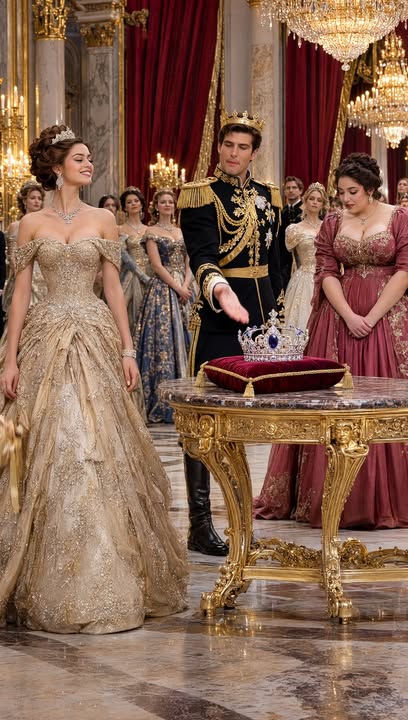
Part 6 – The Crown’s True Weight
For a moment, the ballroom seemed to hold its breath.
William looked from the newly discovered record to Lady Margaret, who had remained near the archivist, her hands clasped around her gloves.
“Is this your handwriting?” he asked.
“It is,” she replied, her voice quiet but steady.
The chancellor kept the sheet extended, but William did not take it immediately.
“Please tell us what happened.”
Lady Margaret glanced at the queen’s original address beneath the glass.
“Her Majesty asked me to remove the final line,” she said. “She had decided that the proposal should be presented separately, after the council had reviewed its wording.”
Celeste’s fingers curled gently around the edge of the table.
“Then why did the records say Lord Ashcombe asked for it?”
“Because he had argued for its removal earlier,” Lady Margaret answered. “When the queen made her final decision, I believed the council would assume he had prevailed. I did not correct them.”
William looked down at the sheet.
“You knew the truth and let the wrong account remain.”
“Yes,” Lady Margaret said. “I was afraid that explaining the change would make it seem as if the queen had abandoned her proposal. I thought I was protecting her intentions by staying quiet.”
“But the silence protected the wrong story,” Celeste said.
Lady Margaret lowered her eyes.
“It did.”
The ballroom remained quiet, but its stillness had changed.
The mystery no longer rested on a hidden hand changing the queen’s words without her knowledge.
It rested on a more human and difficult truth: the queen had made a deliberate choice, and others, fearful of what people might think, had allowed that choice to be misunderstood.
William accepted the paper from the chancellor and studied the date.
“Did my mother still intend to bring the proposal before the council?”
“Yes,” Lady Margaret replied. “She wanted the wording reviewed, then she planned to invite the public to discuss it. She believed the final line, as written, might be mistaken for a promise before the details were ready.”
“Did she ask you to keep that decision private?”
“She asked me to record it, not to erase the earlier draft. I failed to make the distinction clear.”
The queen’s original speech lay between them, the omitted lines still true to her beliefs, even if they had not been the final words she chose for that ceremony.
William returned the sheet to the chancellor.
“Then the record must show both things,” he said. “The original draft, her decision to revise it, and the fact that the proposal itself was never withdrawn.”
The archivist nodded.
“We can preserve the sequence of drafts and attach Lady Margaret’s signed account.”
“And the council correspondence?” Celeste asked.
“It confirms that the proposal was postponed for review, not rejected,” the archivist replied. “It also confirms your family supported the review.”
Celeste took a slow breath.
“For years, my family was described as having opposed the queen’s plans. That was not true.”
“No,” William said. “It was not.”
His words held no ceremony, only the weight of an apology honestly offered.
“I am sorry your family carried that false account for so long.”
Celeste looked at the queen’s papers.
“Thank you. I know an apology cannot give those years back, but the truth can keep the next generation from inheriting the same mistake.”
“It will be corrected in the official record,” William said. “And in the public account of the queen’s work.”
The chancellor inclined his head.
“I will ensure the correction is placed before the council.”
“Not only before the council,” William replied. “It must be available to the public, alongside the documents that explain it.”
The chancellor accepted the instruction without resistance.
“We will arrange that.”
Emma stood beside the crown, where its opened center showed the small compartment preserved beneath the sapphire.
She looked at the queen’s portrait on the papers and remembered the key, the quiet room, and the words spoken to her years ago.
The crown was not a puzzle with one perfect answer.
It was a record of people trying, and sometimes failing, to serve a truth larger than their own fear.
William turned toward the guests.
“My mother’s address was not one unchanging text,” he said. “There was an early version, a later decision, and a proposal she meant to bring forward after careful review. Our records failed to preserve those distinctions, and our family allowed an incomplete account to stand.”
He paused, letting the words reach the farthest corners of the ballroom.
“We will correct the record. We will begin an independent public review of the succession rules and the royal archive. The review will include the queen’s proposal, the council’s correspondence, and the circumstances in which her plans were postponed.”
A murmur moved through the guests, not loud enough to drown him, but full of questions and uncertainty.
William did not ask for their approval.
He did not present the announcement as a gift the palace had decided to grant.
“This is not a promise that every proposal will be adopted,” he continued. “It is a promise that the evidence will be considered openly, that the people affected will be heard, and that the royal household will no longer treat incomplete records as complete truth.”
The chamberlain stepped forward.
“Your Highness, the council will need to establish the review’s authority.”
“Then the council will establish it in public,” William said. “And its terms will be published before the review begins.”
There was no applause yet, only the sound of guests shifting as they understood that the evening had become something other than the ceremony they had expected.
William looked to Celeste.
“Princess Celeste, your family’s support for the queen’s proposal will be entered into the official record. The false account that your family opposed her will be withdrawn, and a formal correction will be issued.”
Celeste’s eyes glistened, but her voice remained clear.
“I accept the correction. I also ask that it name my grandmother’s work, not only our family’s title.”
“It will,” William said.
The archivist stepped closer with the verified council list.
“Her grandmother’s letters and the queen’s correspondence will be included as supporting records.”
Celeste looked down at the page, then up at the gathered guests.
“My grandmother always said that the truth mattered even if she never lived to see it believed,” she said. “I am grateful that it will be heard now.”
William turned to Emma.
“And Emma, I want to thank you for noticing the sapphire’s position and for keeping the key safe.”
Emma glanced at the crown.
“I noticed because I had seen the portrait often.”
“You noticed because you were willing to trust what you saw, even when everyone else thought the contest was finished.”
“I was willing to ask a question,” she said. “That is not the same as knowing the answer.”
“No,” William replied. “But it is often where a better answer begins.”
He looked toward the guests again.
“Emma helped uncover the evidence because she paid attention. She is not a prize, nor will she be treated as one. The contest is ended, and no winner will be named.”
A few guests turned toward her.
Emma felt their attention, but it did not press upon her as it had earlier.
This time she was not being asked to stand in for someone’s fantasy or amusement.
She was standing beside the evidence, on her own ground.
The princess in champagne gold stepped out from the gathered contestants.
Her expression was no longer amused or dismissive.
“Emma,” she said, “I accused you of tampering with the crown when I should have asked what you had seen. I am sorry.”
Emma met her gaze.
“Thank you for saying so.”
The princess lowered her head, accepting that the apology did not undo the moment, but could still be offered with sincerity.
The royal jeweler and conservator moved the crown to the center of the table.
They did not close its compartment.
Instead, the conservator placed a clear, protective cover over the open panel so the mechanism could be seen without being touched.
“The crown will be restored,” William said, “but its compartment will remain part of the public record. The queen’s words and the documents that led us here will be preserved together.”
The jeweler nodded.
“We can reinforce the frame without concealing the release. The crown will be safe to display, and its history will remain visible.”
“Then that is how it will be kept.”
Emma looked at the small opening beneath the sapphire.
The seam had once seemed like a flaw.
Now it seemed like a reminder that even the most polished symbols might contain a history their owners had not yet learned to read.
William read from the queen’s original address, but he began with the passage that had never been in dispute.
“My mother wrote that the crown is a symbol of service, not a claim to unquestioned power. She believed those who held authority should listen before they answered, and should be willing to explain the choices made in their name.”
He looked up from the page.
“Those words remain true. The work before us is to make our actions worthy of them.”
Only then did the ballroom answer with applause.
It began gently, scattered among the guests, and grew as people understood that William was not asking them to celebrate the royal family’s honesty.
He was asking them to hold the family to it.
Celeste stood beside him, no longer a rival to anyone.
Emma stood beside the crown, no longer a maid dismissed by a room full of strangers.
The chamberlain lowered his head toward the queen’s papers, and the chancellor spoke quietly with the archivist about securing copies for the review.
For the first time that night, the palace’s attention turned not toward who might win, but toward what needed to be done.
In the days that followed, the independent review began.
The queen’s letters, the blue ledger, Lady Margaret’s statement, and the council’s correspondence were catalogued by archivists chosen from outside the royal household.
The public received a clear account of the findings, including the queen’s early draft, her later decision to postpone the proposal, and the fact that the palace had failed to preserve the difference accurately.
Celeste’s grandmother’s support was formally recognized.
The correction appeared in the royal record, in the household’s published history, and in the account taught to the young pages who trained in the palace.
Celeste attended the council session where her family’s name was cleared.
She did not ask for an office or a favor in return.
She asked that the council publish its reasons for every decision made during the review, so that no future correction would depend on the memory of someone who had once stood quietly beside a queen.
William agreed, and the council accepted the measure.
The review did not change the succession rules overnight.
It did something less dramatic and more enduring: it brought the proposals into public discussion, invited petitions from across the kingdom, and required the council to answer them in writing.
Some people argued for broad changes.
Others urged caution.
For the first time, the debate took place in the open, with the records available to anyone who wished to understand how the question had begun.
The crown returned to its place in the palace gallery after the jeweler restored its frame.
Its hidden compartment remained visible beneath the central sapphire, protected by a clear panel and accompanied by a small card explaining how the queen had used it to preserve her papers.
The little brass key was placed in the royal archive beside Emma’s account of how it had come to her.
She had chosen to lend it to the archive, not surrender it.
The agreement said it would remain hers unless she decided otherwise, and that no one could use it to open the crown without her consent.
William insisted on that final line.
When the restored crown was displayed, Emma stood with him before the gallery opened.
The afternoon light slipped through the high windows and caught the sapphire’s blue center.
Its angle matched the one in the queen’s portrait.
William looked at the stone.
“Do you think she knew all of this would happen?”
Emma considered the question.
“I think she knew the truth might need someone to make room for it.”
“And she trusted you to notice?”
“I think she trusted me to do my work carefully. The rest came later.”
He smiled faintly.
“That sounds more like her than any grand explanation.”
Emma looked at the portrait.
The queen’s face held a quiet seriousness, but now Emma could see the warmth in it too.
“She trusted many people,” she said. “Some of them kept the truth safe. Some were too afraid to speak it. None of them were only one thing.”
William nodded.
“I used to think a legacy was something you received.”
“What do you think now?”
“That it is something you have to keep choosing.”
The months that followed changed the rhythm of the palace.
William met regularly with the review panel and listened as historians, council members, and citizens presented their views.
He learned that listening was not simply waiting for someone to finish.
Sometimes it meant asking a question that made his own position less comfortable.
Sometimes it meant accepting that an answer would take longer than the court preferred.
Emma returned to her work, though not quite to her old life.
She was invited to train with the archive staff in the care of historic objects, a path she chose because she wanted to learn more, not because anyone had offered her a reward.
The first time a curator asked for her opinion on the queen’s portrait, Emma stood beneath it with a small notebook in hand.
She noticed where the afternoon light caught the painted sapphire, and where the frame’s inner edge had been repaired.
She wrote everything down.
Celeste visited the gallery often.
She had become a regular representative at the public sessions, where she spoke not only of her family’s history but of the importance of keeping the records accessible.
Her friendship with Emma grew slowly, without the forced ease of two people pretending they had never misunderstood each other.
One afternoon, as they walked through the gardens, Celeste said, “I thought winning the contest would prove I belonged here.”
Emma looked at her.
“And now?”
“Now I think belonging should not depend on winning.”
“No,” Emma said. “It shouldn’t.”
Celeste smiled.
“I am glad you touched the crown.”
“So am I.”
“Even though the evening ended nothing like either of us expected?”
“Especially because of that.”
William’s relationship with Emma changed more slowly still.
He did not summon her to private meetings or ask her to remain near him for the sake of appearances.
They spoke when their work brought them together, and later because they had come to enjoy speaking with each other.
Sometimes they discussed the review.
Sometimes they talked about books, gardens, and the small rituals of a palace that never truly slept.
William learned that Emma liked music best when it was played softly enough for conversation to continue.
Emma learned that he was less fond of ceremony than his uniform suggested, and that he kept a notebook of questions he was afraid the council might find inconvenient.
Neither of them hurried to turn friendship into something else.
They had both seen how easily a public story could become more important than the people living inside it.
A year after the night of the crown challenge, William visited the palace archive after the last public tour had ended.
Emma was there, helping the conservator prepare a new exhibit about the queen’s correspondence.
The brass key rested in its case beside the note that had once been hidden beneath the sapphire.
William stood before it for a moment before speaking.
“I have been thinking about what you told me,” he said.
Emma looked up from the exhibit notes.
“Which part?”
“That you didn’t want me to choose you because I thought you deserved a reward.”
“I remember.”
“I don’t.”
She set down her pencil.
William looked toward the open crown, then back at her.
“I want to ask you something, and I want you to know you can say no without having to explain yourself.”
Emma waited.
“I would like to build a life with you,” he said. “Not because the crown brought us together, and not because the court thinks it would make a pleasing ending. I want it because I have come to love the person who asks the questions I might rather avoid, and who never lets me confuse attention with understanding.”
His voice was steady, but she could hear the vulnerability beneath it.
“I don’t want you to become a symbol beside me,” he continued. “I want you to remain yourself, with your own work, your own choices, and the right to disagree with me.”
Emma felt the answer begin to form, but she did not rush to give it.
She thought of the ballroom, of the note, of the years she had kept the key without knowing what it opened.
She thought of how William had changed—not into a perfect prince, but into a man more willing to listen when he did not have an answer.
“If I say yes,” she said, “it has to mean we keep making those choices. Not just tonight.”
“I know.”
“And I will not be presented as the maid who won a crown.”
“No.”
“I would want a life where my work matters, and where I can speak honestly without being treated as a threat to the palace.”
William nodded.
“That is the kind of life I want to build with you.”
Emma looked at the crown, its open compartment still visible beneath the sapphire.
Then she looked at William.
“Yes,” she said. “I will build that future with you, as your equal.”
Relief and joy crossed his face, but he did not reach for her until she offered her hand.
When he took it, the gesture felt neither like a royal claim nor a victory.
It felt like a promise made between two people who had learned that affection, like authority, was strongest when it left room for the other person to choose.
Their partnership was announced months later, after Emma had completed her training and the public review had issued its first recommendations.
The palace did not call her a prize or a discovery.
It introduced her as a woman who had chosen to share her life with William while continuing her own work in the royal archive.
Celeste stood with them at the ceremony.
Lady Margaret attended too, carrying a copy of her signed account, now preserved beside the queen’s words.
The chamberlain watched from the front row, his formal expression softened by a rare smile.
When the gathering moved into the gallery, the crown glimmered beneath the high windows.
The sapphire caught the light.
The seam beneath it remained visible, a small reminder that truth was not made less precious by being opened.
Emma stood beside William, with Celeste at her other side and the queen’s portrait above them.
No one asked her to wear the crown.
No one asked her to prove that she deserved the room.
She had come there by her own choice, and the future before her was one she had helped shape.
William leaned toward her.
“Do you think my mother would approve?”
Emma looked up at the portrait.
“I think she would ask what we plan to do next.”
William laughed softly.
“Then we had better keep listening.”
Together, they turned toward the guests, ready to meet a future that belonged to more than the palace, more than the crown, and more than any one person who wore it.
**–THE END–PLEASE
Share your thoughts or feedback to motivate us to create more stories ♥️
* * *
[PREVIOUS: PART 5](https://storyly.idolsgift.com/blog/part-5-the-note-beneath-the-sapphire-069-6)
✓ Lynn R. Adams
Part 6 – The Crown’s True Weight For a moment, the ballroom seemed to hold its breath. William looked from the newly discovered record to Lady Margaret, who had remained near the archivist, her hand…