PART 6 (THE END): The Note Beneath the Moon 034
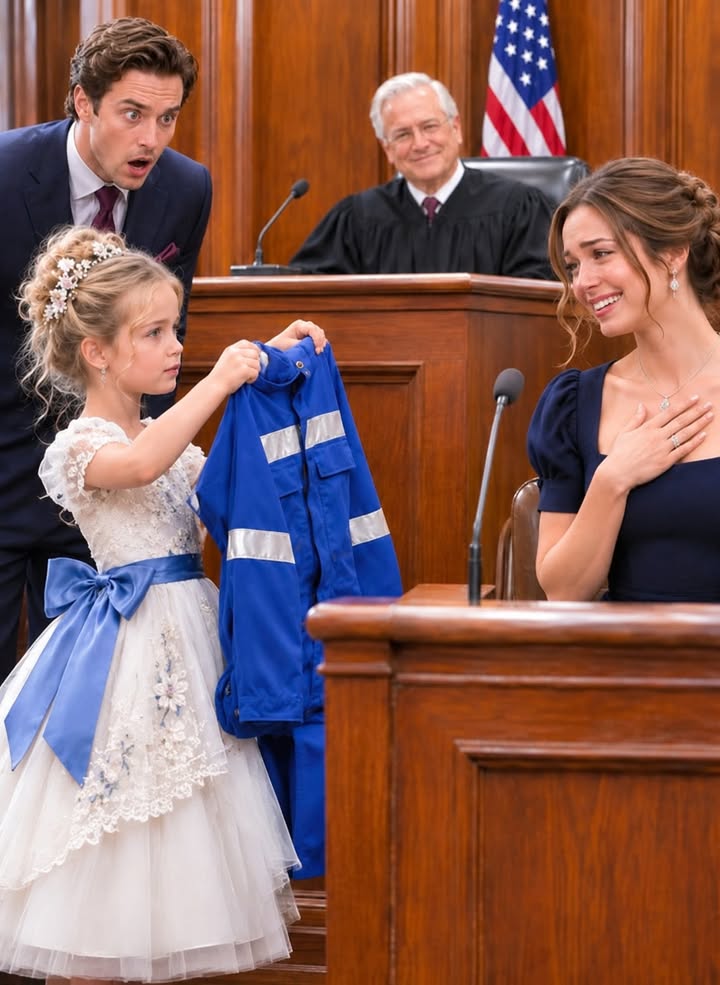
Part 6 – A Star Beside the Moon
My name was written across the envelope in my grandmother’s careful, slanting hand.
For several seconds, I could not make myself look away from it.
The clerk held the evidence bag steady while the judge asked everyone to remain back until the technician could document what he had found.
Willa stood between me and Gwen, her small hand wrapped around the pencil tin.
“Is it for you, Mommy?” she whispered.
“It seems to be.”
“From Grandma?”
“I think so.”
The clerk did not open the envelope.
Instead, the judge directed that it be photographed in place and secured with the other evidence until the court could arrange a careful examination.
It was a sensible instruction, but it asked more patience of me than I knew I had.
My grandmother’s handwriting had traveled through years of silence, through a locket I had sold and a shirt I had thought I bought, only to arrive here, under the cold lights of a courtroom.
Reid watched the sealed garment with his face drained of color.
“I didn’t know there was a letter,” he said.
I believed him.
The statement did not undo what he had done, but it shifted something in me: the last of my suspicion that he had orchestrated every detail of the mystery.
The envelope had belonged to a story older than our marriage, older even than the life we had built around Willa.
The judge adjourned the hearing so the evidence could be examined properly, and the clerk explained that the letter would be opened in the presence of both parents and their representatives.
Willa looked from the bag to me.
“Do we have to wait?”
“Yes,” I said, kneeling beside her. “But it will be kept safe.”
She nodded, accepting the answer with the same serious courage she had shown when she first brought the note into the courtroom.
Reid crouched a short distance away.
“Willa, I’m sorry this has all taken so long.”
She considered him.
“Are you still going to tell the truth?”
“Yes.”
“Even when it’s hard?”
“Especially then.”
She gave a small nod, then leaned against my shoulder.
The judge’s ruling on custody would come after the remaining evidence was reviewed, and the letter might not explain everything.
Still, as we walked out of the courthouse, the three of us moved together rather than in separate directions.
Not as a family restored to what it had been, but as people beginning to understand what rebuilding would require.
The court arranged for the envelope to be opened two days later.
Willa stayed with Gwen that morning, and I met Reid at the courthouse with the old photograph in its protective sleeve.
He looked tired, without the practiced ease he once wore as naturally as his suit.
“I keep thinking your grandmother must have known we’d end up here,” he said.
“I don’t think anyone could have known that.”
“No,” he replied. “I suppose not.”
The clerk brought us into a small conference room, where the judge, a court reporter, and the evidence technician were waiting.
The envelope had been removed from the shirt seam and placed on a clean sheet of paper.
Its paper had yellowed, but the seal remained intact.
The judge confirmed that everyone present agreed to the opening and asked the technician to proceed.
The flap came free with a faint, dry sound.
Inside was a folded letter and a tiny photograph, its edges worn white.
The technician photographed both before the judge passed them to me.
I knew the photograph at once.
It showed my grandmother beside the boy from the other pictures, standing in her garden beneath a young apple tree.
The boy’s silver crescent was pinned to his coat.
On the back, in my grandmother’s hand, were the words, “For the spring we thought would never come.”
I unfolded the letter.
My hands trembled, and I took one breath before I began.
“My dear granddaughter,” I read, “if this reaches you, then the little moon has found its way back into your life.”
The room quieted around my voice.
“I have kept this photograph because it reminds me that kindness is not a loan, and love is not a debt.”
I paused, then continued.
“The boy in the picture is Reid Hadley, who once came to my garden with his mother when his family had very little.”
Across the table, Reid lowered his eyes.
“I gave them work when they needed money and food when they needed help, but they gave me something in return, too.”
My grandmother’s letters were graceful, familiar, as if she were speaking from the kitchen chair where I used to sit as a child.
“They brought laughter into my garden, and Reid planted the first apple tree there with me.”
My throat tightened.
“He made me promise that if he ever grew up to have a daughter, I would tell her about the moon.”
I stopped reading.
Reid looked at me, startled.
The judge waited quietly.
I read on.
“I told him I would, but I also told him that a promise should not be used to make another person carry a burden.”
The words seemed to reach across the table and settle between Reid and me.
“If you are reading this with Willa, tell her that the moon is a reminder to look for the good people can do, not a reason to excuse the harm they cause.”
I had to pause again.
The letter continued.
“Tell her she may love her father without carrying his secrets, and she may love her mother without needing to protect her from the truth.”
My eyes blurred.
“Tell her that kindness must be freely given, and trust must be earned by the choices we make again and again.”
At the bottom, my grandmother had written a final line.
“The mark through the moon was made by Reid when he was a boy, with a thread he found in my sewing basket. He said it would help him recognize it if he ever saw it again.”
I looked at the old photograph beside the letter.
The thin line through the crescent had never been a hidden symbol of danger.
It had been the mark a little boy made so he could remember a kindness, and the promise he made to pass that kindness forward.
The note sewn into Willa’s shirt had turned that memory into a puzzle, but the letter gave it back its human shape.
Reid covered his mouth with one hand.
“I remember the thread,” he said. “She let me stitch it on myself.”
The judge asked whether he wished to add anything to the record.
Reid looked at the letter, then at me.
“I made a promise to help someone when I could,” he said. “And then I tried to protect my daughter by controlling what everyone else knew.”
His voice was rough, but steady.
“I turned kindness into a debt, and fear into an excuse.”
No one answered for him.
“I’m sorry,” he said to me. “I’m sorry I made you stand here and defend the life you were already giving Willa. I’m sorry I let my lawyer use that photograph without telling the truth about the shirt.”
I held the letter carefully in both hands.
“Thank you for saying it,” I replied. “But the apology matters because of what you do next.”
“I know.”
He did not ask me to forgive him.
That mattered, too.
The judge admitted the letter and photograph into the record and asked the clerk to make secure copies for both parents.
He also reminded Reid that his testimony about the landlord and his business partner would be referred to the appropriate authorities for review.
Reid confirmed that he would cooperate.
The company’s records were examined over the following weeks.
The partner’s role in falsifying complaints became clearer, and Reid provided the messages and documents he had withheld at first.
The partner had used the company to pressure several families connected to a development project, including ours, by making their homes appear unsuitable or their circumstances unreliable.
The investigation did not transform Reid into a hero.
It did establish that his fear had not been invented, even though the way he acted had caused real harm.
The landlord eventually admitted that he had been paid to support claims he could not honestly verify.
He withdrew his statement and apologized through his lawyer.
Mrs. Alvarez’s messages helped show how the pressure had begun, and her account was included in the review.
The judge rejected Reid’s request for sole custody.
After reviewing the full record, he recognized that Willa’s daily care had been stable with me and that she needed a dependable relationship with both parents.
The final order granted shared custody with safeguards, a gradual schedule, and supervised visits at first.
Reid accepted the terms without argument.
He also agreed to family counseling and to communicate directly with me about decisions involving Willa, rather than sending messages through her or other people.
When the order was read, I felt no triumph.
I felt relief, and grief for all the days Willa had spent wondering which of us she was allowed to love.
Outside the courtroom, Reid asked if he could speak with her.
Willa had come with Gwen to hear the judge’s decision, though we had told her she could wait outside if she preferred.
She stood beside me with the old photograph in her hands.
“You can tell me here,” she said.
Reid crouched so they were eye to eye.
“I have something I should have told you a long time ago,” he said. “Your great-grandmother helped my family when I was a boy.”
Willa glanced at the picture.
“You planted the tree?”
“I did. I was not very good at it.”
“Did it grow?”
“It did. Your grandmother said I had packed the soil too tightly, but it grew anyway.”
Willa studied the photograph, then his face.
“Why didn’t you tell me?”
“I was afraid that if I told you about the moon, I would have to explain why I was worried about the company and the court.”
“That doesn’t make sense.”
“No,” Reid said. “It doesn’t. I was trying to make a complicated problem simpler by hiding part of it from you. I was wrong.”
Willa looked down at the picture again.
“Grandma said I can love you without carrying your secrets.”
Reid’s face softened with pain and gratitude.
“She was right.”
“And I can love Mom without protecting her too.”
“She was right about that, too.”
Willa gave him the photograph.
“Can you help me plant an apple tree someday?”
“If you want to.”
“Not right away.”
“Whenever you’re ready.”
She nodded, and after a moment, let him hug her.
The embrace was brief and careful.
It did not fix everything, but it made room for something better than silence.
The first supervised visits were awkward.
Willa brought a book or a puzzle, and Reid made sure he arrived on time.
He did not bring expensive presents.
He did not ask her to tell me what she had said or done.
When he made a mistake, he named it without dressing it up as a misunderstanding.
At their third visit, Willa asked him to read an astronomy book aloud.
Reid stumbled over the names of two constellations, and she corrected him with the gentle authority of a child who knew the sky better than her father did.
He laughed, and she laughed with him.
Later, he sent me a message saying the visit had gone well, then added that he would not ask Willa to carry messages between us.
I replied, “Thank you.”
It was a small exchange.
It was also the kind of small truth that could be repeated until it became a new habit.
By summer, Reid was allowed longer visits, still guided by the court’s schedule and by Willa’s comfort.
The partner’s fraud was formally reported, and the company began cooperating with investigators.
The landlord’s retracted statement was entered into the custody record.
None of those steps erased the months of uncertainty.
They did mean that the truth no longer depended on a hidden note or a child finding the courage to reveal it.
The shirt came back to us after the court finished examining it.
The evidence technician had carefully opened the seam and removed the paper fragments, then returned the garment clean and mended.
The navy fabric had faded, but the tiny silver moon remained.
Willa carried it into the kitchen the evening it came home.
“Can I add something?” she asked.
I looked at the shirt.
“What would you like to add?”
“A star.”
Gwen found her small sewing tin, the one with the wooden lid and the loose buttons she had collected over the years.
We set the shirt on the table beneath the warm kitchen light.
Willa chose a length of pale gold thread and practiced a few stitches on a scrap of fabric.
Her first star leaned sideways.
She studied it, then started again.
When she had made a little star beside the moon, she held the shirt up to see how it looked.
“It’s not perfect,” she said.
“It doesn’t have to be,” I replied.
Gwen brushed one finger along the mended seam.
“It’s yours,” she said. “That’s what makes it right.”
Willa wore the shirt on her next birthday.
She had grown enough that the sleeves stopped short of her wrists, but she refused to let me put it away.
The birthday was not a grand celebration.
There was a chocolate cake from the diner bakery, a few paper stars taped to the kitchen wall, and a small cake made by Gwen that leaned gently to one side.
Reid arrived on time with a wrapped gift and no promises he could not keep.
He gave Willa a book about the moon, one he had chosen with her interests in mind.
She thanked him and showed him the shirt.
“Look,” she said, pointing to the little star she had sewn beside the crescent.
“I see it.”
“It’s for telling the truth.”
Reid took that in without looking away.
“That’s a good reason for a star.”
We sat around the kitchen table together, not pretending the hurt had vanished, but not allowing it to speak for every moment ahead.
Gwen poured tea.
Willa made a wish over the candles, then blew them out in a single breath.
When she opened her eyes, she looked at each of us in turn.
“Can we take a picture?” she asked.
We gathered close enough to fit in the frame.
Reid stood beside Willa, while I stood on her other side and Gwen leaned in behind us.
The camera flashed.
For once, no one was trying to make the image prove anything.
It was only a picture of the people who had come, the people who were learning, and a girl wearing her favorite shirt with a small star beside the moon.
After cake, Willa placed the old photograph of my grandmother and Reid on the table.
She had asked to keep a copy in her room, where it sat beside a small drawing of the moon.
“Grandma knew Dad when he was little,” she said.
“Yes.”
“And she helped his family.”
“She did.”
“Then she helped me, too.”
I looked at the shirt, at the mended seam and the uneven gold star.
“Yes,” I said. “She helped all of us.”
Willa leaned against my shoulder, then reached across the table and took Reid’s hand.
He held it gently, without asking her to promise anything.
The silver crescent caught the candlelight.
Beside it, the little star shone in a way no one had planned.
It was not a sign that our family had returned to what it had been.
It was a sign that we had learned to begin again without asking Willa to carry the truth alone.
**–THE END–PLEASE
Share your thoughts or feedback to motivate us to create more stories ♥️
* * *
[PREVIOUS: PART 5](https://puretales.idolsgift.com/blog/part-5-the-note-beneath-the-moon-034)
✓ Lynn R. Adams
Part 6 – A Star Beside the Moon My name was written across the envelope in my grandmother’s careful, slanting hand. For several seconds, I could not make myself look away from it. The clerk held th…