PART 6 (THE END): The Name the Palace Buried 046
Part 6 – Into the Light
“I was told never to come back,” Mara said, her voice barely above a whisper.
“But this says someone came looking for me.”
The words on the thin sheet were faded, and the ink had feathered into the paper where damp had touched it.
Lady Corin brought a lamp nearer while Mara held the page by its edges.
The note was brief, written in a hurried hand.
Mara Vale survived the east-wing fire.
She was carried beyond the north gate and must not be returned to the palace until the passage is cleared.
There was no signature.
For a moment, none of us moved.
Then Mara looked up at Michael.
“Did you write this?”
“No,” he said.
“Do you recognize the hand?”
He leaned toward the lamp but did not touch the paper.
“I don’t.”
“Could it be your father’s?”
“I can’t say.”
Mara lowered her eyes to the note again.
“Someone knew I was alive.”
“Yes,” I said.
“And someone knew where I had been taken.”
The truth neither of us wanted to meet sat plainly between the lines.
They had not lost her in the fire.
They had found her afterward, and decided what should happen to her without asking.
Lady Corin read the note a second time.
“The phrase ‘until the passage is cleared’ suggests it was written during the first days after the fire,” she said.
“Could it have been a message to Sella?” I asked.
“It may have been.”
Mara’s thumb brushed the scar beside it.
“If someone came looking for me, why did they leave me with the warning instead of bringing me home?”
No one answered quickly.
Michael’s gaze rested on the paper.
“Perhaps they believed returning you would endanger you.”
“Perhaps they were ordered to keep me away,” I said.
“Or perhaps both,” Lady Corin replied. “We will have to find the person who wrote it.”
Mara folded the note along its old crease.
“I don’t want to start again tonight.”
“Then we won’t,” I said.
She looked at the open archive doors, then at the boxes waiting inside.
“Will this be added to the public record?”
“After Lady Corin has made a copy and recorded where it was found,” I said. “Nothing will be taken from you without your agreement.”
“Good.”
The next morning, the inquiry began in a room with open windows and a table large enough for every record to be laid out in view.
Lady Corin led it, assisted by two jurists appointed from outside the royal household.
They asked no one to speak before they were ready.
Mara chose to give her account after the documents had been reviewed, and the jurists agreed that she could do so without an audience.
She described the locked passage, the key she had heard, the smoke, the voice beyond the door, and the path through which she escaped.
When she spoke of being carried to Sella’s sister’s cottage, she paused to steady herself.
No one urged her to continue.
When she had finished, she placed both hands on the table.
“I have said what I remember,” she told them. “I won’t pretend to remember what I don’t.”
The jurists thanked her and recorded the statement.
Then they sent for Thom Bell, the kitchen porter named in the old deposition.
He was living in a nearby town, where he kept a small bakery with his wife.
He arrived two days later in a flour-dusted coat, looking uncomfortable beneath the palace ceiling.
He recognized the east-wing records as soon as Lady Corin showed them to him.
“I was on the back stair when I saw Lord Ardent leave,” he said.
“Did you see him carry the key?” one jurist asked.
“I saw a ring in his hand, but I could not be sure what keys were on it.”
“Did you see him enter the passage?”
“No.”
“Did you see him return?”
“No.”
“Did you hear anyone inside?”
Thom’s eyes moved toward Mara.
“I heard a man calling for the door to be opened.”
Mara’s face became still.
“Do you know who it was?” she asked.
“I never saw him.”
“Did you tell anyone?”
“I told the steward the next morning. He said the matter had been dealt with.”
The jurist glanced at the old report.
“It was not included in your final statement.”
“No.”
“Did you ask why?”
“I was young,” Thom said. “I had two little ones at home and no wish to lose my place over something I couldn’t prove.”
There was no accusation in his voice, only the familiar weariness of someone who had once learned how quickly a question could become a burden.
Mara nodded.
“I understand.”
The inquiry traced the numbered account boxes through a series of old ledgers.
They were not ordinary household records.
They contained payment schedules connected to a road project overseen by Lord Ardent’s family, along with accounts that had been kept outside the official treasury.
Some of the payments had been legal.
Others had not been reported to the council, and several had been made through intermediaries to secure favors and conceal the true cost of the project.
The east passage had been used to store the books until they could be moved.
Lord Ardent had taken the key on the night of the fire.
The evidence showed that he had entered the passage shortly before the first alarm, intending to remove the ledgers before a scheduled inspection.
It did not show that he had set the fire.
It did show that he had left without releasing the lock, even after smoke began to spread through the corridor.
A servant trapped inside had died before the door could be opened.
The inquiry found that the fire itself had begun when a work lamp was overturned in the passage, where repair materials had been stored despite clear safety rules.
The flames had reached the adjoining rooms because the door had remained locked and the alarm had been delayed.
Lord Ardent had not planned the fire.
He had chosen secrecy over the people behind the door when he understood what his secret could cost.
My father had received the first reports before dawn.
He had ordered the official account changed to name the laundry rooms as the source of the fire and instructed the inquiry to close before the remaining witnesses were heard.
The records did not say that he had caused the blaze.
They did not need to.
They showed that he had protected the royal household from scandal and allowed the dead to be remembered beneath a lie.
A clerk’s copy of the missing order identified the person who had written the note about Mara.
Her name was Sella Venn, a kitchen attendant who had served my grandmother.
She had carried Mara to the cottage, then sent word to the palace that the girl had survived.
My father’s secretary had replied that Mara must remain away until the records were secured and the inquiry closed.
Sella had understood the command as a warning.
She had gone to Mara and told her never to return.
The note had been kept with Sella’s private papers, then found among the belongings of a retired housekeeper after her death.
No one had come to bring Mara back.
Someone had come to make sure the palace knew she was alive, and the palace had answered by burying the knowledge.
For several days after the findings were entered into the record, Mara spoke very little.
She walked through the gardens before breakfast and spent afternoons in the west library, where she could read the inquiry documents without having to sit beside anyone.
I did not follow her unless she asked me to.
The inquiry cleared my name of my father’s choices, but it did not make me feel untouched by them.
I had inherited the crown, the household, the official story, and every silence that came with them.
I could say I had been young when the fire happened.
I could say I had not known.
Those things were true.
They were not the only truth.
On the sixth day, I asked Mara whether she would walk with me beyond the garden wall.
She thought about it before answering.
“Where?”
“To the old east wing.”
“Why?”
“It has been repaired, but the doors have stayed closed for years.”
She glanced toward the palace.
“Are you asking because you want me to forgive the place?”
“No.”
“Because you think walking there will make the story feel finished?”
“No.”
“Then why?”
“Because I don’t want the only time we go there to be because of what happened.”
Mara looked at me for a long moment.
“Perhaps,” she said. “Not today.”
“Whenever you wish.”
The inquiry continued for another month.
Lord Ardent’s family was ordered to return the funds that had been unlawfully diverted, and his son, Evander, resigned from the council while the accounts were reviewed.
He did not deny the records.
He apologized for his father’s role, though Mara accepted no apology on anyone else’s behalf.
The council approved an independent public archive and required future royal inquiries to make their evidence available once witnesses had been heard.
My father’s name remained in the history books.
So did the order he had signed.
The palace did not fall.
The crown did not vanish.
But the story told about both changed.
Michael gave a full account of the death list, the key, and the papers he had kept.
He did not ask the inquiry to excuse him.
The council removed him from his office and imposed a sentence of service overseeing the transfer and cataloguing of the neglected household records.
He accepted it without protest.
For months, he worked beside the archivists, entering the names of servants and guards whose lives had once been reduced to lines in a ledger.
When he completed the work, the council granted him permission to retire to a small house beyond the city.
Before he left, he asked to speak with Mara.
She agreed to meet him in the garden, with me nearby but not between them.
“I’m not going to ask you to forgive me,” Michael said.
“Good.”
“I wrote your name on the list because I believed you were dead. Later, when I suspected you might be alive, I chose not to find out.”
“Why?”
“Because I feared what the truth would mean for the crown, for the prince, and for myself.”
“You called that protection.”
“I did.”
“It wasn’t.”
“No.”
Mara watched him.
“Do you understand that now?”
“I understand that deciding someone is safer in silence can be a way of protecting yourself from what they might say.”
She considered his answer.
“Then remember it.”
“I will.”
“I don’t know if I can forgive you.”
“You don’t owe me that.”
“No,” she said. “I don’t.”
Michael bowed his head.
“But I hope,” she added, “you use what you have left to make the records honest.”
“That is what I intend to do.”
“Then begin there.”
He did.
The inquiry concluded that I had no knowledge of the altered report or the sealed order, and cleared me of complicity in my father’s decisions.
The council restored my place in the succession.
I thanked them and declined to take it.
“I will serve the country,” I told them, “but I will not inherit the right to rule without limits simply because my father did.”
The council debated for weeks.
In the end, they approved a new settlement that placed the law above the monarch’s private judgment, gave the elected assembly authority over public accounts, and established a court independent of the royal household.
I accepted a constitutional role, one that required me to answer questions in public and allowed the country to remove me from office if I failed in my duties.
Julian remained my cousin and my friend, though we had to learn a new way to speak with each other.
He apologized for having treated Mara’s return as a threat before he understood what she had carried.
She told him his apology was a beginning, not a promise that nothing had happened.
He accepted that.
When the settlement was signed, the crown felt lighter in my hands.
Not because it mattered less, but because it no longer belonged to me alone.
I did not ask Mara to stay.
She remained at the palace until the inquiry ended, then returned to the town where she lived.
For a while, we wrote to each other.
My letters were about the new archive, the changing council, and the small repairs that seemed to take three meetings longer than they should.
Hers were about her work, the weather, and her brother, whom she had finally written to under her own name.
His reply had arrived in a plain envelope.
He had not received the payment listed in the old register.
He had believed she died because no one told him otherwise.
They met in a market town halfway between them, not at the palace.
When she told me about it, she said he had recognized her by the way she folded her thumb before she reached for a cup.
A year after the inquiry, Mara came back to the palace of her own accord.
She arrived without a veil, carrying a small travel bag and a letter she had written but not sent.
I met her at the garden entrance.
“You came,” I said.
“I did.”
“Do you know how long you’ll stay?”
“Long enough to see the east wing.”
“Nothing else?”
“That depends.”
I held the door open.
She entered without asking my permission and without waiting to be led.
The east wing had been restored with wider doors and new windows that opened toward the gardens.
The old passage had been unsealed, and the service corridor no longer narrowed to a shadowed strip behind locked doors.
The walls had been painted a warm cream.
Along one side, small plaques bore the names of the people who had died in the fire, as well as the names of those who had survived and been left out of the first records.
Mara stopped before her own name.
Mara Vale.
Laundry service.
Survivor.
She touched the carved letters with two fingers.
“I thought it would hurt more to see my name here.”
“Does it?”
“Yes.”
She turned toward the open passage.
“And it helps.”
We walked the corridor slowly.
At the far end, sunlight fell across the floor where a narrow window had been added.
Mara stopped there, looking out toward the gardens.
“The night I left,” she said, “I thought I would never see this place again.”
“I’m sorry.”
She turned to me.
“I know.”
I had learned that an apology was not a coin she had to accept and that sorrow did not give me a claim on her.
I waited.
“I came back because I wanted to see what had changed,” she said. “And because I wanted to know whether you had.”
“I hope I have.”
“That is not an answer.”
“No,” I said. “It’s not.”
She reached for my hand, then paused.
I did not close the distance.
After a moment, she laid her palm against mine.
The old scar beside her thumb rested in the hollow of my hand.
“I don’t want to be chosen as proof that you have become a better man,” she said.
“I don’t want you to be.”
“I don’t want a title.”
“I know.”
“And if I leave again, I want it to be because I choose to, not because someone decides the palace is safer without me.”
“It will be your choice.”
“Even if you wish I would stay?”
“Especially then.”
She searched my face, finding no easy promise there.
“I have missed you,” I said. “But I don’t want that to become a debt you have to repay.”
“It won’t.”
“I want a life with you, if you want one with me.”
She looked down at our hands.
“I don’t know yet what kind of life we would have.”
“Neither do I.”
“I don’t know if I can trust a palace.”
“You don’t have to trust the walls.”
“What about you?”
I met her gaze.
“I hope you will, in time.”
She did not answer right away.
Outside, the garden moved in the afternoon breeze, the leaves turning their bright sides toward the light.
“I want to begin slowly,” she said.
“Then slowly.”
“I want to keep my own work.”
“Of course.”
“I want a home that does not belong to the crown.”
“We can find one.”
“And if I never want to be queen?”
“You won’t have to be.”
Her thumb folded inward against my palm.
The gesture carried eighteen years of memory, but it did not belong only to the past anymore.
“All right,” she said.
It was not a promise of forever.
It was a door opening.
The following year, we married in the chapel beside the restored east wing.
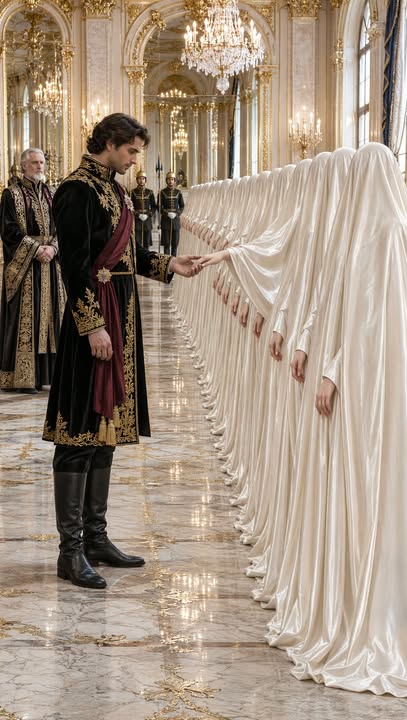
There were no grand processionals and no veiled guests standing in rows while a prince inspected their hands.
Mara chose the small gathering.
She wore a simple cream dress, and she kept her scarred hand bare.
Michael attended after the final decision in his case had been made.
He sat near the back, a quiet guest among the people whose names he had once written into a list.
At the signing table stood the first bound volume of the public archive.
Its pages included the full account of the fire, the testimony of those who had survived, and the names that had been left out of the palace record.
Mara and I signed the marriage register with the same pen.
When the ceremony was over, Julian offered his arm, and Mara accepted it for the walk back through the garden.
I followed beside them, not ahead.
At the garden gate, she let go of Julian’s arm and took my hand.
The afternoon light lay across the restored passage, warm and plain.
I thought of the boy I had been, waiting behind a jammed door while Mara pushed him toward the only open way out.
For years, I had believed the important thing was that I had found my way back to her.
I understood now that returning was not enough.
We had to meet each other where we stood, with the truth between us and neither of us asked to disappear.
Mara glanced toward the sunlit east wing.
“Will you walk with me?” I asked.
She rested her scarred hand in mine.
“Yes,” she said. “This time, together.”
And we stepped into the light.
**–THE END–PLEASE
Share your thoughts or feedback to motivate us to create more stories ♥️
* * *
[PREVIOUS: PART 5](https://echoesofstories.idolsgift.com/blog/part-5-the-name-the-palace-buried-046)
✓ Lynn R. Adams
Part 6 – Into the Light “I was told never to come back,” Mara said, her voice barely above a whisper. “But this says someone came looking for me.” The words on the thin sheet were faded, and the in…