PART 6 (THE END): The Name That Silenced the Ballroom 052
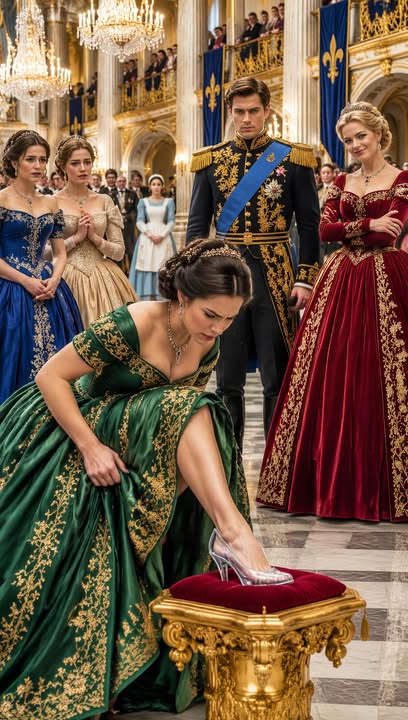
Part 6 – The Name in the Open
The prince remained beside Ella in the quiet corridor, holding the revised statement while the last light of day fell across the palace floor.
Neither of them spoke for a moment.
Then he folded the pages and placed them in Mr. Vale’s hands.
“Tomorrow, we tell what we know,” he said. “And we make clear what we do not know.”
Ella glanced at him.
“That may be the hardest part.”
“I think you’re right.”
He did not ask her to reassure him, and she was grateful.
For a while, they stood listening to the palace settle around them: distant footsteps, a door closing, the muted hum of a household preparing for morning.
At last, Ella touched the pendant beneath her collar.
“My mother carried this for years,” she said. “I used to think it was just something she wanted me to keep.”
“Perhaps it was,” the prince replied. “And perhaps it held more than either of you knew.”
“Do you think she knew?”
“I don’t know.”
It was not the answer Ella wanted, but it was an honest one.
She had learned that honesty did not always bring comfort at once.
Sometimes it brought room to breathe.
That night, she barely slept.
She thought of Clara standing in the old chapel with a baby in her arms, of the King writing a letter he never sent, of Lady Margaret holding that letter through years of delay.
She thought of the prince, who had inherited a family history assembled from silences, and of herself, who had spent most of her life believing her mother’s palace years were a story with no missing pages.
At dawn, Dr. Shaw sent word that the archive had received a response from the county records office.
The solicitor’s placement papers had included a birth date for Mara and the name of the household that had raised her.
A later civil record, found after a careful search, suggested that Mara had married and changed her surname.
There was no guarantee it was the same woman.
There was, however, a current address for a private residence in Ainsley.
“She is alive?” Ella asked when Dr. Shaw told her.
“We believe so,” the archivist said. “The record is consistent, but it would be wrong to treat it as certainty until we hear from her.”
“Has anyone contacted her?”
“Not yet.”
The prince had joined them in the archive, still dressed in the plain dark suit he had worn the previous evening.
“Then we should not send a formal royal letter,” he said. “That could feel like a summons.”
“Agreed,” Ella replied.
Dr. Shaw considered the papers.
“We could ask a local solicitor to make a discreet inquiry, without naming the palace or sharing personal details.”
“Could the inquiry say that someone with information about Clara Brooks would like to speak with her?” Ella asked.
“Yes. She could decline without needing to explain.”
“And if she does?”
“Then we leave her in peace,” the prince said.
The answer came quickly, but not carelessly.
Ella watched him accept that the truth might not lead to a reunion.
There was tenderness in that restraint.
Dr. Shaw drafted a short note, addressed to Mara under the name on the civil record, and sent it through an independent solicitor in Ainsley.
The message did not mention the crown prince.
It said only that a person connected to Clara Brooks had found records that might concern her family history and would welcome a conversation if she wished.
No reply came that day.
Nor the next.
The announcement took place in the small council chamber, just as planned.
The room held a handful of officials, Dr. Shaw, Mr. Vale, and a small group of reporters.
There were no chandeliers, no velvet platform, and no glass slipper.
Ella stood beside the prince, not behind him.
Lady Margaret stood on his other side, wearing a simple dark dress and no royal jewelry.
When the prince began speaking, his voice was steady.
“The palace has recently reviewed records concerning a daughter privately acknowledged by the late King before his marriage,” he said.
The reporters’ pens moved across their notebooks.
“We have confirmed that the child was christened under the name Mara, and that she was raised outside the royal household by Clara Brooks, a palace seamstress who chose a life of care and privacy for the child.”
Ella felt her mother’s name enter the room, spoken clearly and without apology.
The prince continued.
“The surviving records also show that Clara’s departure from palace service was shaped by decisions made within the royal household. Those decisions were not hers alone to carry, and the palace acknowledges the harm caused by keeping the truth from her and from her daughter.”
Lady Margaret’s fingers trembled once at her side, then grew still.
The prince did not look toward her as if asking her to bear the statement for him.
He let the responsibility remain where it belonged.
“Our archive will preserve and make available the relevant documents for independent review,” he said. “We will not identify or seek contact with the woman raised as Mara without her consent.”
He paused.
Then he turned slightly toward Ella.
“This discovery also concerns Clara’s daughter, Ella Brooks, who has chosen to stand here and speak for herself.”
The room became quiet.
Ella’s throat tightened, but she remained where she was.
She looked past the reporters to the faces gathered behind them.
“I came to the palace as a worker,” she said. “I was a daughter before I was a mystery, and I was a person before I was anyone’s clue.”
The prince listened without interrupting.
“My mother worked here. She loved people, she loved a garden, and she raised a child she did not have to raise. The palace can tell the story of the King’s daughter, but Clara’s story must not disappear beneath it.”
Ella took a breath.
“I do not know what Mara wants, and neither does anyone else here. If she wishes to speak with us, we will listen. If she does not, we will respect her choice.”
She felt the pendant against her chest.
“As for me, I am not here to claim a title or let a glass slipper decide my future. I am here because the truth belongs to the people who lived it, and because my mother’s name deserves to be remembered.”
For a beat, the chamber remained silent.
Then the prince inclined his head to her.
Not as a royal honoring a subject, but as a brother honoring the courage of the person beside him.
Lady Margaret stepped forward.
“I knew Clara Brooks,” she said. “I asked her to leave the palace, and I failed to deliver a letter the King had entrusted to me. I told myself that silence would protect people. Instead, it took choices away from them.”
Her voice wavered, but she continued.
“I am sorry to Clara, to Ella, and to the woman who may have been raised as Mara. I cannot ask them to forgive me. I can only make sure the records are preserved and answer honestly for what I did.”
No one applauded.
Ella was glad.
This was not a performance meant to make the room feel generous.
It was a truth that had needed saying.
The questions that followed were careful, though some were difficult.
The prince answered what the records established and refused to guess at what remained unknown.
When a reporter asked whether the newly discovered daughter might alter the royal succession, Mr. Vale explained that no such change followed automatically from the private acknowledgment and that the constitutional implications would be reviewed openly.
When another asked whether Ella would be given a royal title, she replied that she had not asked for one.
“I want the freedom to decide what my life is,” she said. “That is enough.”
Afterward, in the chamber’s antechamber, the prince let out a long breath.
“You did well,” he said.
“I was nervous.”
“So was I.”
“You didn’t look it.”
“I’ve had more practice standing in rooms full of people who expect me to sound certain.”
Ella smiled faintly.
“Do you feel certain?”
“About what we told them, yes. About what happens next, no.”
“That sounds more honest.”
“It is.”
Lady Margaret approached them.
“I thought I would feel lighter after saying it aloud,” she said. “I don’t.”
“Why not?” Ella asked.
“Because saying it does not return the years I kept it hidden.”
“No,” Ella replied. “It doesn’t.”
Margaret’s eyes lowered.
“But it does mean you won’t have to keep hiding it now.”
The older woman nodded.
“I’ll try to be worthy of that difference.”
Before Ella could answer, Mr. Vale entered the antechamber with a folded message.
“It is from the solicitor in Ainsley,” he said.
Dr. Shaw, who had followed them in, took the note and read it.
Her face softened.
“The woman received our inquiry,” she said. “She has agreed to meet one person, privately, with no press and no royal staff.”
The prince stood very still.
“Did she say who she wanted to meet?”
“She asked for Ella.”
Ella’s breath caught.
The prince looked at her, careful not to put expectation into his face.
“You don’t have to go,” he said.
“I know.”
The message included a date and a quiet place in Ainsley, a small community room beside the old public garden.
Mara had requested that no one use the title royal when speaking to her.
She had also asked that the meeting last no longer than an hour.
Ella read the request twice.
It sounded like a person setting a boundary, not someone stepping into a story.
“I’ll go,” she said. “But I’ll go alone.”
The prince nodded.
“I understand.”
“I can travel with you to Ainsley,” he said. “But I won’t enter the room unless she asks.”
Ella appreciated the distinction.
She took the morning train with Dr. Shaw, who would wait outside the meeting room, and the prince, who kept a respectful distance during the journey.
He did not ask her what she would say.
He did not tell her what Mara might feel.
When they arrived, the town was quiet beneath a pale spring sky.
The meeting room stood beside a public garden where children were chasing one another between the benches.
Ella paused outside the door.
Her hand had found the pendant again.
“Are you all right?” the prince asked.
“I don’t know yet.”
“That’s all right.”
She looked at him.
“If she doesn’t want anything from us, we leave.”
“We leave.”
“If she wants answers we don’t have, we tell her that.”
“Yes.”
“If she is angry—”
“She has the right to be.”
Ella nodded.
Then she went inside.
A woman stood beside the window.
She was in her mid-twenties, dressed simply, with dark hair tied back at her neck.
For a moment, neither woman moved.
The years between them had not made them resemble each other in any obvious way.
But Ella saw the same slight turn of the head she had once seen in the mirror when her mother called her from another room.
The woman’s eyes rested on the pendant.
“You’re Ella,” she said.
“Yes.”
“I’m Mara.”
The name sounded different when spoken by the person who had carried it through a life.
Ella did not reach for her hand.
She let Mara decide whether the space between them should close.
Mara remained beside the window.
“Did Clara raise you?” she asked.
“Yes.”
“Did she tell you about me?”
“Not that I remember. She told me she had once helped with a child at the palace, but she didn’t say your name.”
Mara looked down.
“She told me she was my guardian. She said my father was a kind man who had been afraid of what the world might do to me.”
Ella thought of the King’s letter.
“That sounds like her.”
“Did she ever say she was unhappy raising me?”
“No.”
“Did she ever seem to regret leaving the palace?”
Ella searched her memory.
“I think she sometimes missed the garden. She never said she regretted you.”
Mara closed her eyes briefly, as if she had been holding the question for a long time.
“She gave me a quiet childhood,” she said. “I had a mother, even if I knew she wasn’t the one who gave birth to me. I knew there were things she couldn’t explain, but I never knew that the King had acknowledged me.”
Ella sat at the chair nearest her.
“You don’t have to tell me anything you don’t want to.”
“I know.”
Mara took the chair across from her.
“I’m not sure what I want,” she said. “I’m not angry that Clara raised me. I’m grateful to her. But I don’t like discovering that people made decisions about me and then called it protection.”
“I understand.”
“Do you?”
“My mother’s life was shaped by those decisions too. But I didn’t live yours.”
Mara’s gaze warmed slightly.
“That’s an honest answer.”
They sat quietly for a moment.
Then Ella removed the pendant from beneath her collar and laid it on the table between them.
“I was told it came from the palace,” she said. “The rose is an old Whitmore emblem.”
Mara leaned forward, but did not touch it.
“I had a small rose embroidered inside my first coat,” she said. “Clara told me she had added it because she wanted me to have one thing that belonged to my beginning, even if I didn’t know what the beginning was.”
Ella looked at the pendant.
“Did she ever show you a piece of silver?”
“No.”
“She may have kept this because it reminded her of you.”
Mara’s eyes filled, but her voice stayed steady.
“Or because it reminded her of the palace.”
“Perhaps both.”
Mara gave a small, thoughtful nod.
“Was she happy with you?”
“Yes,” Ella said. “She loved you.”
“How can you know?”
“Because of the way she spoke about the people she loved. She didn’t speak carelessly. And because she left the palace and built a life around keeping you safe.”
Mara looked toward the garden outside.
“I was old enough to remember the house,” she said. “I remember Clara’s sewing room. I remember roses growing along the back wall.”
“My father was a gardener.”
“Arthur Brooks?”
Ella nodded.
Mara’s expression changed.
“I remember him too.”
“You do?”
“A little. He used to lift me so I could see the rose beds over the garden wall. He whistled when he worked.”
Ella felt her breath catch.
“That was his way when he was worried.”
Mara smiled, though tears had gathered in her eyes.
“Clara told me he did it when he was happy too.”
They shared a quiet laugh, tender and uncertain.
It was the first thing between them that belonged to neither the King nor the palace.
It belonged to Clara, and to the people she had loved.
Mara asked for the records.
Ella told her that Dr. Shaw could make copies and explain what each document established, without asking Mara to join the royal household or take any public role.
“I don’t want a title,” Mara said. “I don’t want to be introduced to strangers as the King’s daughter.”
“You don’t have to be.”
“I may want to meet the prince one day.”
“He would be glad to meet you, but he won’t come unless you ask.”
Mara considered that.
“Not today.”
“I’ll tell him.”
“I’d like time to think about everything.”
“You’ll have it.”
Mara looked at Ella for a long moment.
“And you? Do you want a sister?”
Ella felt the question land with the weight of a gift she had not expected to be offered.
“I want to know you,” she said. “But I don’t want you to feel you owe me a place in your life.”
“That’s a careful answer.”
“It’s the one I mean.”
Mara looked again at the pendant.
“Would you let me hold it?”
Ella slid it gently across the table.
Mara turned it over in her palm.
The tiny rose caught the daylight, its petals worn smooth at the center.
“Clara used to wear something like this?” she asked.
“I don’t know. She always kept it in a cloth pouch.”
Mara held it for a moment longer, then returned it.
“I think she wanted you to have it.”
“So do I.”
The hour passed without either of them noticing.
When it was time to leave, Mara stood first.
“Thank you for coming without bringing the whole palace with you,” she said.
“Thank you for meeting me.”
Mara hesitated, then opened her arms.
Ella stepped into the embrace.
It was brief, careful, and real.
Outside, the prince waited in the garden with Dr. Shaw.
He did not ask whether Mara had hugged her.
He only looked at Ella’s face.
“She wants time,” Ella said. “She may want to meet you later.”
“I’ll wait.”
“She doesn’t want a title or a public role.”
“Then that is what she gets.”
Ella watched his expression.
“You’re sure?”
“Yes.”
The prince looked toward the window, where Mara had returned to her seat.
“I have spent most of my life believing family meant the people in the portraits,” he said. “I’m learning that it means the people who are allowed to choose whether they come closer.”
Ella felt her chest soften.
“You’re learning.”
“I hope I can keep learning.”
They returned to the palace that evening, but the story did not end there.
The records were reviewed by an independent historian and made available for public study, with Mara’s private details withheld at her request.
The palace released a fuller account of Clara’s service and of the life she had chosen beyond its walls.
Lady Margaret stood before the household staff and apologized for keeping Clara’s story out of the palace’s history.
She did not ask for forgiveness.
She asked that Clara’s name be placed where it belonged.
A small bronze plaque was set in the garden behind the kitchens, beside the rose beds Arthur had once tended.
It read:
**For Clara Brooks, whose skill, courage, and care shaped lives far beyond these walls.**
Below it, a second line honored Arthur, whose hands had tended the garden and whose love had helped make a home.
Ella attended the dedication in a simple blue dress.
The prince stood beside her, not in front of her.
Lady Margaret stood a few steps behind them, where Ella had asked her to stand—not as the center of the moment, but as someone willing to witness it.
When the cloth was lifted, sunlight touched the engraved letters.
Ella placed a small white rose at the foot of the plaque.
For the first time, the palace said her mother’s name without lowering its voice.
In the months that followed, Ella declined the title the council offered to consider.
She did accept an invitation to help establish a scholarship for the children of palace workers.
She named it the Clara Brooks Scholarship, and she insisted that the selection committee include staff members, not only royal officials.
The prince supported the decision without attaching his name to it.
He also began spending time with the household workers in ordinary settings: at the staff dining table, in the gardens, and in the rooms where repairs were made.
He did not always know what to say.
Ella sometimes corrected him.
He learned to be grateful when she did.
The glass slipper remained in the royal collection.
At a display of family history, it was placed beside the old chapel register and the restored page bearing the names of Clara Brooks and Mara.
The accompanying note explained that the slipper had not chosen a bride.
It had brought a forgotten history into the light.
One afternoon, Mara returned to the palace by her own choice.
The prince met her in the garden, with Ella beside him and no photographers waiting.
He did not call her a princess.
He did not ask her to stay.
He simply told her that he was glad she had come.
Mara looked at the roses, then at the three of them.
“I’m not ready to call this home,” she said.
“You don’t have to,” the prince replied.
“But I might come back.”
“We’ll be here.”
She smiled, small but unguarded.
Ella stood between the woman she had just begun to know and the brother she was still learning to trust.
The palace had not become innocent.
No revelation could return the years that silence had taken.
But the truth had been spoken, Clara’s name had been honored, and the people whose lives had been shaped by the secret were finally allowed to choose what came next.
As the evening light rested on the rose garden, Ella felt the silver pendant warm against her skin.
It no longer seemed like evidence of a mystery.
It was a keepsake from her mother, a mark of two intertwined beginnings, and a reminder that love could make a family without asking permission from a crown.
For the first time, the palace felt less like a place that had kept her history from her and more like a place where she could choose what to build.
And among the roses Clara had loved, Ella, the prince, and Mara began—quietly, honestly—to make a family of their own.
**–THE END–PLEASE
Share your thoughts or feedback to motivate us to create more stories ♥️
* * *
[PREVIOUS: PART 5](https://storyly.idolsgift.com/blog/part-5-the-name-that-silenced-the-ballroom-052)
✓ Lynn R. Adams
Part 6 – The Name in the Open The prince remained beside Ella in the quiet corridor, holding the revised statement while the last light of day fell across the palace floor. Neither of them spoke for…