PART 6 (THE END): The Name That Changed Everything 047
Part 6 – A Place at the Table
Vincent did not move toward the door or reach for his coat.
He set the phone on the table, screen dark now, and looked at Sarah and Isabella.
“I’m calling the attorney,” he said. “Then the authorities. I won’t contact Bellini or anyone else on my own.”
Sarah’s pulse beat hard in her throat.
“And Emma?” she asked.
“We’ll follow their advice about keeping her routine steady and her information private,” he replied. “I won’t make decisions for you.”
It was not the promise of safety she wanted.
It was the promise that he would not pretend he could guarantee it.
Isabella took a breath and moved closer to the table.
“Call them,” she said.
Vincent did.
He spoke plainly, sharing the message and the photograph, then explained that he was prepared to provide the records he had already gathered.
He did not ask anyone to make the problem disappear.
He asked what they needed from him to handle it responsibly.
While he listened, Sarah watched Isabella’s face.
Her sister looked frightened, and she did not hide it.
But she stayed.
When the call ended, Vincent wrote down the instructions he had been given and agreed not to discuss the matter with anyone outside the legal team.
The photograph had been taken from a public place.
The sender could not yet be identified, but the authorities would examine the message and help the family take practical steps to protect their privacy.
It was frightening, Sarah realized, but it was not proof that anyone could reach them whenever they wished.
Vincent had spent years believing that power meant having an answer ready.
Now he sat at Sarah’s table with no easy answer, listening instead.
For the next several days, the family followed the attorney’s guidance.
Sarah adjusted Emma’s pickup arrangements, and Rosa helped with the changes.
Isabella checked in each evening, sometimes to talk and sometimes simply to make sure Sarah did not feel alone with her worry.
Vincent kept his distance unless invited, never sending surprise visitors or demanding updates.
He gave the investigators the records he had collected and answered their questions without trying to steer what they should conclude.
The unknown sender did not contact them again.
In time, the authorities traced the message to someone who had once done administrative work for Bellini.
The person had come across the old correspondence while helping with the file review and had sent the photograph to pressure Vincent into abandoning his cooperation.
There had been no plan to approach Emma or Sarah in person, and no further messages followed once the proper authorities became involved.
The explanation did not make the picture any less unsettling.
It did, however, bring the fear back down to the size of something they could understand and address.
The investigation uncovered more than one record of Bellini redirecting personal correspondence.
He had done so in other cases when he believed a family connection might influence Vincent’s decisions.
He had acted to preserve the organization’s control over Vincent’s time and loyalties, telling himself that he was protecting a larger whole.
The records also confirmed that Elena’s letter had been returned unopened, and that Vincent had never received it.
Those facts answered the question of how the message had vanished.
They could not answer every question about what might have happened if it had arrived.
Sarah stopped asking the past to offer a different ending.
It had given them enough truth to understand the choices that shaped them, and no amount of searching could return the years.
The work of becoming a family would have to happen in the time they still had.
Vincent turned over the records and evidence to the authorities.
He formally severed his remaining ties to the network and stepped away from the businesses connected to it.
The process took months, not a dramatic afternoon, and it cost him much of the wealth and influence he had once treated as permanent.
He gave up the offices, the drivers, and the protections that had made people step aside when he entered a room.
He did not ask Sarah or Isabella to praise him for doing so.
He did not tell them that his sacrifice should earn their trust.
He began instead to show up in the ways they had asked him to.
He called before visits.
He remembered the times they had agreed on.
When he could not make something, he told them early and explained why without inventing an excuse.
He listened to Isabella speak about the lonely years without interrupting to describe his own regret.
He learned that an apology was not a door someone else had to walk through.
It was something he could offer, and then leave in their hands.
One spring afternoon, Isabella invited him to visit the small apartment she had made her own.
The first time he came, they drank tea at her kitchen table while rain pressed softly against the windows.
She told him about her studies, the job she hoped to take, and the friends who had helped her build a life without waiting for him.
He asked questions and listened.
When she described the first school play she had performed in, the one she had watched other fathers attend, he looked down at his cup.
“I’m sorry I wasn’t there,” he said.
“I know,” Isabella replied.
“I wish I could give you a different memory.”
“You can’t.”
“No.”
“But you can be here now.”
It was not a pardon.
It was a beginning they had chosen together.
After that, Isabella sometimes called him by his name and sometimes called him Dad.
The word did not become easy all at once, but it stopped feeling impossible.
Sarah’s path was slower.
She set clear limits around Emma’s visits and kept the first meetings short.
Vincent never asked for more time than she had offered.
He never tried to win Emma over with expensive toys or promises.
He brought picture books, crayons, and once a small packet of stickers that Sarah approved before he gave them to her.
He learned that Emma liked to hear the same story several times in a row, and that the stuffed rabbit had to sit beside her when she drew.
He learned her favorite snack, her new words, and the way she leaned toward people she trusted only after watching them for a while.
More importantly, he let her take her time.
At first, Emma called him “the sad grandpa from the diner.”
Then she called him “Grandpa Vincent.”
Sarah did not correct her.
One evening, after Emma had fallen asleep, Sarah sat across from Vincent at the kitchen table.
The heart pendant rested between her fingers.
“I’m not ready to say that everything is fine,” she told him.
“I know.”
“Some days, I’m angry that you were so close to us once and still disappeared.”
“I understand.”
“Some days, I’m angry that Mom spent years believing you had rejected her.”
“So am I.”
“And some days, I’m grateful that the letter never reached you, because it means you didn’t read her words and turn away.”
Vincent bowed his head.
“I wish that were all I could offer you.”
“It isn’t.”
“No.”
She studied his face, no longer searching it for the answer that might make the past simple.
“I don’t know if I’ll ever forgive all of it.”
“You don’t have to decide that for me.”
“I need you to understand that I may love you and still be angry.”
“I’m beginning to understand.”
“Good.”
She closed her hand around the pendant.
“I’m going to let you keep building a relationship with Emma.”
Vincent looked up, but he did not smile as though she had handed him a reward.
“Thank you for trusting me with that.”
“This isn’t trust without limits.”
“I know.”
“And it isn’t a promise about forever.”
“I know.”
“It’s a chance to keep showing us who you are.”
“I’ll try to be worthy of it.”
Sarah shook her head gently.
“Don’t try to be worthy of a title. Just be honest and keep showing up.”
He nodded, and this time he did not add anything.
The following Sunday, Sarah invited Vincent and Isabella to dinner.
She did not call it a reunion.
She called it dinner, because that was what it was: a meal in her small apartment, with a table too narrow for grand speeches and chairs that did not quite match.
Rosa came too, bringing a dish of roasted vegetables and a story about Elena that made Isabella laugh.
Vincent arrived carrying a loaf of bread from the bakery down the block.
He had asked Sarah before bringing it.
Emma came running from the living room when she heard the knock.
“Grandpa!”
Vincent crouched to greet her.
“Hello, Emma.”
“Did you bring cookies?”
“I didn’t,” he said. “But your mother told me there might be some after dinner.”
Emma considered this arrangement, then approved it with a solemn nod.
At the table, conversation moved slowly at first.
They talked about the weather, Rosa’s garden, and Isabella’s plans for work.
Then Emma announced that she had made a drawing of everyone in the family.
She held up the page, crowded with colored shapes and smiling faces.
Sarah leaned closer.
“Who is this one?”
“Mommy.”
“And this?”
“Auntie Isabella.”
“Who’s this?”
“Grandpa.”
Vincent looked at the drawing, where his silver hair had been rendered in a tall, wobbly line of gray.
“I’m honored,” he said.
Emma pointed to a small brown circle near the bottom.
“That’s Rabbit.”
“Rabbit looks very important,” Isabella said.
“He is,” Emma replied.
Laughter loosened the room.
The old photograph of Elena and the two girls sat in a simple frame on the shelf nearby.
Beside it, Sarah had placed the picture of her mother holding newborn Sarah while Isabella leaned close.
Vincent’s hand was visible at the edge of the frame, resting on Elena’s shoulder.
The sight no longer felt like proof of what he had lost.
It was a reminder of what had once been shared, and of how much care it would take to share anything again.
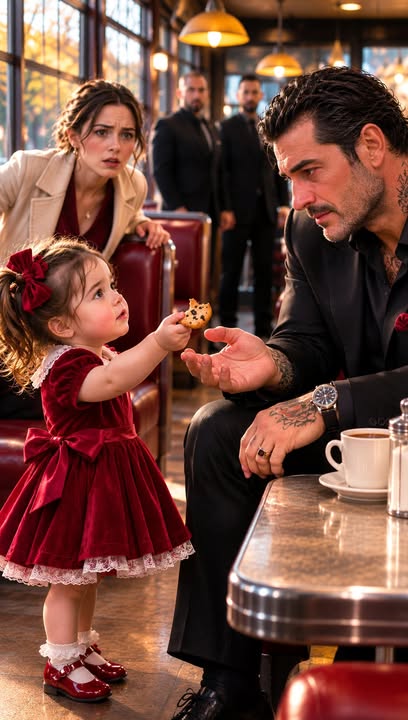
After dinner, Sarah brought out the cookies.
Emma chose one for herself, then broke another in half and offered the larger piece to Vincent.
He looked at the small hand holding it out.
“Are you sure?” he asked.
“Everyone gets one.”
“Then I’ll take it. Thank you.”
This time, there was enough for everyone.
Isabella reached for a cookie, and Rosa took one too.
Sarah selected the last from the plate and sat beside her daughters, the pendant warm at her throat.
Vincent did not sit at the head of the table or try to draw everyone’s attention.
He sat where there was room.
He listened to Emma describe the rabbit’s latest adventure, and when she leaned against his arm, he stayed still enough not to startle her.
Sarah watched them, feeling the old grief present but no longer alone.
It had not disappeared.
It had become part of a larger story, one that now held truth, boundaries, laughter, and the ordinary work of returning.
After the meal, Isabella helped Sarah clear the plates.
At the sink, she glanced at the pendant.
“Do you still wear it every day?”
“I do.”
“Does it feel different now?”
Sarah touched the little silver heart.
“It still reminds me of Mom.”
“It reminds me of her, too.”
Sarah unfastened the chain and laid the pendant in Isabella’s open palm.
“Keep it for a while.”
Isabella looked startled.
“Are you sure?”
“I think Mom meant for it to connect us, not keep us separate.”
Isabella closed her fingers gently around it.
“I’ll bring it back.”
“I know.”
They stood together at the sink, shoulder to shoulder, while the others talked in the next room.
The pendant had once seemed to hold a locked door.
Now it rested between two sisters who had found each other late, but not too late to begin.
When the evening ended, Vincent thanked Sarah for dinner and thanked Isabella for staying.
He did not ask when he could come back.
Sarah told him she would call him the following week about Emma’s school event.
He smiled, a quiet expression that held gratitude without expectation.
“I’ll look forward to it.”
After he left, Isabella lingered by the doorway.
“He’s different,” she said.
“He’s trying to be.”
“Do you think people can change that much?”
Sarah looked toward the table, where Emma’s drawing still lay beside the cookie plate.
“I think they can change what they do next.”
Isabella nodded.
For a moment, they stood together in the gentle hush of the apartment.
Then Emma called for them from the living room, where her rabbit had apparently fallen beneath the sofa.
Sarah and Isabella went to help her, laughing when they both reached for the toy at once.
Later, when the dishes were done and the apartment was quiet, Sarah found Elena’s letter resting safely in its sleeve.
She placed it beside the photographs, not hidden at the bottom of the box, but not displayed as a promise that everything had been made right.
It was part of their history.
So was the unanswered silence.
So were the years of hurt.
And so were the small, steady choices that had brought them to this table.
Vincent could not reclaim the childhoods he had missed or give Elena the answer she had waited for.
He could not make himself the father he should have been.
But he could arrive when invited, listen when it hurt, and accept that love was not a debt his daughters owed him.
In the months that followed, he kept doing just that.
And one Sunday, when Emma offered him a cookie again, she had enough for everyone.
**–THE END–PLEASE
Share your thoughts or feedback to motivate us to create more stories ♥️
* * *
[PREVIOUS: PART 5](https://echoesofstories.idolsgift.com/blog/part-5-the-name-that-changed-everything-047)
✓ Lynn R. Adams
Part 6 – A Place at the Table Vincent did not move toward the door or reach for his coat. He set the phone on the table, screen dark now, and looked at Sarah and Isabella. “I’m calling the attorney…