PART 6 (THE END): The Name on the Screen 008
Part 6 – The Room for What Comes Next
Evelyn’s voice came through the phone with a tremor Graham had never heard from her before.
“The name on the page is Martin Vale,” she said. “Claire had arranged for him to lead the neighborhood initiative with her.”
Graham’s fingers tightened around mine.
“Martin?”
“Yes. The funding wasn’t coming from the company. Claire had secured a commitment from the lending circle, and Martin was going to help build the program from the neighborhood outward.”
He closed his eyes.
For a moment, the shop held only the soft buzz of the cooler and the distant hush of traffic outside.
“Did the funding go through?” he asked.
“Not exactly. There’s a letter from the lending circle attached to the amendment. They were willing to contribute if the company agreed to provide space and administrative support.”
“And Claire had arranged that?”
“She had arranged the conversation. She hadn’t signed anything in your name.”
Evelyn’s careful distinction sounded like Claire: hopeful, but unwilling to promise what she could not deliver.
Graham opened his eyes and looked toward the green ledger on the worktable.
“So she wasn’t asking me to save the project.”
“No,” Evelyn said. “She was asking you to listen before you signed a contract that could close the door on it.”
He let out a breath that had been caught somewhere deep in his chest.
“I wish I had listened.”
“I know.”
“I wish she’d had the chance to tell me.”
“I know that too.”
Evelyn did not try to soften the truth, and Graham did not ask her to.
The years could not be returned, and no recovered page could make their last conversations different.
But the page had given him something more honest than the story he had lived with: Claire had not stopped believing in him.
“I’m sorry I asked you to carry the things I was afraid to look at,” he said.
“You didn’t ask me to,” Evelyn answered. “I chose to keep them.”
“Still.”
“Then we can both stop carrying them alone.”
He looked at me, and I felt his hand loosen around mine.
“When can Martin meet us?” Graham asked.
“Tomorrow, if he’s free.”
“Ask him.”
“I already did.”
A small smile touched Graham’s face.
“Of course you did.”
“He can meet us at the old community office at eleven.”
“I’ll be there.”
“So will I.”
The call ended, and the shop’s quiet returned.
Graham kept his phone in his hand for a moment, then set it face down beside the folded dinner receipt on the counter.
“I think I understand what Claire wanted,” he said.
“Do you?”
“Not all of it. But enough to know it wasn’t an order.”
He glanced at the phone, then back at me.
“And enough to know I can’t make a life out of trying to guess what she would have chosen.”
I squeezed his hand.
“That sounds like a place to begin.”
“It does.”
He looked at the flowers around us, the loose petals near the cooler, the half-finished arrangements waiting for morning.
“I still owe you dinner.”
“You do.”
“Tomorrow?”
“We already said tomorrow.”
“Then I’ll try not to let a hidden page interrupt it.”
“Your sister may have had other plans.”
“Claire would have told me to bring her along in spirit and put my phone away.”
“Would you?”
“I think I can manage that.”
We parted at the shop door, with the promise of dinner between us and the old ledger safe on the worktable.
The following morning, Graham and Evelyn met Martin at a small office above a neighborhood credit union.
It was an ordinary room with a long table, a kettle in the corner, and sunlight falling across the scuffed floorboards.
Martin was in his late sixties, with a soft gray beard and a way of listening that made each person feel they had all the time they needed.
He remembered Claire clearly.
“She came in with a notebook full of numbers and a list of people she wanted me to meet,” he told them. “She said the neighborhood didn’t need a grand gesture. It needed a dependable place to start.”
Graham sat with the old ledger open before him.
“She wanted you to lead the initiative?”
“She wanted us to build it together. She was careful about the word lead.”
Martin smiled faintly.
“Claire believed people were more likely to trust a project if they had a hand in shaping it.”
Evelyn placed the recovered letter beside the ledger.
“Was there ever a final funding agreement?”
“There was a written commitment, conditional on the company providing administrative support and a place for the first group to meet.”
“Do you still have it?” Graham asked.
“I do. It’s in the nonprofit’s archive.”
“Why didn’t you follow up?”
Martin considered the question before answering.
“Claire told me she would speak with Graham first. After she died, Evelyn and I spoke once or twice, but neither of us wanted to presume what Graham would choose.”
Graham lowered his eyes to the table.
“I’m sorry.”
“You don’t owe me an apology for grieving,” Martin said. “But if you want to begin now, I’ll help.”
The agreement was not a miracle.
It did not restore the opportunity they had lost or make the years in between disappear.
It gave them a foundation: an old commitment, a willing partner, and a practical first step.
Graham spent the next weeks doing what had once seemed to him like the least important part of building a business.
He asked questions.
He listened to neighborhood shop owners describe their rent, their risks, and the things they needed that no financial report had captured.
He sat through meetings where he was not the person with the final answer.
He let Evelyn challenge his plans, and when she did, he considered her words instead of reaching for the figures that might end the conversation.
The initiative began modestly, just as Claire had hoped.
They found an affordable room in a shared workspace and committed funding for a small number of local businesses.
Martin helped them create a program that paired short-term loans with practical advice and introductions to people who understood each neighborhood.
Evelyn took responsibility for the company’s side of the work.
Graham learned to give her the authority she needed, even when his first instinct was to step in.
When the initiative was formally launched, they named it Claire’s Common Ground.
The first plaque was small, made by a neighborhood sign-maker, and fixed beside the entrance to the shared workspace.
Graham stood before it after everyone had gone.
He traced the engraved letters with one finger.
“She would have liked that,” Evelyn said beside him.
“Do you think so?”
“She would have said the plaque was too expensive.”
“It wasn’t.”
“She would have asked for the receipt anyway.”
He smiled.
“I miss her.”
“I do too.”
The words brought no rush of shame with them.
He could say them plainly now, without turning grief into a task or searching for some way to earn the right to feel it.
Evelyn slipped her hand around his arm.
They stood there for a while, remembering a woman neither of them had managed to keep from the past, but whom they could finally remember without blaming themselves for everything that had gone unsaid.
On Monday morning, I signed the lease for the Brookline space.
The room was smaller than it had seemed in the photographs, and the front window needed new paint.
But the afternoon light poured across the empty floor, and there was enough room for a cooler, a worktable, and several chairs for flower-arranging classes.
I stood in the center, listening to the echo of my own footsteps.
My fears came with me.
So did my excitement.
I would have to borrow more money than I had ever borrowed, hire another part-time employee, and learn how to manage two locations without losing the parts of the work I loved.
None of that made the choice wrong.
When I called Graham to tell him I had accepted, he was quiet for a moment.
Then he said, “I’m proud of you.”
“You’re not going to ask me if I’m sure?”
“No. You’ve thought about it.”
“I have.”
“Then I trust you.”
The answer warmed me more than congratulations would have.
“Will you come see it?”
“If you want me to.”
“I do.”
“Then I’ll be there.”
He did not ask whether the new shop would make it harder for us to see each other.
He did not tell me what the distance would mean or try to promise that it would mean nothing.
We talked about the train, the hours, and how we might make time for one another without turning either of our lives into a negotiation.
Some evenings I stayed late at the original shop.
Some mornings he came by before work with coffee and helped me carry buckets to the van.
When I had to be in Brookline, he visited there instead, careful not to take over or offer advice unless I asked.
He came to the first flower-arranging class and sat in the back while I taught six people how to choose stems and shape a simple table bouquet.
Afterward, he told me he had never realized how much thought went into making something look effortless.
“Flowers don’t have to look effortless,” I said. “They just have to be alive.”
“I’m beginning to appreciate that.”
Our relationship did not become easy simply because we had chosen it.
There were differences between our lives that could not be settled by affection alone.
Graham was used to planning far ahead, while I preferred to leave a little space for surprise.
He still had days when work swallowed more of him than he intended.
I still had evenings when I wondered whether I had taken on too much.
But we learned to say so.
He learned that caring for me did not mean deciding what I could handle.
I learned that accepting his care did not mean surrendering my independence.
When he struggled, I listened without trying to turn his feelings into a checklist.
When I was frightened, he did not pretend the risks were smaller than they were.
We made room for the truth, even when it was inconvenient.
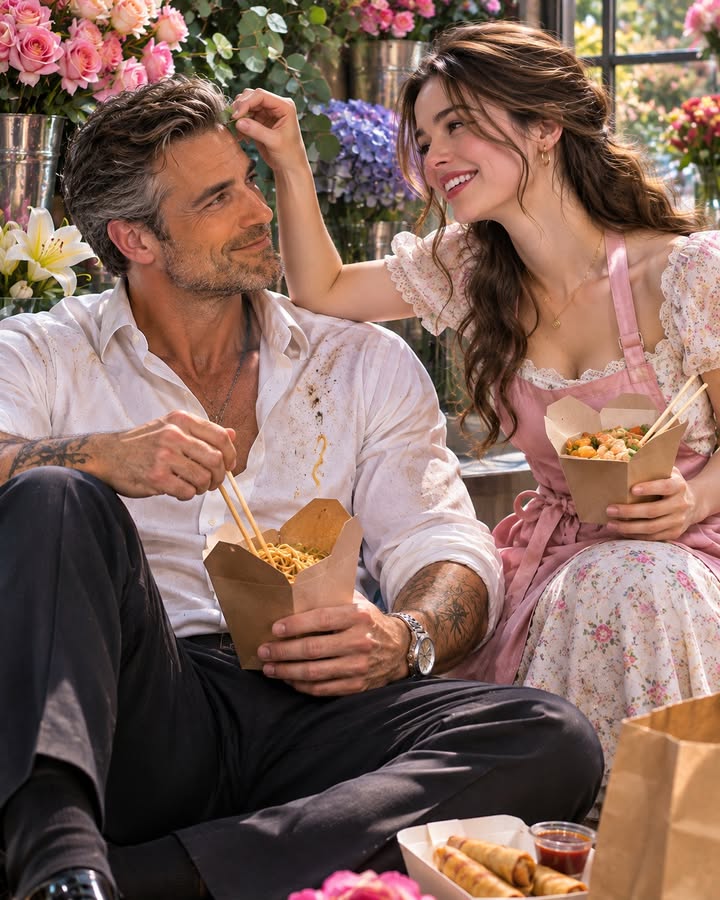
A few months later, on a rainy Thursday evening, Graham arrived at my original shop with two paper bags of takeout.
His phone was in his coat pocket, silenced.
A folded napkin was tucked beneath one of the bags, marked in his careful handwriting.
No calls until dessert.
“You made a rule?” I asked as he set the food on the worktable.
“I made a suggestion.”
“Is it negotiable?”
“Only if the food is terrible.”
“You’ve brought enough for an international summit.”
“I wasn’t sure how hungry you’d be.”
“I’ve been moving boxes since eight this morning.”
“Then I made the right decision.”
He took off his coat and hung it beside mine.
There were flowers everywhere: buckets of anemones, stems of eucalyptus, pale roses that had begun to open, and small bunches of daffodils waiting to be tied.
We carried the food to the floor near the front window and sat with our backs against the counter.
This time, Graham brought proper forks.
“This is less risky than chopsticks,” he said.
“Less entertaining, too.”
“I’m willing to make the sacrifice.”
A smile came easily to him now, though it had not erased the grief that belonged to his sister or the work still required to build the initiative.
His phone stayed in his pocket.
The evening light, gray with rain, shone softly against the glass.
For a while we ate and talked about the new shop, the first businesses Claire’s Common Ground had helped, and the argument Evelyn had won about the company’s meeting schedule.
“She was right,” Graham said.
“She usually is?”
“More often than she enjoys hearing.”
“You should tell her that.”
“I will. She’ll deny it.”
We finished the noodles and split the last spring roll.
A petal from one of the roses had drifted onto Graham’s sleeve.
I reached over and brushed it away.
He caught my hand before I could pull it back, then turned his palm beneath mine.
“Have you decided what the dinner after this one will be?” I asked.
“I thought I might ask you properly.”
“You’re sitting on the flower-shop floor with me again.”
“I meant somewhere with a table.”
“Do we need one?”
“Not necessarily.”
“Then I think this is working.”
He laughed, and the sound settled comfortably among the flowers.
Outside, rain threaded down the window, turning the streetlights into soft gold streaks.
Inside, the shop smelled of green stems and warm food, and the phone in Graham’s pocket remained quiet.
He looked at me with the same careful tenderness that had once kept him from asking for anything at all.
Only now, he did not mistake restraint for the only way to be kind.
“Lucy,” he said, “will you have dinner with me tomorrow?”
I leaned my shoulder against his.
“Yes.”
“And the day after, if we’re both free?”
“Ask me then.”
“I will.”
“And if I’m busy?”
“Then I’ll ask another day.”
“Good.”
He rested his hand beside mine on the floor, close enough to touch and patient enough to wait.
I laced my fingers through his.
Around us, the flowers leaned toward the window, still opening in their own time.
**–THE END–PLEASE
Share your thoughts or feedback to motivate us to create more stories ♥️
* * *
[PREVIOUS: PART 5](https://puretales.idolsgift.com/blog/part-5-the-name-on-the-screen-008)
✓ Lynn R. Adams
Part 6 – The Room for What Comes Next Evelyn’s voice came through the phone with a tremor Graham had never heard from her before. “The name on the page is Martin Vale,” she said. “Claire had arrange…