PART 6 (THE END): The Name on the Locket 047
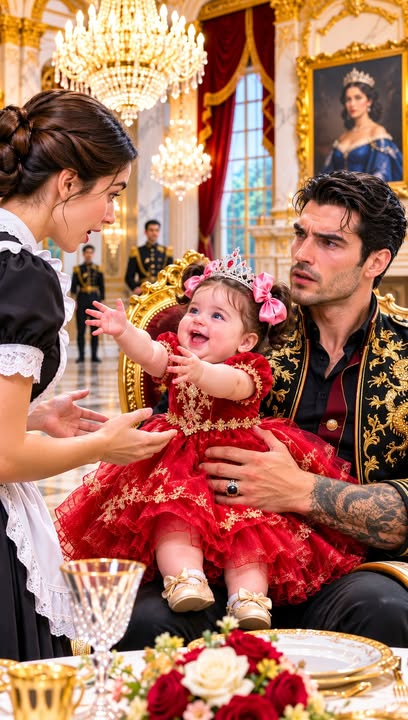
Part 6 – A Home Chosen Freely
“The signature is not the physician’s.”
Dr. Saye’s words settled over the archive, and Helena’s face turned white.
Dante moved closer to the table, but he did not reach for the page.
“Whose signature is it?” he asked.
The archivist held the letter carefully beneath the reading lamp.
“It appears to be Sir Edmund Vale’s.”
Mrs. Vale, who had followed us down the stairs, drew in a sharp breath.
“My father?”
Helena closed her eyes.
The question had been spoken so softly that it might have been meant only for herself.
Dante looked at her.
“You knew?”
“I knew he had been involved in the birth records,” Helena said. “I did not know he had changed them.”
“Was he the physician?”
“No. He was my father’s private secretary.”
Dr. Saye turned the sheet toward us.
The writing described the birth of two healthy girls, recorded under the names Isabella and Mara, and stated that both infants had been examined by the royal physician.
Beneath it was a later notation, in Sir Edmund Vale’s hand, declaring that the second child had died shortly after birth.
The physician’s signature appeared beside the original report.
The false notation had been added beneath it.
“He wrote that I had died,” I said.
Helena’s eyes opened.
“Yes.”
“Why?”
She looked down at the letter, at the official record that had been hidden from her own family for decades.
“My father believed a second heir would create a succession dispute,” she said. “He thought the palace could not withstand uncertainty while the crown was already facing pressure from the council.”
“And you agreed with him?” Dante asked.
“I was young, and I trusted him. He told me the child had died and that the physician’s report had been amended to match the truth.”
“But the physician’s own report said we were both alive.”
“I did not see it.”
“You sealed the records.”
“Yes.”
Her voice was nearly inaudible.
“I was told the original papers could confuse the issue. I thought I was preventing people from using an old mistake to challenge the family.”
The word mistake sounded small beside the life it had redirected.
“Did you know Isabella suspected the truth?” I asked.
“I knew she had questions.”
“Did you know she was looking for me?”
Helena lowered her head.
“Not until after her death.”
Dante’s face held a grief he had stopped trying to conceal.
“She spent her last months trying to bring her sister home.”
“I know,” Helena whispered.
“No,” he said, gently but firmly. “You know it now.”
She accepted the correction without looking up.
Dr. Saye continued reading the document.
A second page had been folded behind the physician’s report.
It was a note from Sir Edmund Vale to the palace records clerk, instructing him to create a single-child entry for the public register and to mark the second infant as deceased.
No mention was made of where I had gone.
No explanation was given for how I had left the palace.
The story had not been carefully constructed.
It had been made to look official, then repeated until people stopped asking questions.
“Can the handwriting be authenticated?” Dante asked.
“Yes,” Dr. Saye said. “There are examples of Sir Edmund’s writing in the archive. We can compare the inks and papers as well.”
“And the birth records?”
“The original entry, the sealed notation, and the letter provide a strong basis for authentication. We will need a specialist’s report and an independent review.”
I looked down at the document.
I had wanted the truth.
Now that it sat before me in black ink and old paper, I felt no triumph.
Only sorrow for the newborn child who had been turned into a line in a ledger, and for the sisters who had been allowed to grow up without knowing one another.
Helena reached toward the table, then stopped before touching the records.
“I will sign the authorization for full access,” she said. “The archive will no longer be sealed at my discretion.”
Dante studied her.
“That’s necessary.”
“I know.”
“It won’t undo what happened.”
“I know that too.”
Her voice shook, but she did not look away.
“I cannot ask you to forgive me.”
“Then don’t,” I said.
She nodded, taking the answer without defending herself.
“May I ask you one thing?”
“What?”
“When the records are verified, will you let the palace acknowledge you as Isabella’s sister?”
The question was careful, almost fragile.
It was not an offer of money or a request for silence.
It was a request to repair, in public, what had been hidden in private.
“I’ll decide when the verification is complete,” I said. “And I’ll decide what the acknowledgment means.”
“Of course.”
“I won’t take a royal title because a document says I should.”
“No one should ask you to.”
“And I won’t be presented as a symbol of the family learning to forgive itself.”
Helena’s expression tightened with shame.
“I understand.”
“I’m a person with a life. I’m Mara Bennett. I want the truth recognized, but I won’t let the palace decide who I have to become.”
Dante’s eyes rested on me with quiet approval, though he did not speak for me.
Helena bowed her head.
“Then we will say exactly that.”
The authenticated review took three weeks.
For those three weeks, I remained at the palace because I chose to, not because a guard stood between me and the gates.
Dante arranged a small guest suite near the nursery, but he also made sure a car was available whenever I wanted to visit my parents.
The first time I went home, my mother opened the door before I had finished ringing the bell.
She held me for a long while without asking what the palace had found.
My father made tea, and we sat at the familiar kitchen table where I had once struggled over schoolwork and complained about my first job.
Their home did not become less mine because another family had appeared in the story.
When I returned to the palace that evening, my mother packed a tin of biscuits for Nicolette.
“She should know there are people beyond those walls who are looking forward to meeting her,” she said.
I carried the tin back with me, and Nicolette tried to eat two biscuits before dinner.
Dante laughed when I caught her.
It was the first time I had heard him laugh without surprise at himself.
He did not laugh often, but when he did, the hard lines around his eyes loosened.
He began telling me stories about Isabella in small pieces.
She had loved old books and terrible puns.
She had once hidden a collection of pressed flowers in a history book because she wanted to see if anyone would notice.
She had been stubborn about choosing Nicolette’s name and had insisted that their daughter should grow up hearing stories from every side of the family.
“She would have liked your parents,” Dante said one afternoon, after I told him about the way my mother had packed the biscuits.
“She would have liked them too.”
He looked down at the silver locket on the table.
It had been cleaned and repaired, though the pale blue lining remained exactly as it had been found.
The photograph inside had been preserved beneath a new protective cover.
“I wish she could have met them,” he said.
“So do I.”
Mrs. Vale became a regular presence in the old nursery.
She helped Dr. Saye sort the records and spoke with the archivist about the years Clara Finch had worked at the palace.
They eventually found Clara’s last known address in an old staff register.
She had moved away after the twins’ birth and later married.
There was no record of why she had left, but a letter in the archive confirmed that she had received no further contact from the palace.
Mrs. Vale read it twice, her hands unsteady.
“I always thought she had been dismissed,” she said.
“She may have chosen to go,” I replied.
“Or perhaps she was frightened.”
“We may never know.”
Mrs. Vale nodded, accepting that not every answer would arrive complete.
The palace physician who had signed the original report had died many years earlier, but his archived notes confirmed that both babies were healthy.
The independent specialists verified the paper, ink, handwriting, and photographs.
The locket’s names and date matched the original birth record.
The concealed photograph showed one of the twins wearing the paired bracelet given to Isabella and her nurse.
The evidence did not leave room for the old story to stand.
I was not Isabella’s child.
I was her twin sister.
The birth mother I remembered as a figure from my adoption papers had been a different woman: my adoptive mother, the one who had raised me with songs and birthday cakes and a hand always ready when I fell.
My birth mother had died when I was an infant.
Isabella had been my sister, not my mother, and the difference did not make our bond smaller.
It made it new.
The day the records were authenticated, Helena came to the old nursery.
She was alone.
“I have signed the archive order,” she said. “The records will be available to the review board and to you.”
“Thank you.”
“There is also something I need to return.”
She held out a thin bundle of letters tied with a faded blue ribbon.
I recognized the handwriting from the page in the locket before I saw the name.
Isabella had written my name on the first envelope.
Mara Bennett.
My hands tightened around the bundle.
“Where did you find these?”
“In a locked drawer in my writing room. They were among my father’s papers.”
“Did you read them?”
“I read the first one years ago.”
“Why did you keep them?”
Helena looked down at the ribbon.
“Because I could not bring myself to destroy them, and I could not bring myself to give them to you.”
The honesty was painful, but it was still honesty.
“How many are there?”
“Four.”
I untied the ribbon.
The first letter was brief, dated several months before Isabella’s death.
She wrote that she had learned I was alive and had found the name of the family who adopted me.
She said she hoped I had been loved.
The second was longer.
She told me about herself, about growing up in the palace, and about the little sister she had believed dead.
She wrote that she did not expect me to call her anything I did not wish to call her.
She only wanted me to know I had not been forgotten.
The final letter was dated five days before she died.
It said she had planned to visit me as soon as she could arrange a quiet meeting.
She wanted to tell Dante first, because she loved him and did not want him to learn the truth from anyone else.
She wrote that she had begun to picture us sitting together at a small table, discovering which parts of our lives had somehow matched.
At the end, she had written:
*If I am too late, I hope you still find a way to know that you were loved before you ever knew my name.*
I held the page against my chest.
Dante stood beside me, his eyes wet.
Helena looked away, giving us the dignity of a private grief.
“I’m sorry,” she said again.
This time, I heard more than regret for the consequences.
I heard the beginning of an understanding that the silence had belonged to her, and that its cost had belonged to us.
“I know,” I said.
I did not forgive her that day.
I did not need to.
Forgiveness, if it came, would not be a door she could open with an apology.
It would have to be a path we each walked at our own pace.
The palace’s public announcement came a week later.
Dante and I sat together in a small reception room, not beneath the great ceremonial crest but beside the windows overlooking the courtyard.
Helena stood behind us, with Dr. Saye and Mrs. Vale nearby.
The statement acknowledged that Isabella and Mara had been born twins, that the original records had been improperly altered, and that the Queen Mother accepted responsibility for preserving the secrecy after learning the truth.
It did not call me a princess.
It did not claim I had returned to take a place in the royal family.
It said I was Mara Bennett, Isabella’s sister, and that the palace respected my right to choose the shape of my own life.
Helena’s apology followed.
She did not ask the public to admire her courage.
She did not offer an excuse that would soften what she had done.
She said she had been wrong to place the family’s reputation ahead of the truth, and that she was sorry for the years Isabella and Mara had been kept apart.
When the announcement was over, I felt neither transformed nor complete.
I felt tired.
I felt sad for the years I had lost.
I felt grateful for the family that had raised me and for the sister who had searched for me.
Mostly, I felt that my life was still mine.
The palace did not decide what I did next.
I did.
I chose to return to my work, though I no longer wore the black-and-white uniform at the palace.
I continued seeing my parents every week.
I continued spending time with Nicolette, who had begun to understand that I was not her mother and did not love her any less for it.
Dante never asked me to stay permanently.
He never used Isabella’s memory to hurry my choices.
When I came to the nursery, he welcomed me.
When I left, he trusted that I would return if I wished.
That trust grew quietly, through breakfasts and small conversations and the shared work of comforting a child who sometimes woke from dreams with no words for what frightened her.
Nicolette began calling me Aunt Mara.
For a while, she stumbled over the word, as if it were a new pair of shoes.
Then one morning she ran into the garden carrying a picture she had drawn.
It showed a tall man, a little girl, and a woman with dark hair.
Above us, she had drawn a crooked yellow sun.
“Who’s this?” I asked, pointing to the woman.
“Me,” Nicolette said.
“And who am I?”
She considered the picture, then smiled.
“Auntie Mama.”
Dante, standing beside us, laughed softly.
The name was not a claim and not a confusion.
It was Nicolette’s own way of joining the comfort she had found in me with the family she was learning to name.
I bent and kissed the top of her head.
“If you want to call me that, you may.”
She slipped her hand into mine.
Dante’s fingers brushed my shoulder as he reached to straighten the picture she held.
The touch was gentle, and it lingered a moment longer than it needed to.
We looked at one another.
There was no great declaration between us.
There was only the understanding that we had been learning how to stand close without asking each other to heal what could not be undone.
Weeks later, we gathered beneath Isabella’s portrait in the old nursery.
My parents came from the city with another tin of biscuits.
Mrs. Vale brought a small vase of roses from the courtyard.
Helena arrived last, and she stood at the edge of the room until Nicolette tugged her forward by the hand.
She did not try to claim a place at the center.
She simply joined us.
Dante placed the repaired locket on a small table beneath Isabella’s portrait.
The photograph inside showed the two baby girls, their names engraved beneath.
Isabella.
Mara.
I had spent my life carrying one name without knowing it had once belonged beside another.
Now the names were together again.
My adoptive mother stood on my left, holding my hand.
Dante stood on my right, with Nicolette between us, one small hand in each of ours.
I looked up at Isabella’s painted face.
For the first time, I did not see only a resemblance that frightened me.
I saw the sister who had searched, written, hoped, and left a path for me to follow.
“I’m here,” I whispered.
The room was still.
Then Nicolette lifted her face and said, “We’re home.”
And this time, no one tried to tell her she was wrong.
**–THE END–PLEASE
Share your thoughts or feedback to motivate us to create more stories ♥️
* * *
[PREVIOUS: PART 5](https://echoesofstories.idolsgift.com/blog/part-5-the-name-on-the-locket-047-6)
✓ Lynn R. Adams
Part 6 – A Home Chosen Freely “The signature is not the physician’s.” Dr. Saye’s words settled over the archive, and Helena’s face turned white. Dante moved closer to the table, but he did not reac…