PART 6 (THE END): The Name on the Folded Paper 056
Part 6 – The Bracelet That Stayed
The employee drew a breath.
Then he said a name I had never expected to hear.
“Martin Vale,” he said. “He was the former CFO’s assistant.”
I knew the name, though I had not heard it in years.
Martin had left the company shortly after the former CFO, saying he wanted to spend more time with his family.
He had never been accused of wrongdoing.
“What makes you recognize his handwriting?” I asked.
“He prepared the vendor requests,” the employee said. “I approved the batches, but I didn’t see the original applications. Martin brought me summaries and told me the supporting documents were in the finance files.”
“Did you ever check?”
“I should have.”
The regret in his voice was quiet, but real.
“Please don’t contact him,” I said. “The investigators need to preserve the records first.”
“I understand.”
The call ended with no new certainty, only another name and another person whose actions had to be examined fairly.
I sent the information to the independent accountant and our counsel, then asked that the review include Martin’s records and the former CFO’s communications.
For the first time, the trail no longer seemed to end at Richard’s credentials.
It continued beyond them, into a system where people had trusted summaries, shared access, and let unfinished questions pass from one desk to another until no one remembered who had first asked them.
The investigation took another month.
During that time, the family fund’s independent administrator reviewed every available application and contacted families whose records had been marked paid without proof of receipt.
Some families had received help.
Others had not.
A few had moved, changed numbers, or kept no record of an application they had submitted so many years earlier.
The administrator worked carefully, taking no one’s memory as proof and no missing paperwork as evidence that a family had been dishonest.
Elena helped build a clearer process for the review, not because she owed the company her labor, but because she understood how easily a person could disappear inside an incomplete file.
She insisted that each family be asked what they remembered before the company decided what the record meant.
When I asked whether she wanted a formal position overseeing the fund, she said she would consider it only if the authority came with real independence.
“You can’t ask me to help repair the process if I’m expected to approve the company’s version of the past,” she told me.
“I wouldn’t ask that.”
“And I need the ability to question a decision without being treated as a problem.”
“You’ll have it.”
“Put that in the job description,” she said. “Promises are easy to lose.”
So we put it in writing.
The investigation eventually confirmed that the former chief financial officer had directed the diversion.
Martin had prepared the vendor paperwork and helped disguise the payments as reimbursements.
He told investigators he had believed the funds were being used to cover legitimate costs, then admitted that he had stopped asking questions when the paperwork no longer added up.
His testimony, the bank records, and the recovered company files showed that the former CFO had used several employees’ credentials without their knowledge, including Richard’s, to make the transactions appear properly approved.
The authorization bearing my signature had been created from a scanned image.
I had never signed it.
The money had been routed through the consulting firm and a second company connected to the former CFO.
The full amount taken from the family fund was larger than the first transfer, but the funds had not vanished beyond recovery.
The company’s insurers and legal team worked with the investigators to recover what remained, and the former executive returned additional money under a settlement approved by the court.
The fund was restored.
Richard had not stolen the money, but the review did not erase his part in what had happened.
He had accepted responsibility for an authorization he had not knowingly approved, then allowed that admission to stand while Elena lost her job and the company’s report described her departure as a resignation.
He had acted out of fear and a misguided belief that silence could protect the families.
It had protected the company’s comfort more than it protected anyone who needed help.
At the board’s request, Richard gave a full account of what he had known, what he had failed to investigate, and why he had kept quiet.
He did not ask me to excuse him.
He did not ask Elena to forgive him.
“I can’t undo the years you spent carrying the wrong story,” he told her after the final review meeting. “I can only tell the truth now, and answer for why I didn’t tell it sooner.”
Elena looked at him for a long moment.
“That’s where you should have started,” she said.
Richard nodded.
There was no embrace.
There was no easy restoration of the friendship they had once shared.
But when Elena left the room, she did not have to carry the record alone.
The company issued a correction stating that Elena had been dismissed after raising legitimate concerns about the family fund, and that the earlier description of her departure had been inaccurate.
It publicly cleared her of any connection to the theft.
It also explained that Richard’s credentials had been misused and that his written admission had described responsibility for processing the authorization, not knowledge of the diversion.
The statement did not call him blameless.
It did not need to.
The facts were now clear, and so was the part he had to own.
I signed the correction myself.
Before it went out, I asked Elena to read it.
She marked one sentence where the company had written that it “regretted any confusion” caused by the old report.
“That sounds like the problem was that people misunderstood,” she said. “The problem was that the company wrote something untrue.”
I crossed out the sentence.
We replaced it with a plain apology for the decision and for the harm it had caused.
The correction appeared in the same place as the earlier statement, and every current employee received a copy.
Elena kept a printed version for her own records.
She folded it neatly and placed it inside her bag, alongside the old letters she had once hidden under sewing cloth.
The restored fund began accepting applications again under its independent administrator.
The rules were rewritten in language families could understand, and decisions came with clear explanations and an appeal process.
Elena accepted the position of community director, with authority to review how the fund served employees’ families and to bring concerns directly to an independent committee.
She did not take the job because the company had finally apologized.
She took it because the fund still mattered, and because no family should have to guess whether asking for help would make them look unworthy of receiving it.
Her first recommendation was to let people ask for assistance privately, without requiring them to tell their story to more managers than necessary.
Her second was to create a small emergency pool for urgent medicine while a full application was reviewed.
“That would have helped us,” she said when she presented it.
“And now it will help someone else,” I replied.
Noah’s application was approved through the restored fund.
The administrator contacted the pharmacy and the medical team directly, and Elena received a clear schedule of what would be covered and when.
No one asked her to appear in a company photograph or tell her story at a board meeting.
No one attached a condition to the help.
It was the fund doing what it had always promised to do.
The first time I saw Noah, he was sitting at the kitchen table in Elena’s apartment, drawing a row of blue and yellow circles on a sheet of paper.
He looked pale and tired, but he grinned when Chloe showed me the new bracelets she had made.
“This one is for you,” she announced, holding up a bracelet with a green thread woven through the blue and yellow.
“What does the green mean?”
“It means you have to listen,” she said.
Elena laughed, and even Noah smiled.
“I’ll try to remember.”
“You already have one,” Chloe said, pointing to my wrist.
“I do.”
“That one is different.”
“How?”
“It’s the one from the bank.”
I looked down at the original blue-and-yellow bracelet, its thread softened from months of wear.
“I’m keeping it.”
“Even when it falls apart?”
“Especially then.”
She seemed to approve of that answer.
Chloe’s bracelets began as a way to help pay for Noah’s medicine.
After the family fund covered his treatment, she and Elena decided to make more, but for a different reason.
They asked the administrator whether the fund could host a small craft sale at the company’s community center, with the proceeds going to other children who wanted to support a sibling or a friend.
The administrator agreed, provided the children could keep their own earnings and participation remained completely voluntary.
Elena helped organize the tables.
Chloe chose the colors and wrote the prices herself.
Five dollars for most bracelets, she told everyone, with a few special ones for anyone who wanted to pay more.
“Why the special ones?” I asked.
“Because some people want to help extra,” she said. “But nobody has to.”
The first sale was held on a bright Saturday in early spring.
The community center smelled of coffee, warm bread, and the tempera paint the children had used to decorate the signs.
Noah sat at a table near the window, wearing one of Chloe’s bracelets on his wrist.
He was stronger than he had been at the bank.
When he laughed, his whole face changed.
Elena stood beside Chloe as people came to buy bracelets, answering questions and tying loose knots with practiced fingers.
She did not stand behind her daughter or speak for her.
She stood beside her.
Richard attended too, at Elena’s invitation.
He arrived without company staff or an explanation prepared.
He bought a green-and-blue bracelet from Chloe and paid exactly what she asked.
“Do you want me to tie it for you?” she asked.
“If you don’t mind.”
She knotted it around his wrist.
“There,” she said. “Now you have to listen too.”
“I could use the reminder.”
Elena watched them, her expression tender but thoughtful.
Richard met her eyes.
“Thank you for letting me come.”
“Chloe invited you,” she said. “That’s different.”
“I know.”
It was not forgiveness.
It was a small opening, offered carefully, with no promise about what might grow from it.
Richard did not ask for more.
When the sale ended, the children counted their money at a long table, placing each bill into a tin marked for the family fund.
Chloe counted slowly, touching each bill with one finger.
Noah leaned beside her, correcting her when she skipped a number.
Elena watched them with an expression I had never seen in the bank.
The fear had not disappeared from her memory, but it no longer occupied every room she entered.
She looked proud, tired, and at peace with the choice she had made.
I had come to the sale intending to thank her for helping the company rebuild its fund.
Instead, she thanked me for giving the investigation room to continue even when the answer became uncomfortable.
“I didn’t do that alone,” I said. “You insisted on the truth when I still thought I was asking the right questions.”
“You did ask better questions.”
“I should have asked them years ago.”
“Yes,” she said. “You should have.”
Then she smiled, just enough to loosen the oldness in the words.
“But you asked them now.”
I looked across the room at Chloe, who was showing a younger child how to tie the ends of a bracelet without pulling the thread too tight.
Noah sat beside her, his medicine schedule tucked safely into Elena’s bag and a cup of juice in his hands.
The company had recovered the stolen money.
The family fund had been restored.
Elena’s name had been cleared, and Richard’s role had been corrected without pretending his silence had been harmless.
Those were the facts.
What stayed with me was simpler.
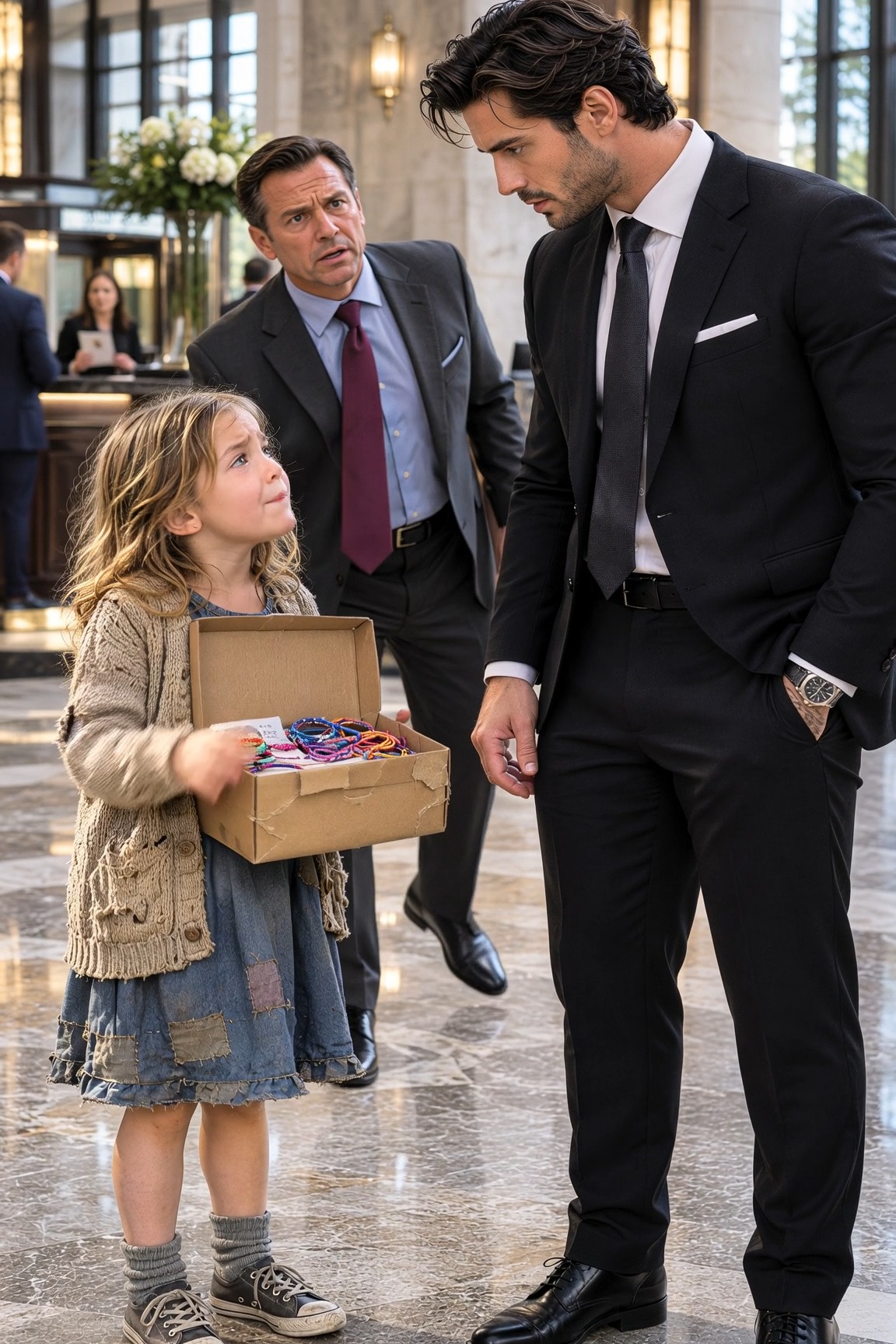
A seven-year-old girl had walked into a bank with a bending shoebox and a handful of bracelets she hoped would help her brother.
She had asked adults to be fair, to keep their promises, and to listen.
When she reached home, I went to my desk and took the blue-and-yellow bracelet from its small case.
I did not put it away again.
The thread had begun to fray near the knot, but the colors were still bright.
I wore it to the next board meeting, and the meeting after that.
Whenever someone called a family a case, or a concern a discrepancy, I looked at the bracelet and remembered how easily a person could disappear when a story was written without listening to them.
Chloe’s shoebox had opened without anyone planning it.
What came out had taken years to understand.
What followed was not a perfect company, or a perfect apology, or a promise that no one would ever fail again.
It was a decision to keep asking questions, to repair what could be repaired, and to let the people most affected have a say in what happened next.
That was not everything.
But it was a beginning worth keeping.
**–THE END–PLEASE
Share your thoughts or feedback to motivate us to create more stories ♥️
* * *
[PREVIOUS: PART 5](https://storyly.idolsgift.com/blog/part-5-the-name-on-the-folded-paper-056)
✓ Lynn R. Adams
Part 6 – The Bracelet That Stayed The employee drew a breath. Then he said a name I had never expected to hear. “Martin Vale,” he said. “He was the former CFO’s assistant.” I knew the name, though…