PART 6 (THE END): The Name on the Envelope 008
Part 6 – The Picture That Held Us
The sentence stayed with me through the night.
She was not the only person in our family who knew your name.
By morning, I had read it so many times that the ink seemed to settle into the grain of the paper.
I wanted to call Miriam and ask what it meant.
I wanted to call Carmen and demand whether she knew.
Most of all, I wanted to open every door that had been closed around Renee’s story.
Then I heard Sofia’s words again.
Choose her.
So I put the note back in its envelope and waited until Renee was awake.
She was sitting at the kitchen table, drawing a row of snow-covered houses, when I joined her.
The sealed page remained safe with the neutral custodian, untouched.
Sofia’s message to me sat between us, its final sentence folded out of sight.
“Did you get another letter?” Renee asked.
I looked at her carefully.
“Yes,” I said. “Your birth mother left me a short note.”
“Does it say something about me?”
“It says she wanted me to put your choices first.”
Renee considered that, then set down her pencil.
“Did she know you?”
“She knew my name.”
“Was she going to tell you something?”
“She left one question without an answer,” I said. “But I’m not going to chase it in a way that takes your privacy away.”
Renee nodded slowly.
“Maybe she wanted you to know she remembered you.”
“Maybe.”
“Can I see the note when I’m older?”
“If you want to, yes. I’ll keep it safe.”
She reached for my hand, and I let her hold it while she studied the houses she had drawn.
The mystery had not vanished.
It had simply stopped being the most important thing in the room.
That week, I called Miriam and told her about Sofia’s note.
She listened, then confirmed that the sealed page addressed to Renee remained protected and that no one could access it without following the instructions Sofia had left.
I asked her to keep both messages together, with a clear record of who could request them and when.
“I’ll make sure they remain secure,” Miriam said. “And I’ll make sure Renee has the choice when she is ready.”
“Thank you.”
After I hung up, I placed my copy of the adoption confirmation in Renee’s room, on the shelf beneath her picture books.
I did not hide it away, and I did not leave it where it might feel like an announcement.
It was simply there, ready whenever she had a question.
The next few days brought no grand reconciliation.
Carmen called once, asking whether Renee might want to speak with her.
I asked Renee, and she said not that day.
I told Carmen, and she answered, “I understand.”
She did not ask me to persuade her.
A few days later, Renee said she wanted to see her grandmother again, but only for a short visit.
Carmen came to the hotel sitting room, where Renee had chosen the place herself.
She brought no present and made no request for a hug.
Instead, she asked Renee whether she would like to show her the new drawing she had made.
Renee handed it to her.
Carmen studied the picture carefully.
There were four figures beneath a tree: Renee, me, and her cousins, with a small figure beside them that Renee had drawn as a snowman.
“Is this me?” Carmen asked, pointing to the snowman.
Renee shook her head.
“That’s a snowman.”
Carmen smiled, then stopped herself from filling the moment with too much.
“I see,” she said. “Thank you for showing me.”
Renee chose a biscuit, and Carmen waited while she ate.
They spoke about the koi fish and the names Renee had invented for them.
When Renee said she was ready to go, Carmen thanked her for the visit and let her leave without asking when they could meet again.
That mattered more than any promise.
Paula kept her word, too.
She called before arranging another visit, and she spoke with her daughters about the difference between being sorry and showing change.
Sophie and Emma began asking Renee what games she wanted to play instead of deciding for her.
They did not offer gifts as a substitute for kindness, though Sophie sometimes brought a drawing she had made and let Renee choose whether to keep it.
The girls were awkward at first, as children often are when they realize they have hurt someone without understanding how deeply.
But awkwardness gave way to ordinary conversation.
Renee told them about her stories, and Sophie taught her a dance step that ended with all three of them laughing.
Emma discovered that Renee liked making paper snowflakes and began folding them beside her at the kitchen table.
Paula watched closely, but she did not urge the girls to become close.
She let trust grow at its own pace.
One afternoon, she sat across from me while the cousins worked on a puzzle.
“I should have stood up for Renee sooner,” she said.
“Yes,” I replied.
She did not look away.
“I can’t change that, but I can keep showing up differently.”
“That’s what matters now.”
She nodded, accepting that I was not offering instant forgiveness.
I had learned that repair was not a single apology or a warm afternoon.
It was a pattern of choices made after the room had gone quiet.
The days moved toward the end of the holiday season, and the old house began to look less like a place where everyone had to perform a role.
Carmen no longer corrected Renee’s manners more sharply than the other girls’.
My father stopped making comments about bloodlines and names.
He had not yet learned how to speak easily to Renee, but he asked whether she wanted to show him her drawings, and he listened to her answers without turning them into lessons.
It was a small beginning, and I made sure nobody mistook it for the whole journey.
Renee did not owe anyone closeness simply because they had begun to behave better.
One evening, Carmen called to ask whether the family could gather for a second Christmas celebration.
“Only if Renee wants to,” I told her.
“I understand.”
I asked Renee the next morning.
She thought for a while, then asked whether Sophie and Emma would be there.
“They would.”
“Would there be presents?”
“There could be.”
“Would I have to wash dishes?”
“No.”
“Would Grandma be nice?”
“She will be expected to be kind,” I said. “And you can leave whenever you want.”
Renee looked down at the red pencil in her hand.
“Could I help choose the food?”
“Of course.”
“Then maybe.”
I called Carmen back and told her Renee might come if she could help plan the celebration and decide when it was over.
Carmen agreed without hesitation.
Renee chose a simple dinner, with roast chicken, potatoes, and the honey-glazed carrots she liked.
She asked for a small cake with strawberries rather than a large decorated one.
For dessert, Sophie and Emma offered to help her choose a recipe.
The three girls decided on cinnamon cookies, then argued amiably about whether the dough needed more flour.
When the day came, the family gathered at my parents’ house in the late afternoon.
Renee entered with me, her hand tucked into mine.
Carmen greeted her at the door and waited.
“Hello, Renee,” she said.
“Hello, Grandma.”
The word was Renee’s choice, and Carmen received it gently, without making it larger than it was.
The house smelled of warm bread and cinnamon.
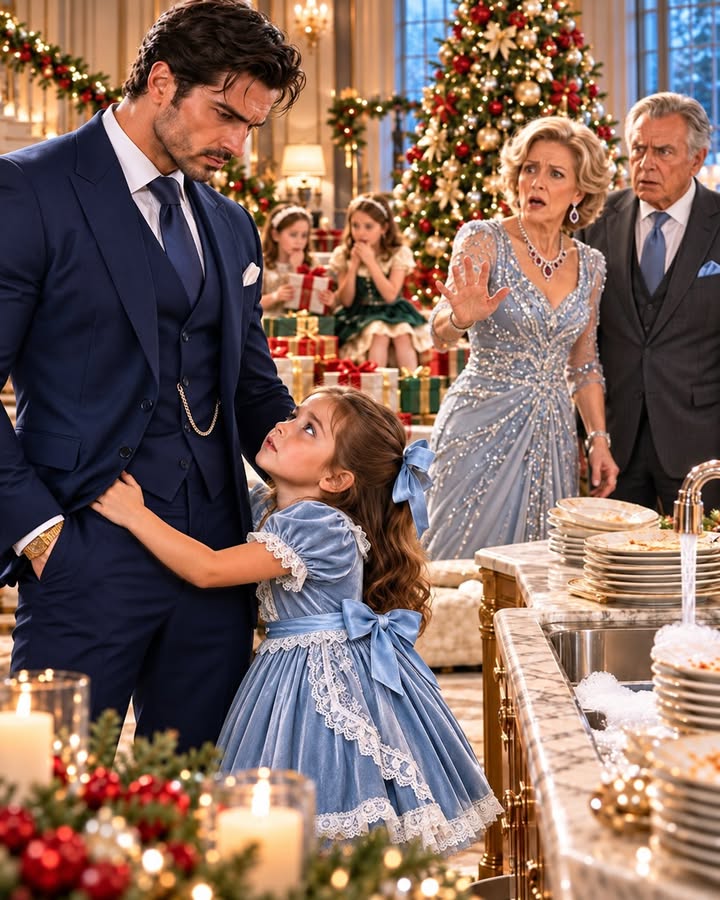
The Christmas tree still stood in the corner, its lights soft against the winter dusk.
Beside it were three small stacks of presents, each with a child’s name written clearly on the tag.
Renee looked at them, then at me.
“Those are all for us?”
“All of them are for the girls,” I said.
She examined the tags.
Sophie.
Emma.
Renee.
The letters of her name were neat and unmistakable.
She took off her coat and hung it on the hook beside the others.
No one asked her to help in the kitchen.
When the meal was ready, she sat beside her cousins, with Carmen across the table and Paula near them.
My father passed her the basket of rolls and asked whether she wanted one.
She chose two.
After dinner, Renee and the girls opened their presents together.
Sophie received a set of paints, Emma a book of animal stories, and Renee a box of colored pencils with a wide range of shades.
Renee looked at the box, then at the two drawings she had already tucked into her coat pocket.
“You remembered,” I said.
“I asked for them,” she replied.
Sophie leaned close to see the colors.
“Can we draw together?”
Renee considered the question.
“Yes.”
They carried the pencils to the living room and spread paper across the rug.
Carmen remained by the tree, watching without trying to join unless she was invited.
After a while, Renee brought her a page.
It showed three girls beneath a winter tree, with a small snowman in the corner and a bright red door behind them.
“This is for you,” she said.
Carmen accepted it with both hands.
“Thank you.”
“You can keep it if you want.”
“I would like that very much.”
Carmen did not ask what the picture meant.
She did not ask whether she had been drawn in the right place.
She simply carried it to the side table and set it where she could see it.
Paula’s eyes grew bright, but she stayed quiet, letting the moment belong to Renee.
When it was time for cake, Renee chose the first piece.
She gave a strawberry to Sophie, then one to Emma, then kept one for herself.
The old kitchen remained busy, but no child stood alone at the sink.
After the meal, the adults cleared the plates together.
Carmen washed, Paula dried, and I carried dishes to the counter.
Renee and her cousins stayed in the living room, drawing and laughing beneath the tree.
No one told Renee that she had to earn a place by being useful.
No one made the work a test of whether she belonged.
Later, when the evening had grown quiet, Renee sat beside me on the sofa and leaned her head against my arm.
“Was this a good Christmas?” I asked.
She watched the lights on the tree.
“It was better.”
“Better is something.”
“It was the best one here.”
I kissed the top of her head.
Across the room, Carmen heard her and looked down at the picture Renee had given her.
She did not turn the child’s praise into an excuse for herself.
She only folded the picture carefully and slipped it into the front of her handbag.
On the drive home, Renee fell asleep before we reached the end of the block.
Her hand rested open in her lap, and the silver star bracelet Sophie had given her shone faintly beneath the passing streetlights.
I thought about Sofia’s note, about the sealed page waiting for the day Renee chose to read it, and about the unanswered line that said someone else in our family had known my name.
I still wondered what Sofia had meant.
But the question had lost its power to pull me away from the child asleep beside me.
One day, Renee might ask for the rest of the story.
When that day came, I would help her find it without turning her life into evidence or her history into a family possession.
Until then, she was allowed to be six.
She was allowed to draw crooked houses, ask for cinnamon rolls, and change her mind about whom she wanted to see.
She was allowed to belong without proving anything.
The next morning, she brought me a new picture while I was making breakfast.
It showed our family gathered beneath a tree, with a broad circle of colored lights around us.
Carmen and my father stood beside Paula.
Sophie and Emma were near Renee.
I was drawn with one arm around my daughter’s shoulders.
And Renee had placed herself right in the middle.
At the bottom of the page, in careful letters, she had written: “my family.”
I looked at the words and felt something inside me finally unclench.
Renee leaned against my side while I held the drawing.
“Do you like it?” she asked.
“I love it.”
“Everyone’s in the right place now,” she said.
I looked at the picture again, at the bright tree and the crowded circle, at the small figure who no longer stood apart.
“Yes,” I said. “They are.”
And for the first time, the answer felt like something we had made true together.
**–THE END–PLEASE
Share your thoughts or feedback to motivate us to create more stories ♥️
* * *
[PREVIOUS: PART 5](https://puretales.idolsgift.com/blog/part-5-the-name-on-the-envelope-008)
✓ Lynn R. Adams
Part 6 – The Picture That Held Us The sentence stayed with me through the night. She was not the only person in our family who knew your name. By morning, I had read it so many times that the ink s…