PART 6 (THE END): The Name on the Bracelet 052
Part 6 – A Life Beyond Fear
The signature at the bottom of the scanned page was unmistakable.
Daniel.
For a moment, the shelter room seemed to tilt around me.
Lily slept in her crib, one small fist tucked beside her cheek, while the old paper glowed on my phone screen with the cold clarity of something no longer hidden.
I read the sentence again, hoping the words would rearrange themselves into something less difficult.
Please do not give this letter to Nicholas until he is ready to know who told the family where to find him.
The signature beneath it belonged to my husband.
I called Nicholas.
He answered at once.
“Have you seen the scan?” I asked.
“Yes.”
“Do you know what it means?”
“No,” he said. “Not yet.”
His voice was steady, but I could hear how carefully he was holding it there.
“Daniel was a child when Elena died,” I said. “He couldn’t have told your family anything then.”
“He could have found out later.”
“Or someone could have written his name by mistake.”
“Either is possible.”
I was grateful he didn’t turn a single signature into a verdict.
“I’ve sent it to Helen,” he continued. “She’s asked the hospital to preserve the original and verify when that note was added.”
“What do you want to do?”
“I want to know the truth. But I don’t want to make you feel responsible for what Daniel may have done.”
“I don’t feel responsible for his choices.”
“I know.”
That answer steadied me more than any promise could have.
A week passed before the hospital released the file to Helen’s team.
The review board papers were incomplete, but they included my mother’s original letter to Nicholas, a record of her request to seal it, and a short statement from a hospital administrator.
The statement said Daniel’s father, who had been a junior employee of the family’s shipping company at the time, had asked questions about Elena’s son years after her death.
He had wanted to know whether the boy’s identity could be kept out of public records.
My mother had believed the request came from concern, not malice.
She had been told Daniel’s father intended to protect the child from unwanted attention connected to the family.
The note about Daniel had been added years later, when he was old enough to help manage the family’s records.
He had learned that the letter existed and had asked that it remain sealed until Nicholas was ready to know.
It was not proof that Daniel had exposed Nicholas to danger.
It was proof that he had known about Elena’s letter and had chosen to keep it from him.
I read the summary twice before I called Nicholas.
“Your father wanted privacy,” I said. “Daniel knew the letter existed, but there’s no record that he told anyone where you were.”
“So the note is a warning about what he knew, not proof that he betrayed me.”
“That’s how Helen understands it.”
Nicholas was silent.
I imagined him standing in one of the hotel’s quiet offices, the report in his hands, facing not a villain but a family history full of fear, good intentions, and decisions made without asking him what he wanted.
“My father may have thought he was protecting me,” he said at last.
“Yes.”
“And Daniel may have believed keeping the letter sealed was the right thing.”
“Maybe.”
“But he knew it mattered.”
“Yes.”
The truth did not excuse Daniel’s choice.
It did make the choice less simple than the sentence on the page had seemed.
Nicholas exhaled slowly.
“I spent years thinking there was one secret that explained everything,” he said. “There isn’t.”
“No,” I replied. “There usually isn’t.”
He gave a quiet, humorless laugh.
“I’m learning that.”
Helen’s review also confirmed the part my mother had feared most.
St. Catherine’s private clinic had delayed Elena’s treatment after she developed a rare complication.
The records did not show that any one person had intended to harm her.
They showed that concerns had been dismissed, that the transfer had been postponed, and that the clinic’s account of the timeline did not match the nurses’ notes.
Elena had survived the birth and held her son.
She had gone home believing she would recover.
When her condition worsened, the clinic had waited too long to act.
By the time she received the care she needed, it was too late.
My mother’s written timeline had been accurate.
The independent review did not bring Elena back, and it could not erase the years Nicholas had spent without knowing her story.
But it confirmed that my mother had not imagined what she saw.
Helen advised that the findings be submitted to the state oversight office and the hospital’s board, with a request for a full accounting and appropriate changes to the clinic’s practices.
Nicholas agreed.
He also agreed not to make private deals that would bury the records.
His advisers objected.
Some believed public scrutiny would damage his reputation and expose old family arrangements.
Others urged him to resolve the matter quietly, away from lawyers and official hearings.
Nicholas listened to them, then asked Helen to proceed through lawful channels.
It was a choice made without spectacle.
No one was threatened.
No one was paid for silence.
The papers were submitted, and the clinic’s remaining patient records were secured for review.
The hospital agreed to an outside investigation and invited former staff to provide statements.
I gave mine about the letter and the papers my mother had preserved.
I did not claim to know more than I did.
I did not allow anyone to make my mother’s account sound like certainty where it was not.
That mattered to me.
For years, I had believed strength meant never needing help.
Now I understood that it could also mean accepting help without handing over the right to decide what happened next.
The custody hearing came several weeks later.
Daniel’s lawyers questioned me about the hotel, Nicholas, and the shelter.
They asked whether I had relied on Nicholas financially, whether he had influenced my decisions, and whether I believed his presence would give me an advantage.
I answered plainly.
Nicholas had offered me one night in a warm, secure room when I had nowhere to take my newborn daughter.
He had told me I could leave.
I had gone to the shelter the next day, chosen my own lawyer, and made my own decisions about Lily.
I said that his help had mattered, but it had not replaced my judgment.
The court reviewed the records of Daniel’s proposed custody arrangement and the financial documents Ms. Patel had gathered.
Those records showed that money from an account in my name had been transferred into the company that purchased our apartment.
Daniel had authorized the transfer without my knowledge.
Further accounting also revealed that he had concealed other shared assets during the marriage.
His lawyers argued that he had intended to protect the funds for the family.
Ms. Patel asked why a family asset had been hidden from the person whose money had helped purchase it.
Daniel had no answer that satisfied the court.
The judge ordered a full financial disclosure and established a temporary custody arrangement that kept Lily with me while allowing Daniel supervised visits, subject to review.
It was not the final decision, but it gave Lily stability and gave me time to continue building a life of my own.
When the hearing ended, Daniel waited near the courthouse doors.
He looked tired, smaller somehow than the man who had once filled our apartment with his certainty.
“I didn’t think they’d make it sound like I was trying to take her from you,” he said.
“You asked me to place her with your parents.”
“I thought it would be easier.”
“For whom?”
He looked down.
“I was scared about what people would say. My family expected a son.”
“And you let their expectations matter more than your daughter.”
“I know I was wrong.”
The words were not an apology polished for court.
They sounded like something he had finally allowed himself to see.
“I’m sorry I hurt you,” he said. “I’m sorry I left you that night.”
I watched him carefully.
Part of me remembered the man I had loved before the marriage had narrowed around his wishes.
Another part remembered snow soaking through my sweater, and his daughter sleeping against my chest while I promised her I would find a way.
“I hear you,” I said. “But I need you to understand that forgiveness won’t mean returning to the marriage.”
“I understand.”
“Any relationship you build with Lily has to be about her. Not about an heir, not about your family, and not about making me change my mind.”
He nodded.
“I want to learn how to be her father.”
“Then start by showing up consistently.”
“I will.”
It was not a reunion.
It was not a promise that trust would return.
It was simply the first honest conversation we had shared since Lily was born, and I left it with my boundaries intact.
Over the months that followed, Daniel complied with the court’s arrangement.
He attended the supervised visits.
At first, he seemed uncertain what to do with Lily, who was still too small to understand the weight of the adults around her.
He learned to hold her gently.
He learned when to ask before picking her up.
He learned that she did not owe him a smile because he was her father.
I watched those visits from across the room, neither encouraging nor obstructing them.
My own life began to change in smaller, steadier ways.
The shelter helped me find a modest apartment in Queens, close to a bus line and a neighborhood clinic.
Ms. Patel helped me secure a temporary support order while the financial case continued.
I found part-time work doing accounts for a family-owned import business that needed help organizing its invoices.
The hours were flexible enough that I could keep Lily with a trusted caregiver three mornings a week.
The first paycheck I received felt more precious than the money itself.
It was proof that I could begin again without pretending I had never been hurt.
Nicholas did not offer me a job.
He did not offer to pay my rent.
He did not ask when I would be ready to leave the shelter or when I would let him see Lily.
He sent a message every few days, usually to ask how the latest step had gone or whether I had found the documents the lawyer needed.
When I did not reply immediately, he waited.
When I said I wanted space, he respected it.
That was how something between us began to change.
Not through grand gestures, but through the absence of demands.
One afternoon, several months after the hearing, I met him for coffee in the hotel lobby.
Lily slept in her stroller beside me.
Nicholas looked different without the strain he had carried since learning about Elena, though grief had not vanished from his face.
He had visited the cemetery where she was buried.
He had brought a copy of my mother’s letter and read Elena’s note alone before leaving it with the family’s papers.
“I thought I’d feel more certain afterward,” he told me.
“Did you?”
“No. But I felt less alone with the truth.”
He wrapped both hands around his coffee cup.
“I used to think I had to be the person everyone feared so they would never see the person I was.”
“Did it work?”
“Sometimes.”
“And now?”
“Now I’m not sure fear is the same as safety.”
I thought of my own old certainty that independence meant refusing every offered hand.
“It isn’t,” I said. “But safety can’t be something someone else controls for you.”
“No,” he said. “It can’t.”
He looked toward Lily’s stroller.
“May I hold her?”
I considered the question, and the reason I trusted it was not that I believed Nicholas could never make a mistake.
I trusted it because he had asked.
“Yes,” I said. “If she wakes, give her back.”
“I will.”
He lifted Lily carefully, supporting her head with both hands.
She opened her eyes, studied his face without interest, and then settled against his shoulder.
Nicholas’s expression softened.
For the first time, I saw no shadow of Elena in the way he looked at my daughter.
Only tenderness.
“I think she’s decided you’re acceptable,” I said.
“I’m honored.”
She yawned against his collar.
He glanced up at me.
“I’d like to see you again,” he said. “Not because you need somewhere to stay. Not because I think I can solve anything for you. Just because I want to.”
I felt the old instinct to search his words for a hidden bargain.
It was there, but quieter now, no longer in charge.
“I’d like that too,” I said.
Nothing changed all at once.
We had dinner a few weeks later, with Rosa joining us for the first half because she had promised to show me a recipe and would not be denied the chance.
Nicholas walked me to the door afterward, then waited while I called my own taxi.
He never asked me to move back into his hotel.
I never asked him to become the answer to every fear I had.
We met again when I wanted to.
We learned each other slowly, through honest conversations and ordinary days.
The review of St. Catherine’s took nearly a year.
The outside investigators confirmed that the clinic had delayed treatment and failed to document several critical decisions.
They required changes to the clinic’s oversight and reporting procedures.
The findings led to a new review of other cases from the same period, and the hospital’s board committed to preserving records rather than treating old mistakes as matters best forgotten.
Nicholas cooperated with the process, even when reporters began asking questions about his family.
He did not threaten anyone into silence.
He did not try to control what I said.
He let the truth be complicated, and he allowed the consequences to reach him.
Daniel’s financial case concluded the following spring.
The court ordered a division of the assets he had concealed, including money connected to the apartment.
I was able to secure a small, clean place of my own and establish a savings account in Lily’s name that no one else could control.
The divorce became final not long after.
Daniel continued his visits with Lily, slowly learning that fatherhood was made of patience, diapers, late afternoons, and showing up when he had said he would.
I did not forgive him in one sweeping moment.
I forgave pieces of what had happened as I became ready, without confusing forgiveness with reunion.
Nicholas and I spoke about Elena often, but never as though our connection belonged to fate.
It belonged to the choices our mothers had made.
My mother had stayed beside a frightened young woman during labor.
Elena had trusted that nurse with the truth of her love.
Rosa had remembered a name.
Nicholas had offered warmth without demanding gratitude.
I had accepted one night of shelter, then chosen my own way forward.
Each act had mattered because it had left room for the next person to choose.
A year and a half after the night on the sidewalk, the Elena Maro Maternal Care Foundation opened in a renovated building near St. Catherine’s.
The foundation funded postpartum nursing visits, emergency transportation, and legal support for parents facing sudden housing or financial instability.
Its first programs were modest, built with the advice of nurses, doctors, and families who knew what help was needed in practice.
Nicholas had asked me to review the foundation’s family-support plan before it was announced.
I agreed because I wanted the work to serve people, not become a monument to grief.
At the opening, I stood near the entrance with Lily’s hand in mine.
She had learned to walk, and she treated every polished floor as an invitation to explore.
Rosa stood beside me, radiant with pride.
Nicholas was speaking with a group of nurses near the front of the room.
When he saw us, he finished the conversation and came over.
“Are you ready?” he asked me.
“I think so.”
He crouched to Lily’s height.
“Would you like to come with me for a moment?”
She reached for him without hesitation.
I watched him lift her, one arm secure beneath her, his other hand supporting her back.
She rested her cheek against his shoulder as though that was where she had meant to be all along.
The room quieted as the doors opened to the courtyard.
A small plaque beside the entrance carried Elena’s name and a line from her letter:
Please make sure my boy knows he was loved.
Below it, another inscription honored Patricia Sullivan and the nurses who had stayed when patients were afraid.
I had not known that my mother’s name would be included until Nicholas asked my permission.
I had said yes.
Not because grief needed to be made public, but because her work deserved to be remembered.
A nurse from the maternity unit stepped forward to speak about the foundation’s first year.
She described families who had come through its doors carrying too much fear and too few options.
She spoke about warm beds, safe rides home, and nurses who returned after discharge to check on mothers and babies.
I listened with Lily’s small hand curled around my finger.
Nicholas stood beside me, no longer looking like a man trying to hold the past at a distance.
He looked like a man who had decided to let love be part of his life without claiming it as his possession.
When the speeches ended, people gathered in the courtyard.
Rosa found a table with pastries.
Lily reached eagerly for a piece of fruit, then offered half of it to Nicholas.
He accepted it with the seriousness of a gift.
I laughed.
“You’ve been chosen.”
“I’ll try to live up to it.”
The late afternoon sun touched the building’s old brickwork and softened its edges.
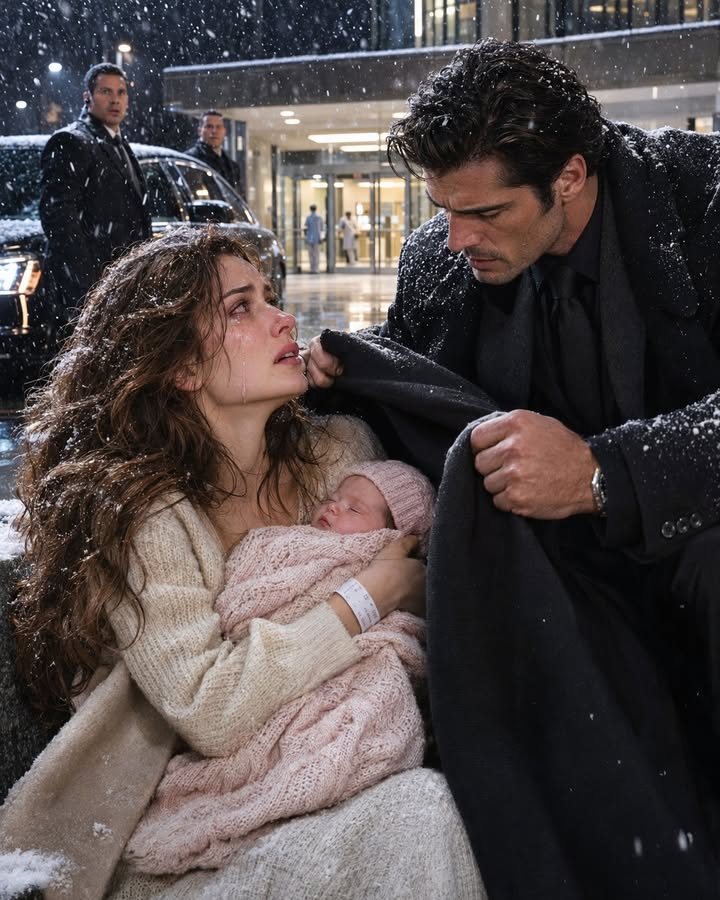
For a moment, I remembered the snow outside St. Catherine’s, my exhausted arms wrapped around a baby I feared I could not protect.
I remembered Nicholas holding out his coat and waiting for me to decide whether to take it.
The memory still hurt, but it no longer held me there.
I had not been rescued from my life.
I had been given a warm place to think, then a choice to leave.
After that, I had made a hundred more choices of my own.
Nicholas stood close enough that our shoulders touched.
He did not take my hand until I offered it.
When I did, his fingers closed gently around mine.
Lily laughed between us, bright and unguarded, while the foundation doors remained open behind us.
For the first time, I understood that family was not a debt, a name, or a promise made on someone else’s behalf.
It was the people who stayed, the people who learned, and the people who let one another choose where to belong.
**–THE END–PLEASE
Share your thoughts or feedback to motivate us to create more stories ♥️
* * *
[PREVIOUS: PART 5](https://storyly.idolsgift.com/blog/part-5-the-name-on-the-bracelet-052)
✓ Lynn R. Adams
Part 6 – A Life Beyond Fear The signature at the bottom of the scanned page was unmistakable. Daniel. For a moment, the shelter room seemed to tilt around me. Lily slept in her crib, one small fis…