PART 6 (THE END): The Name Inside the Train 046
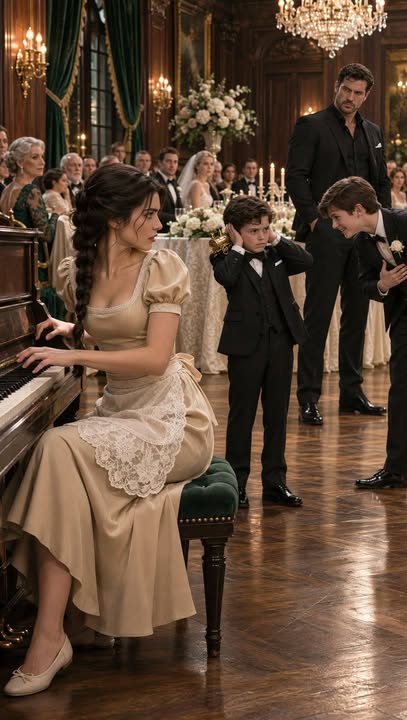
Part 6 – The Room We Choose
“Sofia wrote that Mia wasn’t the only child she hoped to find.”
For a moment, I could only stare at the sentence on Dante’s phone.
The letters were small and steady, like Sofia had known someone might need to read them years later.
“What does she mean?” Mia asked.
Dante lowered the phone.
“I don’t know yet.”
I looked from him to the open doorway, where the hallway was bright with morning light.
“Is there another name?”
“There’s a line beneath it, but the scan cuts off.”
He enlarged the image, then tried turning the phone.
The words blurred at the edge of the screen.
“I can ask the clinic to send the original file,” he said.
“Please.”
Mia shifted against her pillows.
“Could it be someone from the program?”
“That’s what I’m thinking,” Dante said. “Sofia may have been trying to find more than one family.”
I felt the old music room come back in pieces: the painted stars, the crooked piano, the children scattered among folding chairs.
“I remember another little girl by the door,” I said. “The one I thought I gave the train to.”
Mia’s eyes rested on mine.
“You thought I was someone else.”
“I was nine. I saw you were scared, but I didn’t understand how much.”
“You gave me something to hold.”
“I didn’t even know it was you.”
“You knew it was someone who needed it.”
The tenderness in her words eased something I had carried without knowing its weight.
Dante sat down in the chair beside her bed.
“Sofia wrote that she hoped to find the other child too,” he said. “Perhaps she meant the child she’d seen with the train.”
“But she wrote Mia’s name,” I said. “Who else was there?”
“I don’t know.”
The doctor came a little later, and we spoke about the treatment opening again.
Mia asked her questions, then asked a few more.
I asked about the parts she had not thought to ask, and the doctor answered without rushing us toward a decision.
The risks remained real.
So did the possibility of improvement.
When he finished, he left the packet on the table and gave us the rest of the morning.
Mia looked through the pages while I sat beside her.
Dante waited by the window.
No one tried to make the choice for her.
At last, Mia set the packet down.
“I want to go ahead with the assessment,” she said.
I took her hand.
“All right.”
“Not because Sofia helped before,” she added. “Not because we owe her.”
“No.”
“Because I want to know if this could help me.”
“That’s the right reason.”
She looked at Dante.
“And because I’m choosing it.”
“Yes,” he said. “You are.”
We reviewed the financial terms together.
Dante arranged for the money to go directly to the clinic, and the paperwork made clear that the support was a gift, not a loan and not tied to work, meetings, or future favors.
I read every page twice.
Then I made a copy for myself.
Dante watched without impatience.
When I handed the signed forms back, I did not feel that I had surrendered anything.
I felt that I had chosen to open a door with my eyes wide open.
The assessment took several weeks.
There were appointments, additional tests, and long hours in waiting rooms where Mia and I learned which chairs were least uncomfortable.
Dante never asked us to report back to him.
He checked in once, by text, and made it clear that we could answer whenever we wished.
When Mia asked for help getting to one of the appointments, he offered a car and a driver, then waited while she considered.
She accepted the ride.
She did not accept the driver’s offer to carry her bag.
“I can carry my own things,” she said.
“Of course,” he answered.
The treatment began slowly.
There were good days and difficult days, and some that seemed to contain both.
At first, improvement showed itself in small measures: a little more energy, fewer mornings lost to exhaustion, the return of Mia’s appetite for the books she had set aside.
We did not call those things a cure.
We called them reasons to keep going.
Dante never called them proof of anything.
He brought the train to the hospital once, after Leo asked if Mia could see it.
The brass had been polished, but the scratch across the roof remained.
Leo held it carefully in both hands.
He had grown more comfortable with us since the wedding, though loud rooms still asked too much of him.
He had begun visiting with his father, sometimes staying ten minutes and sometimes staying longer.
“Is it still your train?” he asked me.
“It was mine when I was little.”
“Then Mia had it?”
“I gave it to her at the music program.”
He turned to Mia.
“Did you keep it?”
“Not that I remember.”
“Maybe you did for a while,” I said. “Then Sofia kept it safe.”
Leo looked down at the little compartment.
“Can we open it?”
I glanced at Dante.
He gave a small nod.
Leo opened the latch himself and looked inside.
The old paper strip still rested there, its ink faded but legible.
Mia.
He read the name silently.
Then he closed the compartment.
“I like that it has a place for a message,” he said.
“So do I,” Mia replied.
He returned the train to Dante, who handed it back to him without trying to take the conversation further.
That was how trust grew between them: not in grand declarations, but in pauses that were allowed to remain pauses.
After the first stage of treatment, Mia had a stretch of steadier days.
Her doctor was careful not to promise what came next, but the results were encouraging enough for us to continue.
Mia’s humor returned before her strength did.
She began inventing increasingly elaborate voices for the sock puppet, giving it opinions about hospital food and the terrible state of its eyebrows.
I laughed more often.
I noticed the change in myself one morning when I caught my reflection in a dark window.
For a long time, I had looked like someone bracing for the next call, the next bill, the next thing that needed doing.
Now, even when I was tired, there were moments when I forgot to brace.
Dante kept his promises about boundaries.
The medical support remained between the clinic and the fund.
He did not ask us to spend holidays with him or imply that his help entitled him to closeness.
When he invited me to return to school, he did it once, in a letter that said I could keep it, discard it, or answer years later.
I placed it in the box with my old program.
I was not ready to say yes.
I was no longer sure I would always say no.
Near the end of winter, Leo started asking for music.
At first, he wanted only the same short melody I had hummed in the quiet room at the wedding.
He would sit near the open doorway while I played it on a keyboard at the hotel, one hand curled around the brass train.
If the notes grew too loud, he covered his ears.
If he needed me to stop, he raised one finger.
I stopped.
If he wanted the door open wider, he pointed.
I opened it.
Dante sat nearby, learning not to translate every gesture into words.
One afternoon, Leo stayed through an entire song.
When I finished, he touched the train’s wheels and said, “Again.”
I played it again.
Afterward, Dante asked me whether I would consider helping Leo with music regularly.
“I can do that if he wants it,” I said. “But I don’t want to decide for him.”
Dante turned to his son.
“Would you like Clara to come back next week?”
Leo looked toward the doorway.
“It can stay open,” he said.
“We’ll leave it open,” Dante replied.
Leo looked at me.
“Yes.”
So we began with short sessions, always following his signals.
Some days he played two notes and left.
Some days he stayed long enough to match my rhythm.
The room was never made into a test he had to pass.
By spring, the specialist team told us that Mia’s treatment was working, though recovery would remain gradual and we would need to keep monitoring her health.
The words did not erase the hard days behind us.
They gave us a future to imagine beyond them.
Mia was able to come home more often.
She still had appointments and limits, but she could walk farther without stopping, and she began making plans again.
The first plan she made was to attend my recital.
I had returned to the piano in the evenings, starting with ten minutes at a time.
I played the old waltz I had stopped at the wedding, the one that had ended halfway through a bar when I saw Leo at the blocked door.
At first, my fingers stumbled over the place where I had left it.
I could hear the missing notes.
I could also hear the room we had entered afterward: the rain at the window, Leo’s careful taps, the quiet breathing between one phrase and the next.
I started again.
This time, I let the waltz continue.
The music school accepted me into a flexible program that allowed me to study at a pace I could manage.
I chose courses that brought me closer to music therapy again, without pretending I could return to my old life exactly as it had been.
I made a schedule around Mia’s care.
I kept the right to change it when she needed me.
When I told Dante, he listened without congratulating himself.
“That sounds like your decision,” he said.
“It is.”
“I’m glad.”
His support did not become a job, a debt, or a promise that I would always be available to his family.
It remained what I had asked it to be: a gift with clear edges.
Dante and I began speaking about Sofia more often.
Not as though she were a mystery to solve, but as someone whose choices still had meaning in the lives she had touched.
He told us she had loved repairing clothes for people who never asked her to.
She had kept scraps of fabric from old projects because she believed they might be useful someday.
She had also been the kind of person who remembered the name of a child she had met only once.
The missing line in the scanned record arrived from the clinic archive a few weeks later.
Dante forwarded it to me without adding a guess of his own.
Sofia had written: The second child is named Clara; I hope one day she knows her kindness reached her sister, and that the family found help when they needed it.
I read the sentence at the kitchen table, the same place where I had first spread out the old program.
For years, I had believed my life had separated into two stories.
In one, I was the girl who had lost a brass train during a difficult move.
In the other, I was the woman who had put her studies aside to care for Mia.
Sofia’s sentence joined them.
The train had not simply returned.
It had brought back the memory of a kindness I had offered before I understood how much either of us needed it.
I called my mother and read the line aloud.
She was quiet for a while.
Then she said, “I remember the woman who called.”
“You do?”
“I remember her asking whether Mia had been seen. I was frightened about the bills, and I thought someone from the clinic had found a way to make the appointment possible.”
“Did you know it was Sofia?”
“No. I don’t think I ever did.”
“Why didn’t you tell me you remembered the call?”
“I didn’t connect it to the program. I barely connected it to anything. I was tired, and we were moving, and I thought I had understood what happened.”
I could hear the regret in her voice.
“You don’t have to apologize for not recognizing the whole story.”
“I wish I had thanked her.”
“Maybe we can thank her now.”
“How?”
I looked toward the box of school papers, where Sofia’s letter rested with the program and the photograph.
“By letting what she did continue.”
Dante and I talked about the fund over several months.
We were careful not to make it larger than we could manage, or grander than Sofia would have wanted.
We established the Sofia Moretti Music-and-Care Fund through the community center, supporting music sessions and practical care for children whose families needed both.
The first contribution was modest.
The first family to benefit did not know the name Sofia.
That felt right.
At the center, the painted stars were still on one wall, though the piano had been replaced.
The director had found an old photograph from the same program, taken on another day.
Sofia stood near the piano, her patterned scarf loose at her shoulders.
A little girl sat beside her with a brass train in her lap.
The girl’s face was turned toward the wall, so no one could see it clearly.
The train was unmistakable.
Mia looked at the picture for a long time.
“I still don’t remember her,” she said.
“You don’t have to,” I replied.
“But I’m glad she was there.”
“So am I.”
By the time my recital came around, Mia had recovered enough to sit in the front row.
She wore a soft blue sweater and kept a bottle of water beneath her chair.
My mother sat beside her.
Dante came with Leo.
The room was small, the chairs close together, and the lights gentler than those at the wedding.
Leo entered holding the brass train.
He stopped just inside the doorway and looked at the people gathered there.
I was at the piano, waiting.
No one asked him to smile.
No one told him the room was safe before he had decided whether it felt that way.
He looked at the open door.
Then he looked at Dante.
“It can stay open,” Dante said.
Leo glanced toward me.
“Your choice,” I told him.
He held the train against his chest and stepped inside.
He did not go to the front.
He chose a chair near the aisle, with the door visible over one shoulder.
Dante sat beside him, leaving enough space for Leo to move if he wanted.
Mia raised a hand in greeting.
Leo gave her the smallest wave.
I rested my fingers on the keys.
Before the recital, I had asked Mia whether she wanted to hold the train.
She had looked at it, then at Leo.
“Only if he wants me to,” she said.
When the time came, Leo stood and walked to her.
He held out the train.
Mia accepted it carefully.
Her hands closed around the brass, as if she remembered their shape even when her mind did not.
“Thank you,” she whispered.
Leo nodded.
Then he returned to his chair.
I began the waltz.
The first notes trembled slightly beneath my fingers.
I breathed, found the rhythm, and kept going.
Mia held the train in her lap.
My mother listened with her hands folded over her coat.
Dante sat beside his son, still and attentive.
Leo watched the open doorway for a moment.
Then he turned back toward the piano.
The melody reached the bar where I had stopped at the wedding.
This time I did not lift my foot from the pedal.
I let the music carry on, through the phrase and into the next, until the last notes settled softly in the room.
No one applauded too quickly.
For a breath, we all stayed where we were, listening to the silence that followed.
Then Mia began to clap.
Leo did too, once, then again, his hands meeting in a gentle rhythm.
I looked at him across the room.
“Do you want to stay for another song?” I asked.
He glanced at the open door.
Then he looked back at me.
“Yes,” he said.
And because it was his choice, he stayed.
**–THE END–PLEASE
Share your thoughts or feedback to motivate us to create more stories ♥️
* * *
[PREVIOUS: PART 5](https://echoesofstories.idolsgift.com/blog/part-5-the-name-inside-the-train-046)
✓ Lynn R. Adams
Part 6 – The Room We Choose “Sofia wrote that Mia wasn’t the only child she hoped to find.” For a moment, I could only stare at the sentence on Dante’s phone. The letters were small and steady, lik…