PART 6 (THE END): The Name in the Old File 041
Part 6 – A Step Toward Home
The date on Ruth’s message was the day before Eli’s crash.
For several seconds, I could only stare at the screen.
Then I read it again, slower, as if the words might change if I gave them enough time.
Supplementary family file received from Elena Vale.
Do not circulate without her written release.
Beneath that, the date.
The day before Eli died.
I called Ruth.
She answered on the second ring.
“I found the note,” I said.
“I know. I’ve just seen it myself.”
“Where is the file?”
“In the sealed box I mentioned. I haven’t opened it. The committee’s authorization covers the review, but we need to document the seal before we do anything.”
“Then let’s document it.”
“I’m calling Dr. Shaw now.”
I heard papers shifting at Ruth’s end, and the careful steadiness in her voice reassured me more than a quick promise would have.
“We’ll proceed properly,” she said. “No one will take anything out or separate it from the box.”
“Thank you.”
When we ended the call, I opened the photograph of Eli on my kitchen table.
He was holding the velvet pouch, his eyes turned toward the open ledger.
His hand pointed to the page that had been cut out.
I had spent years believing the last part of Eli’s life was a wet road, an unanswered call, and a story everyone had accepted because there was nothing left to question.
Now there was a sealed box, a letter Elena had written, and a file she had placed in the archive before the crash.
I folded the photograph carefully and put it in my bag.
The foundation’s records room was quiet the next morning.
Ruth had set the sealed box on a padded table beneath a bright work lamp.
Dr. Shaw and an independent auditor stood with her, each holding a copy of the authorization.
Adrian waited near the doorway.
When I entered, he moved aside without blocking the way.
No one said that the box might solve everything.
No one said it would.
That was how I knew we had all learned something from the records.
Ruth photographed the seal from every side and entered the time into the evidence log.
The box was old but intact, its lid held shut with two strips of archival tape.
The note from Elena’s office was attached to the outside.
The auditor examined the tape and checked the box number against the catalog.
“Ready?” Dr. Shaw asked.
Ruth looked at me.
I nodded.
She opened the box.
Inside lay a thin folder, a handwritten letter, and a small velvet pouch with a silver starburst stamped on its clasp.
I felt the room draw closer around me.
The emblem was the same one from the photograph, and the same small burst that had glinted on Adrian’s blazer pin the night we met.
He looked at the pouch, then at the letter.
“I’ve seen this before,” he said quietly.
“Not this one,” Ruth replied. “The event pouch was listed separately. This one came with the file.”
The auditor photographed each item before anything was moved.
Ruth opened the folder.
The first pages were copies of transfer records, safety reports, and handwritten notes.
The numbers showed that funds meant for family programs had been redirected through a series of internal accounts.
Some had eventually been returned.
Others had not.
Several entries had been initialed by Martin Kessler.
The supporting receipts were missing.
The records also showed that safety concerns at three family events had been marked resolved without any confirmation that the repairs were complete.
Elena had written careful notes in the margins, matching dates, names, and figures.
She had not written as if she were looking for a scandal.
She had written as if she were trying to make an ordinary system tell the truth.
On the last page was a short note from Eli.
The ledger is complete through the October event.
I copied the figures because the original pages keep disappearing from the binder.
I returned the pouch to the records desk, but the receipt is still missing.
Elena has the second copy.
I could hear his voice in the neatness of the sentences.
Practical, calm, trusting that if he kept track of the details, someone would eventually be able to understand the whole.
Beneath the note was a list of dates and initials.
One of those dates matched the day the foundation van’s brake concern had been marked resolved.
Another matched the day Elena had asked Adrian’s father for a meeting.
My eyes moved to the final sheet.
It was a repair log from the foundation’s vehicle service company.
The van had been inspected the day before Eli’s crash, but the requested brake work had not been completed.
The mechanic’s note was clear: parts unavailable; vehicle not cleared for use.
A second entry, handwritten later, changed the status to ready.
The initials beside the change were Kessler’s.
I read it twice.
Then a third time.
The accident report had called Eli’s death a loss of control on a wet road.
The vehicle log showed that the van he had been assigned was not cleared for use.
It did not tell us who changed the status or why.
It did not tell us whether the brakes caused the crash.
It did show that the official account had been accepted without examining a fact that should have been examined.
The auditor placed a hand beside the folder, careful not to touch the paper.
“This warrants an immediate referral to the appropriate investigators,” she said. “The records alone don’t establish every detail, but they raise serious questions about the vehicle, the financial records, and the safety reports.”
Adrian looked at the papers.
“Then refer them.”
The auditor nodded.
“Your family may be asked to provide additional documents and statements.”
“I’ll cooperate.”
Dr. Shaw turned toward me.
“We’ll contact the independent authorities today. The foundation will preserve every related record and make no further internal changes to the files.”
“Thank you,” I said.
My voice sounded far away.
I looked at Eli’s note again.
The ledger is complete through the October event.
He had found the missing pieces.
He had tried to return what was entrusted to him.
And while we had been told his death was a simple accident, the records that might have clarified the circumstances had been overlooked, misfiled, or kept from view.
My fingers pressed against the table’s edge.
A quiet breath came from Adrian.
He did not reach for me.
He waited.
“I thought I should have answered his call,” I said.
I had not planned to say it.
For three years, I had kept that thought inside me as if repeating it silently could turn it into a form of responsibility.
“His last call came while I was at work,” I continued. “I saw it afterward. I thought if I’d picked up, maybe I would have known what he was dealing with.”
Adrian’s expression softened with pain.
“You could not have known what no one told you.”
“I know that now, mostly.”
“Mostly is enough for today.”
A tear slipped down my cheek.
I wiped it away, annoyed by the familiar reflex to apologize for it.
No one asked me to.
Ruth had lowered her eyes to the file.
Dr. Shaw gave the room the privacy of looking over the evidence log.
Adrian remained where he was, close but not claiming the moment.
I looked again at Eli’s handwriting.
He had been trying to help Elena protect the families who trusted the foundation.
He had not been reckless or careless or greedy.
He had noticed what others overlooked, and then trusted that the records would speak clearly when someone finally looked.
“I want the file released,” I said.
“The financial and safety records?” Dr. Shaw asked.
“The relevant ones, yes. The families’ personal details still need to be protected. But Eli’s work and the evidence should be made public.”
“Your brother’s note?”
“Release the parts that show what he found and what he did. Keep the personal letter between us.”
Dr. Shaw nodded.
“We can do that.”
The auditor sealed the original documents again after each page had been documented.
The velvet pouch was placed in a separate sleeve.
Its silver starburst rested against the clear material, bright and small.
When the records were sent to independent investigators, Adrian’s family name went with them.
No one tried to conceal that.
The foundation announced that it was placing its records and programs under independent oversight while the investigation proceeded.
The public notice did not claim that every mystery was solved.
It said that earlier reviews had failed to account for missing records, unverified safety repairs, and a false financial suspicion involving a former temporary assistant.
It also stated that the matter had been referred for further investigation.
I read the notice at my kitchen table, the same place where I had first enlarged the photograph of the velvet pouch.
The language was formal.
The correction, when it came weeks later, was not.
An independent review established that Eli had not taken any money from the foundation.
The missing deposit had been transferred to a reserve account before the event ended, and the transfer had been recorded on the page removed from the ledger.
The review also found that Kessler had altered the vehicle log and approved safety reports without verifying the repairs.
The investigation could not establish every detail of the crash, but the evidence showed that Eli had been sent out in a vehicle that had not been cleared for use.
The official account was amended.
It no longer described the crash as the result of Eli’s reckless driving.
It stated that the mechanical condition of the vehicle had not been properly assessed and that the foundation’s records had been incomplete.
For our family, the correction did not return him.
It did give us back the part of his life that had been buried under an accusation.
My mother read the new statement at the kitchen table with both hands around a cup of tea.
“He was trying to help people,” she said.
“Yes.”
“I should have known.”
I reached for her hand.
“You knew he was kind.”
Her eyes filled.
“I wish I’d known the rest.”
“So do I.”
We let the sadness sit with us without asking it to become anything else.
When the case went forward, Kessler admitted to altering the vehicle log and diverting some of the foundation’s funds.
He said he had believed the money would be returned before anyone noticed.
He said the safety reports had seemed like small administrative matters at the time.
Neither explanation made what he had done harmless.
But his cooperation helped establish what had happened, and the evidence supported the charges brought against him.
The court found him responsible for the financial diversion and the falsified records.
The vehicle investigation remained more complicated, but the foundation accepted responsibility for sending Eli out in an uncleared van and for failing to preserve the records that could have clarified the crash sooner.
Adrian’s father was no longer alive to answer questions about why he had kept Elena’s file or why he had allowed the false suspicion to remain.
His signature appeared in the documents, showing that he had known Eli was not responsible for the missing money.
It also showed that he had kept Elena’s concerns within the family office rather than ensuring they were investigated.
Adrian did not excuse him.
He did not turn him into a villain, either.
When I asked whether he could forgive his father, he sat beside me in the foundation courtyard and considered the question for a long time.
“I can understand that he may have believed he was protecting the foundation,” he said. “I can still think he was wrong.”
“That sounds like a difficult way to love someone.”
“It is.”
The foundation changed under independent oversight.
Its accounts were made public.
Its family programs were redesigned with input from the people who used them.
A quiet room remained available, but it was placed near the entrance rather than hidden at the back.
Families received schedules in advance.
Children could leave an activity without being treated as if they had failed.
Elena’s old notes were preserved in the archive, including her reminder that families should not have to prove they deserved care.
Eli’s floor plan was framed beside them.
Not as a memorial to a tragic ending, but as a record of what he had noticed and what he had hoped to make easier for someone else.
I did not join the foundation because Adrian asked me to.
He never asked.
After the review was complete and the programs had been rebuilt, the family-services director invited me to help design a new series of quiet family events.
I asked for time to think.
Then I accepted.
I kept my apartment.
I kept my own work and my own routines.
I went to the foundation three days a week because I wanted to, and I left at the end of each day because I could.
Adrian never treated my choice as a favor owed to him.
Our closeness grew by small, ordinary steps.
He learned when I wanted company and when I wanted to be alone.
I learned that beneath his careful reserve was a man who asked questions more readily than he gave orders, and who was willing to admit when he did not know what Sofia needed.
We disagreed sometimes.
When we did, he listened.
When I was wrong, I tried to listen too.
Sofia’s affection did not become a bargain between us.
It became its own bright, patient thing.
She began to expect me at the foundation on certain days, though she still checked the picture schedule to be sure.
She showed me new blocks she had sorted by shape, introduced me to the names of every rabbit in the family room, and once spent a whole afternoon teaching Adrian that a blue cup could be purple if the light was low.
He accepted the lesson with great seriousness.
I tried not to laugh.
He laughed first.
By the time winter had turned to spring, our family had taken a shape none of us would have been able to name at the gala.
It did not happen all at once.
There were quiet lunches, shared rides, and afternoons when Sofia fell asleep against Adrian’s shoulder while I sat nearby reading.
There were conversations about Elena, about my brother, and about the difference between remembering someone and asking them to stay exactly as they were.
There were days when grief came back without warning.
On those days, no one tried to rush it away.
The foundation held a small celebration when the independent review concluded and the rebuilt family program opened.
There were no speeches about triumph.
Only a row of long tables, simple food, open doors, and a quiet corner available to anyone who wanted it.
The silver starburst appeared on a new sign beside the entrance.
Under it, the staff had printed Elena’s old words: A light can be useful without being loud.
My mother came.
Ruth brought a stack of photographs, including the one of Eli holding the velvet pouch.
Kessler had no place at the celebration, and no one suggested that the day belonged to the forgiveness of the people who had made the harm.
It belonged to the families the foundation served, to the people who had rebuilt its work, and to the ones who were no longer here to see it.
I stood by the garden gate with Adrian while children moved between the tables.
“The records are still at the archive,” he said. “The auditor has finished with the originals.”
“Good.”
“Would you like to see the pouch?”
“I think I’ve seen enough of that pouch.”
A small smile touched his mouth.
“I understand.”
“Eli returned it. That matters more than who kept it.”
“Yes.”
He looked toward the garden.
“I wish he had known the record was corrected.”
“So do I.”
The ache came, but it did not take the whole moment from me.
I could think of Eli without imagining only the road.
I could remember his handwriting, his careful drawings, the way he made room for people without asking them to earn it.
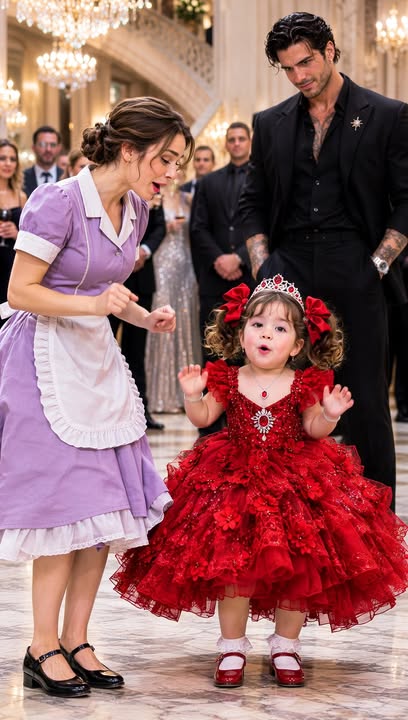
Sofia appeared at the open doors, wearing a bright red dress with two small ruby bows in her curls.
She carried the wooden rabbit beneath one arm.
“Come,” she said.
Adrian crouched beside her.
“Where are we going?”
She pointed toward the path between the tables.
“To the garden.”
“Would you like me to walk with you?”
She looked at me.
“Both.”
The word was simple, and it filled me with a tenderness I did not try to hide.
I held out one finger.
Sofia took it.
Adrian offered his hand on her other side, palm open, waiting.
She placed her free hand in his.
For a moment, the three of us stood at the edge of the garden.
Sofia glanced down at her shoes, then at the path ahead.
She was not being hurried.
No one was asking her to smile or wave or prove how brave she was.
She looked up at me.
“One,” she said.
“One,” I answered.
She squeezed my finger.
“Two.”
“Two.”
Her small shoulders rose with a careful breath.
“Twee.”
“Three.”
Sofia took one steady step toward the garden.
Then another.
Adrian walked beside her, matching her pace.
I walked with them, holding lightly enough that she could let go whenever she was ready.
At the garden path, she released my finger and reached for both our hands again.
The sun warmed the stone beneath our feet.
Behind us, the foundation doors stood open.
Inside, Eli’s floor plan rested on the wall beside Elena’s notes, no longer hidden in an archive or mistaken for an accusation.
Ahead, Sofia took one more confident step.
And this time, no one counted because she needed help finding her way.
We counted because we were there with her, happy to begin together.
**–THE END–PLEASE
Share your thoughts or feedback to motivate us to create more stories ♥️
* * *
[PREVIOUS: PART 5](https://echoesofstories.idolsgift.com/blog/part-5-the-name-in-the-old-file-041-9)
✓ Lynn R. Adams
Part 6 – A Step Toward Home The date on Ruth’s message was the day before Eli’s crash. For several seconds, I could only stare at the screen. Then I read it again, slower, as if the words might cha…