PART 6 (THE END): The Name in the File 047
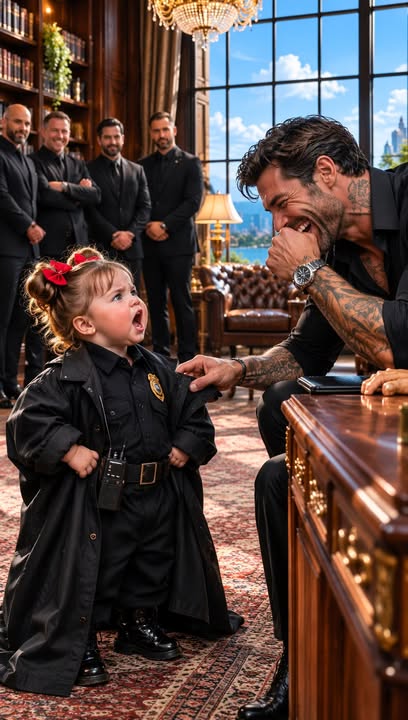
Part 6 – The Promise Kept
Franklin read the message twice, the neat blue letters seeming to alter with each glance.
Do not let Julian speak to Lydia Shaw alone.
The time and place were written beneath it, followed by Emma’s name.
For a moment, he wondered whether the note was a warning, an invitation, or a mistake.
Then he remembered Emma’s steady eyes when she had asked him to keep her informed.
He lifted the paper and went straight to the library.
Julian was there with Mia, who had arranged three cookies beside her paper badge and was explaining that the plate needed a guard of its own.
Franklin held out the note.
Julian read it once, then looked toward the doorway.
“Where is Emma?”
“She’s in the staff sitting room.”
“Did she write this?”
“It looks like her hand.”
Mia climbed down from her chair.
“Mommy coming?”
“Not yet,” Julian said. “I need to speak with her.”
Mia took the badge from the desk and placed it in his palm.
“Then you take guard.”
Julian closed his fingers around it.
“Thank you.”
He found Emma by the lake-facing window, looking over the water with a cup of tea cooling on the sill.
He showed her the note.
She read it without surprise.
“I left it for Franklin,” she said.
“Why?”
“Because I don’t want you meeting Lydia alone.”
“Franklin will be with me.”
“Franklin was with you when the first records were found.”
The words were gentle, but they carried the history of every silence.
Franklin stood in the open doorway and accepted them.
“You’re right,” he said.
Emma turned to him.
“I’m not saying you intended harm.”
“I understand.”
“But you made choices for me once, even if you didn’t know it.”
Franklin lowered his gaze.
“I did.”
She looked back to Julian.
“I want to be there when you speak with Lydia.”
Julian considered her request.
“If you’re comfortable.”
“I’m not sure I will be.”
“Then you don’t have to.”
“I want to hear what she knows.”
“All right.”
Emma studied him, as though waiting to see whether he would ask her to reconsider.
He did not.
“Thank you,” she said.
The next afternoon, they met Lydia Shaw in a quiet room at an independent law office, with a neutral attorney present to keep the discussion orderly and to record what was said.
Lydia arrived carrying a small canvas folder.
She was in her seventies now, with careful white hair and a face that seemed to have grown more tired than stern.
Her gaze rested on Emma for a long moment.
“I remember you,” she said.
Emma kept her hands folded on the table.
“I remember the man who came to the hotel.”
Lydia flinched as if the words had touched a bruise she had hoped was gone.
“I’m sorry.”
“I don’t know what you did.”
“That is why I asked to meet.”
Julian sat opposite her, with Franklin beside him.
Emma chose the chair nearest the door.
No one began with a raised voice.
The attorney placed the carbon copy and the old inventory record on the table.
Lydia looked at them and opened her canvas folder.
Inside were several handwritten pages and a small envelope.
“I kept copies of the correspondence,” she said.
“Why?” Julian asked.
“Because your father told me to remove them from the family archive, and I thought records ought not to vanish simply because someone powerful wanted them out of sight.”
Franklin’s eyes dropped to the envelope.
“You wrote the note on the carbon copy?”
“Yes.”
“‘Keep this out of the family archive’?”
“I did.”
“Why?”
“Because I did not trust the archive to remain untouched.”
Lydia looked at Franklin.
“I knew you had been ordered to manage the matter, but I did not know what you had been told.”
“I believed Emma had accepted the money and left,” Franklin said.
“I know.”
“How?”
“Your father told me you had accepted his account.”
Franklin looked away.
Lydia continued.
“I wrote the warning because I thought a record might protect the truth from being changed later.”
“Yet the note made the document harder to find,” Emma said.
“Yes.”
“I’m sorry,” Lydia replied. “I thought hiding it from one person might keep it safe from another, and I did not consider how many years that would leave you alone with the consequences.”
Emma held her gaze.
“Thank you for saying that.”
Lydia took a breath and unfolded the handwritten pages.
“The missing page was not a letter from Julian,” she said. “It was a memorandum from his father to Martin Vale and me.”
Julian’s face remained still.
“Please read it.”
Lydia read the memorandum aloud.
It recorded that Emma had refused the money, that she intended to raise her child without help, and that a message had been sent warning her to leave Milwaukee.
It also stated that Julian must not be told because, in his father’s view, he would bring the child into a family life that could put both mother and child under scrutiny.
The memorandum did not claim that Emma had accepted payment.
It did not claim that she had asked for money.
It did not say she had left because she wished to.
Those false details had been added later to an internal summary.
Julian listened without interrupting.
When Lydia finished, the room held the quiet of a place where the past had finally been spoken in its own words.
“Who added the false summary?” Franklin asked.
“I don’t know,” Lydia said. “The typeface matches the office system, but several people had access.”
“Could it have been Martin?” Julian asked.
“I never saw him write it.”
“Could it have been my father?”
“I cannot say.”
Julian looked at the papers.
“What about the message that Emma received?”
“I never saw the exact note,” Lydia said. “Your father told me it had been delivered. I was not present when it was written.”
Emma’s fingers tightened slightly around one another.
“So the person who wrote it remains unknown.”
“Yes,” Lydia said.
“And the person who decided I had accepted money?”
“I don’t know.”
Emma nodded slowly.
For years, she had carried the certainty that someone connected to Vince had decided she and her child were better kept out of sight.
Now the record confirmed the decision, though not every hand behind it.
The mystery had not ended with one villain and one confession.
It had ended with a chain of ordinary choices, each person deciding that silence was easier than asking the woman at the center what she wanted.
Julian looked toward Emma.
“I’m sorry.”
She gave a small nod.
“I know.”
“I wish I had known.”
“So do I.”
“I would have tried to find you.”
“Maybe you would have.”
The answer was not an accusation, but it was not a gift of absolution either.
Julian accepted it.
“I won’t ask you to believe a version of me that you never got the chance to know.”
Emma’s eyes stayed on his.
“Good.”
The attorney gathered the documents and explained that the records would be preserved as part of the independent review.
Julian agreed to provide copies to the appropriate authorities.
He did not ask for the file to be kept private.
He did not ask for Lydia to be spared from questions.
Lydia said she would cooperate fully.
When the meeting ended, she paused beside Emma.
“I can’t give you back those years,” she said.
“No,” Emma replied.
“But I can tell the truth now.”
Emma looked at her for a long moment.
“Then do that.”
Outside, the afternoon was clear and cold, the city’s winter light shining off the windows.
Emma walked beside Julian but left a careful space between them.
Franklin followed at a distance, carrying the file.
“You could have asked me to stay out of the meeting,” Emma said.
“I could have.”
“You didn’t.”
“No.”
“Why?”
“Because it was your life before it was a secret in my family’s records.”
She watched him as they crossed the pavement.
“That answer took you a long time.”
“It did.”
“Are you going to keep letting it take time?”
“I’m going to keep trying not to decide for you.”
Emma nodded.
“That matters.”
It did not solve everything.
It did not restore the years when Mia was a baby and Julian was a stranger.
But it gave them a place to stand that was not built on guesswork.
The months that followed were difficult in ways no single conversation could make simple.
Stonegate’s independent review uncovered contracts that had been used to disguise payments and business arrangements that had depended on intimidation.
Julian cooperated with investigators, surrendered control of the compromised operations, and testified about what he knew.
Some cases concerned his father’s decisions.
Others concerned choices made during Julian’s own years in charge.
He did not pretend he had inherited only the consequences and none of the responsibility.
The investigations took time.
The company changed shape.
Several businesses were sold, others closed, and the remaining legitimate operations were placed under independent oversight.
Julian lost control of the empire he had once believed was the only thing keeping him safe.
He also lost the certainty that control had ever been the same as safety.
Franklin testified to what he knew and what he had failed to question.
He no longer described his silence as loyalty.
For the first time, he understood that loyalty without honesty had only helped the lie survive.
Emma and Mia moved out of Stonegate House before the most difficult parts of the review became public.
Julian did not ask them to stay.
He arranged a secure, ordinary apartment through an independent agency, with no family staff and no name on the lease that could make Emma feel indebted.
She chose the neighborhood, met the landlord herself, and reviewed every document before signing.
When Julian offered to pay the first month’s rent, she refused.
When he offered to help carry boxes, she considered the request and said he could come for one afternoon.
He arrived on time with a borrowed van and no entourage.
He carried the light boxes up the stairs, waited while Emma decided where the furniture should go, and asked before touching Mia’s toys.
Mia was busy assigning posts to her stuffed animals.
“Bunny gets window,” she announced.
“Where do I go?” Julian asked.
She examined him.
“Door.”
“Should I stand outside?”
“No,” Mia said. “Inside door.”
“Understood.”
Emma watched from the kitchen doorway.
Julian did not try to turn the afternoon into a family portrait.
He did not ask Mia to call him anything special.
He did not tell Emma that he had missed them, although she knew he had.
He simply stayed until the last box was carried upstairs, then asked if they needed anything else.
“Not today,” Emma said.
“All right.”
He left when she asked him to.
That became the first of many ordinary acts.
He showed up when they agreed he would.
When Emma changed a visit, he accepted the change without argument.
When Mia wanted to talk about cookies instead of the past, he talked about cookies.
When she wanted him to listen to a story about Bunny’s difficult patrol, he listened as if every detail mattered.
He learned which foods she liked and which ones she rejected after one suspicious bite.
He learned that she preferred her bedtime stories read slowly, with different voices for every animal.
He learned to ask Emma before making plans, and to accept that sometimes the answer was no.
There were setbacks.
Once, Julian arrived at the apartment with a small silver locket he had found among the Milwaukee papers.
He thought Emma might want it because it had belonged to the hotel where she and Vince had first spoken.
She looked at the locket, then at him.
“I don’t want keepsakes that turn me into a story you can hold.”
He understood at once that he had mistaken a relic for an offering.
“I’m sorry,” he said.
“You can keep it.”
“I don’t want to keep something that belongs to you.”
“I didn’t say it belonged to me.”
He took it back and made no argument.
A week later, he asked whether she wanted it destroyed or given to an archive.
She chose the archive.
He followed her choice.
The first time he attended one of Mia’s preschool events, he sat in the back row and let Emma decide whether he could join them afterward.
Mia spotted him during the songs and waved so enthusiastically that she forgot the words.
Afterward, she hurried to him with a paper crown.
“You came.”
“I did.”
“Did you watch?”
“Every minute.”
“I was a dragon.”
“You were an excellent dragon.”
Mia seemed satisfied with the review.
Emma stood nearby, her hand resting on the strap of her bag.
“Thank you for coming,” she said.
“Thank you for letting me.”
She did not promise he would be invited next time.
He did not ask.
The legal review continued, and Julian’s cooperation cost him more than money.
He lost colleagues who had preferred the old arrangements.
He faced questions from people who wanted him to preserve the family name by keeping its history quiet.
He refused.
He also stopped calling what he had done a sacrifice.
A sacrifice sounded noble.
This was simply the price of no longer asking other people to carry the truth for him.
One spring afternoon, after the last of the company’s compromised accounts had been transferred to the outside administrators, Franklin invited Emma and Mia to meet him by the lake.
He had left Stonegate’s management months earlier.
Now he worked with the independent review team, organizing records and correcting the gaps he had once allowed to remain.
He met them at a public overlook a short drive from the old house.
Mia ran toward him with her paper badge pinned to her coat.
“Mr. Franklin!”
“Agent Hayes.”
“I have new rules.”
“I’m ready.”
“First, no running near the water.”
“A wise rule.”
“Second, cookies can be eaten if Mommy says.”
“An excellent rule.”
“Third, you have to bring Julian.”
Franklin smiled.
“I believe he’s already on his way.”
Julian arrived a few minutes later carrying a paper bag from a bakery.
He wore a plain coat, and there was no driver waiting nearby.
Mia inspected the bag.
“Cookies?”
“Cookies.”
“Chocolate?”
“Two kinds.”
She looked at Emma for permission.
Emma nodded.
Mia chose a cookie and placed one beside it for Franklin.
Then she picked another and gave it to Julian.
“You get big one,” she told him.
“Thank you.”
She looked at the remaining cookie in the bag.
“Mommy gets big one too.”
Emma laughed softly.
“That’s generous of you.”
Mia climbed onto the bench and kicked her feet above the ground.
The lake stretched behind them, silver-blue beneath a wide spring sky.
For a while, no one talked about the past.
Franklin told Mia about a seagull he had seen trying to steal a sandwich from a tourist.
Mia decided that the bird had been “bad guard.”
Julian listened to her explain how Bunny would have handled the situation.
Emma sat beside them, her shoulder near Julian’s but not touching.
The space between them had changed.
It was no longer the distance of suspicion, but the distance of a choice still being made.
Julian turned the paper badge in his hands.
“You’ve been my bodyguard for a long time,” he said.
“Yep.”
“Do you think I’m safe now?”
Mia studied him with solemn care.
“Mostly.”
“What would make me safer?”
“Tell the truth.”
Franklin looked down at his cookie.
Emma’s gaze rested on Julian.
He gave Mia a small nod.
“That’s good advice.”
“I know.”
“And what is your job now?” Julian asked.
Mia tapped the badge.
“Still bodyguard.”
“Do you need an assistant?”
She considered him.
“You can be assistant.”
“I would be honored.”
“But you have to listen.”
“I will.”
“And you can’t be boss.”
“I understand.”
Mia handed him the badge.
Julian pinned it carefully to his coat.
Emma watched the simple exchange.
The little girl who had once marched into Stonegate’s library believing she could protect a man from dangers she could not name had given him a place beside her.
Not a claim.
Not a promise about the future.
A job, with rules she expected him to follow.
Julian treated it as the trust it was.
When the cookies were gone, Franklin stood and brushed crumbs from his coat.
“I should get back,” he said.
“Do you have work?” Mia asked.
“I do.”
“Good. Everybody needs a job.”
“Even me?”
Mia pointed at Julian.
“You’re assistant.”
“Right. I’d better be on duty.”
Franklin smiled at Emma.
“Thank you for coming.”
“Thank you for inviting us.”
He looked at Julian, then at the badge pinned to his coat.
“Keep listening,” Franklin said.
“I will.”
Franklin walked back toward the parking lot, leaving the three of them beside the water.
Mia hopped down from the bench and ran a short distance along the path, staying within sight.
Emma watched her until she turned to examine a cluster of small stones near the edge of the grass.
“She trusts you,” Julian said.
“She likes you.”
“That isn’t the same thing.”
“No,” Emma said. “It isn’t.”
He waited.
Emma turned toward him.
“I won’t promise you that everything will become easy.”
“I wouldn’t ask you to.”
“I won’t pretend the years didn’t happen.”
“I don’t want you to.”
“And I won’t always know how close I want you to stand.”
“Then I’ll ask.”
She studied his face.
The man she had known as Vince had been gentle in the brief, narrow space they shared.
The man before her now was not the same person, though he had finally begun to understand what the old kindness had failed to do.
He had come back without expecting to be welcomed.
He had stayed without asking to be forgiven.
He had learned that being Mia’s father could not be claimed from a resemblance, a secret, or a page in an archive.
It had to be offered to him, again and again, in small pieces.
Emma looked toward their daughter.
Mia had chosen a smooth gray stone and was holding it up to the light.
“She’s happy,” Emma said.
“Yes.”
“That matters most.”
“It does.”
She reached for his hand.
The touch was light at first, a question neither of them needed to say aloud.
Julian did not close his fingers until she did.
When she rested her palm in his, he held it carefully, as if he understood that being allowed to stay was not the same as being entitled to remain.
Mia came back, the stone tucked into her pocket.
“Family protected,” she announced.
Emma looked at Julian.
He looked back at her, the old fear in his eyes no longer disguised as control.
“Protected,” he agreed.
This time, nobody laughed at her.
**–THE END–PLEASE
Share your thoughts or feedback to motivate us to create more stories ♥️
* * *
[PREVIOUS: PART 5](https://echoesofstories.idolsgift.com/blog/part-5-the-name-in-the-file-047)
✓ Lynn R. Adams
Part 6 – The Promise Kept Franklin read the message twice, the neat blue letters seeming to alter with each glance. Do not let Julian speak to Lydia Shaw alone. The time and place were written bene…