PART 6 (THE END): The Name I Was Afraid to Say 047
Part 6 – A Home We Choose
“The woman at that address is alive,” Mrs. Chen said. “And she has been asking about you.”
For a moment, the car seemed to have stopped moving, though I could see the city slipping past the window.
Mia turned toward me, her small hand resting over mine.
“Who is she?” I asked.
“I can’t be certain,” Mrs. Chen replied. “The registry gives her name as Rosa Bellini, and the address is current. She has contacted the clinic twice in the last year, asking whether anyone had come looking for information about Marina.”
My breath caught.
“Did she say she was my mother’s sister?”
“No. She didn’t explain their relationship.”
I looked through the window at the gray afternoon, at the buildings that had been my home for years and were already beginning to feel like something I was leaving behind.
“Mrs. Chen, I’m on my way to Albany.”
“I know. I’m sorry to call at such a moment.”
“No, you did the right thing.”
The driver glanced at me in the mirror, then returned his attention to the road.
I lowered my voice.
“Could you send me the address and whatever else the registry says?”
“Of course.”
“And please don’t contact her again until I decide what I want to do.”
“I won’t.”
When the call ended, I held the phone in my lap.
Alessandro’s face came to mind: the way he had stood at the curb without asking me to stay, the way he had let me leave even though he wanted me near him.
I could call him.
I could tell him what Mrs. Chen had found, and I knew he would offer to drive me back, to speak with Rosa, to make sure I did not have to face anything alone.
But I did not want to turn one discovery into a decision made for me.
The car carried us north.
Mia fell asleep against my shoulder before we reached the edge of the city, her breath warm through my coat.
I watched the road unfold ahead and understood that choosing Albany did not mean I had to close every door behind me.
It meant I could arrive somewhere new as myself, with the right to decide what came next.
The first months were harder than I had expected and better than I had dared to hope.
The center in Albany was smaller than the photographs had suggested, but the staff welcomed me as a colleague rather than a favor they had agreed to do.
My work was demanding.
I helped families navigate appointments, childcare, and the bewildering stacks of forms that could make a person feel invisible before they had even reached the right desk.
On the days when the waiting room filled with tired parents and restless children, I remembered the laundry room in Alessandro’s penthouse and the folded blanket I had hidden behind the towels.
Then I remembered the people who had helped me without asking me to become someone else in return.
I tried to make the center feel like a place where no one had to hide.
Mia had a small room in our apartment, with a blue quilt from Lucia folded at the end of her crib.
She learned to walk there, first by holding the edge of the couch, then by letting go and crossing the room with her arms outstretched.
She fell often.
She always got up smiling.
I sent Alessandro pictures.
At first, I sent one every few weeks, usually after Mia learned something new or did something that made me laugh.
He responded with warmth, never with a demand for more.
Sofia called from New York every Sunday.
Sometimes she asked about my work.
Sometimes she asked whether Mia was still trying to eat books.
Once, she told me that Alessandro had begun sorting through his mother’s old foundation files.
“He says he wants to understand what she built,” Sofia said. “Not only what she left behind.”
I sat at my kitchen table, listening to Mia bang a wooden spoon against her high-chair tray.
“That sounds like him.”
“It does now,” Sofia replied. “He’s learning that understanding a thing means listening to the people who need it.”
I thought of the years when his household had felt too polished and silent to enter with a problem.
“I hope he lets people help him, too.”
“He’s working on it.”
In the spring, I made my decision about Rosa Bellini.
I wrote her a letter first.
I explained who I was, that I had found my mother’s note in the clinic registry, and that I did not know what our connection might be.
I told her I was not asking for anything.
I only wanted to understand why my mother had left her name, and whether there was a story she believed I should know.
I gave her my phone number and the address of the center.
Then I waited.
Her reply came three weeks later in a pale blue envelope with my name written in an unsteady hand.
She said she was Marina’s older sister.
She said she had been young and overwhelmed when my mother became pregnant, and that she had tried to help from a distance while respecting Marina’s wish to keep certain parts of her life private.
She had not known about the clinic’s sealed instruction.
She had not known whether Marina wanted her to find me.
“I asked the clinic if anyone had reached out because I never stopped wondering how you were,” she wrote. “But I did not want to enter your life without being invited.”
There was no grand revelation in the letter.
No hidden inheritance, no explanation that changed the shape of my childhood.
There was only an aunt who had cared about my mother, had lost contact with her, and had been afraid that reaching for me might be another way of ignoring what Marina had asked for.
I wrote back.
We spoke on the phone in June.
Rosa had my mother’s quiet laugh, though her voice was lower.
She told me stories of Marina as a girl: how she had climbed the fence behind their childhood home to retrieve a ball, how she hated raisins, how she had once taken apart a radio because she wanted to know where the music lived.
I had never heard those stories before.
When we met in person, there was no instant certainty between us, only an awkward tenderness that grew as we shared coffee and old photographs.
She brought a picture of my mother holding me at the clinic garden.
The silver compass bracelet circled my newborn wrist.
I looked at the image for a long time.
My mother’s face was tired but bright.
Beside her stood Amalia Duca, one hand resting lightly on Marina’s shoulder, the other holding a small paper packet of seeds.
Rosa had never met Amalia.
She knew only that my mother had spoken of her as the woman who had stayed.
“Marina didn’t tell me everything,” Rosa said as we sat together near the window. “But she told me enough to know that you were loved.”
“I know that now.”
Rosa reached across the table, then stopped before touching my hand.
I closed the distance myself.
It was not the beginning of an old family restored.
It was the beginning of a new relationship, built slowly and with permission.
By the time Mia turned one, I had a job I was proud of, childcare I trusted, and a family connection I could choose to keep discovering.
I also had a growing certainty that leaving New York had not ended what I felt for Alessandro.
It had given those feelings room to become something neither of us had to confuse with need.
We spoke more often as the months passed.
He told me about the foundation’s old files and the trustees who had agreed to meet.
I told him about the center, my work, and the way Mia had learned to say “more” with both hands raised.
He never asked me to come back.
He never used the past to persuade me.
And because he didn’t, I began to wonder what it might feel like to return by choice.
The first time I visited New York again was for a weekend in late summer.
Alessandro met us at the station.
He stood on the platform in a dark suit without a tie, holding a small stuffed rabbit Mia had left behind months earlier.
Mia saw him before I did.
She wriggled in my arms and reached toward him.
“Hello, little one,” he said.
He waited until I nodded before taking her.
She settled against his shoulder as if the months between us had been no more than a long afternoon.
I watched his face while he held her.
The wonder in it was still there, but it had changed.
He did not look as if he were trying to understand a mystery.
He looked as if he were glad she was real and glad she was here.
“You came,” he said to me.
“I did.”
“Are you glad?”
“I think so.”
His smile was small and unguarded.
“That’s enough for a beginning.”
During the visit, he showed us the work that had begun on his mother’s foundation.
The old clinic building had been repaired, and its garden had been cleared of weeds.
A few rooms were being prepared for childcare, family counseling, and emergency support.
The trustees wanted the center to offer practical help without making families feel they had to tell every painful detail before they could receive it.
Alessandro had asked people who used similar services what mattered to them.
He had listened to Sofia, Mrs. Chen, and the staff who remembered the clinic.
He had also asked me to advise them.
I agreed on one condition: I would be paid for my work, and my title would reflect my experience rather than my connection to him.
He accepted both conditions.
We met with the board by video from Albany.
I brought the perspective of someone who had needed support and still needed to make her own decisions.
The foundation’s plan changed because of those meetings.
The childcare rooms would be open to working families with a sliding fee.
The emergency fund would cover short gaps in rent, medicine, and transport without requiring a person to prove that their hardship was worthy.
The center would keep a quiet room for parents who needed a moment before speaking.
When the trustees approved the plan, Alessandro called me.
“My mother would have liked what you told them,” he said.
“Your mother would have liked that they asked families first.”
He was quiet for a moment.
“Yes,” he said. “She would.”
A year after I had left New York, the center reopened.
I had already accepted a better position in Albany by then, one that allowed me to oversee family programs and continue the work I had come to love.
The offer had come through my own experience and the recommendations of people who had watched me do the work.
I considered it carefully.
I spoke with my supervisor, with Rosa, and with Mrs. Alvarez, who still watched Mia whenever I was in New York.
Most importantly, I spoke with myself.
The job gave me the stability I needed.
The center in New York offered a chance to help build something that mattered to me, but I did not want to return to the city simply because Alessandro was there.
So I accepted a position with the foundation on a trial basis, with a clear salary, defined responsibilities, and the freedom to continue my career rather than disappear into someone else’s household.
I would return to New York, but not as an employee in Alessandro’s penthouse.
Not as the frightened woman who had hidden her daughter beneath stacks of towels.
I would return as Elena, a mother with her own work, her own voice, and a place at a table she had helped build.
The morning we arrived, the foundation’s garden was bright with late autumn leaves.
A sign had been placed beside the gate.
THE AMALIA DUCA FAMILY CENTER.
Beneath the name was the old compass emblem.
I touched the cool metal of the plaque.
For a moment, I felt my mother beside me.
Not as a ghost or a memory I had to chase, but in the choices I could see around me: the small rooms prepared for children, the chairs set near the door, the forms written in plain language.
Sofia came down the steps with her arms open.
Mia reached for her, then spotted Alessandro behind her.
He stood in the doorway, no longer trying to make the building feel grand.
He seemed to have spent the morning carrying boxes.
There was a faint smear of paint on one sleeve.
“Is that part of your new executive wardrobe?” I asked.
“It’s part of my new responsibilities.”
“Are you sure?”
“Absolutely not.”
I smiled, and he did too.
The three of us walked into the center.
The rooms were warm, practical, and full of daylight.
A little girl sat on the rug stacking blocks while her father filled out an intake form at a nearby table.
One of the staff members offered him coffee without asking what had brought him there.
He accepted.
In the nursery, the cribs were low enough for a child to see through the bars, and the shelves held books, soft toys, and boxes of washable crayons.
I stood in the doorway and watched the room breathe around the people in it.
“This is what she wanted,” I said.
Alessandro stood beside me.
“I think so.”
Mia had been placed on the rug with a small collection of toys.
She crawled toward the block tower, knocked it down with both hands, and laughed.
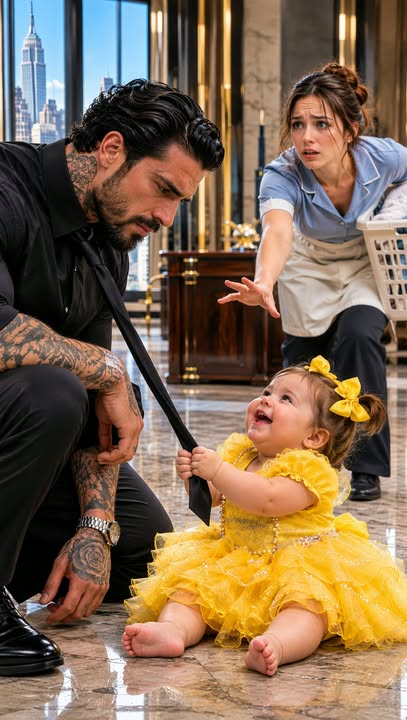
Then she noticed Alessandro’s black tie, folded over his arm.
She had not seen that tie in months, but she recognized it immediately.
She pulled herself upright against his leg and reached for it.
Alessandro looked at me.
“May I?”
I nodded.
He knelt and offered the tie to her.
Mia took it in both hands, then turned and held it out toward me.
I crouched beside them.
For a second, the tie stretched between us, black silk in Mia’s small fingers, Alessandro’s hand beneath it, mine reaching from the other side.
I remembered the first day in his office, when I had been afraid his silence meant the end of everything.
I remembered the laundry room, the hidden bottle warmer, and the question that had changed the shape of my fear.
Who had made you believe you couldn’t ask?
No one person had made that fear.
It had grown from necessity, from loss, from the knowledge that a job could mean the difference between shelter and an empty room.
But no one had to live inside it forever.
Alessandro’s hand touched mine beneath the tie.
“Welcome home,” he said.
I looked at him.
“This is my home now because I chose to come back.”
“Yes,” he replied. “That’s what I meant.”
Mia let go of the tie.
It fell across both our hands.
She made a pleased little sound and leaned forward, one palm on Alessandro’s knee and the other against my shoulder.
Alessandro stayed where he was, giving her room to balance.
I placed my hand over his.
The compass on Mia’s bracelet caught the light from the nursery window.
It no longer felt like a clue pointing backward toward a secret.
It felt like what my mother had intended: a reminder that there could be more than one way home.
Around us, children laughed, a kettle warmed in the kitchen, and Sofia called someone by name with the easy kindness that made the whole building feel less like an institution and more like a promise.
Mia steadied herself between us.
And there, in the place our mothers had helped make possible, we began the life we had chosen together.
**–THE END–PLEASE
Share your thoughts or feedback to motivate us to create more stories ♥️
* * *
[PREVIOUS: PART 5](https://echoesofstories.idolsgift.com/blog/part-5-the-name-i-was-afraid-to-say-047-2)
✓ Lynn R. Adams
Part 6 – A Home We Choose “The woman at that address is alive,” Mrs. Chen said. “And she has been asking about you.” For a moment, the car seemed to have stopped moving, though I could see the city …