PART 6 (THE END): The Name Hidden in the Ledgers 047
Part 6 – A Future Without Fear
Dominic looked at the message, then at Rosie, who was already reaching for his shoulder again.
For one breath, the old instinct rose inside him: move quickly, take control, make every decision himself before anyone else could be hurt.
Then Rosie’s small hand found his collar, and Emily’s arms tightened around her.
“First, we get Rosie somewhere safe,” Dominic said.
He kept his voice calm, though the words in the message seemed to ring through the room.
“Then we call the authorities and tell them everything.”
Emily searched his face.
“You mean all of it?”
“All of it.”
Mara was already speaking with the security team, arranging a quiet move to a location known only to the people they trusted.
Dominic did not ask for armed men to flood the house, or for anyone to pursue the person who had sent the message.
He asked Mara to preserve the photograph, record its time, and give the message directly to investigators.
The evidence they had gathered belonged in careful hands now, not in another private contest for control.
Rosie watched the adults with solemn eyes.
“Go car?” she asked.
“Yes, sweetheart,” Emily said, smoothing the hair away from her forehead. “We’re going to stay with friends for a little while.”
“Horsey?”
Dominic bent to meet her gaze.
“Not right now. But I’ll carry you.”
Rosie considered this, then lifted both arms.
He gathered her close, feeling the solid warmth of her against his chest.
Emily reached for the pink backpack, but Mara stopped her gently.
“Leave it here,” she said. “The investigators may need it.”
Emily looked at the small bag, its familiar straps worn where Rosie’s fingers had tugged them.
For a moment, it seemed to hold the whole story: the farmhouse, the hidden drive, the terrible night when a child’s half-understood words had brought her family back together.
Then Emily took Rosie’s hand instead.
They left through the side entrance, without a rush, and traveled in two cars to a quiet house outside the city where a trusted family friend had once stayed during a long renovation.
The rooms were plain and bright, with a small garden beyond the kitchen window.
Rosie found a basket of wooden toys and settled on the rug, arranging them in a crooked line.
Dominic stood nearby, watching her as if the simple sight were a promise he had not known he needed.
Emily came to stand beside him.
“You didn’t go after them,” she said.
“No.”
“You didn’t send anyone to find out who had the original.”
“The investigators will.”
She rested her hand on his arm.
“I know how hard that was.”
Dominic looked down at her hand, then at her face.
“I used to think protecting you meant making sure nothing could reach you.”
“And now?”
“Now I think it means trusting you to stand beside me when something does.”
Emily’s eyes glistened, but her voice remained steady.
“That’s a better beginning.”
“It is only a beginning.”
“Yes,” she said. “But it’s ours.”
Mara arrived soon after with news from the investigators.
The message had been sent through a prepaid phone, and the photograph had been taken at Sal’s house.
The original agreement had indeed been removed from its cabinet, but no one had forced entry.
Sal had been found safe at a nearby office, where he had gone to search through his old correspondence.
He had not taken the agreement.
Instead, he had discovered the cabinet open and reported the missing papers.
“He says he thinks he knows who came for them,” Mara told Dominic and Emily.
“Who?” Dominic asked.
“Arthur Bell, the former accountant who managed the foundation’s reserve accounts after your father died.”
Emily frowned. “Was he still working with Victor?”
“Not directly, as far as Sal knew. But Bell had access to the old account structure and helped prepare some of the transfers that appeared on the drive.”
Dominic absorbed the information without moving.
“What about the message?”
“The investigators believe Bell sent it, though they’re verifying that. He may have taken the agreement because it identifies the accounts and the original trustees.”
“Why send the photograph of Rosie’s backpack?” Emily asked.
“Because it was recognizable, and because he wanted us to believe Rosie was being watched,” Mara said. “The photograph was taken at the farmhouse months ago, before Emily was found. The backpack had been left there.”
Emily lowered her eyes.
The message had been designed to turn old fear into immediate panic.
It had not meant that Rosie was in danger at that moment.
That knowledge brought relief, but not comfort.
“What happens now?” Dominic asked.
“The investigators have contacted Bell’s attorney. They’re arranging for him to surrender the agreement and provide a statement. He may be trying to bargain for leniency, but that decision belongs to the authorities.”
“And Victor?”
“His case remains separate. The recordings and transfers are still strong evidence. He has agreed to answer questions through his lawyer.”
Dominic glanced toward Rosie, who had begun stacking the wooden animals on top of a block.
“Could Bell’s account have been used to target Emily?”
“He may have helped Victor identify the old records,” Mara said. “We don’t yet know whether he knew the full plan. The investigators will establish what he did and when.”
There was no easy villain-shaped answer to take away the uncertainty.
There were several people who had made different choices, and a chain of secrecy that had given each of them room to pretend someone else was responsible.
Dominic let out a slow breath.
“Then we wait for the facts.”
Mara nodded.
“That’s the plan.”
Emily turned to him.
“You’re all right with that?”
“No,” he said honestly. “But I can live with it.”
She gave him a small, grateful smile.
The following days were filled with interviews, document reviews, and careful conversations with the people whose lives had been connected to the family’s businesses.
Dominic and Emily spoke with the investigators together.
They provided copies of the drive’s contents, the foundation records, their father’s letter, and the surviving account summaries.
When the investigators asked whether they would cooperate fully, Dominic answered before fear could reshape the sentence.
“Yes.”
Emily sat beside him, shoulder to shoulder.
The first consequences arrived sooner than either expected.
Several business accounts were frozen while their histories were examined.
Properties tied to the old organization could not be transferred or sold until the review was complete.
Some employees worried that their jobs would disappear.
Others were angry that the family had not told them sooner what the accounts were connected to.
Dominic listened to their concerns without asking them to stay loyal.
He arranged for legitimate wages to be paid through a transparent temporary fund, reviewed by independent administrators, and made no promise that every position could be protected.
It was not a perfect solution.
It was a truthful one.
The family’s remaining wealth began to shrink beneath legal fees, repayment agreements, and the loss of assets that could not be separated from the old criminal structure.
Dominic had expected to feel stripped of something essential.
Instead, he felt grief, and then an unexpected quiet.
For the first time in years, his future did not depend on preserving a power he had inherited without choosing.
Three weeks after the message appeared, Sal came to see them at the small house.
He brought no guards, no document case, and no excuses.
He stood on the front step while Emily opened the door.
“I’m not here to ask you to forgive me,” he said.
“Good,” Emily replied. “I don’t know how to do that yet.”
“I understand.”
She let him in.
Dominic was at the kitchen table, reviewing a list of properties with Mara.
When he saw his uncle, he closed the folder.
“Did the investigators find the agreement?”
“They did,” Sal said. “Bell turned it over through his attorney.”
“Was anything altered?”
“Not that they can tell. The letter was still with it.”
“Why did Bell take it?”
“He said he panicked when he learned you were preparing a full disclosure. He believed the agreement would make him look responsible for the old transfers.”
“Was he?”
“Partly. He handled the accounts after your father died and approved transfers without proper review. He also helped Victor interpret the old ledgers.”
Sal looked down at his hands.
“He says he did not know Victor planned to harm Emily or Dominic.”
“That will be for the investigators to establish,” Mara said.
Sal nodded.
“Yes.”
Emily set a cup of tea in front of him but did not sit beside him.
“Did Dad know Bell was careless?”
“I don’t know. I think he trusted him with routine records and expected the trustee to supervise the rest.”
“Did you supervise it?”
“Not well enough.”
Silence settled across the kitchen.
Sal looked at Emily.
“Your father believed the reserve would make it possible for you to leave the family business without having to carry its history with you.”
“He should have told us,” she said.
“He should have.”
“He should have trusted us with the truth.”
“Yes.”
“And you should have brought the records to us.”
“Yes.”
His answers did not repair the years of silence.
But they did not try to deny them, either.
Dominic folded his hands on the table.
“What did Dad say to you before he died?”
Sal’s eyes moved toward the window.
“He said he wanted to tell you both everything. I told him to wait until he had a complete plan.”
“Why?”
“I believed that if he spoke before we knew exactly how to leave, the two of you might try to make a choice that could not be taken back.”
“He was allowed to trust us with a difficult choice.”
“Yes,” Sal said. “He was.”
“Did he blame you?”
“No. That was the worst part. He was disappointed, but he never blamed me.”
Sal’s mouth tightened.
“I spent years telling myself that I had kept the family together. Now I see I helped keep it trapped.”
Emily’s expression softened, but she did not reach for him.
“Do you understand what you’re asking us to carry?”
“I’m not asking you to carry anything for me.”
“Good.”
Sal nodded.
“I’ll cooperate with the investigation. I’ve given them every record I still have, and I’ll answer whatever they ask.”
“Will you accept what comes of it?” Dominic asked.
“I will.”
The answer sounded difficult, but sincere.
When Sal left, he paused at the doorway.
“I loved your father,” he said. “I loved you both. I thought those things gave me the right to decide what was best.”
Emily looked at him.
“They didn’t.”
“I know.”
He stepped outside and closed the door behind him.
Emily stayed by the window until he was out of sight.
“Do you believe he means it?” Dominic asked.
“I believe he regrets it.”
“That’s not the same.”
“No.”
“What will you do with that?”
She glanced toward the living room, where Rosie was trying to fit a wooden horse into a small basket.
“I’ll take my time.”
Dominic nodded.
That was more than enough.
The investigation continued for months.
Victor was ultimately charged for the conspiracy that had brought Emily to the farmhouse and for the financial schemes documented on the drive.
Arthur Bell cooperated with the inquiry and accepted responsibility for the accounts he had mishandled.
Sal admitted that he had delayed the original transition plan and had failed to keep a close enough watch on the reserve after their father died.
The family turned over every record it possessed.
Dominic did not bargain to protect his name or ask anyone to hide an old transfer.
The remaining criminal operation was dismantled through the legal process, piece by piece.
Several legitimate businesses survived under new ownership and independent oversight, while others closed.
Some properties were sold to repay what was owed.
The family’s reputation changed, sometimes with fairness and sometimes without it.
Dominic learned that telling the truth did not make every consequence gentle.
It did make the consequences real, and therefore possible to meet.
Emily moved back into the family house when she was ready.
She did not move into the room she had occupied before she disappeared.
Instead, she and Rosie chose a bright suite overlooking the garden, where the morning sun reached the window before it touched the rest of the house.
Dominic asked Emily what she wanted the rooms to become.
She asked for a small table where she could work, shelves for Rosie’s books, and a lock on the door that only she controlled.
He gave her the key and did not ask for a copy.
Their relationship did not heal in one conversation.
It grew through ordinary things.
Dominic learned to ask before making plans that involved Emily and Rosie.
Emily learned that she could disagree with him without being shut out.
Some days they spoke easily.
On other days, a question about their father or an old family habit brought the hurt back to the surface.
When that happened, they did not pretend it had gone away.
They stayed in the room.
They listened.
Rosie grew taller, steadier on her feet, and increasingly certain that the entire household existed to answer her requests for snacks and horse rides.
She still called Dominic “Unca Dom,” though sometimes the second word came out more clearly than the first.
One afternoon, nearly a year after the night at the farmhouse, Emily brought a flat wooden box into the library.
They had been sorting through their parents’ papers with Mara’s help, deciding what belonged in the family archive and what could be shared with the foundation’s new board.
“I found something beneath the lining,” Emily said.
Inside the box was a sealed letter, its edges softened by time.
Their father’s handwriting crossed the front.
For my children, when they are ready to know what I should have told them sooner.
Dominic sat beside Emily.
Neither of them hurried to open it.
When at last Emily broke the seal, the letter contained only a few paragraphs.
Their father wrote that he had wanted his children to inherit their mother’s generosity rather than his fear.
He wrote that leaving the old life would require more courage than he had shown, and that he hoped they would find a way to be braver than he had been.
He did not ask them to excuse him.
He did not insist that his intentions made up for his silence.
He simply told them he loved them and wished he had known how to say so while they could still hear him.
Emily folded the letter carefully.
“I wish he had,” she whispered.
“So do I.”
She leaned her shoulder against his.
For a while, they sat with the letter between them and the afternoon light drifting across the library rug.
Then Rosie came in, carrying a drawing folded in half.
“Horse,” she announced.
She opened the paper.
It showed a red house, a yellow sun, three people holding hands, and a small figure with a pink bow.
Dominic pointed to the largest person.
“Who’s that?”
“Unca Dom.”
“And that one?”
“Mommy.”
“Who’s the small one?”
Rosie turned the drawing around as if the answer should have been obvious.
“Me.”
Emily laughed softly.
Rosie climbed into her lap, then looked at the old family photograph on the table.
“Grandma?”
“Yes,” Emily said. “That’s Grandma.”
“Grandpa?”
“That’s Grandpa.”
Rosie reached for the letter.
Emily lifted it out of reach and touched Rosie’s cheek.
“We’ll tell you about them when you’re bigger.”
“Now.”
“Soon.”
Rosie considered this and accepted the answer with the solemn patience of a child who had other important things to do.
The foundation reopened its doors the following spring.
It was no longer an arm of the family business and no longer a place where money could pass quietly without explanation.
Its board included community members, former staff, and independent advisers.
Its accounts were public, its grants carefully reviewed, and its work shaped by the people it was meant to serve.
Dominic and Emily named it the Moretti-Bellweather Community Fund in honor of both parents, but they refused to place the family’s name above its purpose.
They used what remained of the legitimate assets to support the clinic, provide housing assistance, and fund a program for families facing sudden hardship.
At the opening gathering, people filled the small garden outside the clinic.
There were children running between folding chairs, neighbors talking over paper cups of lemonade, and former staff who had once feared the foundation would disappear entirely.
Dominic stood near the edge of the crowd, unsure what to do with the applause when the director thanked the family.
Emily came to stand beside him.
“You can smile,” she said.
“I’m considering it.”
“You’re allowed.”
He looked at her, then let the smile come.
It was not the guarded expression he wore when people watched him for signs of weakness.
It was simply his own.
Rosie ran up carrying a paper crown decorated with blue stars.
“Unca Dom!”
She held out the crown.
“For me?”
She nodded.
He bent down, and she set it crookedly on his head.
Emily laughed.
“You look very dignified.”
“I was hoping for that.”
Rosie climbed onto his shoes and raised both arms.
“Horsey!”
Dominic looked at Emily.
She gave a small nod.
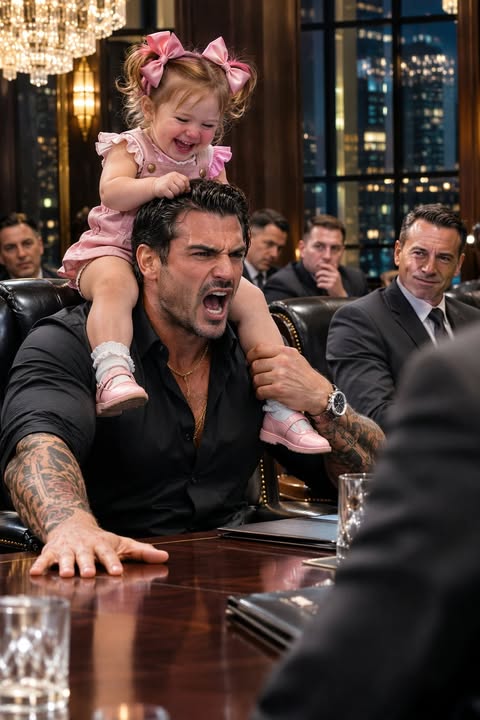
He lifted Rosie onto his shoulders.
The crowd around them softened into smiles as Rosie settled above him, her pink bow fluttering in the breeze.
She patted the crown.
“King!”
“I’m not a king,” Dominic told her.
“Horsey king.”
“I can live with that.”
Rosie leaned forward, tucked her hands into his hair, and gave the garden her familiar triumphant cry.
“NEIGHHH!”
The laughter that followed was easy and warm, no longer carefully hidden behind hands or lowered eyes.
Dominic began walking through the garden, slow enough for Rosie to wave at everyone she recognized.
Emily walked beside him.
For a little while, they followed the path that wound past the clinic doors, the new garden beds, and a row of young trees planted in their parents’ memory.
At the far end stood a small red playhouse built for the children who came to the foundation.
Rosie spotted it.
“Red house!”
Emily’s fingers brushed Dominic’s arm.
The old phrase no longer carried the whole weight of fear.
It belonged to Rosie now, to laughter and sunlight and a bright little doorway she could run through whenever she wanted.
Dominic looked toward Emily.
“Are you all right?”
“I am,” she said.
He believed her because she had told him, not because he had decided for her.
Rosie pressed her cheek against his head.
“Home?”
Dominic covered one of her hands with his.
“Yes, sweetheart,” he said. “We’re home.”
And when they turned toward the garden full of family, neighbors, and a future they no longer had to hide, Dominic carried Rosie forward without feeling the old life behind him reaching for their heels.
**–THE END–PLEASE
Share your thoughts or feedback to motivate us to create more stories ♥️
* * *
[PREVIOUS: PART 5](https://echoesofstories.idolsgift.com/blog/part-5-the-name-hidden-in-the-ledgers-047)
✓ Lynn R. Adams
Part 6 – A Future Without Fear Dominic looked at the message, then at Rosie, who was already reaching for his shoulder again. For one breath, the old instinct rose inside him: move quickly, take con…