PART 6 (THE END): The Name He Remembered 041
Part 6 – A Quieter Kind of Promise
“Ben was awake when Elena came to see him.”
My mother’s words trembled over the phone.
I looked at the sealed envelope on the table, the handwriting on its face suddenly more intimate than ink could explain.
“What did they tell you?” I asked.
“That she sat with him for a while. That he knew who she was.”
I pressed the phone closer to my ear.
“Did they say what they talked about?”
“No. The woman said there might be a note in the letter.” My mother took a shaky breath. “I want to read it, Mara. But I want you here.”
“I’m coming.”
I ended the call and looked at Luca.
He had risen, but stayed on the far side of the table, his hands at his sides.
“Would you like me to leave?” he asked.
I glanced at the envelope.
“No. But you don’t read it before we do.”
“I won’t.”
Ms. Hsu confirmed that the sleeve could be taken to my mother, provided we kept it sealed until we were together.
I placed it carefully inside my bag.
Luca walked with me to the entrance, then stopped beside the open door.
“I can have someone take you,” he said, then paused. “No. You’ve already told me what you want.”
“I’ll take a cab.”
“All right.”
His restraint was quiet, but I could feel the effort behind it.
“Thank you for asking,” I said.
He nodded.
“And Luca?”
“Yes?”
“Don’t decide what Elena’s visit meant before we read what she wrote.”
“I won’t.”
My mother waited at her kitchen table, Ben’s old blue mug beside her and two cups of tea untouched.
I placed the archival sleeve between us.
For a long moment, neither of us reached for it.
Then my mother held out her hand.
“Together,” she said.
We broke the seal carefully, lifted out the cream-colored envelope, and unfolded the pages inside.
Elena’s handwriting moved across the paper in measured lines, elegant but not distant.
The first page was addressed to my mother.
She wrote that she had met Ben in the hospital after the worst of the emergency had passed, when he was awake but exhausted and still frightened by every sudden sound.
She had brought him a small card with a picture of a night sky.
He had asked whether the stars in the picture made noise.
Elena had told him they did not.
Ben had studied the card, then asked whether she could make a room where the stars were quieter.
“I told him I would try,” Elena had written.
My mother covered her mouth.
I kept reading, my voice low enough that each sentence seemed to belong to both of us.
Elena wrote that Ben had been clear about what he needed.
He had wanted fewer people speaking at once, a place away from the television, and more time to answer questions.
He had also wanted to know when my mother would come back from speaking to the doctor.
Elena had promised to find her.
She had found my mother in the corridor and stayed with Ben until she returned.
The letter acknowledged that Elena’s promise had not been enough.
The quiet room had been prepared for children like Ben, but it had not been kept available when the department grew busy.
Elena had believed that funding the room would protect it.
She had been wrong.
The next paragraphs described the meeting with the trustees.
Elena had argued that the hospital could not call a program successful while families were being told that its room was unavailable.
She had asked for the incident report to be preserved and for an independent review.
When the trustees warned that public scrutiny might lead to the program’s closure, she had agreed to keep the discussions private while she tried to secure the room and the training.
She had believed she could fix the problem quietly before the hospital chose between accountability and continued funding.
Instead, the report was withdrawn, the review narrowed, and the explanation given to the family was allowed to stand.
Elena wrote that she had been afraid of making things worse, and that fear had let powerful people decide what the truth could include.
She apologized to my mother for leaving her with sympathy when she had also owed her honesty.
She apologized to Ben for making a promise she could not keep alone.
At the end, she wrote that she had not come back because the trustees had told her the hospital was preparing to reopen the room and that they would contact the family once the review was complete.
She had believed them.
Then she had become ill, and time had narrowed around her before she could return.
The letter ended with one final sentence.
I hope you will not mistake my silence for forgetting him, but I know that remembering him privately was not enough.
My mother lowered the pages to the table.
“I remember the woman with the stars,” she whispered.
I took her hand.
“She sat beside him while I spoke to the doctor,” my mother continued.
“She didn’t tell me her name. She asked Ben about the picture on his card, and he told her the moon looked lonely.”
A quiet, broken laugh escaped her.
“That sounds like him,” I said.
“He was tired. He still wanted to make sure the moon had company.”
We sat together until the tea had cooled.
My mother read the letter again, slower this time, stopping now and then to touch the edge of a page.
When she finished, she folded it neatly.
“I believe she was sorry,” she said.
“So do I.”
“Does that make it all right?”
“No.”
My mother nodded, accepting the answer without needing it to be different.
“But I’m glad we know,” she said. “And I’m glad Ben got to tell someone what he needed.”
The next weeks were not simple, but they were honest.
The independent review examined the emergency department’s response, the failure to keep the sensory-support room available, and the removal and alteration of the incident report.
It also traced the transfer of the sealed letter to the Moretti family residence.
The review found that Gideon Vale, then a trustee, had arranged for the report and envelope to be moved while the foundation considered how to respond to Elena’s request.
He had not destroyed the documents, and the review found no evidence that he had opened the letter.
But he had allowed the records to leave the hospital archive without ensuring they were returned or delivered to the family.
His stated reason had been to protect the program from being shut down before its funding was secured.
The review concluded that his decision had obstructed the family’s right to an accurate account and had prolonged the hospital’s failure to acknowledge what had gone wrong.
Luca’s father had pressured Dr. Rusk to keep the matter within the trustees’ control and had helped secure a private agreement instead of a full investigation.
The hospital’s own leaders had accepted that pressure and failed to restore the original findings.
No single person had caused every mistake.
No single apology could repair what Ben and my family had lost.
But the review named the decisions, the delays, and the ways a promise of privacy had become a shelter for people who did not want to answer questions.
Luca did not ask for his father’s part to be softened.
At the public hearing, he sat beside me, not behind me and not between me and the panel.
When it was his turn to speak, he described his father’s role plainly.
He said that Elena had tried to tell him something was wrong, and that he had mistaken her silence for a choice she had made freely.
He said he had not caused the hospital’s decisions, but that his family’s influence had helped keep them from being challenged.
“I can’t change what my father did,” he told the panel. “I can decide whether I use what he left me to keep the same doors closed.”
His voice did not shake, though his fingers did.
I spoke after him.
I talked about Ben’s love of stars, his dislike of scratchy labels, and the way he made up riddles that had no answers.
I talked about the waiting room, the television, and how he had tried to tell adults that he was frightened.
I did not pretend to know every detail of what happened in the hours before he died.
I did not claim that one quiet room would have changed everything.
I said only that the room had been promised, that it had not been available, and that the people responsible had not told us the full truth.
When I finished, the room remained quiet for a moment.
Then my mother reached for my hand.
Luca did not touch me until I turned toward him.
His hand rested lightly beside mine on the table, leaving me to choose whether to take it.
I did.
The review led to consequences that were not dramatic, but were difficult and public.
The hospital issued a formal correction to its earlier account, acknowledged the avoidable delay, and apologized to my family.
Gideon Vale resigned from his remaining advisory role.
The foundation agreed to independent oversight of its grants and records.
Luca’s family released its financial documents and acknowledged his father’s involvement without trying to rename it as a misunderstanding.
The hospital established a permanent sensory-support program with a dedicated room, trained staff, and a rule that the room could never be turned into storage.
It would serve children who needed less noise, more time, or another way to communicate.
The program was named for Ben.
I accepted a paid position as an advocate and program consultant, with a clear contract and the freedom to keep my other work.
I was not asked to be grateful for the opportunity, and I was not expected to tell my story whenever someone wanted a moving speech.
I helped choose the signs, the quiet lighting, and the training materials.
Most of all, I helped make sure the staff understood that a child’s silence was not a refusal to communicate.
The room’s shelves held soft books, drawing paper, and small objects children could touch while they waited.
A painted night sky covered one wall.
Beneath it, in simple letters, the room’s name read Ben Bell Sensory Support Room.
My mother stood beneath the sign on opening day, one hand pressed to her chest.
“He would have liked the planets,” she said.
“He would have asked why the moon was bigger than Jupiter,” I replied.
“He would have been right to ask.”
Luca had not brought a crowd of guards to the opening.
He came with Sofia, carrying a small paper bag with two apple slices and a familiar blue toy tucked inside.
Sofia had grown more comfortable in busy places, though she still needed quiet when the noise piled too high.
Luca had learned to watch for the small signs before she had to ask.
He asked before moving her chair.
He told her what would happen next.
When she covered her ears during a burst of applause, he did not urge her to stay.
He took her to the new room and sat beside her until she was ready to come back.
It was a small change, ordinary enough that no one else noticed.
I noticed.
Near the end of the opening, Luca found me beside the wall of painted stars.
“You built something good here,” he said.
“We built something that should have existed already.”
“Yes.”
He did not claim more credit than that.
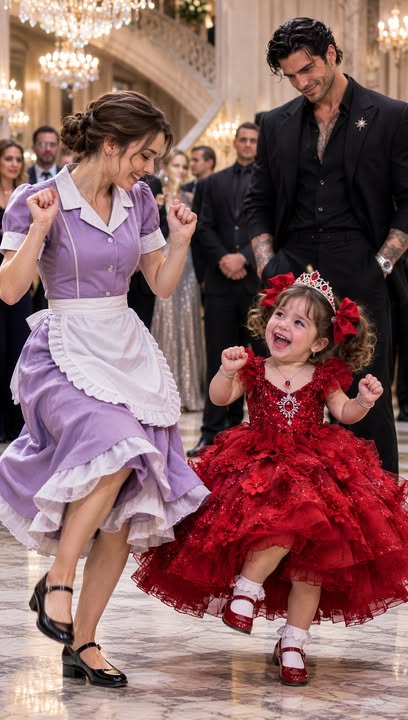
Sofia came to stand between us, holding the ruby-red bow that had once slipped loose from her hair at the gala.
She was wearing a simple blue dress today, soft at the collar and easy to move in.
“Count?” she asked.
I crouched beside her.
“One,” I said.
“Two,” she answered.
“Twee.”
Luca lowered himself beside us, careful not to crowd her.
He held out one hand, palm up, and waited.
Sofia placed her fingers in his.
“Again,” she said.
“One,” I began.
“Two,” Luca said.
“Twee!” Sofia finished.
She looked at the painted stars, then at the open doorway leading to the garden path beyond the hospital’s small courtyard.
The path was level and clear, bordered by low flowers and a handrail painted the same pale blue as the quiet-room walls.
“Walk?” she asked.
Luca looked at her, then at me.
“If you want,” he said.
Sofia nodded.
He did not lift her or guide her by the shoulders.
He rose slowly and held out his hand, letting her decide whether to take it.
She did.
Her first steps were careful, her shoes making a soft sound against the paving stones.
I walked beside her, matching her pace.
“One,” I said.
“Two,” she answered.
Luca followed a half-step behind.
At the end of the path, Sofia stopped and turned toward him.
“Dada, count.”
He came to her side.
“One,” he said.
“Two,” I answered.
“Twee,” Sofia said, clear and delighted.
She took another small step, then another, her hand resting securely in Luca’s.
No one clapped.
No one hurried her.
The garden held the quiet around us, not as a demand but as a kindness we had finally learned to keep.
Sofia looked up at the evening sky.
“Stars,” she whispered.
“Soon,” Luca said.
She offered me her other hand.
I took it, and together we began to count.
One.
Two.
Three.
The numbers that had once helped a frightened little girl find her footing now carried a promise neither of us had to make alone: that the next child who needed the world to be quieter would be heard before the moment passed.
**–THE END–PLEASE
Share your thoughts or feedback to motivate us to create more stories ♥️
* * *
[PREVIOUS: PART 5](https://echoesofstories.idolsgift.com/blog/part-5-the-name-he-remembered-041-8)
✓ Lynn R. Adams
Part 6 – A Quieter Kind of Promise “Ben was awake when Elena came to see him.” My mother’s words trembled over the phone. I looked at the sealed envelope on the table, the handwriting on its face s…