PART 6 (THE END): The Name Beneath the Signature 056
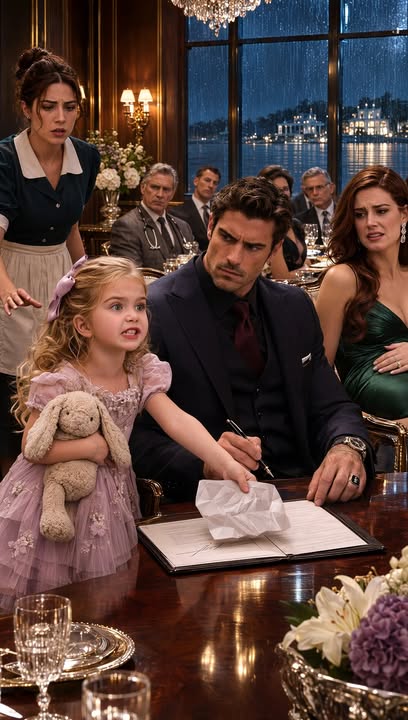
Part 6 – The Place at the Table
For a moment, Vincent could only stare at the note in his hand.
The paper was small enough to disappear inside his palm, its edges softened by years of being folded and carried.
Elena’s handwriting sloped gently across it, familiar from birthday cards and the notes she used to leave beside his coffee.
Beneath her signature, Bianca’s final line seemed to darken as he read it again.
“Tell him why the first copy disappeared,” Mara said quietly.
Lily looked from one adult to another, her fingers tucked around Button’s worn paw.
“Is it bad?” she asked.
“No,” Vincent told her, lowering himself beside her chair. “It’s something we need to understand.”
He did not touch the note again until the attorney had brought an evidence sleeve from the study.
Lily watched as he placed it inside.
“Did you hide it in Button?” he asked her.
“I didn’t,” she said quickly. “I was fixing his pocket.”
“I know.”
“Maybe Button kept it safe.”
The small hope in her voice loosened something in Vincent’s face.
“Maybe he did.”
He asked the attorney to contact Bianca and her counsel, explaining that they had found a personal note from Elena and needed to know what Bianca meant by the final line.
He did not accuse her of anything.
He did not guess aloud about what the first copy might have been or why it had disappeared.
When Bianca arrived the following morning, she looked as though she had spent the night awake.
The attorney showed her the note without giving it to her.
Bianca read Elena’s words first, then the line beneath them.
Her eyes closed.
“I should have told you,” she said.
Vincent sat across from her, the archive box open on the table.
“Tell me now.”
Bianca drew a careful breath.
“The first copy was not the trust memorandum,” she said. “It was a letter Elena wrote to you.”
Vincent’s face changed.
“What did it say?”
“She wanted to tell you that she hoped you would build a family again, if you ever wanted one.”
The words seemed to reach him slowly.
Bianca continued before he could ask.
“She wrote that a child would not need to be hers by blood to belong to you. She said she wanted any child you chose to raise to be protected and welcomed.”
“That sounds like the memorandum.”
“It was the reason for it.”
Bianca looked down at her hands.
“I found a copy of the letter while I was helping organize the foundation files. I thought it was private, and I put it aside instead of forwarding it with the other correspondence.”
“Why?”
“Because I had no right to decide when you should read it.”
“And yet you decided not to give it to me.”
“Yes.”
There was no attempt to excuse the choice.
“Later, I showed Sophia the letter,” Bianca said. “I told her Elena had hoped you would someday have a family again. I thought it might help her understand that loving you did not mean competing with Elena.”
“But it did not help.”
“No.”
“Did you give Sophia the first copy?”
“I did.”
“Where is it now?”
“I don’t know.”
Bianca looked toward the small note in the evidence sleeve.
“Elena made several copies while her estate papers were being prepared. One was meant for your attorney, one for the foundation file, and one was for you.”
“The copy you held back disappeared.”
“I gave it to Sophia months later. She returned it to me after she began preparing the agreement.”
“Why did you keep it?”
Bianca’s voice faltered.
“I meant to give it to you. I kept waiting for a moment that felt kind rather than painful.”
Vincent looked at the note again.
“And you wrote the line beneath Elena’s name?”
“Yes.”
“Why?”
“Because I was afraid you would think I had hidden it deliberately to help Sophia.”
“You had hidden it deliberately.”
“I had.”
“But not for that reason?”
“Not at first.”
The distinction did not absolve her, but it mattered.
Bianca told them that when Sophia had admitted the pregnancy had not been confirmed, Bianca had understood that the agreement was built on a lie.
She had wanted to stop the plan, but fear of what would follow had made her delay.
Then she had begun telling herself the paper was only a draft, that Vincent would see through it, or that the money would remain safely within a trust.
Each excuse had given her another day to avoid admitting what she had done.
“The first copy disappeared because I gave it to Sophia and didn’t ask for it back,” she said.
“I told myself she needed comfort from Elena’s words.”
Vincent’s gaze remained steady, though grief had entered it.
“And afterward?”
“Afterward, I let her use those words to make the false agreement sound legitimate.”
The attorney made notes and asked Bianca to include the account in her written statement.
Bianca agreed.
She also offered to help the investigation locate the missing letter, though she could not promise where it had gone.
When the meeting ended, Vincent thanked her for answering.
He did not tell her everything was forgiven.
He did not ask her to leave in anger.
He simply asked that she continue cooperating with the attorneys and the investigators.
Bianca nodded and left the study with her counsel.
Afterward, Vincent stood alone by Elena’s portrait.
I found him there with the note’s evidence sleeve resting on the desk.
“She wanted you to know,” I said.
“Yes.”
“Maybe she knew it would be hard to tell you while she was here.”
He studied the words through the clear plastic.
“She knew I would have tried to stop her from planning for a life without her.”
“Would you have?”
“I might have.”
“Then perhaps she found the only way to leave you the truth.”
He turned toward me.
“By hiding it in a rabbit?”
A faint smile touched my face.
“Lily would say Button kept it safe.”
Vincent’s smile was warmer, if still unsteady.
“She may be right.”
The attorneys completed their report over the following weeks.
The false agreement was formally withdrawn, and the proposed transfer was canceled before any money changed hands.
The evidence was preserved and given to the authorities, who reviewed the statements and documents.
Sophia cooperated fully, including in locating the person who had helped format the agreement.
Bianca provided her records from the foundation and admitted what she had withheld.
The investigation determined that the signature attributed to Dr. Reed had been copied from a reference document, not written or authorized by him.
The note about the clinic appointment could not be tied conclusively to one person, but the attorneys found that the date and details had been available through the paperwork Sophia and Vincent had signed at the clinic.
No evidence suggested that anyone had entered Vincent’s study by force.
The brass key, however, was never found.
Vincent chose not to treat its disappearance as proof of more than the investigation could establish.
He changed the study lock, secured Elena’s original papers, and asked the attorneys to review every foundation file that had been handled during the transition.
The final report found that Sophia had knowingly presented a false claim of pregnancy and participated in preparing an agreement that would have transferred funds under false pretenses.
Bianca had helped her use Elena’s private papers to make the transfer appear legitimate.
Both women accepted the legal consequences of their actions.
There were no public statements, no spectacle, and no demand that either of them explain themselves to strangers.
The truth went where it needed to go: to the lawyers, the investigators, and the people whose trust had been damaged.
Dr. Reed returned to the house once the signature review was complete.
He came to the study carrying no folder this time, only a handwritten letter.
Vincent read it standing by the desk.
“I was wrong to keep quiet,” Reed said. “I thought privacy was the safest choice, and I failed to see how my silence could become part of a larger lie.”
Vincent folded the letter.
“You didn’t create the document.”
“No.”
“But you could have told me you had seen her.”
“Yes.”
“I don’t know whether I can call that friendship.”
“I understand.”
Reed did not ask to be forgiven.
He apologized to Mara as well, for letting the confusion around the medical visit reach the household without taking steps to correct it sooner.
Then he apologized to Lily, in words simple enough for her to understand.
“I should have been clearer with the grown-ups,” he told her.
Lily considered this.
“Did you make the paper?”
“No.”
“Did you tell Mrs. Sophia there was a baby?”
“No.”
“Then you should tell people when they’re confused.”
“I should,” he said.
She nodded, apparently satisfied.
The trust Elena had intended was established according to the original terms.
Vincent funded it from the estate, with the language preserved exactly as Elena had written it.
It would support any child he later chose to raise, whether related to him by blood or not, and it would not be tied to marriage, a pregnancy, or anyone’s willingness to remain in his life.
He refused to add Lily’s name as a condition or a reward.
Mara read the trust documents with her own independent adviser and returned them unopened to Vincent.
“I’m glad it exists,” she told him. “But Lily is not going to be part of a bargain.”
“She never was.”
“And if we leave, it will still exist.”
“Yes.”
“And if we stay, it won’t mean she owes you anything.”
“That’s right.”
Mara watched him for a long moment.
Then she nodded.
“Good.”
Vincent also spoke with Sophia once more, after her statement had been accepted.
She came without the ivory dress, without the careful hand at her stomach, and without the polished smile she had worn at the dinner.
They met in the garden, where the late spring sun had turned the wet paths gold.
“I won’t ask you to forgive me,” she said.
“I’m not ready to.”
“I know.”
“I hope you understand that the life I thought we were building wasn’t real in the way I believed.”
“I do.”
She looked toward the roses, where new leaves had opened beneath the old blossoms.
“I wanted to be chosen,” she said. “I thought if I could give you a reason to choose me, you would stop asking whether I was the right person.”
Vincent’s voice remained gentle.
“You deserved to be chosen honestly, or not chosen at all.”
Her eyes filled.
“I know that now.”
They did not promise to remain friends.
They did not pretend that an apology repaired everything.
But when they parted, Sophia left with her head lifted, and Vincent did not watch her as though he had lost the only future available to him.
He had finally understood that longing was not the same as love, and that a family could not be secured by a signature.
Mara’s decision took longer.
Vincent offered her a stable position supervising the household’s community program, with a salary that did not depend on his personal favor.
He arranged for an independent employment adviser to review the offer and made clear that she was free to decline.
He also offered to help her find an apartment for herself and Lily, with no connection to whether she accepted the job or continued seeing him.
Mara listened without interrupting.
“I don’t want you to make this offer because Lily found a paper,” she said.
“I’m offering the position because you’re capable of doing the work.”
“And the apartment?”
“Because you deserve a home you can afford without having to wonder whether your job depends on anyone’s mood.”
She glanced toward Lily, who was seated on the back steps with Button in her lap.
“You’re trying to make sure I can leave.”
“I’m trying to make sure that if you stay, it’s because you want to.”
Mara held his gaze.
“That matters.”
“I know.”
“Do you?”
“I’m learning.”
She smiled then, though her eyes were bright.
“I’ll take the position.”
Vincent let out a breath.
“I’m glad.”
“I’ll decide about the apartment after I visit it.”
“Of course.”
“And I’m not promising anything about the rest of my life.”
“I wouldn’t ask you to.”
“That’s why I can say yes to the job.”
The apartment was small, sunny, and close enough to Lily’s school that Mara could walk with her each morning.
She kept it.
For several months, she and Lily lived there, while Mara worked at the Moretti foundation and Vincent came to visit only when invited.
He brought groceries when Mara asked, never as a reason to enter without permission.
He attended Lily’s school reading day after Mara told him there would be a seat available.
He learned that she liked her toast barely browned, that Button needed to sit on the table during meals, and that she preferred being asked before anyone picked her up.
Mara learned that Vincent could listen without turning every silence into an answer he wanted.
Their trust did not grow in a straight line.
Some days were easy, filled with garden walks and shared lunches.
Other days, a word or gesture reminded Mara of how easily security could be mistaken for safety.
When that happened, Vincent did not insist that she was overreacting.
He asked what she needed.
Sometimes the answer was space.
Sometimes it was a conversation.
Sometimes it was nothing more than for him to stay where he was and let the difficult feeling pass without trying to purchase its absence.
Lily, meanwhile, began leaving her drawings at the Moretti house whenever she visited.
The pictures changed as she grew more comfortable.
First there were houses with separate doors.
Then there were paths between the houses.
At last came a page with one wide porch, a yellow sun, and four people standing beside a small gray rabbit.
Vincent kept every drawing in the study.
He placed Elena’s restored trust papers in a separate cabinet, where they would be protected but not hidden.
The letter Bianca had once held back was never recovered.
Vincent no longer needed to read it to understand what Elena had wanted him to know.
On the anniversary of the dinner, he asked Mara and Lily to join him for a simple meal at the house.
He did not call it a family dinner.
He did not make a toast or invite lawyers, relatives, or staff to witness anything.
There was roast chicken, potatoes, green beans, and a small lemon cake that Lily had helped choose from the bakery.
Mara arrived with a casserole of her own and an overnight bag, though she said it was only in case Lily got tired.
“I can take her home whenever she wants,” she reminded Vincent.
“Of course,” he said.
Lily had become taller since the night she placed a crumpled document on his contract.
Her curls were longer, her words more certain, and Button’s right ear had been repaired with blue thread.
She carried the rabbit into the dining room and set him beside the place where Vincent sat.
On the table, next to his father’s restored fountain pen, lay the small evidence sleeve containing Elena’s note.
The note had been carefully preserved, not as a legal exhibit now, but as a reminder of the choice Elena had made and the truth Bianca had finally told.
Lily looked from the sleeve to the pen.
“Button should sit here,” she said, nudging the rabbit closer.
Vincent moved the pen a little to make room.
“Then this is his place.”
Mara watched them, her expression tender and wary at once.
Vincent pulled out the chair beside his.
He did not assume she would take it.
“Mara,” he said, “you and Lily have made my life kinder than I knew it could be.”
She looked down at the chair, then back at him.
“I want you to know that you can leave tonight, tomorrow, or a year from now, and what Elena left behind will still be yours to honor.”
Mara’s eyes glistened.
“I know.”
“And if you would like to make a home with me, I would like to try.”
He paused, letting the quiet belong to her.
“Not because of the trust. Not because Lily spoke up. Not because you owe me anything.”
Lily looked at her mother, then at Vincent.
He continued, his voice soft.
“Would you like to make a home together?”
Mara did not answer at once.
Vincent waited.
The pause did not frighten him as it once might have.
It was not a test or a door closing.
It was simply room for her choice.
At last, Mara reached for his hand.
“I would like to try,” she said.
Lily’s face brightened.
“Does that mean we can stay for dinner?”
“We can stay for dinner,” Mara replied.
“And tomorrow?”
“We’ll talk about tomorrow together.”
Lily seemed pleased by this answer.
She settled into her chair, then carefully placed Button beside Vincent’s restored pen.
The old metal gleamed beneath the dining-room lights.
The rabbit’s blue stitches sat beside it, imperfect and bright.
Vincent looked at the place beside him, the place across from him, and the small hand resting in his.
For years, he had believed that family was something a person lost once and then tried to reconstruct from memory.
Now he understood it was made in smaller ways: a truth spoken at the right time, an apology without a demand, a door left open, a chair offered without assuming who would sit.
The rain began beyond the windows, soft against the glass.
This time, no one at the table was waiting for a signature.
**–THE END–PLEASE
Share your thoughts or feedback to motivate us to create more stories ♥️
* * *
[PREVIOUS: PART 5](https://storyly.idolsgift.com/blog/part-5-the-name-beneath-the-signature-056-1)
✓ Lynn R. Adams
Part 6 – The Place at the Table For a moment, Vincent could only stare at the note in his hand. The paper was small enough to disappear inside his palm, its edges softened by years of being folded a…